
Welcome to the essential guide for Identification and Natural History of the Ducks, Geese, and Swans of South Carolina. This guide includes detailed species accounts, featuring multiple plumages highlighting key identification features. This resource was created to help the community to confidently learn about and identify the waterfowl found throughout the Palmetto State’s natural habitats and city parks and municipal ponds.
How to use this Guide
Click on any of the four major groups below (DABBLING DUCKS, DIVING DUCKS, GEESE, and SWANS) to explore the species included in each category, including their detailed subgroups. You can also use the Table of Contents below this section to browse the entire guide.
Tree Ducks
Wood Duck
Sea Ducks
Mergansers
Stiff-tailed Ducks
- How to use this Guide
- Birds Included in this Guide
- DABBLING DUCKS OF SOUTH CAROLINA
- Core Dabbling Ducks (Anas/Spatula/Mareca)
- Blue-winged Teal (Spatula discors)
- Northern Shoveler (Spatula clypeata)
- Gadwall (Mareca strepera)
- American Wigeon (Mareca americana)
- Eurasian Wigeon (Mareca penelope)
- Mallard (Anas platyrhynchos)
- American Black Duck (Anas rubripes)
- Mottled Duck (Anas fulvigula)
- Northern Pintail (Anas acuta)
- Green-winged Teal (Anas crecca)
- Black-bellied Whistling-Duck (Dendrocygna autumnalis)
- Wood Duck (Aix sponsa)
- DIVING DUCKS OF SOUTH CAROLINA
- Core South Carolina Diving Ducks (Aythya)
- Canvasback (Aythya valisineria)
- Redhead (Aythya americana)
- Ring-necked Duck (Aythya collaris)
- Greater Scaup (Aythya marila)
- Lesser Scaup (Aythya affinis)
- Common Eider (Somateria mollissima)
- Surf Scoter (Melanitta perspicillata)
- White-winged Scoter (Melanitta deglandi)
- Black Scoter (Melanitta americana)
- Long-tailed Duck (Clangula hyemalis)
- Bufflehead (Bucephala albeola)
- Common Goldeneye (Bucephala clangula)
- Hooded Merganser (Lophodytes cucullatus)
- Red-breasted Merganser (Mergus serrator)
- Common Merganser (Mergus merganser)
- Ruddy Duck (Oxyura jamaicensis)
- GEESE OF SOUTH CAROLINA
- SWANS OF SOUTH CAROLINA
- The Urban Mix: Feral and Domestic Waterfowl of South Carolina
- South Carolina Wading Bird Hotspots: Top 5 Locations for Viewing
- Threats and Conservation Status of South Carolina Waterfowl
Birds Included in this Guide
This guide features ducks, mergansers, geese, and swans that occur in South Carolina. While most North American waterfowl species have been recorded here as vagrants or accidental, this guide focuses on species whose official range includes South Carolina, as documented by the eBird/Science platform.
At the end, you’ll also find a section on domestic and feral species commonly seen in city parks and retention ponds. Waterfowl often share wetland habitats with other birds. For a broader overview of birds commonly found in the water, shallows, and marshes in South Carolina explore our guides to the Wetland Birds of South Carolina (cranes, ibises to rails and snipes) and the guide to the South Carolina’s Herons, Egrets, and Bitterns.
Beyond South Carolina Waterfowl: Exploring Essential Concepts and Definitions
This state-specific guide focuses on the local status and occurrence of waterfowl in South Carolina. However, to master key terminology and understand the science behind identification, you may wish to dig deeper into the foundational concepts. If you’re curious about topics like the “Big Divide” between Dabbling vs. Diving Ducks“, the function of their anatomy, how to identify plumage cycles, or the principles of migration and conservation across North America, these subjects are thoroughly explained in our comprehensive resource.
For an exhaustive breakdown of all definitions, concepts, and techniques used in this guide, please follow the link below to the main pillar page: Complete Guide to Ducks, Geese, and Swans of North America.
Ducks, Mergansers, Geese, and Swans in South Carolina
This guide includes a total of 33 species of ducks, mergansers, geese and swans. The breakdown by groups is as follows:
- Dabbling Ducks
- Core Dabbling Ducks: 13 species.
- Whistling (Tree) ducks: 1 species
- Specialized Dabblers: 1 species
- Diving Ducks
- Core divers: 5 species.
- Sea ducks: 6 species.
- Mergansers: 2 species.
- Stiff-tailed duck: 1 species.
- Geese: 5 species.
- Swans: 2 species
DABBLING DUCKS OF SOUTH CAROLINA
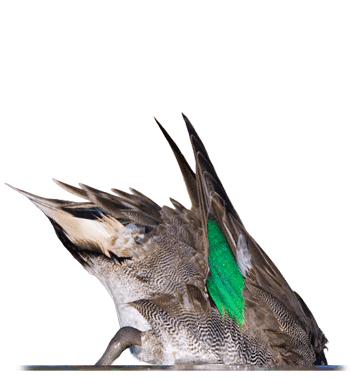
The Dabbling Ducks are the most commonly encountered waterfowl in the State, recognized by their habit of feeding in shallow water. They rarely fully submerge, instead feeding by tipping up to reach submerged plants and invertebrates—leaving only their tail feathers visible. Their legs are centrally placed, allowing them to walk easily on land and launch straight up into the air when taking flight.
Core Dabbling Ducks (Anas/Spatula/Mareca)
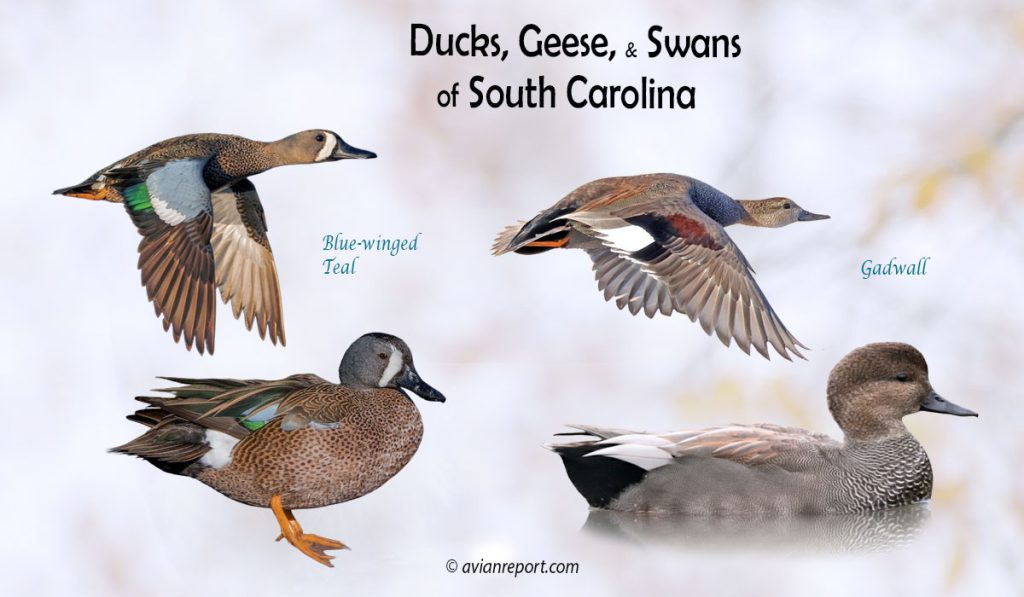
Blue-winged Teal (Spatula discors)
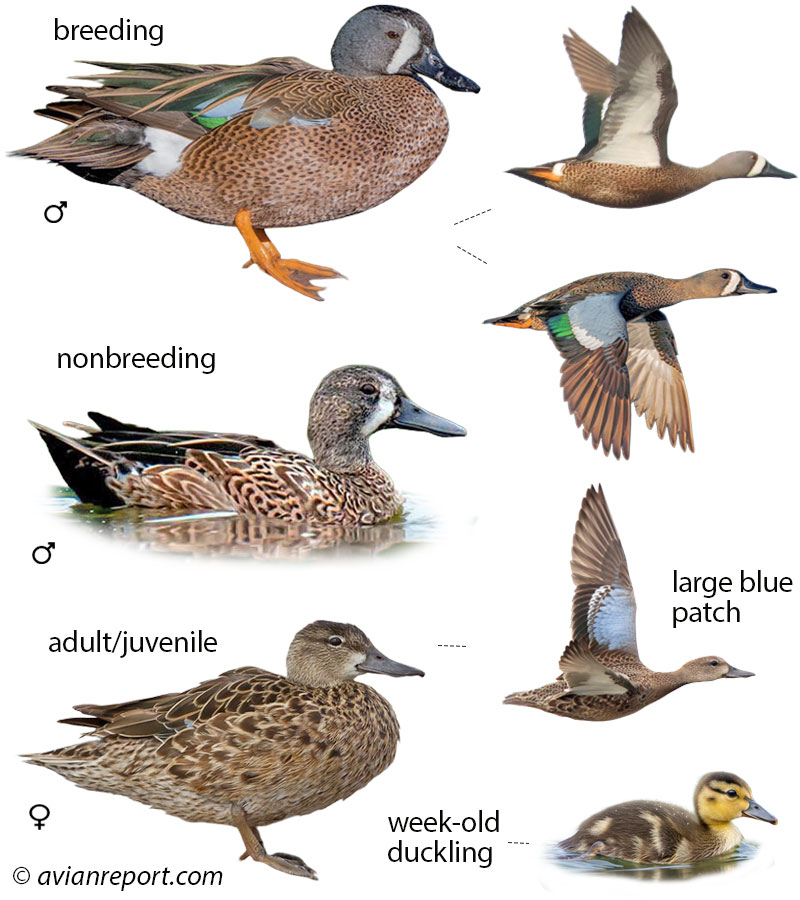
Length: 15 in, Weight: 14 oz, Wingspan: 24 in
Identification: Drake: slaty-blue head, white crescent behind bill, speckled brown body. Hen: brown, has a pale area at base of bill. Both sexes reveal bold powder-blue wing patches on the upper wing.
Compare: Hen Green-winged Teal is darker, and has a different wing color pattern. Female Cinnamon Teal is warmer-toned overall, has a longer a more spatulated bill, and duller face pattern. Learn the subtle field marks to distinguish the Female Blue-winged Teal from the Female Cinnamon Teal.
Behavior: Dabbling duck, tips up or submerges head/bill for food. Monogamous; pair bonds usually dissolve during incubation.
Flocking: The Blue-winged Teal forms small compact flocks that twist and turn at high speed. Flocks often fly low over marshes. It frequently mixes with other dabbling ducks.
Habitat: Shallow ponds, pond-marsh mixes, marshes, vegetated wetlands, rice fields, estuaries, mangroves.
Range: Breeds across much of North America; winters southern US to Central and South America.
Status and Movements: The Blue-winged Teal is a common transient and less common winter resident in South Carolina. It moves through the state early, appearing mid-August and departing by April.
Diet: Aquatic insect larvae, crustaceans, clams, snails, and grains.
Nest: Small circular depression scraped by female. Lined with dried grasses and down/breast feathers.
Breeding: Egg laying: late Apr-Aug | Clutch: 6-14 eggs | Broods: 1 brood | Eggs: Creamy white | Incubation: 19-29 days.
Lifespan: At least 23 years, 3 months.
Population: Global breeding population estimated at 7.8 million individuals. The Blue-winged Teal is the second most abundant duck in North America.
Northern Shoveler (Spatula clypeata)
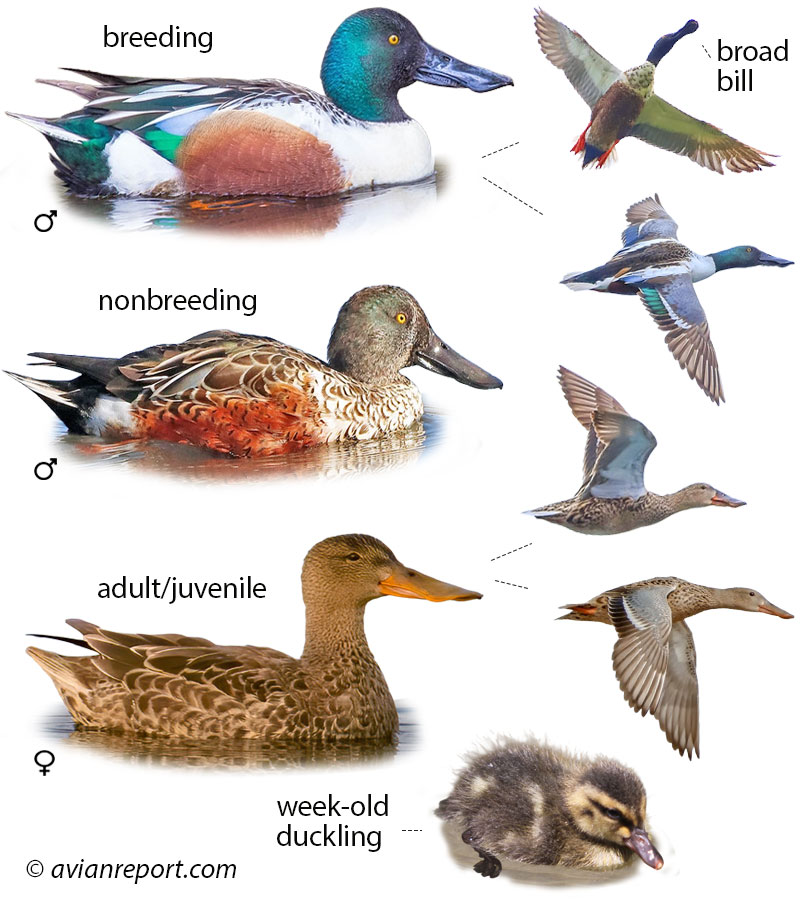
Length: 19 in, Weight: 22 oz, Wingspan: 30 in
Identification: Breeding drake: Northern Shoveler has bright green head, white chest, rust sides. Hen/immature: mottled brown, large orange bill, blue wing patches. Unique shovel-shaped bill.
Compare: Drake and hen Northern Shoveler share their wing color pattern with Cinnamon and Blue-winged teals, but shovelers are noticeably larger. Hen has a large orangish and spatulated bill.
Behavior: Tips up and sweeps bill side to side to filter tiny prey. Large groups sometimes swim in circles to stir up food. Pairs stay together until almost fall migration.
Flocking: Flight is steady and direct typically in flocks of 5 to 20 birds during the non-breeding season. During the breeding season groups are generally limited to pairs. Northern Shovelers gather in larger rafts or flocks at major migratory stopovers.
Habitat: Shallow wetlands, coastal marshes, rice fields, flooded fields, lakes, sewage lagoons.
Range: Breeds across North America; winters southern U.S. south to Central America and Caribbean.
Status and Movements: The Northern Shoveler is a common winter resident in South Carolina. This dabbling duck arrives in late fall and departs quickly in the spring, rarely lingering past March.
Diet: Tiny crustaceans, aquatic invertebrates, seeds.
Nest: Small depression on ground. Lined with downy feathers. Surrounded by vegetation, typically within 150 feet of water.
Breeding: Egg laying: May-Jun | Clutch: 8-12 eggs | Broods: 1 brood | Eggs: Pale greenish gray or olive-buff | Incubation: 22-25 days.
Lifespan: At least 16 years, 7 months.
Population: Global breeding population estimated approx. 5.9 million individuals.
Gadwall (Mareca strepera)
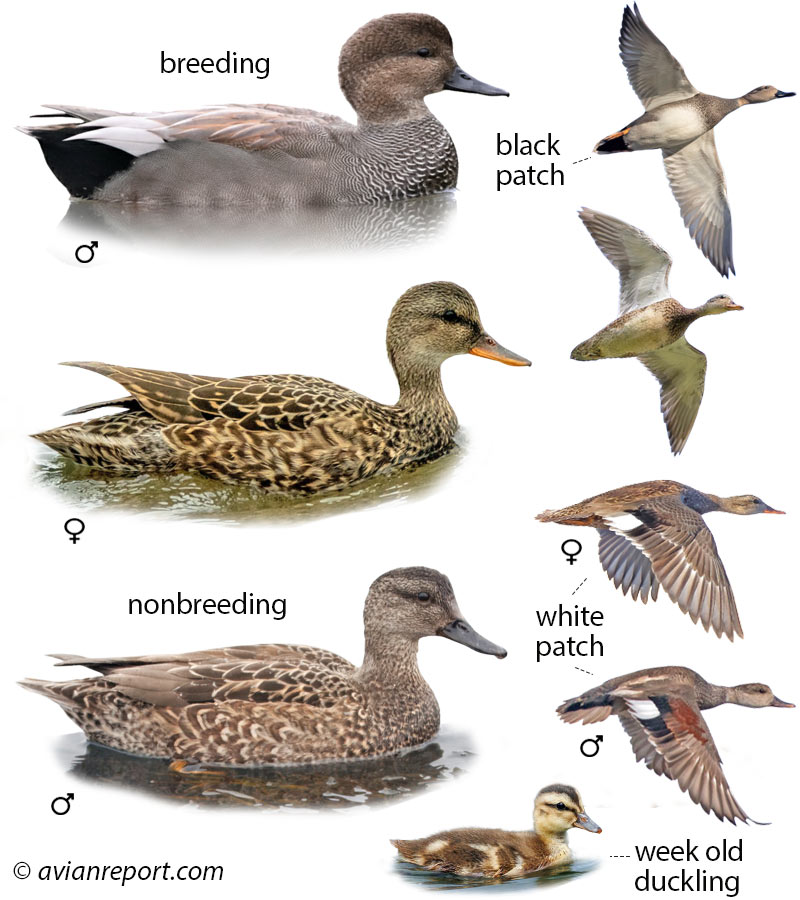
Length: 20.1 in, Weight: 31 oz, Wingspan: 33.1 in
Identification: Drake intricate gray-brown pattern, black rear end. Hen patterned brown/buff, thinner dark bill with thin orange edge. Both sexes show a white wing patch.
Compare: Hen Gadwall is similar to other hen teals but has an orange line along the edge of the bill. Both sexes have a distinctive white wing patch. Hen Mallard has a large blue wing speculum.
Behavior: Tips forward for submerged vegetation, rarely dives. Pairs form early, often in late fall. Seasonally monogamous.
Flocking: The Gadwall flies swiftly in a small to medium size flocks, often in a nervous, irregular fashion with many twists and turns.
Habitat: Prairie potholes, Canadian prairies, tundra, boreal forest wetlands, fresh/salt water wetlands.
Range: The Gadwall breeds primarily in the Great Plains and Canadian prairies; winters across the southern U.S. and Mexico.
Status and Movements: The Gadwall is a very common winter resident throughout South Carolina. It is abundant on freshwater wetlands and impoundments from late October through early April.
Diet: Mostly submerged aquatic vegetation, snails, midges, water beetles.
Nest: Hollow scrape on ground, lined with twigs, leaves, down.
Breeding: Egg laying: mid-Apr-Jun | Clutch: 7-12 eggs | Broods: 1 brood | Eggs: N/A | Incubation: 24-27 days
Lifespan: At least 19 years, 6 months.
Population: Approximately 4.4 million individuals.
American Wigeon (Mareca americana)
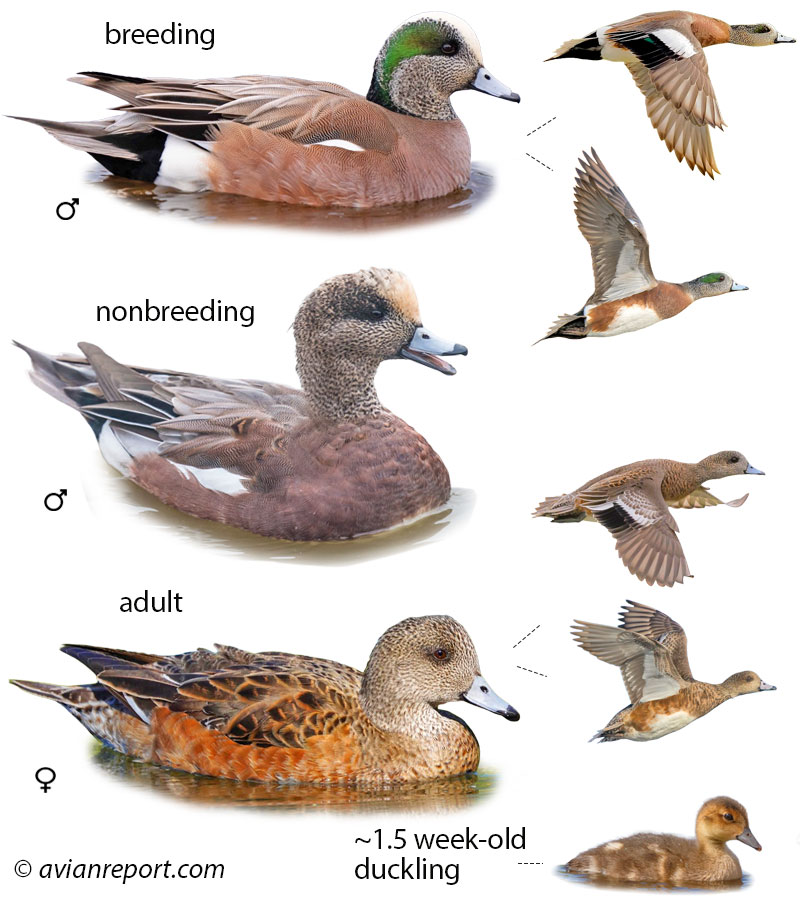
Length: 20 in, Weight: 33 oz, Wingspan: 33 in
Identification: Drake: gray head with a white forehead and crown, green patch behind the eye, cinnamon body, large white wing patch. Bill: pale gray, black tip, white rump. Hen: plainer brown with rusty sides.
Compare: Drake American Wigeon differ from drake Eurasian Wigeon due to a chestnut head and a buffy forehead. Female Eurasian has a warmer orangey head, but difficult to separate from female American.
Behavior: Forages on the surface or tips up for aquatic plants; plucks terrestrial plants with short bill. Quite vocal; distinctive whistle.
Flocking: The American Wigeon is highly social outside of breeding season, forming large noisy flocks on water and grazing fields.
Habitat: Freshwater wetlands, lakes, slow rivers, marshes, estuaries, bays, grasslands, pastures, golf courses.
Range: Breeds Alaska, Canada, Northwest U.S.; winters southern U.S. and Mexico.
Status and Movements: The American Wigeon is a common winter resident in South Carolina. This grazing duck is found on coastal and inland marshes and open water habitats from November through March.
Diet: Aquatic plants. Upland plants. Invertebrates (midges, mollusks).
Nest: Small depression on dry ground, sometimes far from water. Lined with grasses, reeds, cattails, and down feathers.
Breeding: Egg laying: Early May-Jun | Clutch: 3-13 eggs | Broods: 1 brood | Eggs: Creamy white | Incubation: 22-28 days.
Lifespan: At least 21 years, 4 months.
Population: Approximately 2.7 million individuals.
Eurasian Wigeon (Mareca penelope)
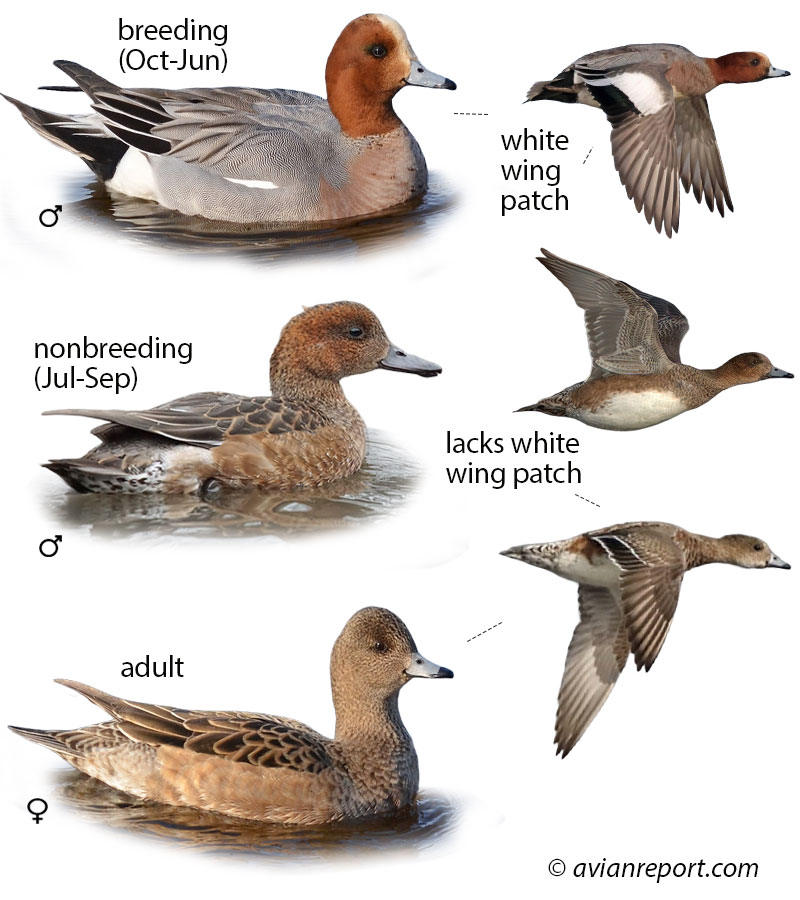
Identification: Drake: gray body, bright rufous head, buffy-cream forecrown, large white wing patch. Hen: mostly brown, some rufous on flanks/head. Juveniles resemble Hens. Bill: black-tipped, blue-gray.
Compare: Drake is similar to a Drake American Wigeon, which has a gray head and white forehead and crown. Hen American has a colder gray head.
Behavior: Forages in flocks, tips up for submerged plants. Drakes court with ritual movements, often gathered around one hen.
Flocking: The Eurasian Wigeon is highly gregarious outside of breeding season. In North America, they are almost invariably found mixed within large flocks of American Wigeon.
Habitat: Shallow wetlands, freshwater marshes, ponds, lakes. Winters: coastal sites, estuaries, bays, brackish lagoons.
Range: Rare visitor to North America. Winters Pacific/Atlantic coasts (Iceland/Asia origin).
Status and Movements: The Eurasian Wigeon is a rare but annual winter visitor in South Carolina. Look for this distinct bird among flocks of American Wigeon from November to March, mainly near the coast.
Diet: Aquatic/terrestrial plants. Grasses, cultivated rice, wheat, barley, potato. Invertebrates.
Nest: Shallow depression on ground. Near small pond/marsh or upland site. Lined with grasses and female breasts down.
Breeding: Does not breed in NA | Clutch: 6-12 eggs | Eggs: Buffy in color | Incubation: 22-28 days.
Lifespan: At least 33 years, 7 months (Europe).
Population: Worldwide breeding population estimated at 2 million individuals.
Mallard (Anas platyrhynchos)
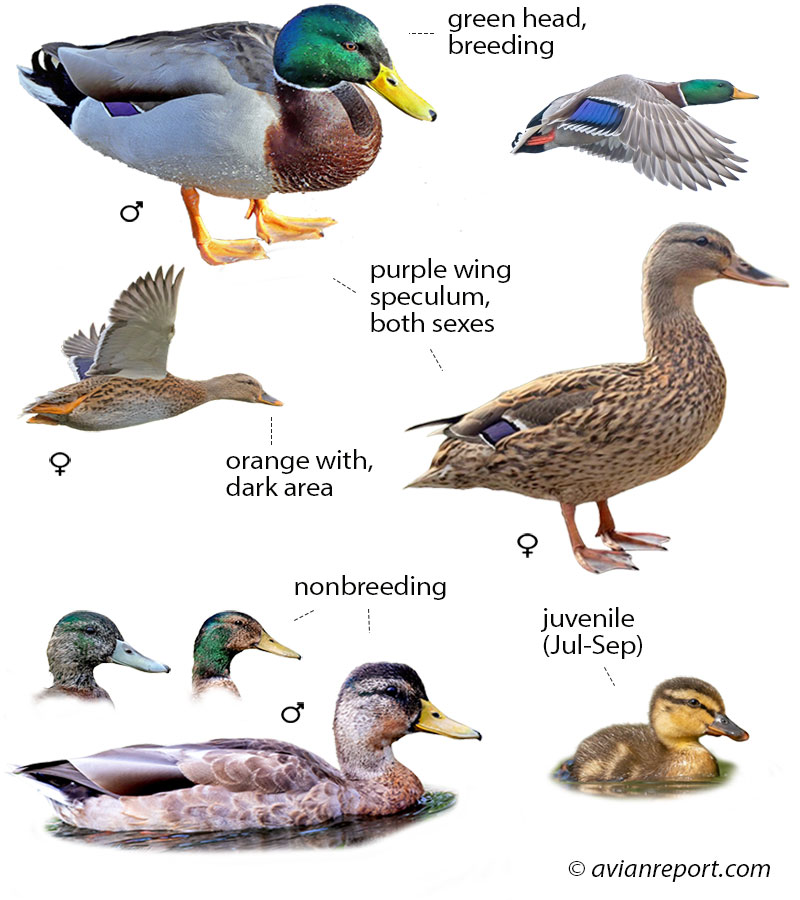
Length: 23 in, Weight: 41 oz, Wingspan: 35 in
Identification: Drake: iridescent green head, yellow bill, gray flanks, pale tail with black tail-curls. Hen/Juvenile: mottled brown, orange bill with dark patch. Both sexes show white-bordered, blue speculum.
Compare: The hen Mallard differs from hens American Black Duck, Mottled Duck, and Mexican Duck due to a warmer brown body, black and orange bill, and bold white wing bars on the leading and trailing edges of the blue wing speculum. Learn the subtle field marks to distinguish the American Black Duck from the Female Mallard.
Behavior: Dabbling duck, tips forward to graze; rarely dives. Generally monogamous, pairs form in fall.
Flocking: Mallards are social and gregarious outside of breeding season. They form large, loose flocks (up to hundreds of birds) often mixing with other dabblers.
Habitat: Ponds, lakes, marshes, rivers, coastal habitats, estuaries and City parks.
Range: Widespread throughout North. Breeds far north; year-round/winter in central/southern U.S. and Mexico.
Status and Movements: The Mallard is a common year-round resident across South Carolina. Its numbers swell dramatically in winter with migratory visitors, favoring nearly all freshwater habitats.
Diet: Seeds, aquatic vegetation, insect larvae, freshwater shrimp. Agricultural grain, human handouts.
Nest: Shallow bowl/depression on ground near water, concealed under vegetation.
Breeding: Egg laying: Early-Apr-Jul | Clutch: 1-13 eggs | Broods: 1-2 | Eggs: Creamy to grayish or greenish buff | Incubation: 23-30 days.
Lifespan: At least 27 years, 7 months.
Population: Estimated population around 19 million individuals.
American Black Duck (Anas rubripes)
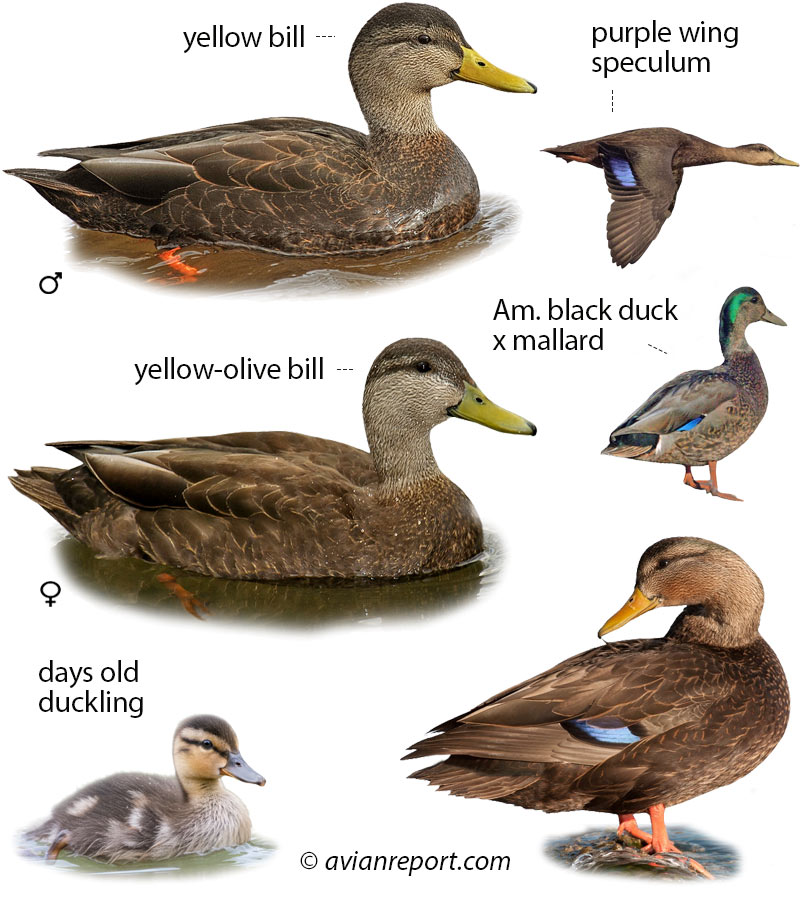
Length: 22 in, Weight: 42 oz, Wingspan: 36 in
Identification: Dark brown body, pale gray-brown head. Drake: yellow-green bill. Hen: duller olive bill. Both show iridescent purple speculum; white underwings visible in flight.
Compare: Similar to a hen Mallard, which has a lighter warmer brown body, orange and black bill, and bold white wing bars on the leading and trailing edges of the blue wing speculum. Learn the subtle field marks to distinguish the American Black Duck from the Female Mallard.
Behavior: Tips up for food; rarely dives. Monogamous pairs. A wary duck.
Flocking: The American Black Duck is moderately social, usually forming small, loose flocks or pairs that often mix with Mallards. Flocks fly swiftly in direct lines or small, tight groups. Rarely forms the large rafts.
Habitat: Freshwater wetlands, saltmarshes, beaver ponds, bogs, wooded swamps.
Range: Eastern North America; breeds Canada/Northeast U.S.; year-round/winter throughout Eastern U.S.
Status and Movements: The American Black Duck is a common winter resident in South Carolina. It prefers coastal salt marshes and brackish impoundments, typically present from November through March.
Diet: Plant matter, seeds, roots, tubers, leaves, aquatic insect larvae, crustaceans, agricultural grains.
Nest: Shallow bowl/basin on ground, well-concealed under vegetation near water. Lined with grass and down feathers.
Breeding: Egg laying: late Mar-early Aug | Clutch: 6-14 eggs | Broods: 1 | Eggs: White, cream-colored, pale greenish buff | Incubation: 23-33 days.
Lifespan: At least 26 years, 5 months.
Population: Global breeding population estimated at 700,000 individuals.
Mottled Duck (Anas fulvigula)
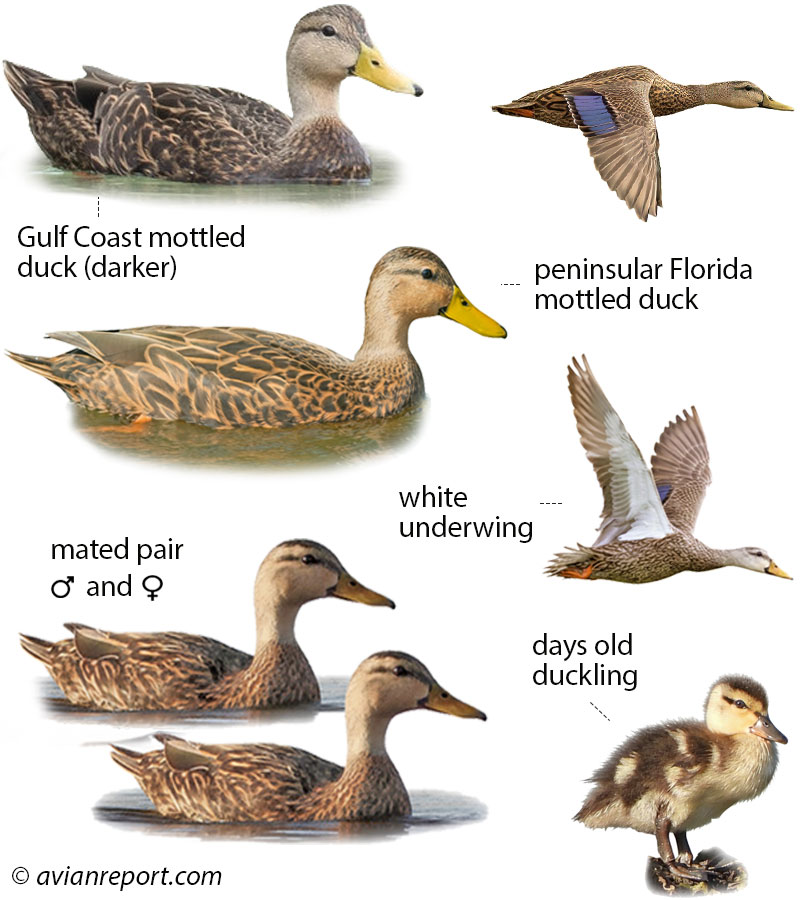
Length: 20.5 in, Weight: 36 oz, Wingspan: 32 in
Identification: Rich brown/buff body, buffy head/neck. Mottled Duck males: yellow bill. Hens: greenish yellow bill, variable dark markings. Black spot at gape. Pure Mottled Duck tail is dark.
Compare: Similar to a hen Mallard, but has a creamy head, plain yellow-olive bill and very thin leading and trailing white wing bars on the speculum. Hen Mallards have whitish tail feathers. Hybrids can be confusing.
Behavior: Forages surface or tips up for submerged vegetation; rarely dives. Pairs form early, typically by November. Drake stays with mate well into incubation.
Flocking: The Mottled Duck is generally found in pairs. Forms small, loose flocks up to 10 birds. Flies swiftly, powerfully, and directly.
Habitat: Coastal freshwater marshes, ponds, lakes, ditches, flooded rice fields, urban/suburban wetlands, tidal wetlands.
Range: Limited range along the Gulf of Mexico coast, including Texas, Louisiana, and Florida.
Status and Movements: The Mottled Duck is a non-migratory, local resident in coastal South Carolina. It is found year-round in estuarine and brackish marsh systems, especially the southern half of the coast.
Diet: Aquatic plants (seeds/shoots): grasses. Invertebrates and small fish.
Nest: Circular, bowl-shaped depression in grass, near water, lined with grass, shredded grass, female down.
Breeding: Egg laying: Feb-early Jul | Clutch: 8-12 eggs | Broods: 1 | Eggs: Dull white to olive | Incubation: 25-26 days.
Lifespan: At least 13 years, 7 months.
Population: Global population estimated at over 180,000 individuals.
Northern Pintail (Anas acuta)
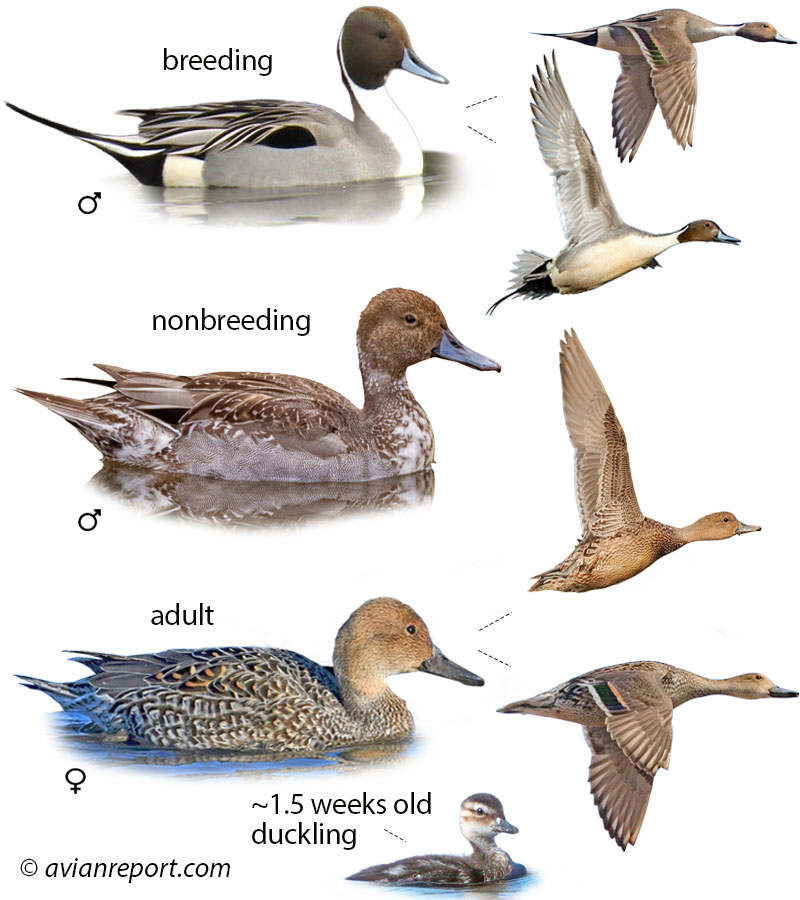
Length: 25 in, Weight: 34.4 oz, Wingspan: 34 in
Identification: Drake: chocolate head/neck, white breast/stripe down neck, long pointed tail. Hen/immature: mottled brown, pale tan face, bluish-gray bill.
Compare: The hen is similar to other hen teals and hen Mallard, Mottled and American Black Ducks. The female Pintail has a warmer brown head, long neck, and distinctive bluish-gray bill.
Behavior: Dabbling duck. Forages on surface or tips up, filters food with bill. Generally social.
Flocking: The Northern Pintail is highly social, forming large, loose flocks (often hundreds) in winter. Flocks are known for fast, graceful flight in long, wavering lines or V-formations. Often feed and roost with American Wigeon.
Habitat: Seasonal wetlands, croplands, wet meadows, shortgrass prairies, lakes, estuaries, tidal marshes, flooded agricultural fields.
Range: Breeds Alaska, Canada, Great Plains; winters southern U.S. and Mexico.
Status and Movements: The Northern Pintail is a common winter resident in South Carolina. This elegant dabbler favors shallow, open impoundments and flooded fields, present from November through March.
Diet: Aquatic plant seeds, worms, snails, crustaceans, aquatic insects, small grains.
Nest: Shallow bowl on ground, far from water. Female makes scrapes, lines nest with grasses/down.
Breeding: Egg laying: Apr-mid-Jun | Clutch: 3-12 eggs | Broods: 1 brood | Eggs: Greenish buff | Incubation: 22-24 days.
Lifespan: At least 22 years, 3 months.
Population: Global breeding population estimated at 5.1 million individuals.
Green-winged Teal (Anas crecca)
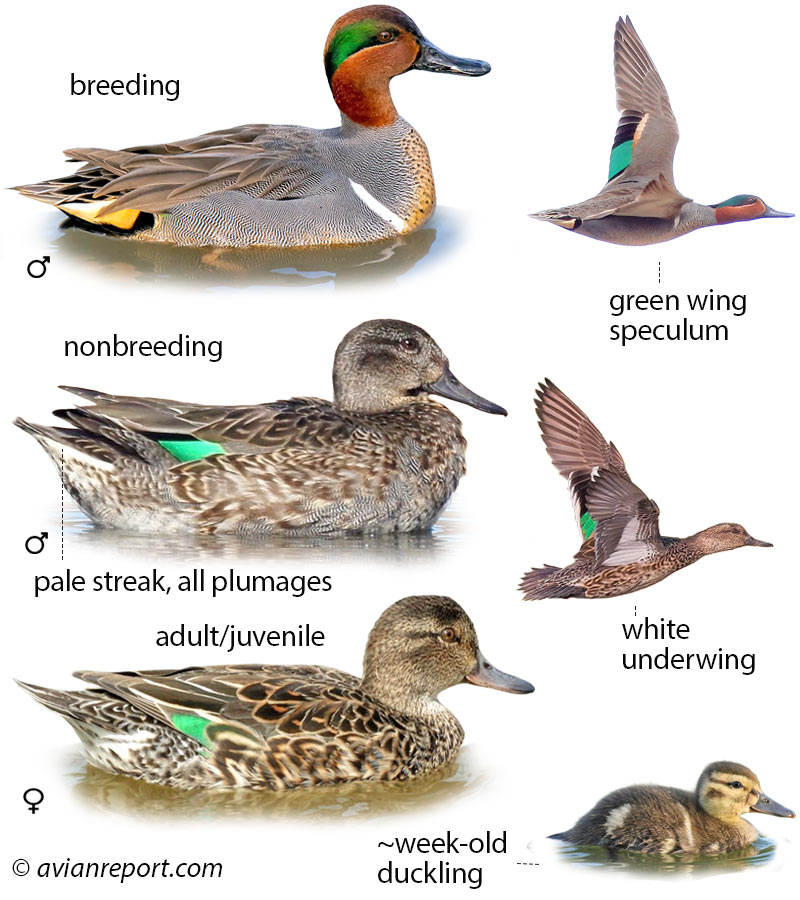
Length: 14 in, Weight: 11.3 oz, Wingspan: 22 in
Identification: Smallest dabbling duck. Drake: cinnamon head, gleaming green eye crescent, white vertical stripe on shoulder. Hen: mottled brown, yellowish tail streak. Both show green speculum.
Compare: Hen is similar to other teals and Hen Mallard but differs due to a tiny size, darker overall, and green wing speculum.
Behavior: Dabbling duck. Forages shallow wetlands by tipping up or picking while standing in puddles. Quite vocal. Pairs form fall/winter.
Flocking: The Green-winged Teal is highly gregarious, forming tight, dense flocks of up to hundreds of birds. Flocks perform fast, highly erratic movements and sudden, synchronized turns in flight; renowned for their speed and agility.
Habitat: Shallow ponds, flooded fields, coastal marshes, estuaries, river deltas, boreal forest wetlands, sedge meadows, beaver ponds.
Range: Breeds widely across northern North America (Canada/Alaska). Winters in southern U.S. and Mexico.
Status and Movements: The Green-winged Teal is an abundant winter resident in South Carolina. It utilizes nearly all shallow freshwater and brackish habitats from late October through early April.
Diet: Aquatic invertebrates, seeds, sedge fruit, pondweeds, grasses, rice, corn.
Nest: Well-concealed depression on ground, typically within 200 yards of water. Lined with grasses, sedges, leaves, down.
Breeding: Egg laying: mid-Apr-late Jul | Clutch: 6-9 eggs | Broods: 1-2 | Eggs: Creamy white to pale olive-buff | Incubation: 20-23 days.
Lifespan: At least 20 years, 3 months.
Population: Global breeding population estimated at 6.7 million individuals.
Subgroup: Whistling-Ducks (Tree Ducks)
The Whistling-Ducks are a unique and highly tropical presence in South Carolina. They are often described as being part duck and part goose due to their long legs, upright posture, and strong pair bonds. True to their alternate name, “Tree Ducks,” they frequently perch in trees and are one of the few ducks that readily nest in tree cavities or nest boxes.
Black-bellied Whistling-Duck (Dendrocygna autumnalis)
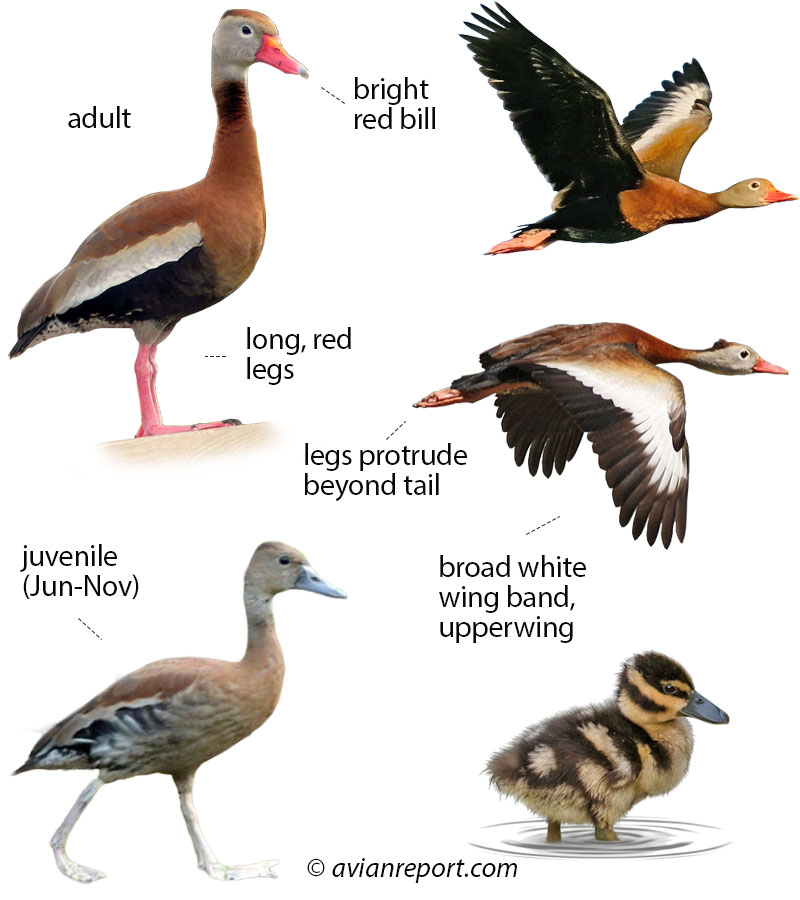
Length: 19.3 in, Weight:30 oz, Wingspan: N/A
Identification: Chestnut neck, back, and breast, black belly, bright pink bill/legs, grayish face, white wing stripe. Immatures duller, dark bill, pale breast, mottled black belly.
Compare: Structurally similar to a Fulvous Whistling Duck, which lacks the black belly and has dark bill and legs.
Behavior: Forages for waste grain, often nocturnal. Gregarious year-round. Forms lifelong pair bonds. Perches in trees/on logs.
Flocking: The Black-bellied Whistling Duck is highly social, forming large, noisy flocks. They fly low and slowly with shallow, rhythmic wingbeats, often in loose V-formations or long lines, giving continuous whistling calls. Flocks travel from feeding fields to roosts around sunset.
Habitat: Shallow ponds, agricultural/rice fields, golf courses, city parks, schoolyards. Mesquite, willow, live oak thickets. Mangroves, rivers, lagoons.
Range: Occurs in several southern U.S. states; Black-bellied Whistling-Duck range expanding northward.
Status and Movements: The Black-bellied Whistling-Duck is an uncommon, but expanding, year-round resident in coastal South Carolina. It favors wooded swamps and rice fields, where it nests.
Diet: Plants: smartweed, grasses, sedges. Crops: corn, rice, wheat, sorghum, millet. Invertebrates.
Nest: Tree hollows/cavities or nest boxes used. Ground nest is grass scrape. No material typically added in cavities.
Breeding: Egg laying: Apr-Sep | Clutch: 9-18 eggs | Broods: 1-2 | Eggs: White | Incubation: 25-30 days.
Lifespan: At least 10 years, 7 months.
Population: Global breeding population estimated at 1 million Black-bellied Whistling-Ducks.
Native Specialized Dabblers
Wood Duck (Aix sponsa)
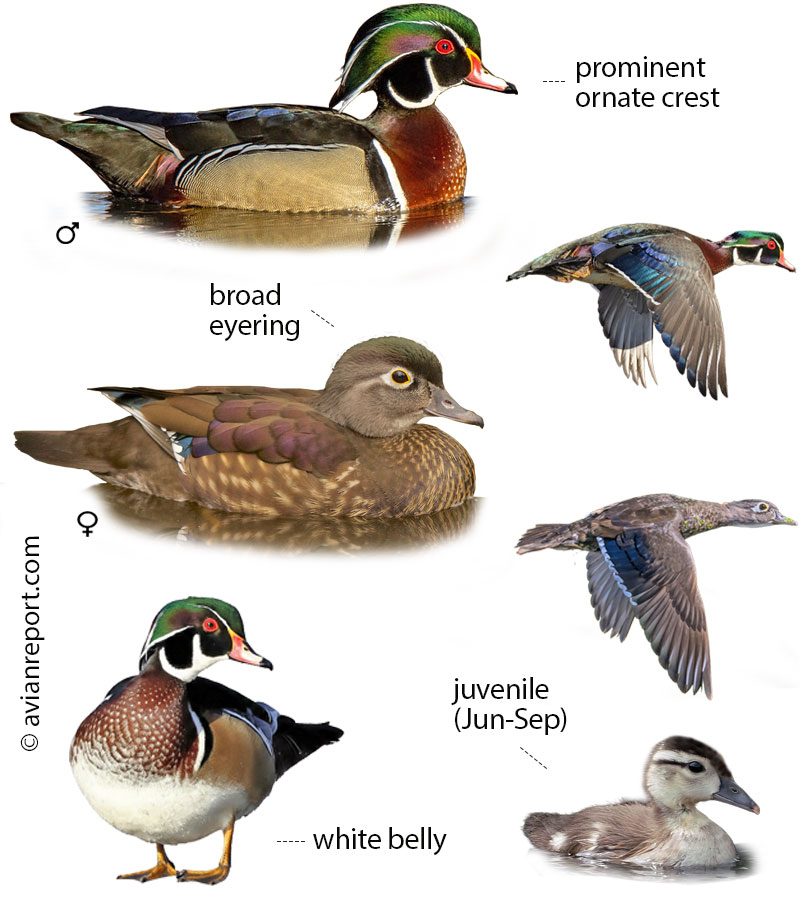
Length: 20 in, Weight: 23.2 oz, Wingspan: 27 in
Identification: Drake vivid colors: glossy green head, white stripes, chestnut breast, buff sides. Hen gray-brown, white-speckled breast. Juveniles are similar. Unique crested head. The Wood Duck is often called a “perching duck,” but feeds primarily by dabbling.
Compare: The hen Wood Duck is similar to many other hen ducks, but is distinguished by a bold eye ring, distinctive gray crest, and longish tail. Habitat choice is crucial.
Behavior: Dabbling duck, dives shallowly. Perches, nests in trees. Head jerks when swimming. Pairs form January; bond dissolves after eggs laid.
Flocking: The Wood Duck is less gregarious than many ducks; typically found in pairs or small, loose family groups. Larger flocks (50+) may form during fall migration or roosting at dusk. Flight is fast, direct, and often through dense timber.
Habitat: Wooded swamps, marshes, streams, beaver ponds, small lakes, tree cavities, forested wetlands, bottomland forests.
Range: Found in wooded swamps, streams, and lake edges across North America.
Status and Movements: The Wood Duck is a common year-round resident across South Carolina. It breeds statewide in wooded swamps, riverine forests, and nesting boxes, with peak populations in winter
Diet: Seeds, fruits, insects, arthropods. Acorns, soybeans, smartweed, duckweed, millet, grain, wild cherries, beetles, snails.
Nest: Tree cavity or woodpecker hole, 2–60 feet high. Lined with down feathers and wood chips.
Breeding: Egg laying: early Apr-Jun (Pairs form Jan) | Clutch: 6-16 eggs | Broods: 1-2 broods | Eggs: Glossy creamy white to tan | Incubation: 28-37 days. Egg-dumping common, especially in nest boxes.
Lifespan: At least 22 years, 6 months.
Population: Estimated at approximately over 3 million birds.
DIVING DUCKS OF SOUTH CAROLINA
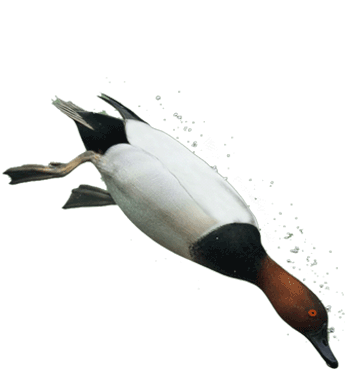
The Diving Ducks are built for life beneath the water’s surface. Unlike dabblers, their legs are set far back on their bodies, which provides maximum propulsion underwater but makes them clumsy on land. To take flight, they must run, or “patter,” across the water’s surface to gain enough speed. This group primarily forages in deeper lakes, large rivers, and coastal bays.
Core South Carolina Diving Ducks (Aythya)
Canvasback (Aythya valisineria)
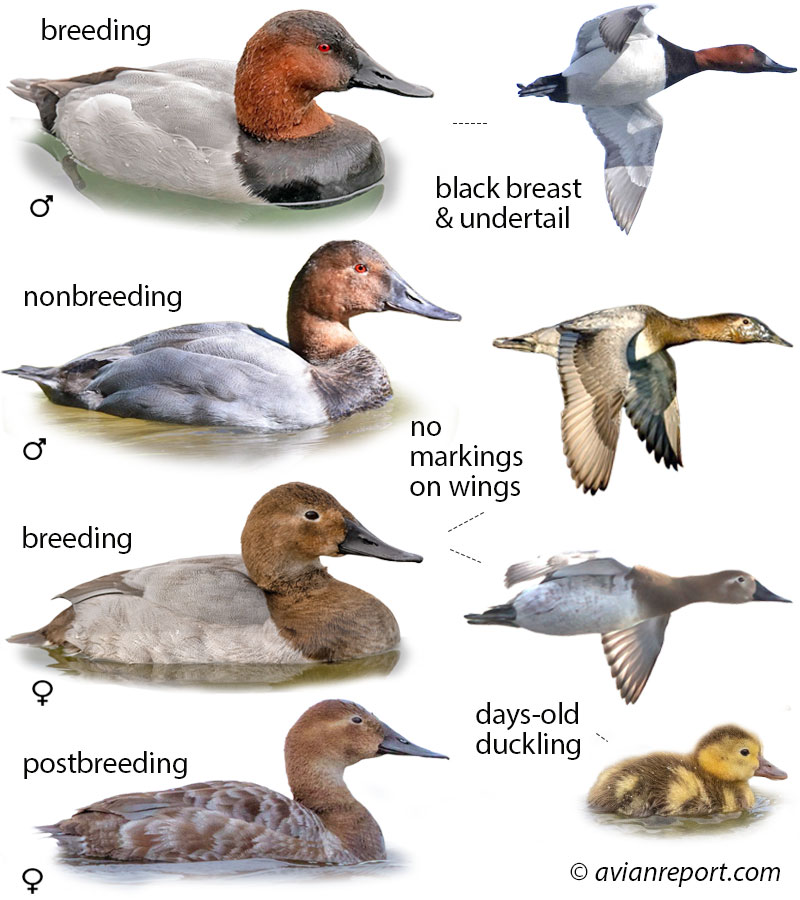
Length: 21 in, Weight: 43.2 oz, Wingspan: 33 in
Identification: Drake Rusty head/neck, gleaming whitish body, black chest/rear. Hen Grayish/brown body, dark eyes. Both have long sloping foreheads and black bill.
Compare: Redheads have a similar color pattern but are smaller, with a steeper forehead, a gray (not white) back, and a bluish (not black) bill. Learn the subtle field marks to distinguish the Canvasback from the Redhead.
Behavior: Diving duck, gregarious nonbreeding season. Dives underwater constantly. Rarely goes ashore. It often forms large rafts.
Flocking: The Canvasback is highly social, forming massive, dense rafts (thousands) on large lakes. Flocks fly in long, swift, oblique lines or V-formations with powerful, sustained speed. They are the fastest fliers of North American ducks.
Habitat: Lakes, deep-water marshes, ponds, estuaries, coastal waters, lagoons, rivers, flooded agricultural fields.
Range: Breeds lakes/marshes Prairie Pothole Region, Canada, Alaska. Winters US coasts/inland waters, Mexico. This Canvasback is widespread.
Status and Movements: The Canvasback is a common winter resident in South Carolina. This large diver prefers open water on large reservoirs and coastal bays, present from November through March.
Diet: Plant tubers, rhizomes, aquatic plant seeds, wild celery, mussels, clams, insects.
Nest: Large bulky platform of sedges, reeds, rushes. Loosely woven, floats on water, attached to emergent stalks.
Breeding: Egg laying mid Apr-early Jul | Clutch: 5-11 eggs | Broods: 1 | Eggs: Greenish drab | Incubation: 24-29 days.
Lifespan: At least 22 years, 7 months.
Population: Estimated breeding population is 566,000.
Redhead (Aythya americana)
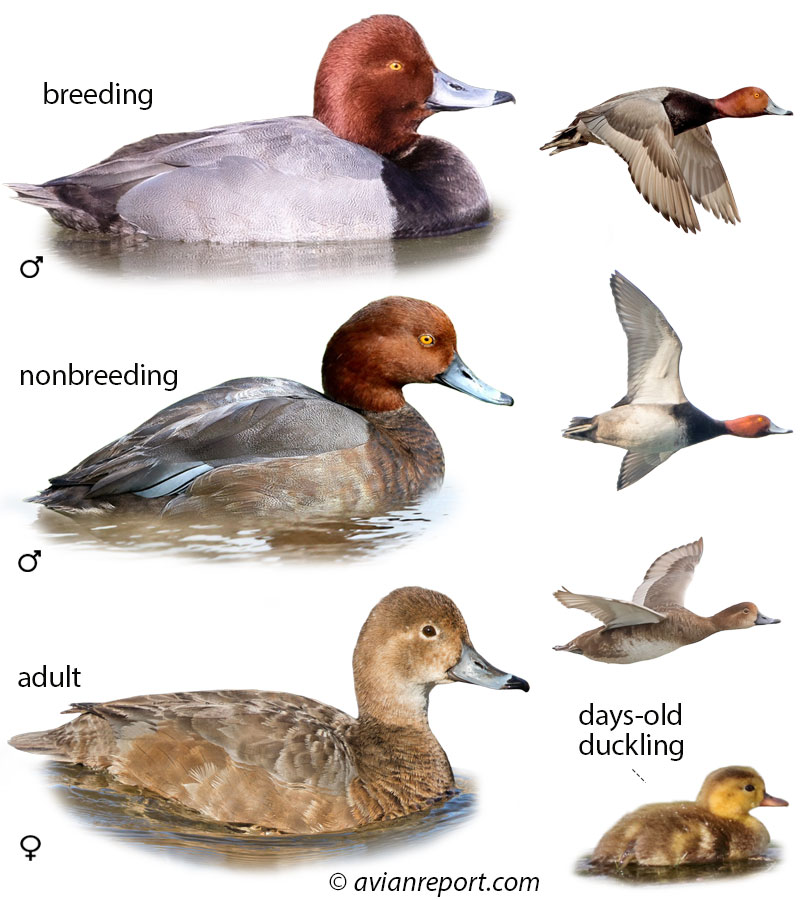
Length: 19 in, Weight: 37 oz, Wingspan: 30 in
Identification: Drake: Gleaming cinnamon head, black breast/tail, neat gray body. Hen/immature: uniform brown. Both sexes: black-tipped, gray bill, smoothly rounded head.
Compare: Canvasbacks have a similar color pattern but are larger, with a sloping forehead (triangular head), a white (not gray) back, and a black (not bluish) bill. Learn the subtle field marks to distinguish the Canvasback from the Redhead.
Behavior: Sociable duck. Usually dives for food, may tip up in shallow water like dabbling ducks. Monogamous; drakes court hen with gymnastic “head throw” display.
Flocking: The Redhead is highly social, forming large, dense rafts on open water (often thousands). Flocks fly in tight, changing patterns or long, wavy lines with rapid, shallow wingbeats. Often flies with scaups and Canvasbacks.
Habitat: Seasonal wetlands, prairie potholes, deep marsh, large lakes, reservoirs, coastal bays, Gulf Coast, agricultural fields.
Range: Breeds Great Plains/Midwest prairie pothole region, West. Winters Gulf Coast, Great Lakes, southern U.S. waters.
Status and Movements: The Redhead is a common winter resident in South Carolina. It concentrates on brackish coastal bays and impoundments, with typical occurrence from November through March.
Diet: Submerged aquatic plants, green algae. Invertebrates: snails, zebra mussels, mayflies, small clams.
Nest: Circular woven bowl built by female using plant material on an underwater vegetation foundation. Found in cattails/bulrushes over water.
Breeding: Egg laying: May-late Jul | Clutch: 7-8 eggs | Broods: 1 | Eggs: Creamy white to pale, olive buff/buffy brown | Incubation: 22-28 days
Lifespan: At least 20 years, 7 months.
Population: North American population estimated at 1.2 million Redhead individuals (2015).
Ring-necked Duck (Aythya collaris)
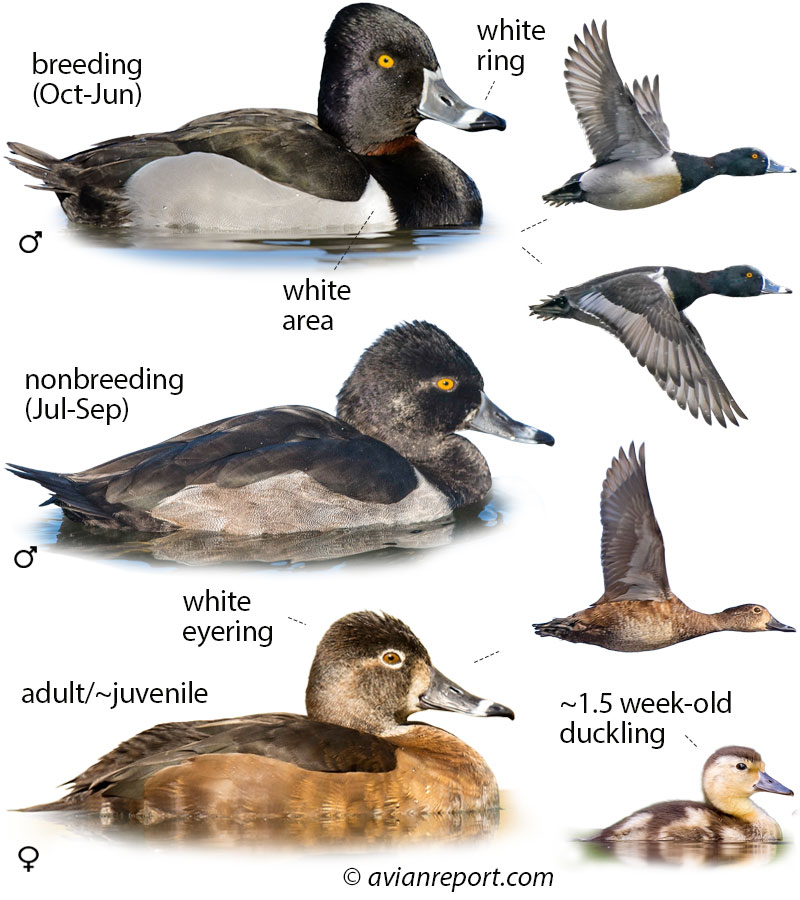
Length: 17 in, Weight: 25 oz, Wingspan: 25 in
Identification: Drake: black/gray, peaked head, prominent white bill ring, black back, white chest (area) spur. Hen: rich brown, pale cheek, whitish eye ring/bill patch.
Compare: Drake Lesser Scaups have a pale back, lack the white side spur, and the white band and black tip of the bill of the Ring-necked. Hen scaups have a solid dark-brown head, not the capped look of the hen Ring-necked Duck.
Behavior: Diving duck. Forages diving for mollusks, invertebrates, submerged vegetation. Uses displays (head throw, nodding) for courtship and rival warnings.
Flocking: The Ring-necked Duck typically forms medium-sized flocks, flying swiftly and directly in loose V-formations or irregular groups. Their agile flight, characterized by quick wingbeats, makes them appear energetic.
Habitat: Freshwater marshes, bogs, beaver ponds, shallow lakes, flooded agricultural fields, cattle ponds, river floodplains, brackish estuaries, reservoirs.
Range: Breeds far northern North America boreal forest. Winters widely US inland/coastal waters, Mexico, Central America/Caribbean.
Status and Movements: The Ring-necked Duck is an abundant winter resident in South Carolina. It prefers inland freshwater habitats, especially ponds and reservoirs, present from October through April.
Diet: Submerged plants and seeds, aquatic invertebrates, mollusks, earthworms, leeches.
Nest: Simple bowl of sedges/plants on/over water or floating vegetation. Flimsy collection of bent stems, lined with down feathers.
Breeding: Egg laying: early May-mid-Jul | Clutch: 6-14 eggs | Broods: 1 | Eggs: N/A | Incubation: 25-29 days.
Lifespan: At least 20 years, 5 months.
Population: Global breeding population estimated at 2 million individuals.
Greater Scaup (Aythya marila)
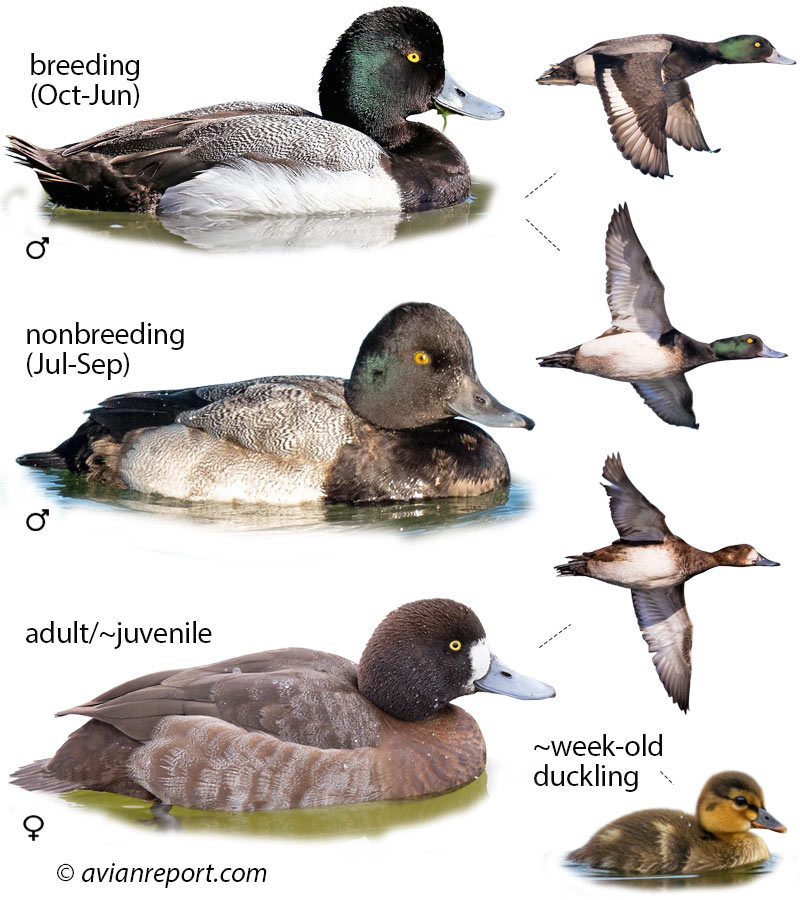
Length: 19 in, Weight: 37 oz, Wingspan: 30 in
Identification: Drake black/white, rounded head, iridescent green sheen. Blue bill, yellow eye. Hen brown, darker head, variable white bill patch. Nonbreeding mottled gray/brown.
Compare: Drake and hen Lesser Scaup usually show a peak at the back of the head, while Greater Scaup has a more smoothly rounded head. Overall, very similar species. Learn the subtle field marks to distinguish the Lesser Scaup from the Greater Scaup.
Behavior: Diving duck. Forages underwater for aquatic invertebrates/plants, diving up to 23 feet. Monogamous seasonally; pairs form in winter.
Flocking: Greater Scaup are highly gregarious, often forming immense, dense rafts. Their powerful, fast flight occurs in coordinated, tightly packed flocks, often shifting patterns over water, exhibiting strong, direct movement.
Habitat: Shallow lakes, ponds, treeless wetlands, tundra. Coastal bays, reservoirs, Great Lakes, Pacific/Atlantic shorelines.
Range: Breeds North American tundra. Winters Pacific/Atlantic coasts, Great Lakes, reservoirs.
Status and Movements: The Greater Scaup is a common winter resident in South Carolina. It prefers deeper, open saltwater habitats like bays and sounds, typically arriving in November and departing by March.
Diet: Aquatic invertebrates, mollusks, insects, crustaceans. Aquatic plants, seeds.
Nest: Saucer-shaped depression on ground, near water, dense cover. Lined with grasses, plant material, downy feathers.
Breeding: Egg laying: mid-May – late Aug | Clutch: 5-13 eggs | Broods: 1 | Eggs: Brownish olive-buff | Incubation: 23-28 days.
Lifespan: At least 20 years, 5 months.
Population: Estimated 780,000 individuals. The Greater Scaup is listed as a common bird in steep decline.
Lesser Scaup (Aythya affinis)
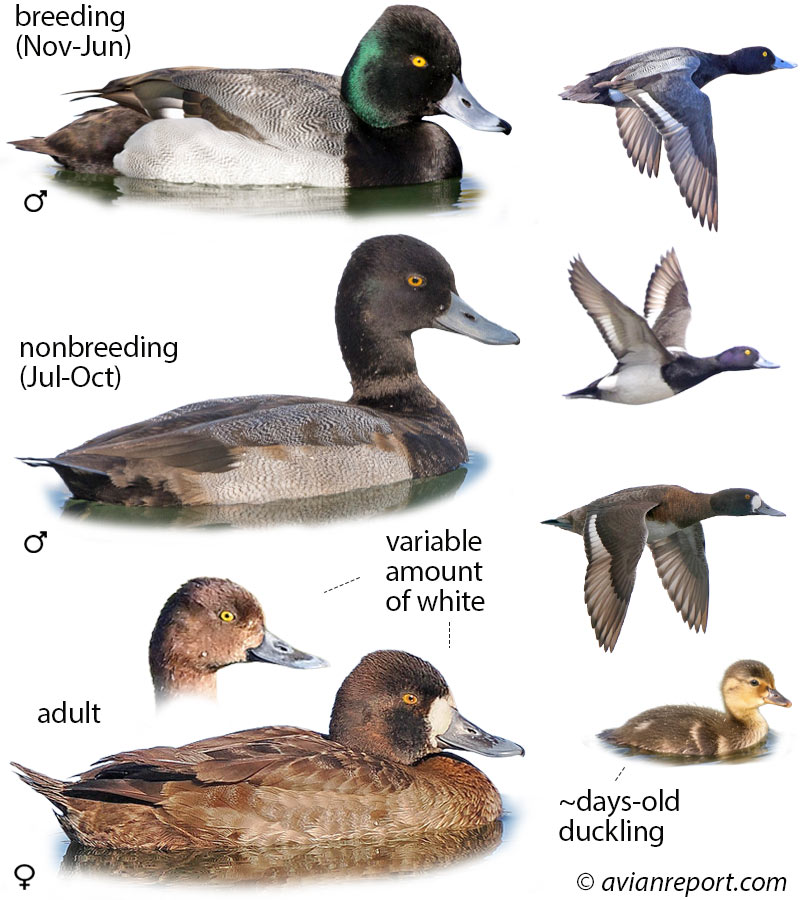
Length: 17 in, Weight: 27 oz, Wingspan: 29 in
Identification: The Lesser Scaup Drake: Black/white, peaked head, iridescent purple/green sheen, bluish bill/yellow eye. Hen: brown, pale bill patch variable.
Compare: Drake and hen Greater Scaup usually show a more rounded head, while Lesser Scaup shows a peak at the back of the head. Overall, very similar species. Learn the subtle field marks to distinguish the Lesser Scaup from the Greater Scaup.
Behavior: Diving duck. Sleeps on water. Seasonally monogamous, new mates yearly. Drakes display vigorously courting hens.
Flocking: The Lesser Scaup typically forms smaller, yet still gregarious, flocks than its larger cousin. They fly swiftly and directly, often in erratic or loose V-formations with rapid wingbeats, showing agile aerial maneuvers.
Habitat: Prairie potholes, boreal forest, tundra wetlands, hayfields. Lakes, reservoirs, coastal bays, estuaries, agricultural ponds.
Range: Breeds Northern North America/Prairie Potholes. Winters US inland/coastal waters, extending south to Central America/Caribbean.
Status and Movements: The Lesser Scaup is an abundant winter resident across South Carolina. It utilizes both coastal and inland freshwater habitats, arriving in October and lingering until April.
Diet: Aquatic invertebrates: mollusks, insects, crustaceans. Aquatic plants, seeds.
Nest: Saucer-shaped depression on ground in tall, well-concealed vegetation (prairies/marshes). Lined with grasses and female down.
Breeding: Egg laying: late May-Jul | Clutch: 6-14 eggs | Broods: 1 | Eggs: Pale to dark olive/greenish buff | Incubation: 21-27 days.
Lifespan: At least 18 years.
Population: Global breeding population estimated at 3.8 million individuals.
Subgroup: Sea Ducks and Scoters
Though most often associated with northern coasts, the Sea Ducks occasionally winter in South Carolina’s coastal waters. This subgroup, which includes the heavy-bodied Scoters and the buoyant Bufflehead and Goldeneye, is primarily found in saltwater environments where they dive deep to feed on mollusks and crustaceans.
Common Eider (Somateria mollissima)
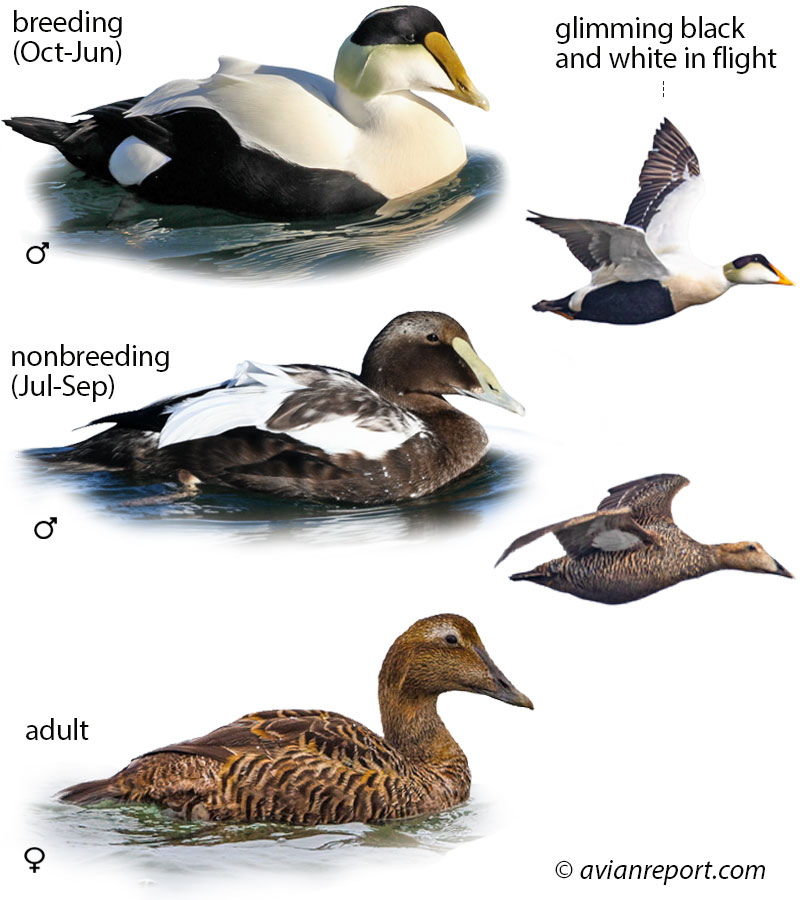
Length: 24 in, Weight: 69 oz, Wingspan: 38 in
Identification: Largest sea duck. Drake: white/black, black cap, pale green nape, sloping bill. Hen: warm brown, densely black-barred, black bill. Immature males chocolate brown.
Compare: Drake King Eiders have a black back and a more square and colorful head than Common Eiders. Hen King Eiders have a more rounded head and long sloping forehead.
Behavior: Diving duck, use wings to swim, pry mussels/shellfish from rocks. Spend much day resting/loafing. Males croon softly courting.
Flocking: Common Eiders are highly social, forming large, often dense, rafts. Their powerful, direct flight is usually low over the water in long, undulating lines or irregular groups, exhibiting strong, deliberate wingbeats for sustained movement.
Habitat: Rocky ocean coasts, islands, estuaries, bays, Arctic tundra heath, taiga, gravel spits, rocky seafloors.
Range: Breeds Alaska/Canada Arctic tundra. Winters Atlantic Canada, New England, S. Alaska coasts. The Common Eider is rare south of mid-Atlantic states.
Status and Movements: The Common Eider is a rare winter vagrant to South Carolina. Sporadic sightings occur mainly on offshore sandbars or ocean waters, generally between December and February.
Diet: Mollusks (blue mussels), crustaceans (spider crabs), echinoderms (sea urchins), marine worms, fish eggs, marine algae.
Nest: Ground depression, usually covered (rock/vegetation), near sea. Lined with down (after 3rd egg). Nests in large colonies (Atlantic).
Breeding: Egg laying: Jun – mid-Jul | Clutch: 3-8 eggs | Broods: 1 | Eggs: Olive or greenish | Incubation: 24-26 days.
Lifespan: At least 22 years, 7 months.
Population: North American breeding
Population: 750,000 individuals.
Surf Scoter (Melanitta perspicillata)
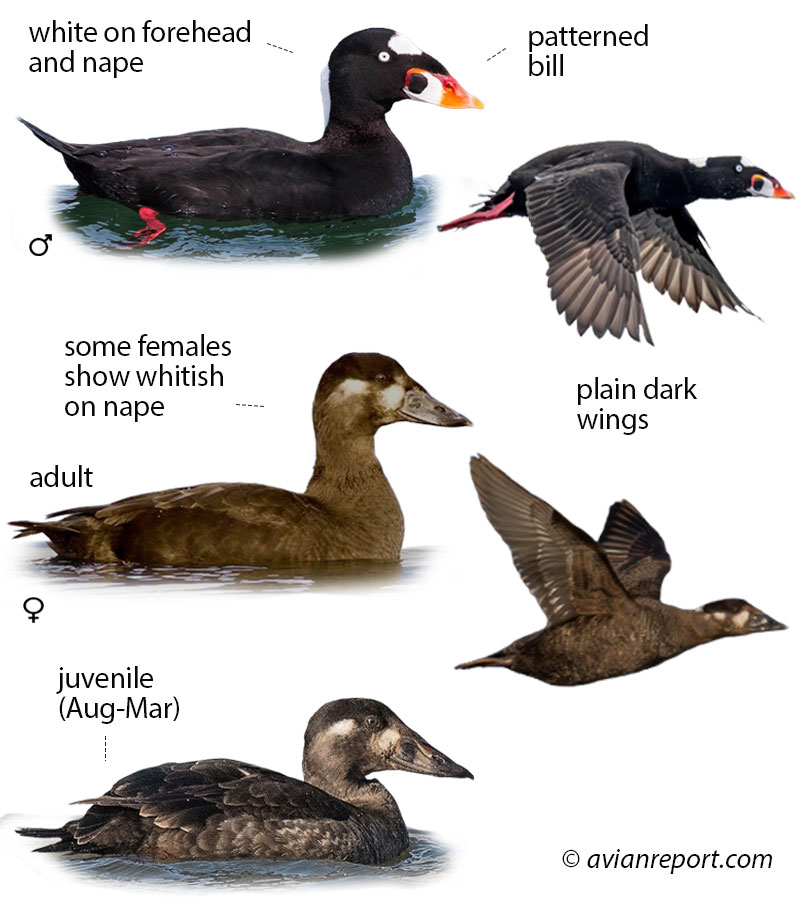
Length: 21 in, Weight: 39 oz, Wingspan: 30 in
Identification: Drake jet black, orange/white/black bill, white nape/forecrown patches. Hen dark brown, dark bill, usually two white face patches.
Compare: White-winged Scoters have a large white patch in the wing that Surf Scoters lack. Surf Scoters have distinctive white patches on the forehead and back of the neck. Hen have a darker cap than White-winged Scoters.
Behavior: Dives for prey, often just before ocean waves break. Rests on water. Drake defends moving area around hen during breeding.
Flocking: Surf Scoters typically form smaller flocks, often flying in loose, undulating lines or irregular groups low over the waves. Their direct, powerful flight exhibits purposeful movement, characterized by strong, steady wingbeats. Roosts miles offshore nightly.
Habitat: Taiga shield ecotone, shallow lakes, boreal forest/tundra blend, ocean coasts, bays, estuaries, inland lakes (migration/storms).
Range: Breeds N. Canada/Alaska boreal forest/tundra. Winters Atlantic/Pacific coasts, inland waters. The Surf Scoter is widespread.
Status and Movements: The Surf Scoter is a common winter resident of open coastal waters in South Carolina. These sea ducks are present from late October through April, favoring nearshore areas.
Diet: Mollusks (mussels, clams), marine snails, crabs, worms, herring spawn. Aquatic vegetation. Freshwater invertebrates/insects (breeding).
Nest: Well concealed depression on ground. Beneath vegetation/rocky ledges. Lined with down, moss, grasses, needles, twigs, bark.
Breeding: Egg laying: mid May – mid-Aug | Clutch: 6-9 eggs | Broods: 1 | Eggs: Creamy white | Incubation: 28-30 days.
Lifespan: At least 19 years, 7 months.
Population: Global breeding population estimated at 470,000 individuals.
White-winged Scoter (Melanitta deglandi)
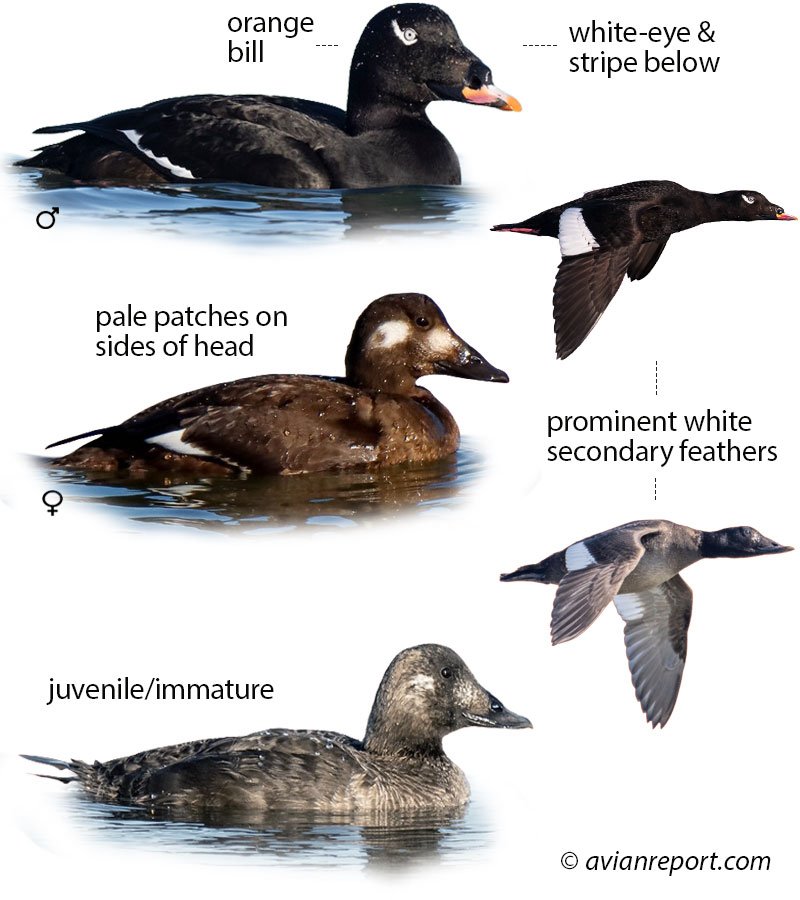
Length: 21 in, Weight: 49 oz, Wingspan: 32 in
Identification: Drake velvety black, white comma eye patch, orange-tipped bill, white wing patch. Hen dark brown, two smudgy white face patches. Juveniles similar to females.
Compare: Drake Surf Scoters have a large white patch on the forehead and back of the neck that male White-winged Scoters lack. Females have a uniform dark head that contrasts with the dark-capped head of a hen Surf Scoter.
Behavior: Forages diving deep underwater. Swallows prey whole underwater. Winters in flocks. Monogamous mating system presumed.
Flocking: White-winged Scoters typically form small, loose flocks, flying with strong, direct wingbeats. Their flight is powerful and steady, often staying low over coastal waters, occasionally gathering in larger, dispersed rafts.
Habitat: Boreal forest, shallow freshwater lakes, brushy shrubs (breeding). Coastal areas, shallow saltwater bays, estuaries, Great Lakes (winter).
Range: Breeds Northern Canada/Alaska boreal forest. Winters Atlantic/Pacific coasts, Great Lakes, inland waters. This White-winged Scoter is widespread.
Status and Movements: The White-winged Scoter is an uncommon winter resident in South Carolina. Look for it in open ocean and large coastal bays from November through March.
Diet: Mollusks (mussels, clams, snails), crustaceans, fish, insects (freshwater: caddisflies/midges), aquatic plants (small amounts).
Nest: Depression in soil, beneath heavy, thorny vegetation (roses/berry bushes). Fluffy bowl of down/grasses/twigs.
Breeding: Egg laying: Jun-mid-Aug | Clutch: 6-16 eggs | Broods: 1 | Eggs: Creamy buff or light pink | Incubation: 28-30 days.
Lifespan: At least 18 years, 1 month.
Population: Global breeding population estimated at 400,000 individuals.
Black Scoter (Melanitta americana)
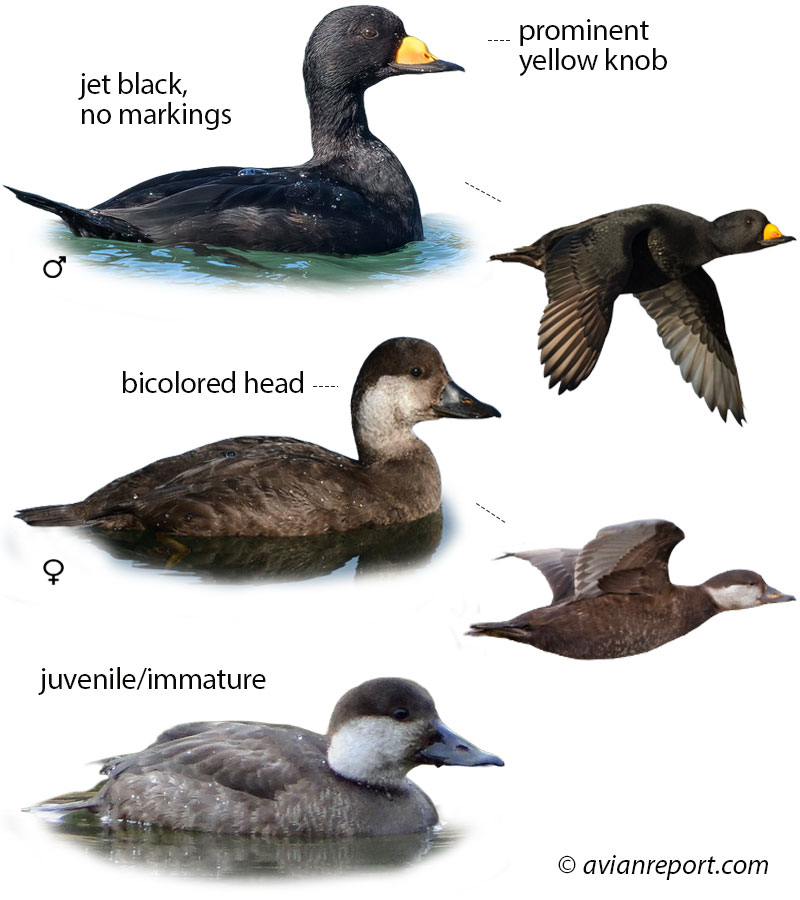
Length: 18 in, Weight: 35 oz, Wingspan: 28 in
Identification: Drake all jet black, orange knob at base of bill. Hen dark brown, pale face and delineated dark cap.
Compare: White-winged Scoters have a white patch in the wing that Black Scoters lack. The orange bill knob in Black Scoters is distinctive. Hen Black Scoter have a pale face and delineated dark cap.
Behavior: Dives for shellfish/mussels (winter); marsh insects (summer). Males vocal, croon. Monogamous, males closely guard mates.
Flocking: Black Scoters gather in moderate to large flocks, maintaining tight, often crescent-shaped flight patterns. They exhibit strong, direct flight with steady, powerful wingbeats, frequently moving low over the water in cohesive groups.
Habitat: Coastal ocean waters, bays, inland lakes/rivers, boreal forest lakes, shallow water, rocky bottoms.
Range: Breeds far north boreal forest/tundra; winters Atlantic/Pacific coasts, Great Lakes, inland waters, scarce southern US.
Status and Movements: The Black Scoter is a common winter resident of South Carolina’s coastal waters. This sea duck is typically found in nearshore and offshore marine environments from November to March.
Diet: Mollusks (mussels, clams, scallop), crustaceans, insects/larvae, fish eggs, marine vegetation (eelgrass).
Nest: Depression on ground, grassy/sheltered spot, usually <100 feet from water. Lined with hen’s down feathers.
Breeding: Egg laying: mid-May – mid-Aug | Clutch: 8-9 eggs | Broods: 1 | Eggs: Off-white to pinkish buff | Incubation: 27-28 days.
Lifespan: At least 10 years, 6 months.
Population: Global breeding population estimated at 900,000 individuals.
Long-tailed Duck (Clangula hyemalis)
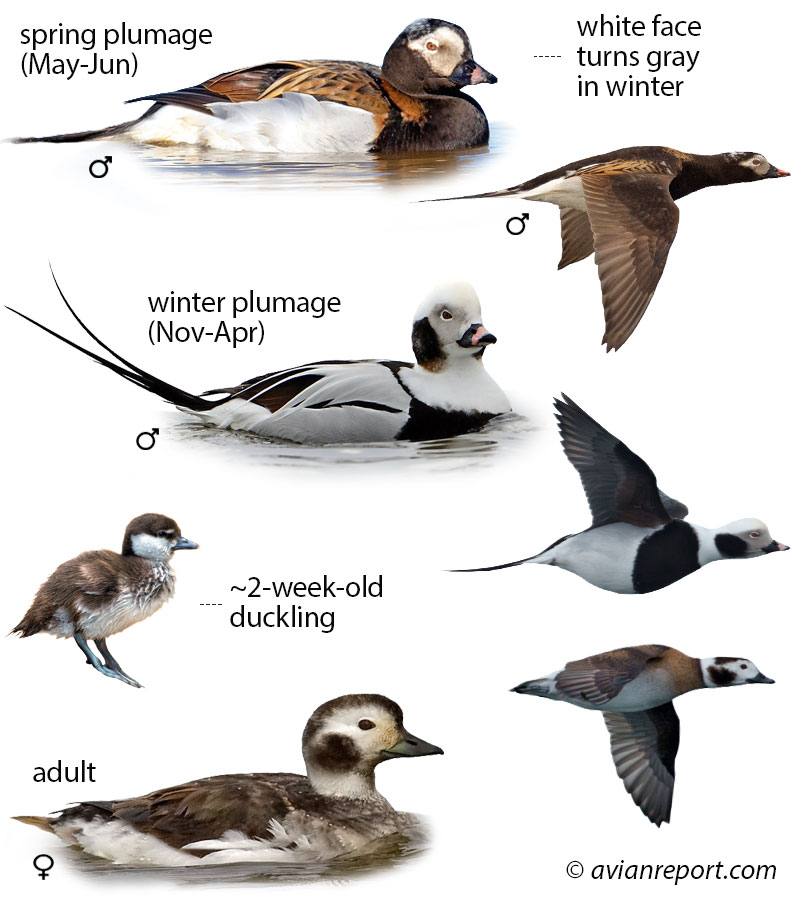
Length: 17 in, Weight: 27 oz, Wingspan: 28 in
Identification: Drake: stunning black/white in winter; dark/white face patch summer. Extravagantly long tail plumes (male). Hen/immature smudgy brown/white, brown crown/cheek patch, dark bill.
Compare: Shares the long and slender tail feathers with the Northern Pintail, but the head color pattern and bill color are different.
Behavior: The Long-tailed Duck is a strong swimmer, active diver, often reaching 200 feet deep to forage. Thought monogamous; pairs lasting many seasons.
Flocking: Highly social when not breeding. Can form large flocks, often far offshore. Occasionally mixes with other diving duck species. Flight erratic.
Habitat: Long-tailed Ducks occupy arctic wetlands, tundra, freshwater lakes, ocean coasts, large freshwater lakes, protected bays.
Status and Movements: The Long-tailed Duck is an uncommon winter visitor to South Carolina’s coastal waters, arriving in late fall and departing by early spring. Its distinctive plumage and vocalizations make it unique among sea ducks.
Movements: Migrates between high Arctic breeding grounds and Southern coasts/large lakes. Movement influenced by sea-ice coverage.
Diet: Marine crustaceans, aquatic insects, mussels, small fish, zooplankton, fairy shrimp, fish eggs, plant matter.
Nest: Shallow depression in ground, lined with dwarf willow/birch leaves. Located in clusters on arctic islands/peninsulas.
Breeding: Egg laying: late May-early Jul | Clutch: 6-9 eggs | Broods: 1 | Eggs: Pale gray to olive | Incubation: 24-29 days
Lifespan: At least 17 years.
Population: Global breeding population estimated at 3.2 million individuals.
Bufflehead (Bucephala albeola)
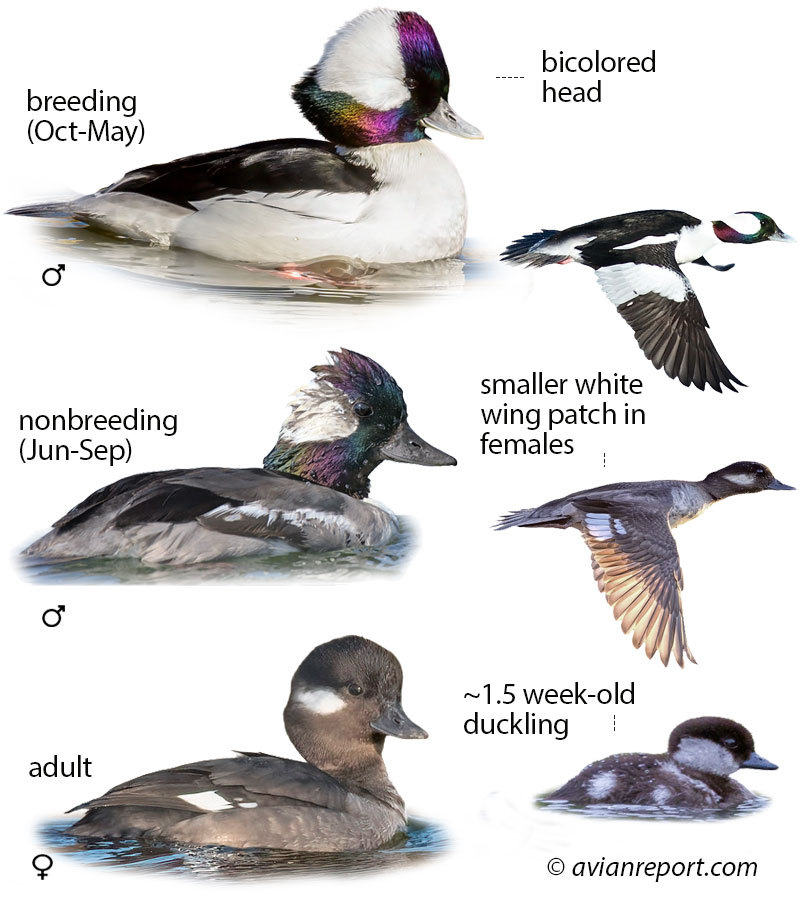
Length: 14 in, Weight: 16 oz, Wingspan: 22 in
Identification: Drake: White body, black back, glossy green/purple head, large white patch. Hen/immature: gray-brown, oval white cheek patch.
Compare: Drake Hooded Mergansers have cinnamon (not white) sides and a longer, thinner bill than male Buffleheads. The hen Bufflehead has a dark round head and single white patch on the cheek.
Behavior: The Bufflehead dives underwater for aquatic invertebrates. Monogamous; pairs often last several years. Males rapidly bob heads courting females.
Flocking: Buffleheads are typically found in small, scattered groups or pairs, rarely forming large flocks. Their flight is remarkably fast and erratic, characterized by rapid, whirring wingbeats and sudden, darting movements, especially when flushed.
Habitat: Buffleheads occupy boreal forests, aspen parkland lakes/ponds. Winter: shallow saltwater bays, estuaries, large lakes, inland ponds.
Range: Breeds Canada/Alaska boreal forest; isolated western U.S. populations. Winters coasts/large inland waters across southern North America.
Status and Movements: The Bufflehead is an abundant winter resident throughout South Carolina. This small diver is found on large reservoirs and coastal bays from late October until April.
Diet: Aquatic invertebrates, shrimp, crabs, mussels, fish eggs, small fish. Plant seeds (pondweeds/bulrushes).
Nest: Nests exclusively in tree cavities, primarily old Northern Flicker holes. Female lines cavity with down.
Breeding: Egg laying: late Apr-mid-Jul | Clutch: 4-17 eggs | Eggs: Cream-colored or buff; unmarked.
Lifespan: At least 18 years, 8 months.
Population: Global breeding population estimated at 1.3 million individuals.
Common Goldeneye (Bucephala clangula)
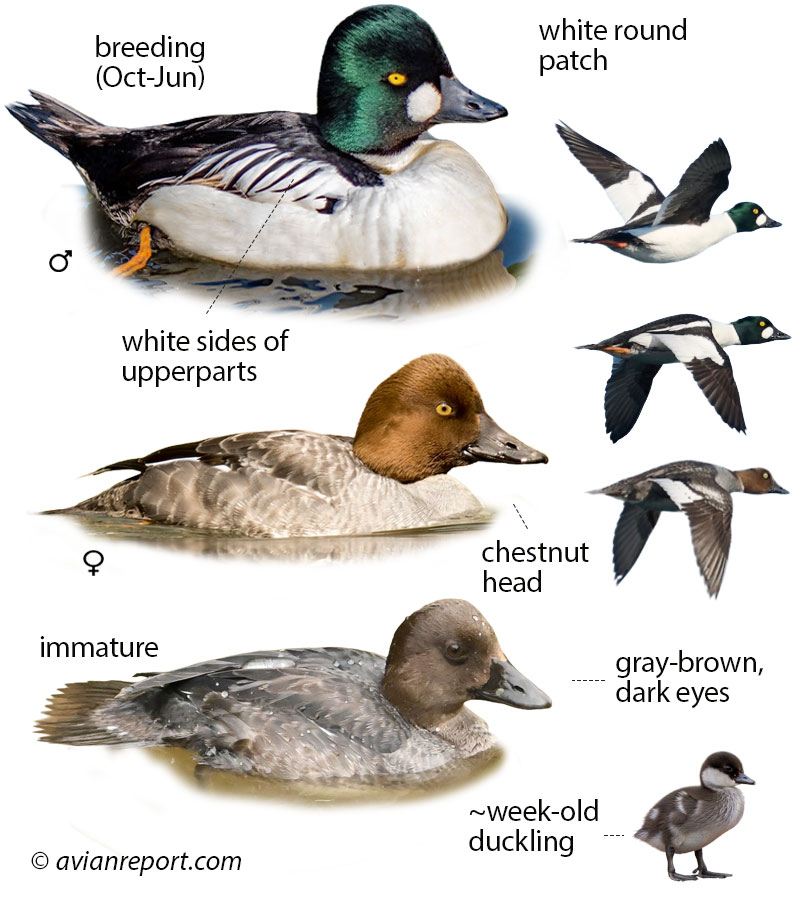
Length: 18 in, Weight: 34 oz, Wingspan: 32 in
Identification: Drake: Green-black head, round white spot, radiant amber eye, crisp black/white body/wings. Hens: Chocolate head, bright eye, gray body.
Compare: Barrow’s Goldeneyes have an oval or crescent-shaped white spot behind the bill whereas the spot on male Common Goldeneyes is round. Barrow’s also have a black spur on the side that Common Goldeneyes lack. Learn the subtle field marks to distinguish the Common Goldeneye from the Barrow’s Goldeneye.
Behavior: Diving duck. The Common Goldeneye forages in flocks that often perform synchronized dives. Drakes display (head backward/forward) courting females.
Flocking: Forms small, loose flocks or linear formations, flying with strong, direct, and swift movements. Their rapid, whirring wingbeats propel them quickly across the water, often in cohesive, though not dense, groups of a few dozen.
Habitat: Boreal forest, tree cavities, lakes, rivers, wetlands. Winter: Protected coastal waters, large inland lakes.
Range: Breeds Canada/Alaska boreal forest, some US states. Winters Atlantic, Pacific, Gulf coasts, large inland waters.
Status and Movements: The Common Goldeneye is an uncommon winter resident in South Carolina. It prefers open water on larger rivers and coastal bays, usually present from November through March.
Diet: Aquatic invertebrates. Vegetation: seeds/tubers (pondweeds, bulrush).
Nest: The Common Goldeneye nests in tree cavities (natural/woodpecker holes) or nest boxes. Female lines cavity/bowl with down feathers.
Breeding: Egg laying: early Apr-mid-Jul | Clutch: 4-9 eggs | Broods: 1 | Eggs: Greenish to olive-green | Incubation: 27-33 days.
Lifespan: At least 20 years, 5 months.
Population: Global breeding population estimated at 2.5 million individuals.
Subgroup: Mergansers (Sawbill Ducks)
The Mergansers are easily distinguished by their thin, streamlined bills that are serrated, or “saw-toothed,” which gives them their nickname, “Sawbill Ducks.” This specialized bill is an adaptation for their nearly exclusive diet of fish. While they are powerful divers like the rest of the group, Mergansers in South Carolina can be found in a variety of habitats, from freshwater lakes and rivers (Hooded Merganser) to saltwater estuaries (Red-breasted Merganser).
Hooded Merganser (Lophodytes cucullatus)
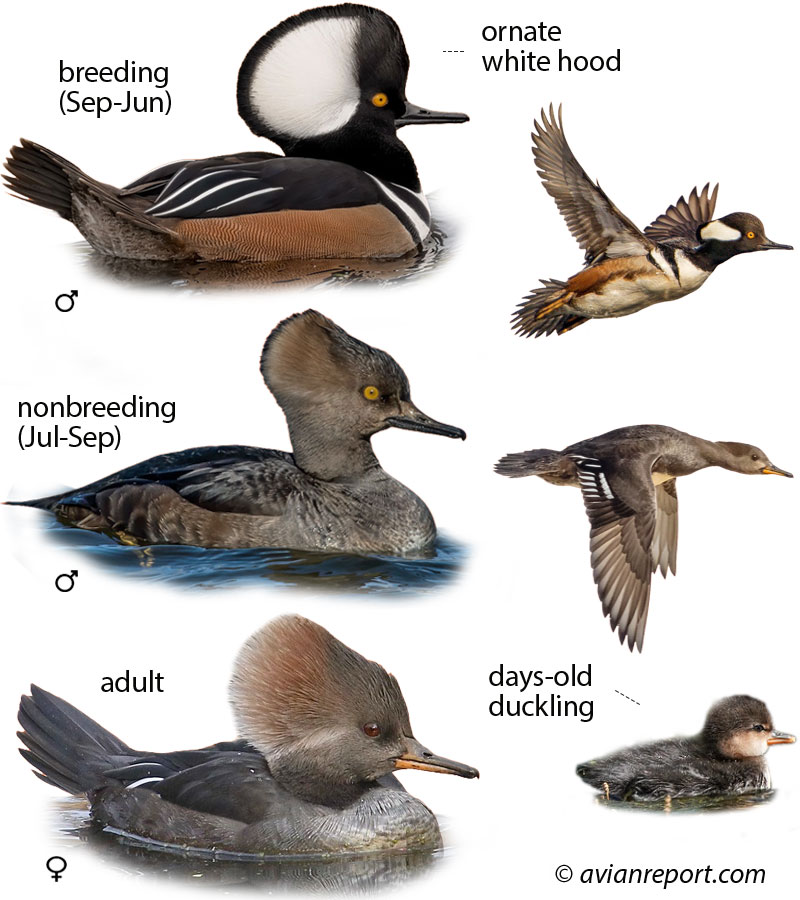
Length: 18 in, Weight: 24 oz, Wingspan: 25 in
Identification: Drake: black/white patterns, chestnut flanks, large white patch on black, fan-shaped crest. Hen/immature: gray/brown with tawny-cinnamon crest.
Compare: Drake Buffleheads have a white belly and sides whereas male Hooded Mergansers have cinnamon sides and a longer and thinner bill. Buffleheads are smaller. Hens Hooded Merganser are darker and smaller than Hens Red-breasted and Common Mergansers.
Behavior: Busy diver. Drakes court expanding crests, making low, groaning calls. Not known if pairs reunite post-incubation. Runs across water to fly.
Flocking: Hooded Mergansers typically fly in small, often single-file groups, rarely forming large congregations. They exhibit very fast, direct flight with rapid, shallow wingbeats, displaying surprising agility as they navigate waterways with heads held low.
Habitat: Forested wetlands, small ponds, rivers, lakes, marshes, protected saltwater bays.
Range: Breeds eastern half/Pacific Northwest North America. Winters large fresh/brackish bays, US inland waters.
Status and Movements: The Common Goldeneye is an uncommon winter resident in South Carolina. It prefers open water on larger rivers and coastal bays, usually present from November through March.
Diet: Small fish, aquatic insects, crustaceans, amphibians, mollusks, vegetation.
Nest: Tree cavity (live/dead tree, 10–90 feet high) or nest box. Female adds down to shallow bowl in cavity.
Breeding: Egg laying: Feb-early May | Clutch: 5-13 eggs | Broods: 1 brood | Eggs: White, thick shelled | Incubation: 26-41 days
Lifespan: At least 14 years, 6 months.
Population: Estimated at 1.1 million individuals.
Red-breasted Merganser (Mergus serrator)
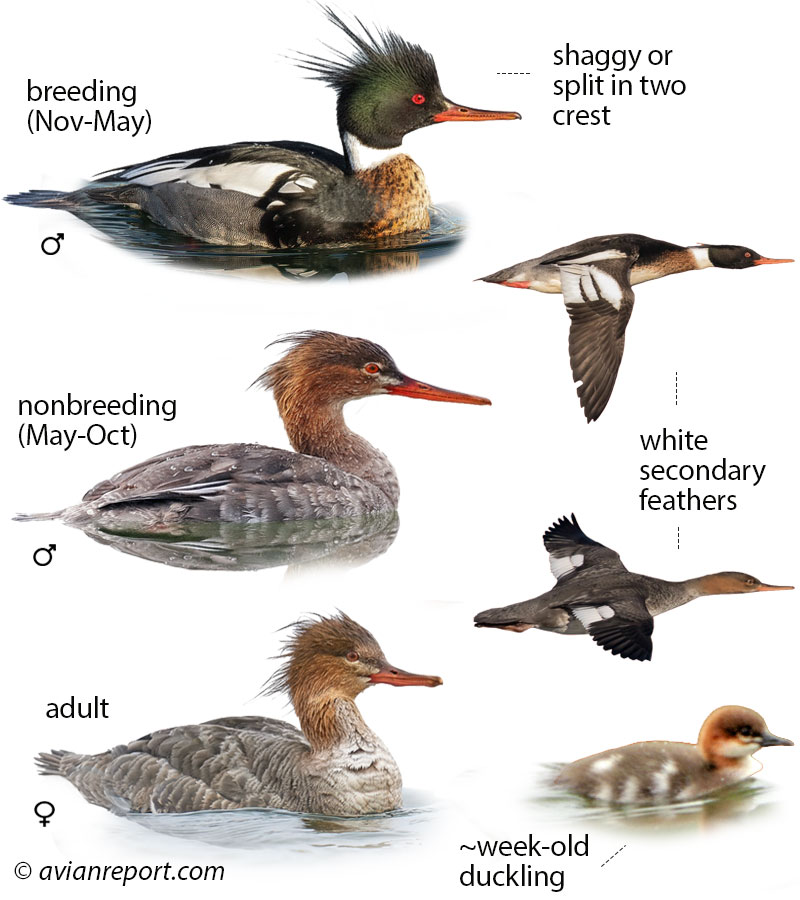
Length: 23 in , Weight: 38 oz, Wingspan: 28 in
Identification: Drake: dark green shaggy crest, red bill/eye, rusty chest, white neck band. Hen/nonbreeding male: brownish gray, brown shaggy head.
Compare: Breeding male Common Mergansers have white sides and a white breast whereas male Red-breasted Mergansers have gray sides and a cinnamon breast. Hen Common Merganser have a neat border (fussy in Red-breasted) between cinnamon head and pale neck/breast. Learn the subtle field marks to distinguish the Female Common Merganser from the Female Red-breasted Merganser.
Behavior: Dives underwater capturing prey with serrated bill. Non-territorial, social. Sits low in water. Requires running start to become airborne.
Flocking: The Red-breasted Merganser often flies in small, loose flocks or irregular lines, demonstrating strong, direct flight close to the water. Their flight is rapid and powerful, with quick wingbeats.
Habitat: Boreal forest, fresh/brackish/saltwater wetlands (breeding). Oceans, lakes, rivers, estuaries, bays (winter).
Range: Breeds boreal forest, typically near coast. Winters US coastal waters, Mexico, large inland lakes.
Status and Movements: The Red-breasted Merganser is a common winter resident in South Carolina. It predominantly uses coastal bays and sounds, present from November and lingering into April.
Diet: Small fish (4–6 inches long), crustaceans, insects, tadpoles.
Nest: Depression on ground under dense cover (logs/boulders/branches). Lined with dead grasses, insulating down feathers. Nests alone or in colonies.
Breeding: Egg laying: mid-May – mid-Jul | Clutch: 3-24 eggs | Broods: 1 brood | Eggs: Olive-buff | Incubation: 28-35 days.
Lifespan: At least 9 years, 6 months.
Population: Estimated at 370,000 individuals.
Common Merganser (Mergus merganser)
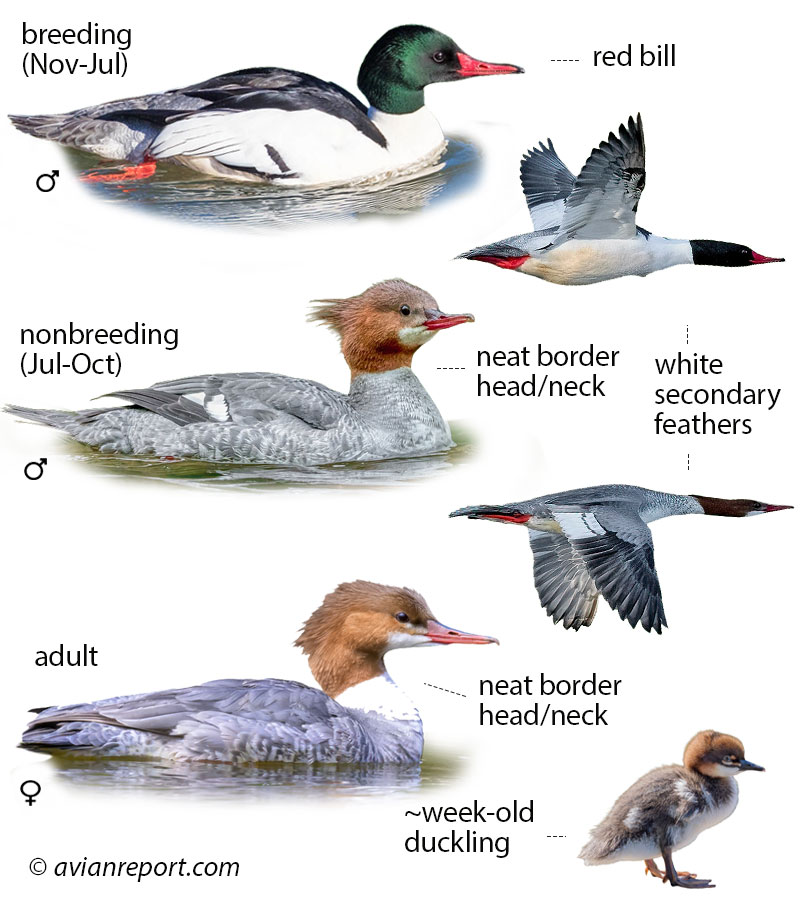
Length: 25 in , Weight: 54 oz, Wingspan: 34 in
Identification: Breeding Drake: gleaming white body, dark iridescent-green head, slender red bill. Hen: gray body, rusty-cinnamon head, short crest. Males wear nonbreeding plumage (late summer to mid-autumn) similar to female.
Compare: Breeding Drake Common Mergansers have white sides and a white breast whereas Drake Red-breasted Mergansers have gray sides and a cinnamon breast. Hen Common Merganser have a neat border (blended in Red-breasted) between cinnamon head and pale neck/breast. Learn the subtle field marks to distinguish the Female Common Merganser from the Female Red-breasted Merganser.
Behavior: Dive underwater to catch fish. Hen cares for chicks; Drakes gather in large flocks. Foraging: probe sediments/stones with serrated bill.
Flocking: Forms large flocks in winter on large inland reservoirs/rivers. Flocks may include other diving ducks (Bufflehead, goldeneyes). Up to 75 individuals.
Habitat: Northern forested habitats, large lakes, rivers. Winter: large lakes, rivers, reservoirs, coastal bays, estuaries.
Range: Breeds northern North America rivers/lakes. Winters southern/coastal regions, US states. The Common Merganser is widespread.
Status and Movements: The Common Merganser is a rare and localized winter visitor to South Carolina. Sightings are scarce, typically confined to large, fast-moving inland rivers or major reservoirs.
Movements: Winters on large lakes/rivers, moving to coasts/southern regions of range.
Diet: Fish, aquatic invertebrates (insects, mollusks, crustaceans, worms), frogs, small mammals, birds, plants.
Nest: Tree cavity (natural or woodpecker hole) or nest box. Hen uses wood chips/shavings, lines with breast down.
Breeding: Egg laying: mid Apr-early Aug | Clutch: 6-17 eggs | Broods: 1 | Eggs: White, creamy, or ivory yellow | Incubation: 28-35 days.
Lifespan: At least 13 years, 5 months.
Population: Global breeding population estimated at 1.9 million individuals.
Subgroup: Stiff-Tailed Ducks
The Stiff-Tailed Ducks are a small, distinctive group named for their unique, rigid tail feathers that are often held upright like a sail when the birds are at rest or displaying. These ducks are highly aquatic and arguably the most specialized diving ducks in North America.
They have compact bodies, thick necks, and legs positioned so far back that they are nearly incapable of walking on land. Consequently, they spend almost their entire lives on the water, where they dive frequently and expertly propel themselves using their large feet. In South Carolina, the group is represented almost exclusively by the Ruddy Duck, a relatively common winter visitor. The second species in this group, the tropical Masked Duck, an extremely rare and accidental visitor to the state.
Ruddy Duck (Oxyura jamaicensis)
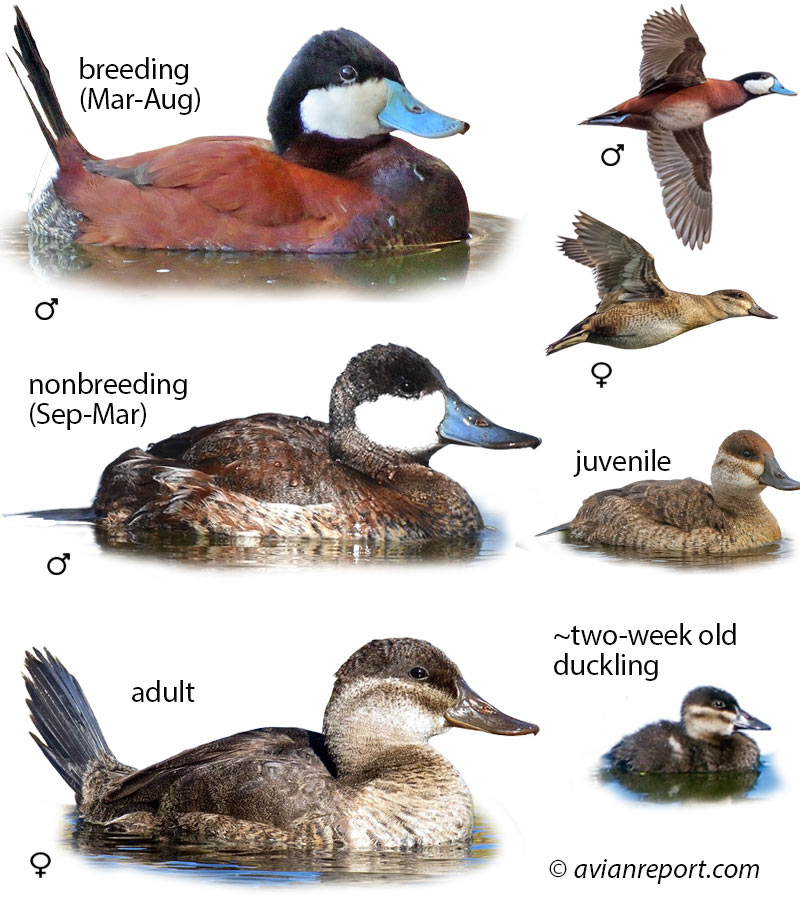
Length: 15 in, Weight: 20 oz, Wingspan: 23 in
Identification: Drake summer: chestnut body, sky-blue bill, white cheek, black cap. Winter Drake/hen: dull gray-brown, blurry cheek stripe. Compact, stiff tail often held upright.
Compare: Hen Black Scoters are larger and do not hold their tail upwards like Ruddy Ducks do. Hen Buffleheads are smaller.
Behavior: Dive for aquatic invertebrates. Forages mostly nocturnally. Highly aggressive, often fight others. Courtship: bill striking neck creates water bubbles.
Flocking: The Ruddy Duck is a reluctant flyer, typically seen alone or in small groups. When aloft, it flies low over water with rapid, stiff wingbeats in a direct path, preferring to dive when disturbed.
Habitat: Marshes, reservoirs, large lakes, prairie potholes, brackish bays, coastal estuaries, ponds.
Range: Breeds prairie pothole region/western US. Winters in the southern US, extending through Mexico to Central America.
Status and Movements: The Ruddy Duck is a common winter resident in South Carolina. This stiff-tailed diving duck is widespread on reservoirs and impoundments, present from late October to April.
Diet: Midge larvae, aquatic insects, crustaceans, zooplankton, worms, snails. Aquatic plants (pondweed, bulrushes), seeds.
Nest: Dry plant materials platform becomes bowl-like. Female weaves vegetation canopy over nest. Built 2–10 inches over water in cattails.
Breeding: Egg laying: N/A | Clutch: 3-13 eggs | Broods: 1-2 | Eggs: White/yellowish white, pebbly | Incubation: 20-26 days.
Lifespan: At least 13 years, 7 months.
Population: Global breeding population estimated at 1.3 million individuals.
GEESE OF SOUTH CAROLINA
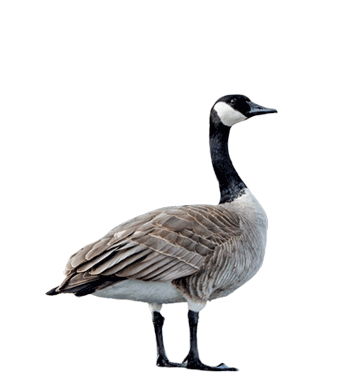
Geese are easily distinguished from ducks by their larger size, longer necks, and more upright posture. Unlike ducks, geese are primarily grazers, spending much of their feeding time on land, eating grass and other short vegetation. They also form strong, lasting pair bonds and travel in tight-knit family units, giving them a much different social structure than most ducks. South Carolina’s mild climate and southern location mean its goose diversity is markedly lower than in northerly states.
Canada Goose (Branta canadensis)
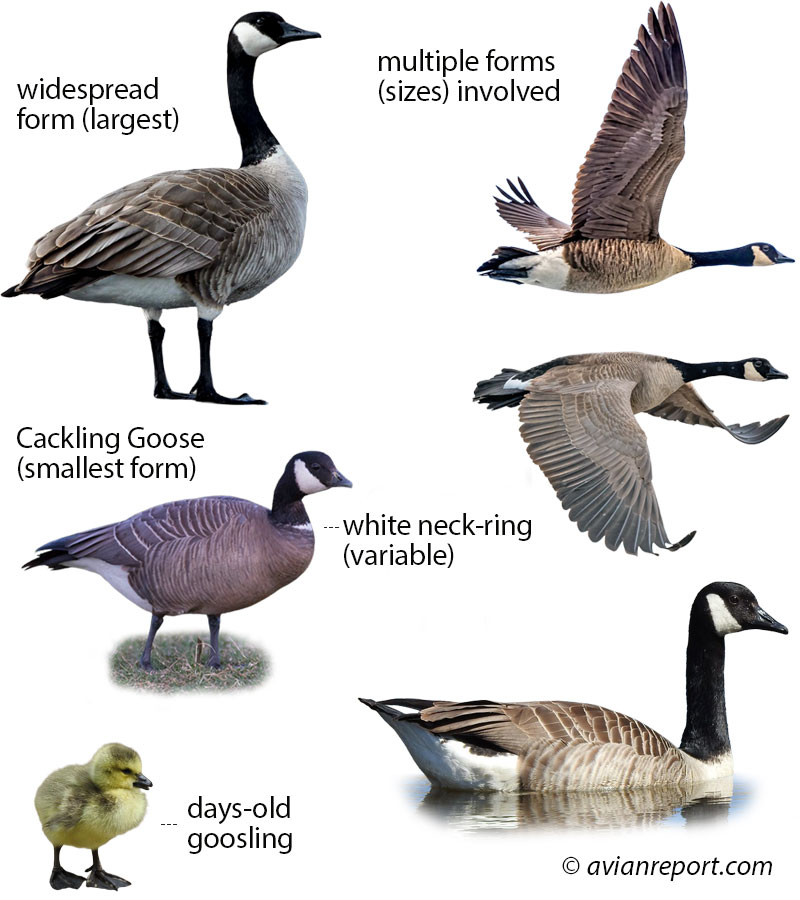
Length: 37 in, Weight: 212 oz, Wingspan: 58 in
Identification: Black head, white cheeks/chinstrap, black neck, brown back. Adults: tan breast.
Compare: Cackling Geese are smaller with a smaller bill and a shorter neck than Canada Goose. Cackling Geese also have a blockier head and steeper forehead than Canada Geese. Learn the subtle field marks to distinguish the Cackling Goose from the Canada Goose.
Behavior: Dabbling in water or grazing fields/lawns. Mate for life, pairs remain together year-round. Highly social; defend territory aggressively during breeding.
Flocking: The Canada Goose is highly gregarious, flying in large, organized V-formations or wavy lines with powerful, rhythmic wingbeats. Their flight is strong and purposeful, covering vast distances during migration at a steady pace.
Habitat: Lakes, rivers, ponds, marshes, yards, park lawns, farm fields, airports, golf courses.
Range: Widespread North American distribution. Migrates north/south; increasing resident populations in urban/suburban areas. The Canada Goose is common and widespread.
Status and Movements: The Canada Goose is a common year-round resident in South Carolina, bolstered by large numbers of winter migrants. It is abundant in parks and open aquatic habitats statewide.
Diet: Grasses, sedges, eelgrass, berries, seeds, agricultural grains (corn, wheat).
Nest: Large open cup on ground. Dry grasses, mosses, lichens, plant material. Lined with down/body feathers. Elevated site near water.
Breeding: Egg laying: Apr-mid-May | Clutch: 2-8 eggs | Broods: 1 brood | Eggs: Creamy white | Incubation: 25-28 days.
Lifespan: At least 33 years, 3 months.
Population: Population estimated at 7.1 million individuals.
Cackling Goose (Branta hutchinsii)
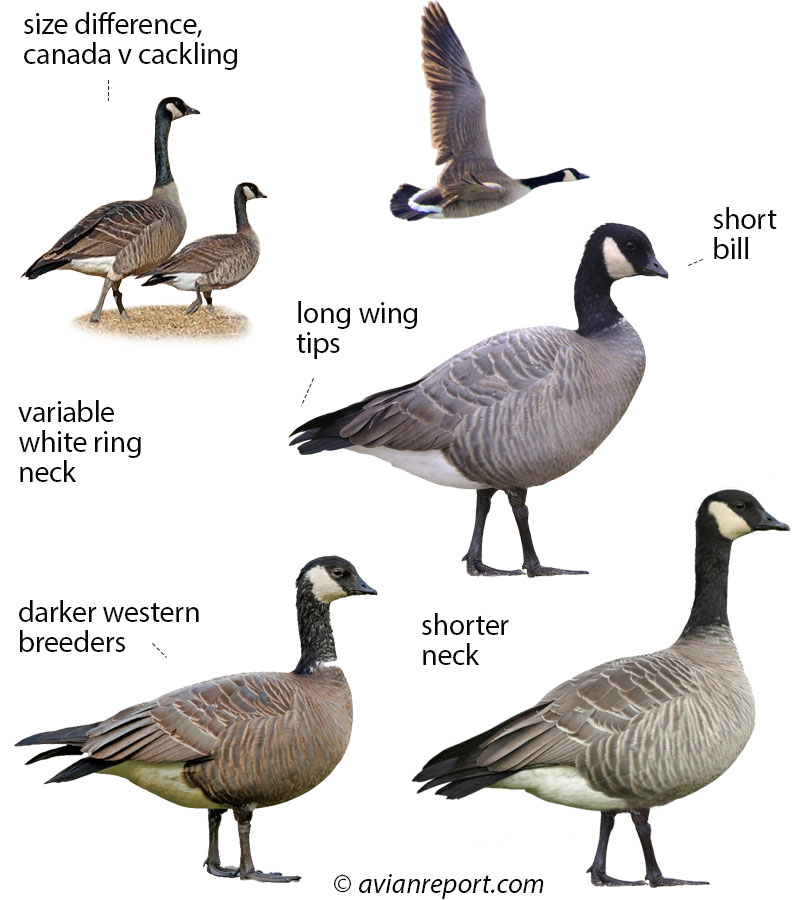
Length: 26 in, Weight: 70 oz, Wingspan: 43 in
Identification: Small, short-necked, round head, stubby-billed goose. Size and shape are best identification clues. Four subspecies involved.
Compare: Usually very similar in plumage to Canada Goose, but some Cackling have a more prominent white neck collar. Some are only slightly larger than a Mallard while some can be only slightly smaller than a Canada Goose. Learn the subtle field marks to distinguish the Cackling Goose from the Canada Goose.
Behavior: Dabbling in water or grazing fields/lawns. Pairs remain together year-round. Highly social.
Flocking: Associate in large flocks. Flocks assume V formation in flight. Flights involve loose family aggregations.
Habitat: Grassy field, rivers, ponds, marshes, yards, park lawns, farm fields.
Range: Each subspecies breed in separate regions of the far north in Canada and Alaska. Increasing resident populations in urban/suburban areas.
Status and Movements: The Cackling Goose is an uncommon winter visitor in South Carolina, arriving in late fall and departing by early spring. This diminutive goose is easily distinguished from Canada Geese by its smaller size.
Diet: Grasses, sedges, eelgrass, berries, seeds, agricultural grains.
Nest: Large open cup on ground. Dry grasses, mosses, lichens, plant material. Lined with down/body feathers.
Breeding: Egg laying: mid May-mid-July | Clutch: 2-8 eggs | Broods: 1 brood | Eggs: Creamy white | Incubation: 25-28 days.
Lifespan: At least 22 years, 8 months.
Population: Population estimated at 7.1 million individuals.
Snow Goose (Anser caerulescens)
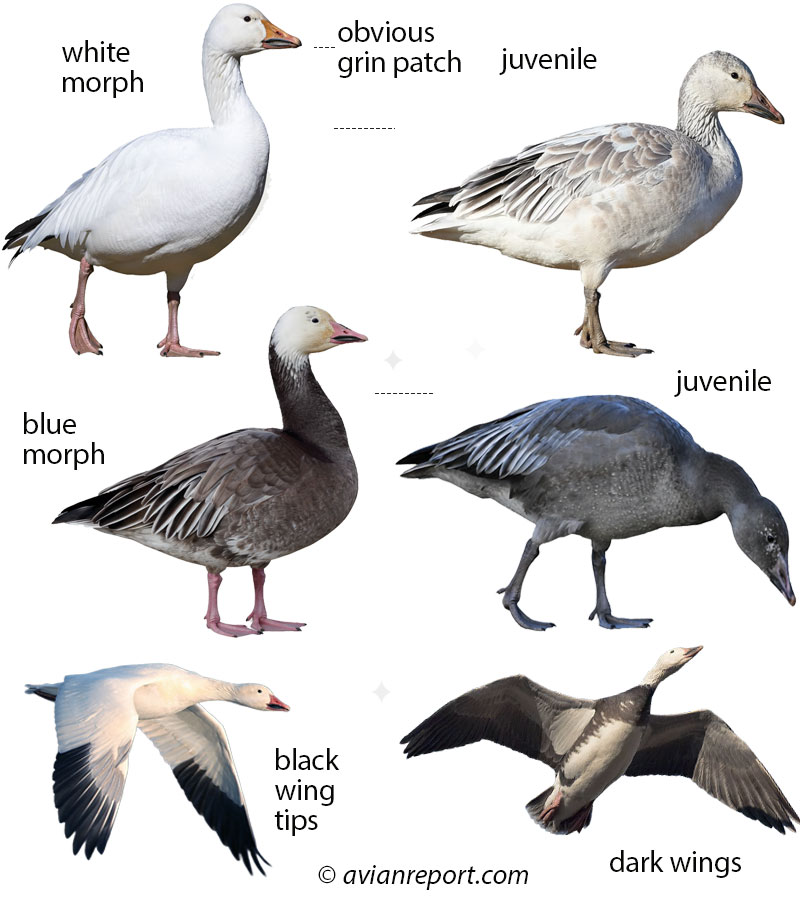
Length: 30 in, Weight: 86 oz, Wingspan: 54 in
Identification: White body, black wingtips visible in flight. Pink bill has dark “grin patch” (border along base of bill) Dark morph (“Blue Goose”): white face, dark brown body. Juveniles slightly smaller/grayer.
Compare: Ross’s Goose is smaller with a small stubby bill. Lacks or has little “grin patch”. Learn the subtle field marks to distinguish the Snow Goose from the Ross’s Goose.
Behavior: Forages digging up roots/tubers (muddy areas) or grazing. Highly social, forms immense flocks. Females incubate; males guard.
Flocking: The Snow Goose forms immense, often chaotic, flocks numbering in the thousands. Their flight is strong and erratic, often appearing as undulating masses or loose V-formations, creating a cacophony as they move purposefully.
Habitat: Arctic tundra, ponds, shallow lakes, coastal salt marshes, streams, agricultural fields, wetlands, grasslands, marine inlets.
Range: Breeds Canadian/Alaskan Arctic tundra. Winters US/Mexico coasts, inland areas, agricultural fields.
Status and Movements: The Snow Goose is an abundant winter resident in coastal South Carolina. Large flocks forage in salt marshes and agricultural fields, arriving in November and departing by March.
Diet: Grasses, sedges, rushes, forbs, horsetails, shrubs, willows, roots, tubers, seeds, agricultural grains.
Nest: Hen builds simple scrape, adds down, plant material (sea-lyme grass, eelgrass, willow, birch, seaweed).
Breeding: Egg laying: late May-early Jul | Clutch: 2-6 eggs | Broods: 1 brood | Eggs: Creamy white (staining dirty gray) | Incubation: 24 days.
Lifespan: At least 30 years, 8 months.
Population: Estimated at 16 million individuals.
Ross’s Goose (Anser rossii)
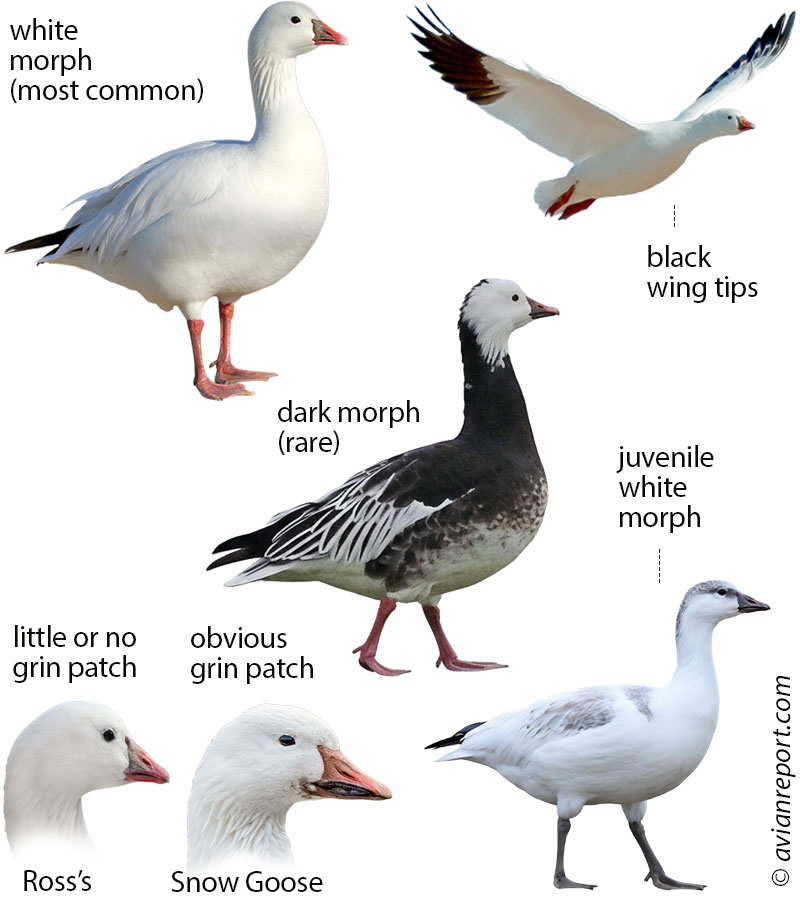
Length: 23.9 in, Weight: 46.6 oz, Wingspan: 45.1 in
Identification: Adults white, black wingtips, pink bill, no or little “grin patch”. Rare dark (“blue”) morphs exist. Immatures white, tinged gray, dark bill.
Compare: Snow Goose is larger with a larger bill and obvious grin patch. Learn the subtle field marks to distinguish the Snow Goose from the Ross’s Goose.
Habitat: Low arctic tundra, islands (nesting/breeding). Wetlands, meadows, agricultural fields, lakes, reservoirs (migration/winter).
Range: Breeds Low Arctic tundra (Canada). Winters California, New Mexico, Texas, Louisiana, mixing with other geese.
Status and Movements: The Ross’s Goose is an uncommon winter visitor to South Carolina, typically observed from late fall through early spring. It often associates with larger flocks of Snow Geese.
Diet: Plant matter: grasses, sedges, wild and domestic grains. Rarely digs roots/tubers like Snow Goose.
Nest: Large, soft bowl/depression on raised tundra, often island colonies. Grass, willow, moss, down-lined.
Breeding: Egg laying: Jun-late-Jul | Clutch: 2-6 eggs | Broods: 1 brood | Eggs: White, usually stained | Incubation: 19-25 days.
Lifespan: At least 22 years, 6 months.
Population: Estimated at 1.7 million individuals. The Ross’s Goose population was historically low but increased steeply due to climate change reducing snow cover.
Greater White-fronted Goose (Anser albifrons)
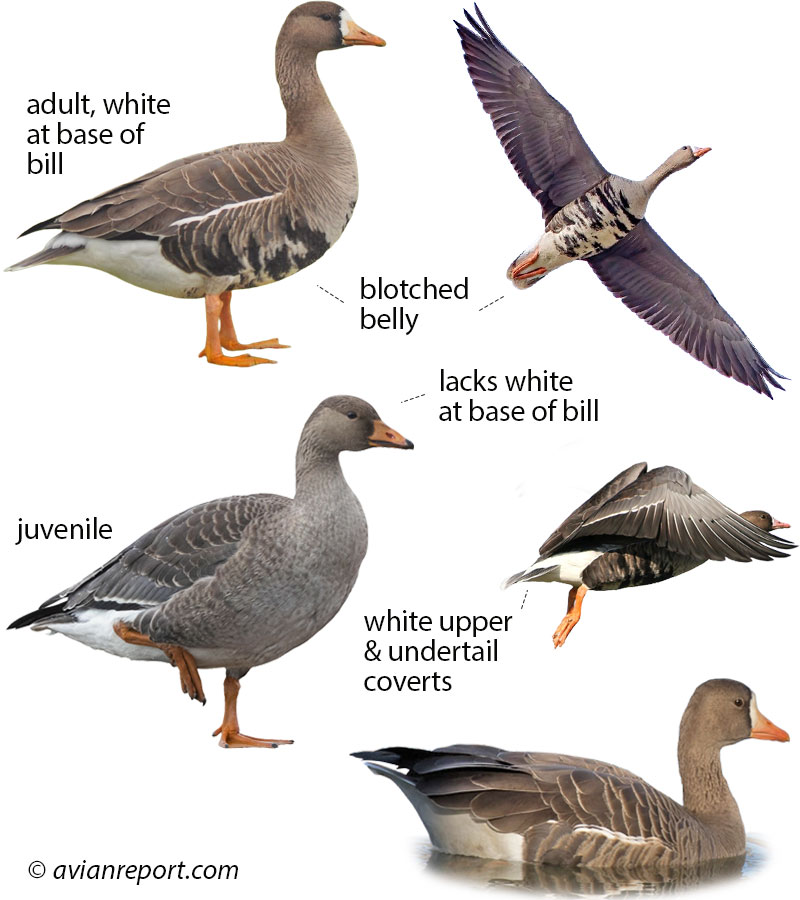
Length: 29 in, Weight: 93 oz, Wingspan: 53 in
Identification: Adults brown, white around the base of pinkish-orange bill, black belly barring, dark tail forms a “U” with upper/undertail coverts. Juveniles lack belly barring/white face feathers.
Compare: Canada Goose neck and head are black. Greater White-fronted Goose has the bill and legs pink-orange.
Behavior: Forages fields/lakes in groups. First to flush when disturbed. Forms long-term pair bonds, stay together year-round.
Flocking: The Greater White-fronted Goose gathers in moderate to large flocks, migrating in less rigid V-formations or undulating lines. Their flight is strong and direct, with deliberate wingbeats, maintaining a consistent speed over long distances.
Habitat: Tundra wetlands, rivers, ponds, sedge meadows, tidal mudflats, agricultural fields, lakes, marshes.
Range: Breeds tundra. Migrates/winters mainly west of Mississippi, California, Texas, Louisiana.
Status and Movements: The Greater White-fronted Goose is an uncommon but regular winter visitor to South Carolina. Small flocks appear sporadically among other geese, generally between November and February.
Diet: Sedges, grasses, berries, plant tubers (summer). Seeds, grain, grasses (winter).
Nest: Scrape in ground, densely covered by grass/sedge/dwarf shrubs near water/upland tundra. Lined with plant material/down.
Breeding: Egg laying: late May-early Jul | Clutch: 1-8 eggs | Broods: 1 brood | Eggs: White to tan, stained | Incubation: 22-27 days.
Lifespan: At least 25 years, 6 months.
Population: Estimated at 2.1 million individuals.
SWANS OF SOUTH CAROLINA
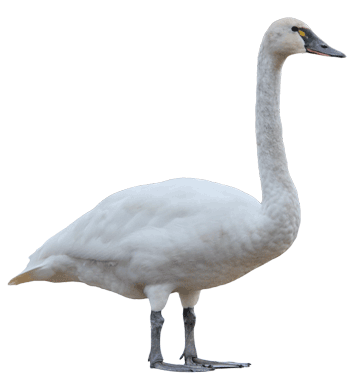
Swans are the largest species of waterfowl, easily distinguished from both ducks and geese by their truly massive size, pure white plumage, and exceptionally long necks. They are perhaps the most elegant of all water birds, known for their signature “S” curve of their necks when swimming. Unlike native swans, which are migratory, the introduced Mute Swan is primarily an ornamental species, often found on private and public ponds throughout South Carolina.
Tundra Swan (Cygnus columbianus)
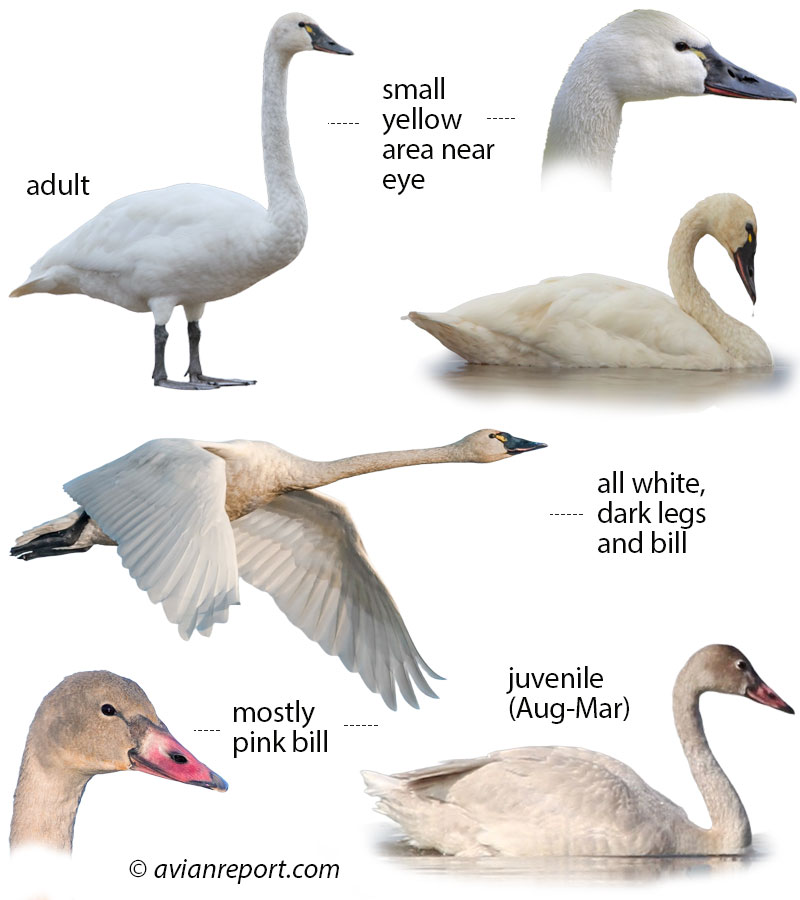
Length: 52 in, Weight: 252 oz, Wingspan: 66 in
Identification: Entirely white plumage, black bill, usually yellow spot near the eye. Neck straight. Immature gray-tinged on wings/head/neck.
Compare: Most Trundra Swans have a yellow spot near the eye in contrast to an all-black bill of the Trumpeter Swan, which is larger in size. The border separating the bill and forehead is “V” shaped in Trumpeter Swan and more “U” shaped in Tundra Swan. Learn the subtle field marks to distinguish the Trumpeter Swan from the Tundra Swan.
Behavior: Form lifelong pairs, feed/roost together year-round. Tip up for submerged vegetation. Pairs defend territory.
Flocking: Forms large, gregarious flocks when not breeding. Fly with necks outstretched; wings make characteristic whistling sound. Flocks forage/roost together.
Habitat: Arctic tundra, river deltas, pools, lakes, ponds, estuaries, coastal waters, agricultural fields.
Range: Nests Arctic tundra (Alaska/Canada). Winters US coastal/inland waters.
Status and Movements: The Tundra Swan is an uncommon winter resident in selected locations inSouth Carolina. Flocks gather in wetland and fields, arriving in fall and departing by early spring.
Diet: Plant matter, tubers, stems, leaves, seeds, pondweed, sedges, algae, mollusks, arthropods, agricultural grains (corn/soybeans/rice).
Nest: Mound of vegetation (grasses/sedges/lichens). Built on island or elevated tundra ridge near large water body.
Breeding: Egg laying: May-mid-Jul | Clutch: 3-5 eggs | Broods: 1 brood | Eggs: Creamy white, stained tan | Incubation: 31-32 days.
Lifespan: At least 23 years, 7 months.
Population: Population estimated at 280,000 individuals.
Mute Swan (Cygnus olor)
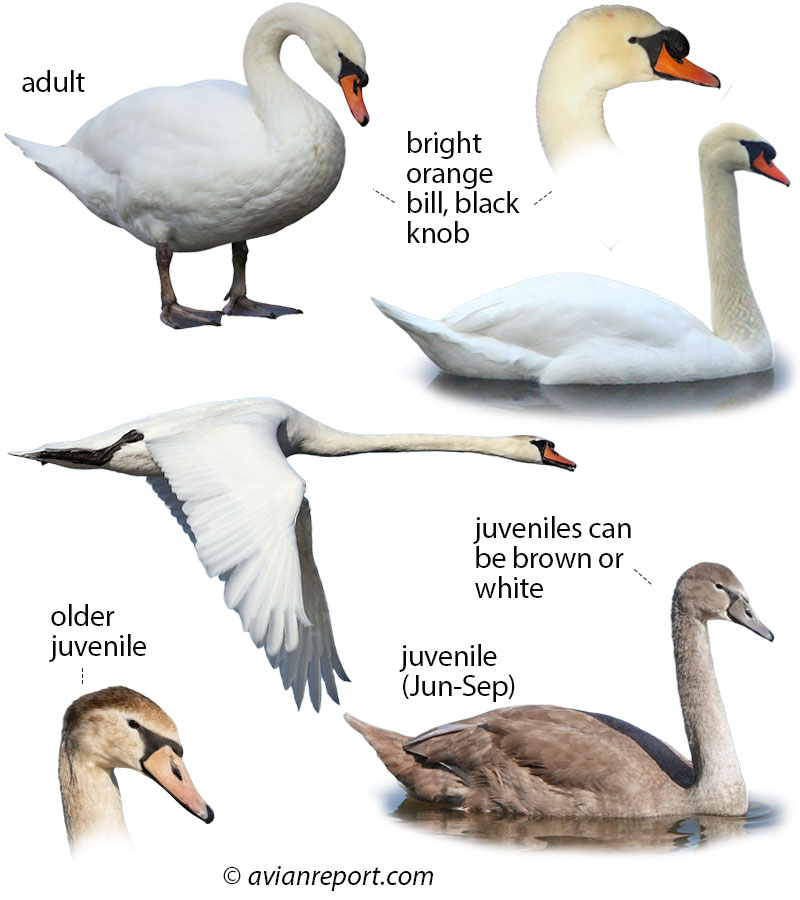
Length: 55 in, Weight: 349 oz, Wingspan: 88 in
Identification: Entirely white plumage. Orange bill with a black base/knob (knob swells in breeding male). Neck usually curved into an S. Juveniles dusky gray-brown.
Compare: Tundra Swans are smaller than Mute Swans with a black (not orange) bill. They often hold their neck straighter than Mute Swans.
Behavior: Swims with wings slightly raised. Feeds grazing underwater vegetation, raking bottom with feet. Extremely aggressive, attacks intruders.
Flocking: The Mute Swan often flies in pairs or small family groups, sometimes forming larger winter flocks. Their powerful, direct flight features slow, deep wingbeats producing a characteristic humming sound, moving steadily in loose lines.
Habitat: Urban lakes, farm ponds, rivers, estuaries, bogs, creeks, streams, embayments.
Range: Nonnative. Established in the Northeast, Midatlantic, Great Lakes, Pacific Northwest US. The Mute Swan is widespread across these areas.
Status and Movements: The Mute Swan is a localized, non-native resident in South Carolina. Populations are small, found primarily on municipal ponds and certain coastal lagoons year-round.
Diet: Aquatic vegetation (eelgrass, pondweeds, algae, flowering grasses, grains), frogs, tadpoles, fish, snails, mollusks, insects.
Nest: Large platform of vegetation (twigs, reeds, grasses). Built on peninsula/shoreline/island. Lined with grass/down.
Breeding: Egg laying: late Mar-early May | Clutch: 2-5 eggs | Broods: 1 brood | Eggs: Blue-green (changes to white/chalky) | Incubation: 34-41 days
Lifespan: At least 26 years, 9 months.
Population: Global population estimated at 400,000 individuals.
The Urban Mix: Feral and Domestic Waterfowl of South Carolina
In South Carolina’s municipal ponds, retention ponds, and urban lakes, birders and casual observers often encounter waterfowl that do not fit the description of wild, native species. This group, labeled Feral and Domestic Waterfowl of South Carolina, consists of birds that have either escaped captivity, been intentionally released, or are descendants of those birds.
Identification Challenges
The presence of domestic stock, particularly the Mallard and the non-native Muscovy Duck, leads to two major identification hurdles:
- Variable Plumage: Domestic birds, descended from wild stock, have been bred for varied colors (white, black, crested, etc.). These individuals often show exaggerated features or color patterns never found in wild populations.
- Hybridization: Domestic birds readily interbreed with wild counterparts and with other domestic strains, resulting in a large number of hybrids. These birds often exhibit a confusing mix of physical traits that makes tracing their parent species virtually impossible.
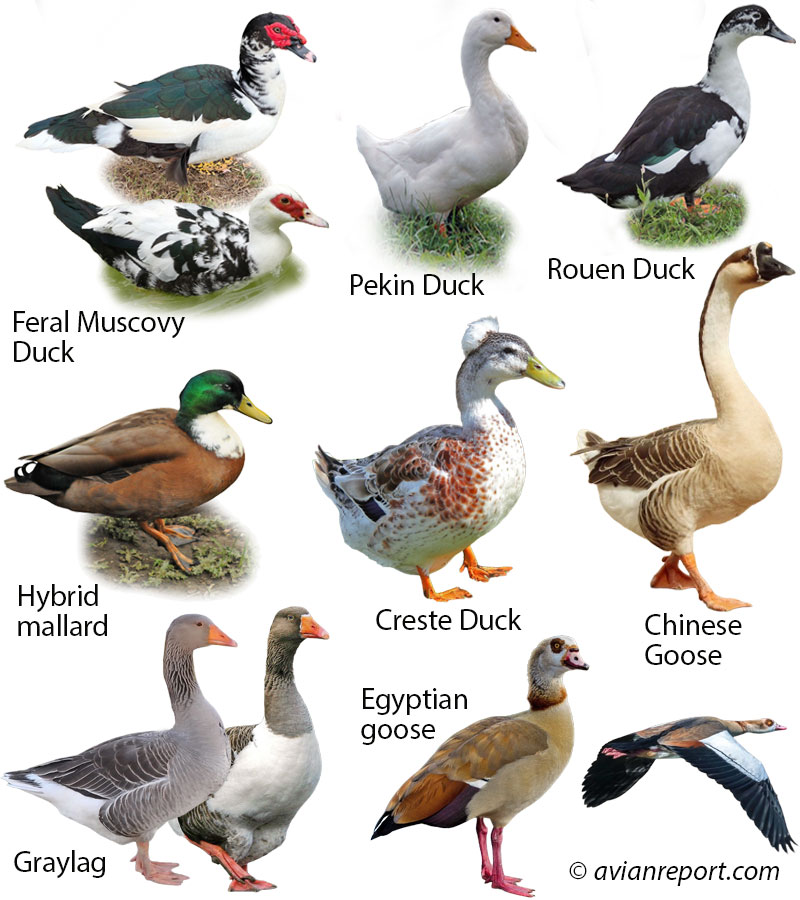
Feral Muscovy (Cairina moschata): Large, long-bodied duck with a carunculated (red, warty) face mask. Plumage is highly variable (black, white, piebald) but retains the large white wing patch.
Pekin Duck (Domestic Mallard): Large and heavy, entirely white body; bright yellow-orange bill and legs.
Rouen Duck (Domestic Mallard): Very large and heavy version of the Mallard; often has the same rich brown and green plumage.
Hybrid Mallards: Exhibits a confusing mix of traits. Look for: Patches of pure white on a normally-colored duck; a green head with a speckled or streaked breast; or odd bill/leg colors.
Crested Duck (Domestic Mallard): Any color (often white, piebald, or mottled) but defined by a distinct puff of feathers on the top of the head.
Chinese Goose (Anser cygnoides domesticus): Recognized by the distinctive large, raised knob or ‘knob-bill’ at the base of the forehead, just above the bill. Usually white or brown/gray, with a long, slender neck.
Graylag (Barnyard) Goose (Anser anser): Large, bulky gray or white goose with thick neck, stout legs, and a prominent orange or pink bill. Often appears very heavy-bodied and flightless.
Egyptian Goose (Alopochen aegyptiaca): Large, goose-like bird with pink legs/bill and a conspicuous dark brown eye patch (goggles). The body is beige, gray, and brown with a unique white-and-black wing pattern visible in flight.
The most confusing identification issues in South Carolina’s urban environments stem from non-native species like the Feral Muscovy Duck and the various domestic Mallard hybrids. The image above features the nine most common non-native species you may encounter in South Carolina’s city parks, retention ponds, and suburban waterways. These non-native ducks and geese are the primary cause of ID confusion in the State.
For a complete North American guide covering the lineage, identification keys of these confusing domestic and invasive species, please consult our in-depth article: Beyond the Mallard: A North American Guide to Urban Ducks, Geese, and Hybrids.
South Carolina Wading Bird Hotspots: Top 5 Locations for Viewing
South Carolina’s diverse aquatic habitats, ranging from vast coastal estuaries to inland freshwater impoundments, create ideal conditions that support substantial concentrations of ducks and geese. These sites offer reliable viewing opportunities, especially during the peak winter migration season when diversity is highest.
Location List
Donnelley Wildlife Management Area (WMA): Located in the Lowcountry near Green Pond, this area features managed rice fields, freshwater impoundments, and cypress swamps. It is renowned for large wintering numbers of Northern Pintail, Green-winged Teal, and Shoveler.
SCDNR Yawkey Wildlife Center: Situated on the coast near Georgetown, this private preserve encompasses extensive brackish marsh and managed wetlands. It provides critical habitat for Mottled Ducks, Wigeon, and the occasional Tundra Swan during cold snaps.
Huntington Beach State Park: Found on the Atlantic coast near Murrells Inlet, the park’s jetty, freshwater lake, and saltwater marsh attract a variety of species. Look for Red-breasted Merganser, Bufflehead, and Redhead near the coast.
Lake Murray: This large reservoir located near Columbia in the Central Midlands offers expansive open water and forested coves. During winter, it attracts flocks of diving ducks, including Lesser Scaup, Canvasback, and Ring-necked Ducks.
Santee National Wildlife Refuge (NWR): Located in the central part of the state on Lake Marion, this refuge manages vast freshwater impoundments and cypress-tupelo swamps. It is a major wintering ground for Wood Ducks, Gadwall, and Snow Geese.
Threats and Conservation Status of South Carolina Waterfowl
The conservation status of South Carolina waterfowl varies widely, with some species experiencing stable or increasing populations, while others face steep declines and require significant management intervention. Conservation assessments, such as those provided by Partners in Flight, often utilize the Continental Concern Score (typically rated out of 20), where lower scores indicate a species of lower conservation concern.
Species of High Conservation Concern and Decline in South Carolina
Several waterfowl species are facing significant population declines, resulting in high conservation rankings:
- Red Alert Tipping Point Species: The 2025 State of the Birds report lists the Mottled Duck as Red Alert Tipping Point species, signifying that it has lost more than 50% of their population in the past 50 years, maintain perilously low numbers, and exhibit steep declining trends. The Mottled Duck experienced a cumulative decline of 72% between 1966 and 2023.
Key Threats to Waterfowl Populations
Conservation efforts focus on mitigating several major threats spanning habitat loss, pollution, biological pressures, and climate change:
1. Habitat Loss and Degradation
Wetland loss and degradation due to human development, agricultural practices, and resource extraction represent a widespread challenge.
- Wetland Drainage and Conversion: For the Mottled Duck, wetland drainage in South Carolina pose serious conservation issues.
2. Biological and Ecological Threats
- Hybridization: Hybridization with the ubiquitous Mallard poses a threat to related species, most notably the Mottled Duck. This problem is particularly pronounced in South Carolina, where hybridization has produced “Muddled Ducks,” and is estimated to affect 10% of the Mottled Duck population there. Mallards may also contribute to the decline of the American Black Duck by displacing these shyer ducks from habitats and interbreeding with them.
Read more about the Conservation Status of North American Ducks, Geese, and Swans.
Conclusion:
This guide provide the tools to navigate the diverse world of South Carolina waterfowl. It provides the foundation for confident identification, covering native, migrants, and addressing confusing urban species. We encourage you to use the information provided here as you explore the state.
Photo Credits:
The photographic material used in this guide was made available on various websites. Many thanks to Andrew Morffew, Mark Mochell, Elizabeth Milson, Emily Chen, Dennis Church, Wendy Miller, Ken Slade, John Benson, Mick Thompson, Steve Guttman, Nicole Beaulac, Andy Reago, Chrissy McLaren, Garry C., Shawn Taylor, Steve Kersting, Gary Leaven, Vicky DeLoach, Don Hoechlin, Tom Murray, Kevin Krebs, Deborah Freeman, Kenneth Cole-Schneider, Doug Greenberg, Ian Preston, Brian Garrett, John Strung, Becky Matsubara, Judy Gallagher, Bob Jensen, Veit, Sand Diego Zoo, David Inman, Dan Mooney, Ian Preston, Lloyd Davis, Denis Fournier, Gregory Heaton, Greg Lavaty, Dona Hilkey, Alain Doyle, Aaron Maizlish, Ashley Tubs, Richard George, Ethan Gosnell, Nick, , Steve Valasek, Mitch Walters, , and Julio Mulero.
Voices:
Most recordings were obtain from: (Xeno-canto https://xeno-canto.org/)
References and Sources:
- Allaboutbirds.org
- eBird. (https://ebird.org/)
- Birds of the World: https://birdsoftheworld.org/bow/home
- Gill, Frank B., 1994. Ornithology – 2nd Edition, W. H. Freeman and Company.
- Sibley, David, 2000, The Sibley Guide to Birds. Alfred A. Knopf, Publisher.
- Species Longevity Data: United States Geological Survey (https://www.usgs.gov/)
- The Sibley Guide to Bird Life and Behavior, 2001. Chris Elphick, John Dunning, and David Sibley (eds). Alfred A. Knopf, New York.
Author:
