
Discover the wetland birds of the Province of Manitoba with this identification guide featuring 51 species plates. To simplify identification, we’ve categorized resident and migrant birds by size—from massive pelicans to secretive rails. Grouping these birds by size allows you to quickly recognize key traits, habitats, and behaviors across Manitoba’s wetlands, riparian zones, and coastal marshes.
How to use this Guide
Click on any of the four size groups below (Crane, Stork, Egret, and Gallinule) to explore the species included in the category. You can also use the Table of Contents below this section to browse the entire guide.
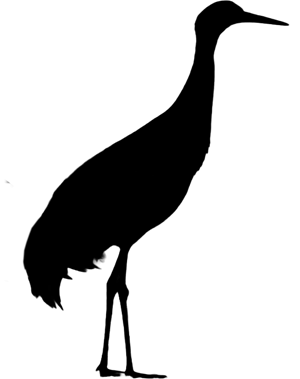
>10 lb
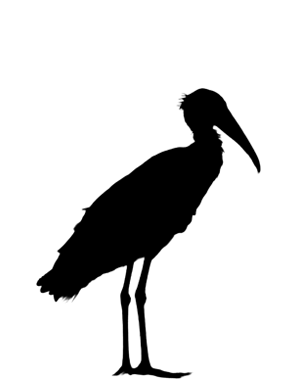
10-5 lb
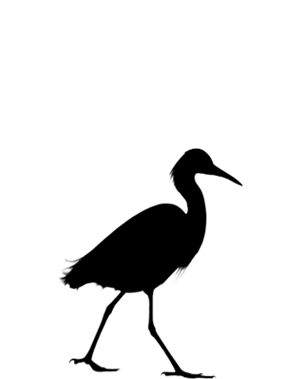
5-1 lb
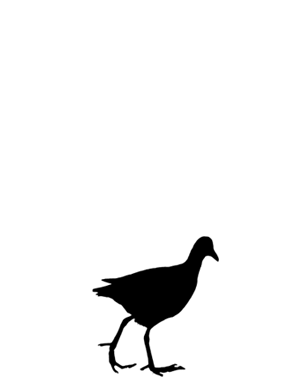
<1 lb
While weight offers a useful starting point, appearances can be deceiving—plumage, body shape, and leg length often make a bird look larger or smaller than its true size.
- How to use this Guide
- Birds of Manitoba's Marshes, Swamps, and Coastal Wetlands
- Very Large Wetland Birds of Manitoba (>10 lb)
- Large-Wetland-Birds of Manitoba (5-10 lb)
- Medium-sized Wetland Birds of Manitoba (4–1 lb)
- Small Wetland Birds of Manitoba (< 1 lb)
- Foraging Strategy and Habitat use as tools to Identify Manitoba Wetland Birds
- Manitoba Wetland Bird Hotspots: Top 5 Locations for Viewing
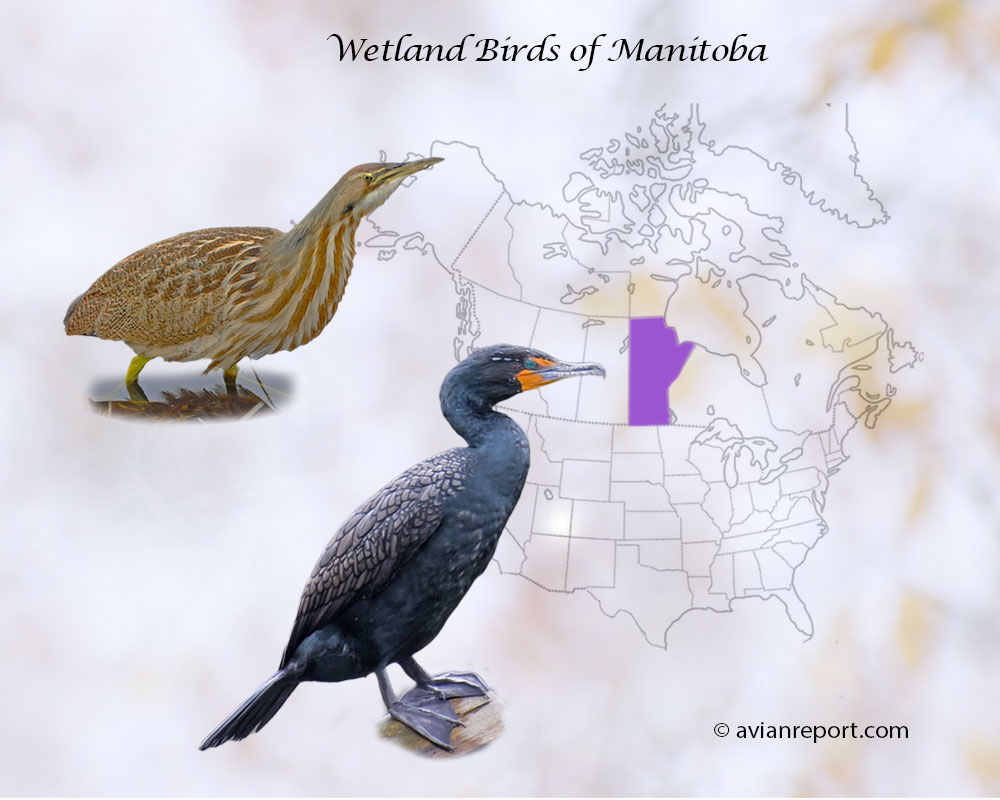
Manitoba Wetlands
The Province of Manitoba contains approximately 22 million hectares (54 million acres) of wetlands, which accounts for more than 33% (one-third) of the province’s total area.
Statistics of Interest
- Staggering Carbon Sequestration Power: Manitoba’s boreal wetlands act as a colossal global carbon sink, locking away between 18.5 and 27.9 billion tonnes of carbon within their rich, saturated soils.
- The Intercontinental Waterfowl Flyway: Renowned wetland complexes like the Oak Hammock Marsh and Delta Marsh host over 300 distinct bird species. During peak migration seasons, upwards of 100,000 waterfowl individuals pass through these protected habitats in a single day.
- Massive Habitat Footprint: The province’s vast web of peatlands, bogs, and marshes is so extensive that its boreal wetland system covers roughly 10 times more area than all of Manitoba’s agricultural croplands combined.
- Ongoing Conservation Threats: Despite extensive environmental protections and new boreal codes of practice, southern agricultural zones face continued strain, with Manitoba losing an estimated 3.6 hectares (9 acres) of wetlands every single day to development and drainage.
Wetlands constitute less than 5% of the land area of the contiguous United States.
More about wetlands: Understanding Wetlands: An Overview for State Bird Guides
Birds of Manitoba’s Marshes, Swamps, and Coastal Wetlands
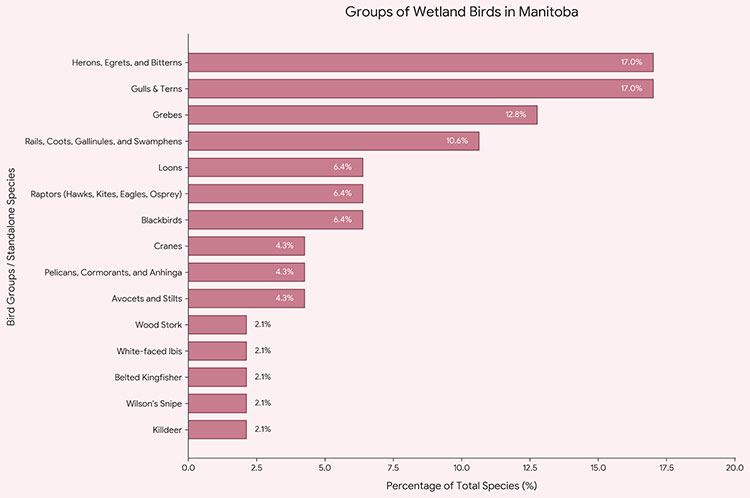
This guide highlights the 51 bird species most closely tied to Manitoba’s water systems. It features classic wading species—herons, egrets, and ibises—along with other wetland regulars like loons, grebes, coots, rails, and snipes.
While these species are the focus of this guide, they are rarely the only birds you’ll find in the marsh. For a broader overview of the species commonly seen in open water, shallows, and grassy edges, explore our Guide to the Ducks, Geese, and Swans of Manitoba.
The breakdown of wetland birds by group is as follows:
Very Large Wetland Birds of Manitoba (>10 lb)
This category includes the true giants of Manitoba’s wetlands. Though few in number, these species command attention with their size, broad wingspans, and body mass. Individuals in this group range from approximately 11 to over 16 pounds, making them the heaviest regularly occurring wetland birds in the state. Their size, slow wingbeats, and visual presence distinguish them clearly from all other waterbirds.
Whooping Crane
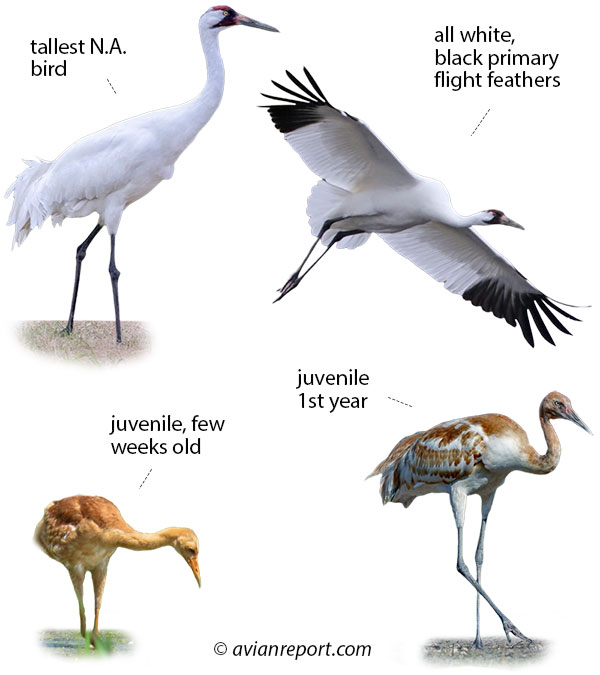
Length: 52″ | Wingspan: 87″ | Weight: 15 lb
Identification: Adults are bright white with a crimson crown, and black wingtips visible in flight. Immatures are whitish below with mottled brownish-rusty plumage above.
Habitat: The Whooping Crane (Grus americana) favors open habitats, such as marshes, shallow wetlands, river flats, croplands, and grasslands.
Status and Movements: The Whooping Crane is a rare transient migrant in Manitoba, present primarily from May and September through October. It passes quickly through the province between its northern breeding grounds and southern wintering areas.
Behavior: Forages by pecking, probing, and gleaning. Monogamous, forming lifelong pairs. Courtship includes elaborate dancing.
Diet: Generalist, including Invertebrates, small vertebrates, tubers, berries, waste grains, blue crabs, and clams.
Nest: A mound of vegetation, 2–5 ft across, flat or shallowly concave, built in shallow water on islands.
Breeding: Season: January-May | Clutch: 1–3 light brown with brown splotches eggs | Incubation: 29–31 days | Hatchlings: able to walk within hours.
Lifespan: At least 28 years, 4 months.
How many are there? ~802 individuals in 2021, including 136 in captivity.
Conservation Status: Federally endangered.
American White Pelican
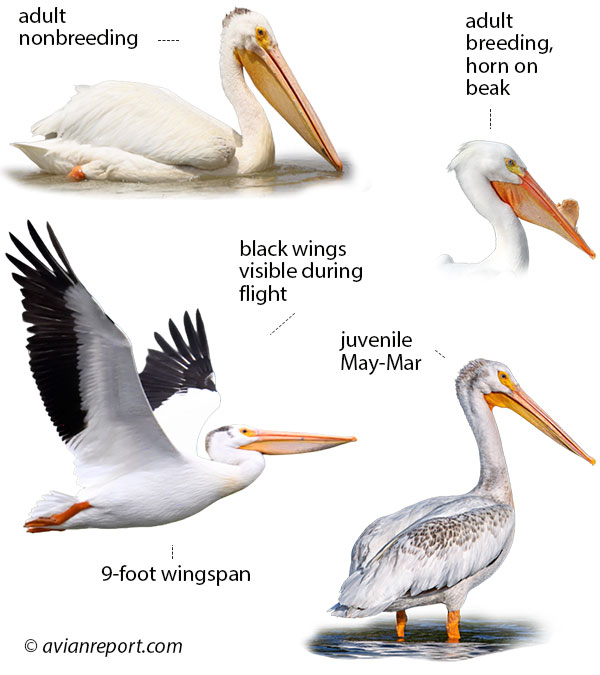
Length: 62″ | Wingspan: 108″ | Weight: 16.5 lb
Silent
Identification: Adult: Snowy white with black flight feathers visible in flight. Yellow-orange bill and legs; breeding adults show a yellow chest patch and grow a bill horn. Immature: Mostly white with dusky head, neck, and back.
Habitat: The American White Pelican (Pelecanus erythrorhynchos) forages in shallow inland marshes, lake and river edges, estuaries, sloughs, and inlets.
Status and Movements: The American White Pelican is a common summer resident and transient in Manitoba, present from May through September. It nests colonially on isolated islands in large lakes across the southern and central regions..
Behavior: Forages by dipping bill at the water’s surface to scoop fish; also upends like dabbling ducks. Known for cooperative foraging, driving fish toward shore. Highly gregarious.
Diet: Primarily small fish, but also salamanders, tadpoles, crayfish, and game fish.
Nest: A shallow depression on the ground, sometimes lined with vegetation. Nests in colonies.
Breeding: Season: April-late August | Clutch: 2 chalky white eggs | Incubation: ~30 days | Nestling period: 63–70 days.
Lifespan: At least 23 years, 6 months.
How many are there? Global population estimated at ~450,000.
Conservation Status: Low conservation concern.
Sandhill Crane
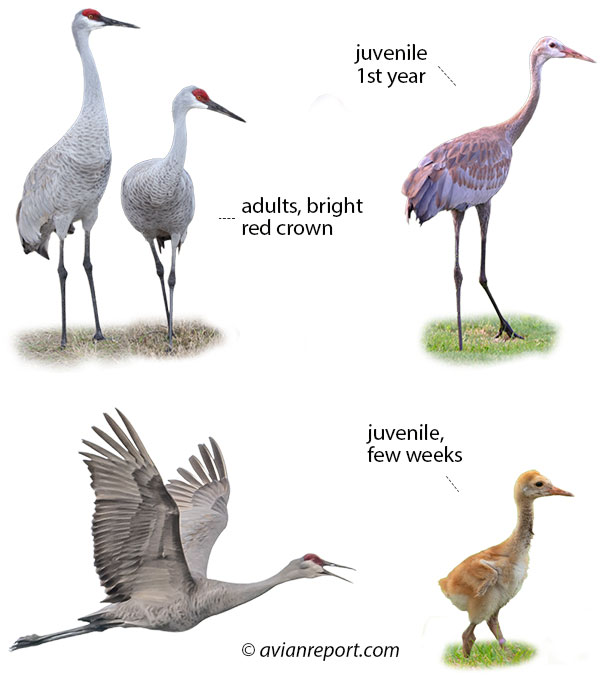
Length: 45.6″ | Wingspan: 77″ | Weight: 11 lb
Identification: Adult: Slate gray with rusty wash, pale cheek, red crown, black legs. Juvenile: Gray and rusty brown, lacking pale cheek and red crown.
Habitat: The Sandhill Crane (Antigone canadensis) forages in open wetlands, prairies, bogs, lakes, croplands.
Status and Movements: The Sandhill Crane is a common summer resident and abundant transient in Manitoba, present from April through October. It breeds in extensive northern bogs and congregates in massive staging flocks in southern agricultural areas during autumn.
Behavior: Forages for food by gleaning/probing. Social. Pairs perform elaborate dances.
Diet: Sandhill cranes feed on invertebrates, small vertebrates, seeds, berries, tubers.
Nest: Cup-shaped structure of dominant vegetation, 30–40 in across, on the ground.
Breeding: Season: Jan to May. Breeding age: 2–7 years | Clutch: 1–3 pale brownish yellow/gray markings eggs | Broods: 1 | Incubation: 29–32 days | Offspring dependency: 9–10 months.
Lifespan: At least 37 years, 3 months.
How many are there? The global population of Sandhill Cranes is estimated to be between 650,000 and over 800,000 individuals.
Conservation Status: Low concern.
Common Loon
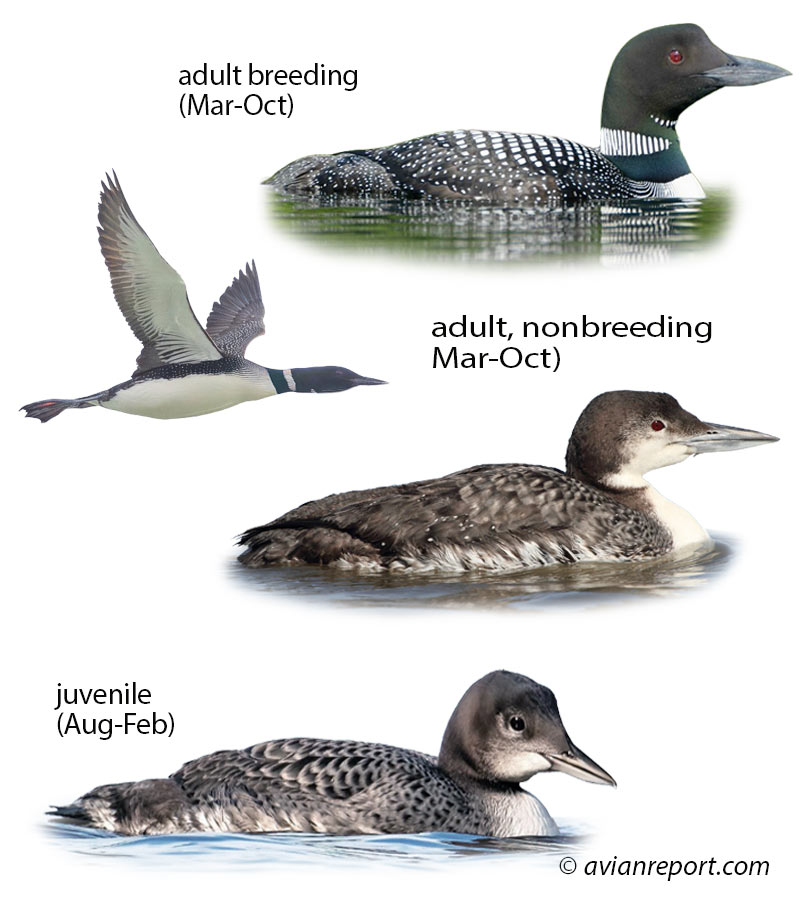
Length: 31″ | Wingspan: 46.9″ | Weight: 10.6 lb
Identification: Breeding: black head, spotted back, white breast. Nonbreeding: gray back/head, white throat. Juvenile: like nonbreeding with scalloping. Large, rounded head, dagger-like bill.
Habitat: The Common Loon (Gavia immer) favors clear freshwater lakes, ponds, islands, seacoasts, reservoirs, estuaries, rivers.
Status and Movements: The Common Loon is a common summer resident and transient in Manitoba, present from May through October. It breeds widely on clear, deep lakes throughout the boreal forest region before departing for coastal wintering grounds.
Behavior: Stealthy divers, catch fish underwater. Monogamous pairs; vocal nocturnal choruses. Males yodel for territory.
Diet: Common loons feed on fish, perch, sunfish, croaker, silversides, crustaceans, snails, leeches, aquatic insect larvae.
Nest: Mound of dead sedges and grasses on protected lakeshores or islands near water.
Breeding: Season: May-Oct | Clutch: 1-2 brown, with dark splotches eggs | Broods: 1 | Incubation: 26-29 days | Nestling: 1-2 days.
Lifespan: At least 29 years, 10 months.
How many are there: There are ~1.2 million Common Loons globally.
Conservation Status: Low Concern.
Large-Wetland-Birds of Manitoba (5-10 lb)
This category includes four species weighing between approximately 5 and 10 pounds. Members of this group are substantial in size and often appear even larger due to elongated legs and tall, upright posture. Their height and broad wingspans contribute to a strong visual presence in wetland habitats, placing them clearly above medium-sized species but below the heaviest wetland birds in the state.
Bald Eagle
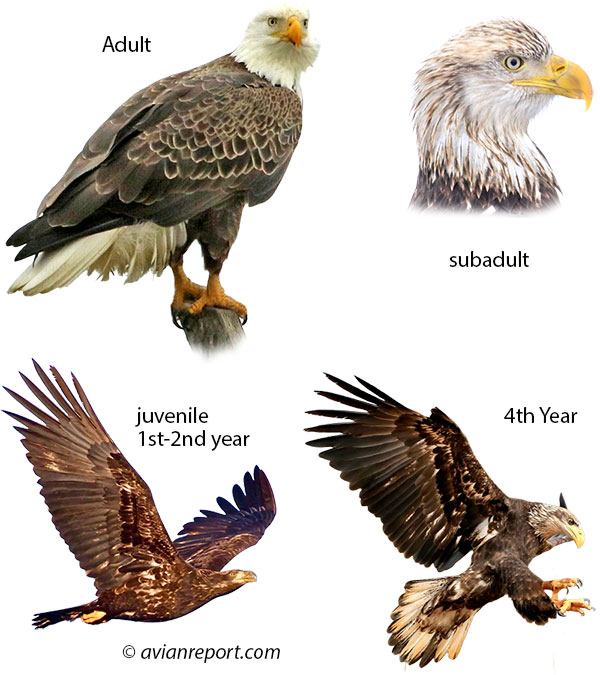
Length: 31″ | Wingspan: 80″ | Weight: 9.5 lb
Identification: Striking white head and tail contrasting with a dark brown body and wings, plus yellow legs and bill. Immatures are dark with mottled brown-and-white, and take about five years to acquire full adult plumage.
Habitat: The Bald Eagle (Haliaeetus leucocephalus) is found in forests near large bodies of water with tall mature trees for nesting. In winter, they use dry open uplands as well.
Status and Movements: The Bald Eagle is a common summer resident and transient in Manitoba, present from April through November. It nests near large lakes and river systems, with few individuals remaining into winter near open water.
Behavior: Powerful fliers that hunt, steal prey from other animals, scavenge carrion, and even feed on garbage.
Diet: Primarily fish, but also birds, reptiles, amphibians, crabs, rabbits, and muskrats.
Nest: Bald Eagles have the largest nests of any North American bird. Nests are placed in tall trees, cliffs, or occasionally on the ground.
Breeding: Season: December-mid-May (South) | Clutch: 1–3 dull white, usually unmarked eggs | Broods: 1 | Incubation: 34–36 days | Nestling period: 56–98 days.
Lifespan: At least 38 years.
How many are there? Over 316,000 individuals in the U.S. Lower 48.
Conservation Status: Low Concern.
Great Blue Heron
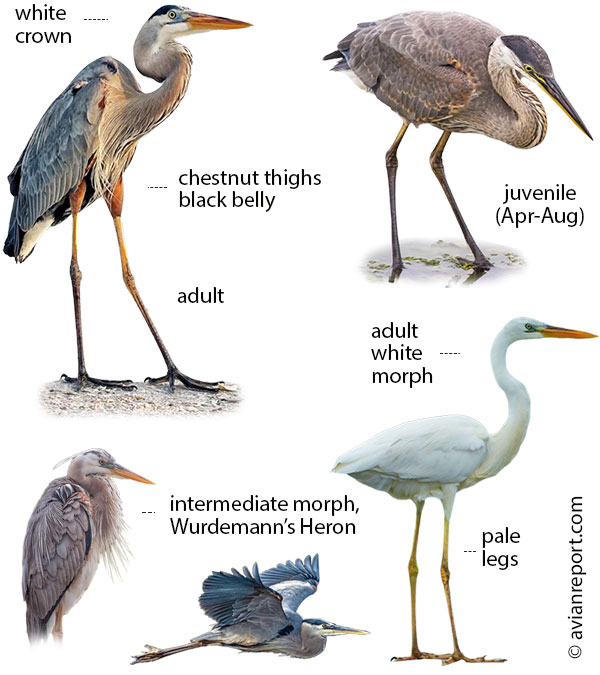
Length: 46″ | Wingspan: 72″ | Weight: 5.3 lb
Identification: Largest North American heron with long legs, S-shaped neck, and dagger-like bill. Blue-gray plumage, black eye stripe, and shaggy head. A white morph occurs in the Florida Keys.
Habitat: The Great Blue Heron (Ardea herodias) favors fresh, saltwater, brackish wetlands, ditches, and farmland.
Status and Movements: The Great Blue Heron is a common summer resident in Manitoba, present from May through September. It nests in colonial rookeries in tall trees near productive lakes, rivers, and southern wetlands.
Behavior: Hunts by standing still or stalking in shallow water. Flies with neck tucked and legs trailing. Defends feeding territories.
Diet: Fish, amphibians, reptiles, mammals, insects, and birds. Prey grabbed or impaled with bill.
Nest: Great Blue Herons build a stick platform in trees; also on ground, bushes, or man-made structures. Often in colonies.
Breeding: Season: March–August | Clutch: 2–6 pale blue eggs | Broods: 1–2 | Incubation: 27–29 days | Nestling: 49–81 days.
Lifespan: At least 24 years, 6 months.
How many are there?? About 700,000 globally.
Conservation Status: Stable, low concern.
Wood Stork
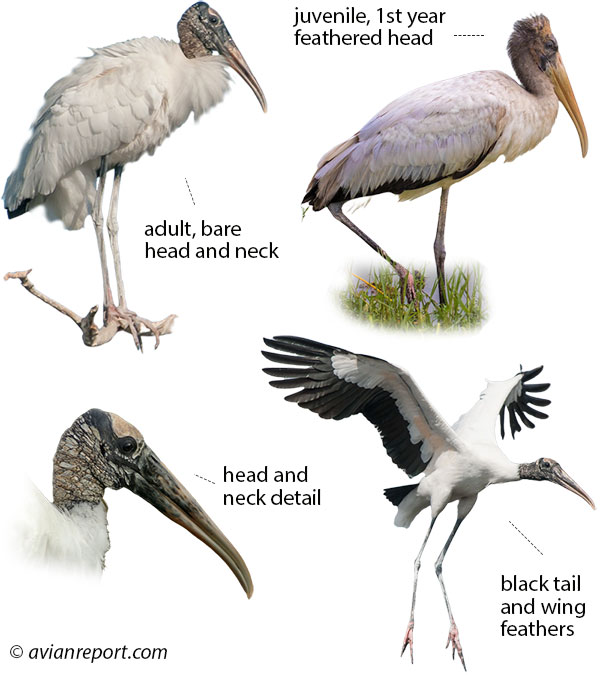
Length: 40″ | Wingspan: 61″ | Weight: 5.3 lb
Identification: Large, white wading bird with black flight feathers and tail, bald scaly head, and thick, slightly curved bill.
Habitat: The Wood Stork (Mycteria americana) inhabits marshes, forested wetlands, swamps, and shorelines.
Status and Movements: The Wood Stork is an accidental summer vagrant in Manitoba, present unpredictably from July through August. This southern species exceptionally rarely wanders north into Canadian prairie potholes or marshy edges.
Behavior: Wood storks feed by probing water and feeling for prey; may startle prey. Social, soars on thermals.
Diet: Fish, aquatic invertebrates, seeds, amphibians, nestlings, reptiles.
Nest: Large stick structure in trees above standing water, lined with greenery, secured with guano; in colonies.
Breeding: Season: December-August | Clutch: 1–5 creamy white eggs | Broods: 1 | Incubation: 28 and 32 days | Nestling: 50 days.
Lifespan: At least 22 years, 6 months.
How many are there? The U.S. Wood Stork population has rebounded from about 5,000 nesting pairs in the 1970s to over 11,000 pairs by early 2023.
Conservation Status: Low concern.
Medium-sized Wetland Birds of Manitoba (4–1 lb)
This group includes species that fall within an intermediate weight range of approximately 3.7 to 1 pound. It represents one of the most diverse and potentially confusing size categories, as body shape and structure vary considerably within the same weight bracket. Some species appear large and long-limbed, while others are compact and low-profile, creating notable contrasts despite overlapping weights.
Pacific Loon
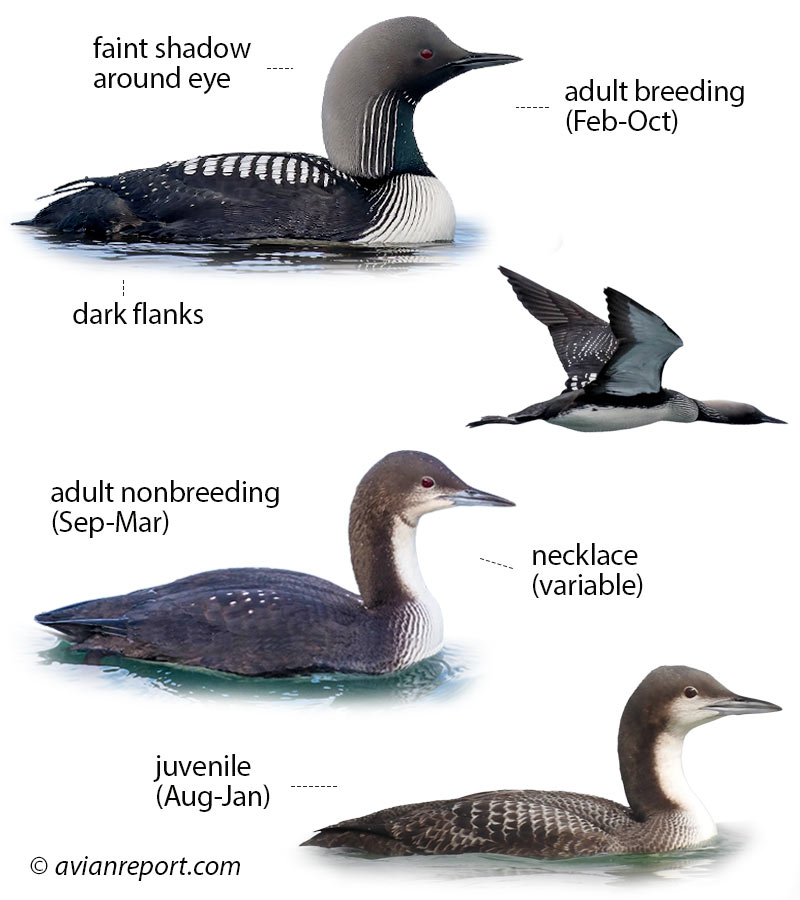
Length: 26″ | Wingspan: 47″ | Weight: 4 lb
Identification: Breeding: gray head, black back with white lines, black throat. Nonbreeding: gray-brown above, white below. Juveniles: pale-edged feathers. Sturdy, pointed bill.
Habitat: Tundra, taiga lakes, coastal ocean, bays, estuaries, reservoirs.
Status and Movements: The Pacific Loon is a common summer resident and transient in Manitoba, present from June through September. It breeds on tundra lakes in the far north and passes through large inland lakes during migration..
Behavior: Forages by diving with slight forward leap. Highly territorial during breeding; social during migration.
Diet: Small fish, snails, mollusks, insect larvae, zooplankton, squid, seeds.
Nest: Mud and vegetation mound on islands or shorelines; occasionally floating.
Breeding: Season: Jun-mid Oct | Clutch: 1-2 buff, brown, or olive-green eggs | Broods: 1 | Incubation: 23-28 days | Nestling: 1-2 days.
Lifespan: Up to 20 years.
How many are there: There are ~840,000 Pacific Loons globally.
Conservation Status: Low Concern.
Double-crested Cormorant
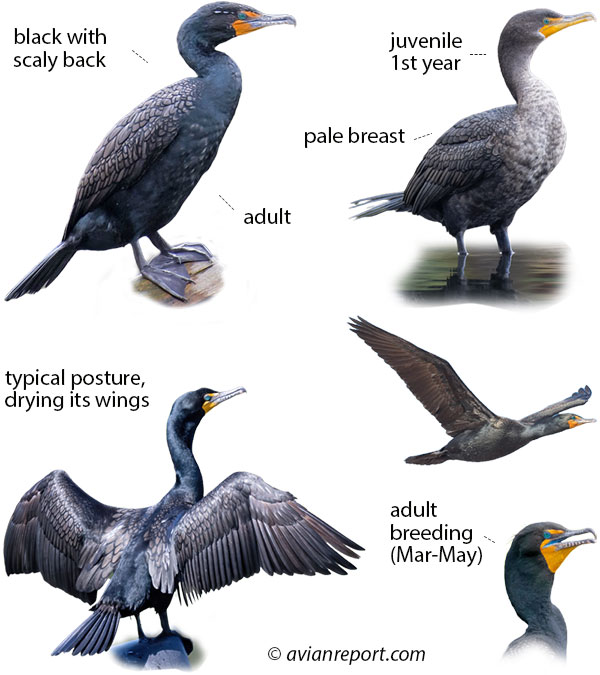
Length: 33″ | Wingspan: 52″ | Weight: 3.7 lb
Identification: Adult: Brown-black plumage, yellow-orange facial skin. Breeding adults show double crests (black/white). Immatures browner, with pale neck/breast.
Habitat: The Double-crested Cormorant (Nannopterum auritum) favor freshwater and saltwater habitats, coasts, large inland lakes.
Status and Movements: The Double-crested Cormorant is a common summer resident and abundant transient in Manitoba, present from May through October. It nests colonially on islands and dead trees within major lake systems..
Behavior: Dives to catch small fish, spreads wings to dry. Flies in V-shaped flocks, nests colonially.
Diet: Double-crested Cormorants feed on mainly small fish.
Nest: Bulky stick nest, often in tree colonies.
Breeding: Season: Varies in every region | Clutch: 1-6 unmarked pale blue eggs | Broods: 1-2 | Incubation: 25-28 days | Nestling: 21-28 days.
Lifespan: At least 23 years, 8 months.
How many are there? Abundant.
Conservation Status: Low concern.
Osprey
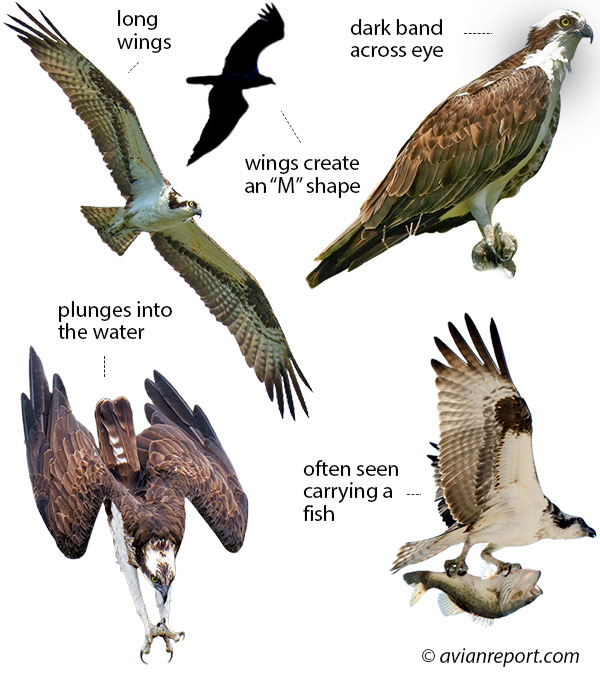
Length: 23″ | Wingspan: 63″ | Weight: 3.5 lb
Identification: Dark brown upperparts, white underparts. White head marked with a bold brown eye stripe. Juveniles have white spots on the back and buff-tinted breast shading.
Habitat: Ospreys (Pandion haliaetus) inhabit open waters with abundant fish; plus elevated nesting sites.
Status and Movements: The Osprey is a common summer resident and transient in Manitoba, present from May through September. It nests near fish-rich lakes and rivers, particularly across the boreal forest zone.
Behavior: Hunts live fish by hovering and diving feet-first. Mostly solitary; males perform aerial “sky-dance” displays.
Diet: Ospreys feed almost exclusively live fish (99%), occasionally fish remains, birds, snakes, voles, squirrels.
Nest: Large, untidy stick platforms, often on poles, snags, dead trees, or artificial platforms.
Breeding: Season: mid April-early September | Breeds spring–fall | Clutch: 1–4 cream spotted with reddish eggs | Broods: 1 | Incubation: 36–42 days | Nestling period: 50–55 days.
Lifespan: At least 25 years, 2 months.
How many are there? ~1.2 million global breeding population.
Conservation Status: Low Concern.
Red-throated Loon
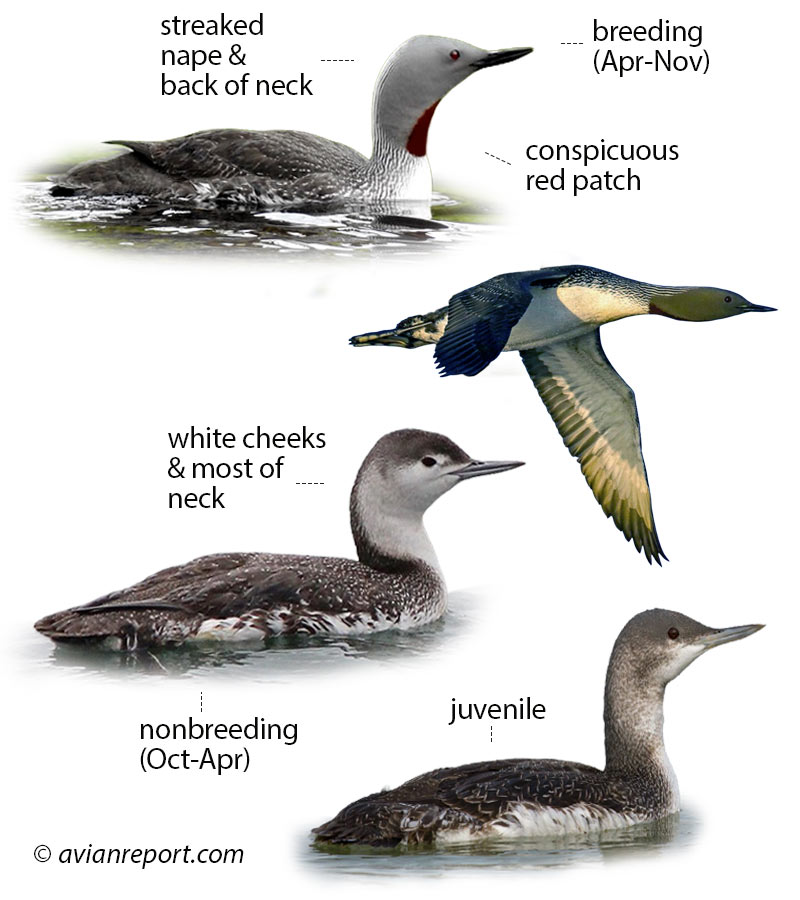
Length: 24″ | Wingspan: 44″ | Weight: 3.3 lb
Identification: Breeding: gray neck, rusty throat patch, black-and-white neck stripes. Nonbreeding: blackish above, white face/underparts. Juvenile: grayish brown above, pale below. Slender with bill tipped upward.
Habitat: The Red-throated Loon (Gavia stellata) favors tundra, taiga lakes, marine coasts, large lakes, bays, estuaries, sounds, shallow coastal waters.
Status and Movements: The Red-throated Loon is a common summer resident and transient in Manitoba, present from June through September. It breeds on small tundra ponds in the coastal Hudson Bay region and migrates southward.
Behavior: Dives for fish; scans underwater by dipping head. Highly mobile; social during migration, forming large flocks.
Diet: Red-throated loons feed on fish, leeches, copepods, crustaceans, mollusks, squid, polychaete worms, aquatic insects.
Nest: Mounds of moss, mud, and vegetation built on shorelines or shallow water of small ponds.
Breeding: Season: May-Sep | Clutch: 1-2 brown to olive, speckled eggs | Broods: 1 | Incubation: 24-31 days | Nestling: <1 day.
Lifespan: At least 23 years and 7 months.
How many are there: Estimated global breeding population is ~260,000.
Conservation Status: Low Concern.
Western Grebe
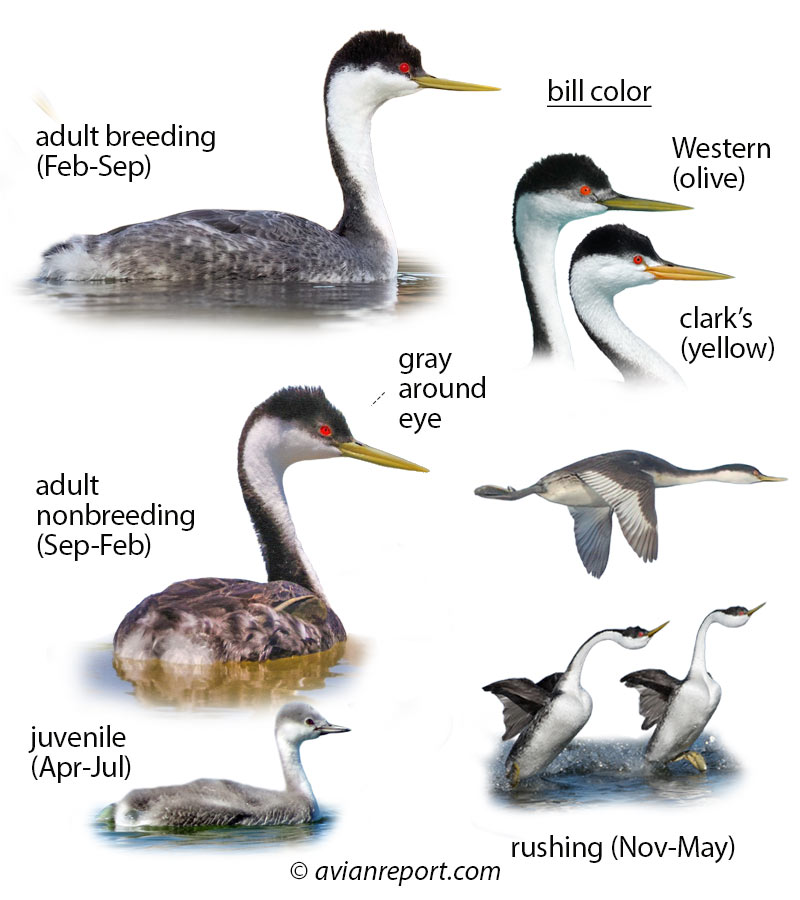
Length: 19.5″ | Wingspan: 29″ | Weight: 3 lb
Identification: Crisp black-and-white, sharp neck transition. Black head, white below eye. Yellowish bill, red eyes. Juveniles have blackish or silvery down.
Habitat: The Western Grebe (Aechmophorus occidentalis) favors freshwater lakes, marshes, reeds, rushes, ocean shores, bays, rivers, estuaries.
Status and Movements: The Western Grebe is a common summer resident and transient in Manitoba, present from May through September. It breeds in large colonies on big, vegetation-fringed lakes in the southern half of the province.
Behavior: The Western Grebe forages by deep diving. Synchronized “rushing” and “weed” ceremonies. Colonial; territorial at nest.
Diet: Western grebes feed on fish, salamanders, crustaceans, marine worms, grasshoppers, aquatic insects, larvae.
Nest: Floating vegetation mound anchored in emergent plants. Nests in colonies of hundreds.
Breeding: Season: Jun-mid Aug | Clutch: 2-3 pale bluish eggs | Broods: 1 | Incubation: 24 days | Nestling: <1 day.
Lifespan: At least 11 years.
How many are there?: There are ~87,000 Western Grebes globally.
Conservation Status: Least Concern.
Clark’s Grebe
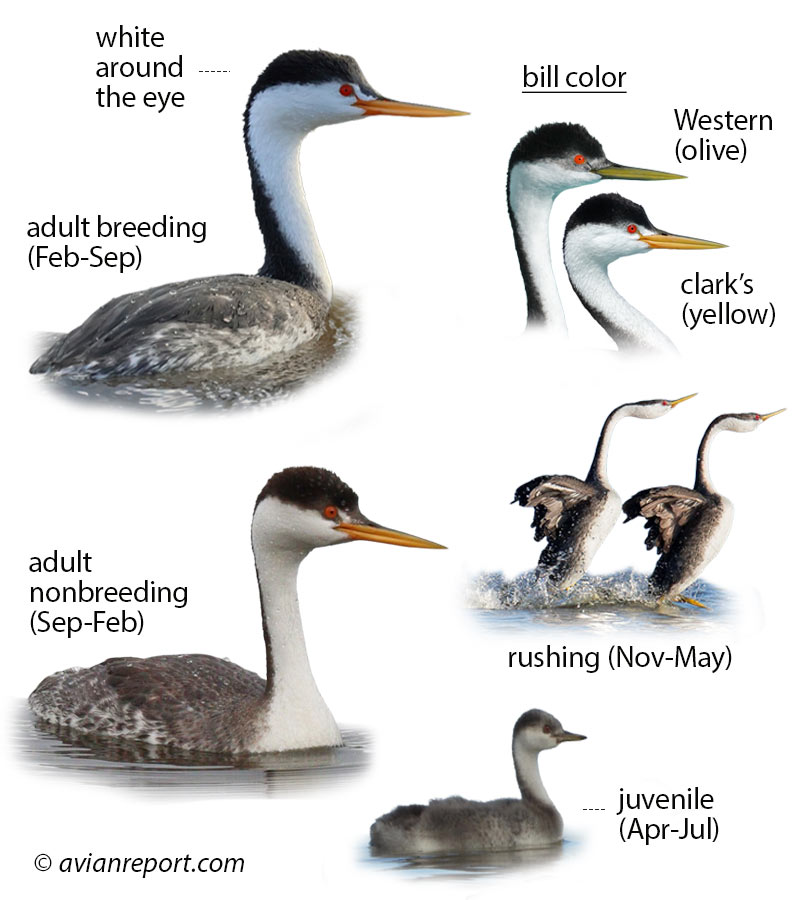
Length: 26″ | Wingspan: 36″ | Weight: 2.4 lb
Identification: Blackish above, white below. White face surrounds red eye; black cap. Vivid orange bill; long, slender neck. Young ride on parents’ backs.
Habitat: The Clark’s Grebe (Aechmophorus clarkii) favors marshes, freshwater lakes, emergent vegetation, saltwater coasts, sheltered bays, rivers, estuaries.
Status and Movements: The Clark’s Grebe is a casual summer visitor and transient in Manitoba, present from May through September. It is occasionally found nesting within large western grebe colonies on major southern lakes.
Behavior: Forages by deep diving far from shore. Famous “rushing” and “weed” courtship ceremonies. Colonial and territorial.
Diet: Clark’s grebes feed on fish, salamanders, crustaceans, marine worms, grasshoppers, aquatic insects, larvae.
Nest: Floating vegetation mound anchored in emergent plants. Nests in colonies of hundreds on large lakes.
Breeding: Season: Jun-mid Aug | Clutch: 2-3 pale bluish eggs | Broods: 1 | Incubation: 24 days | Nestling: <1 day. Breeding information not well known, but likely similar to that of the Western Grebe.
Lifespan: Not known.
How many are there?: There are ~11,000 Clark’s Grebes globally.
Conservation Status: Low Concern.
Red-necked Grebe
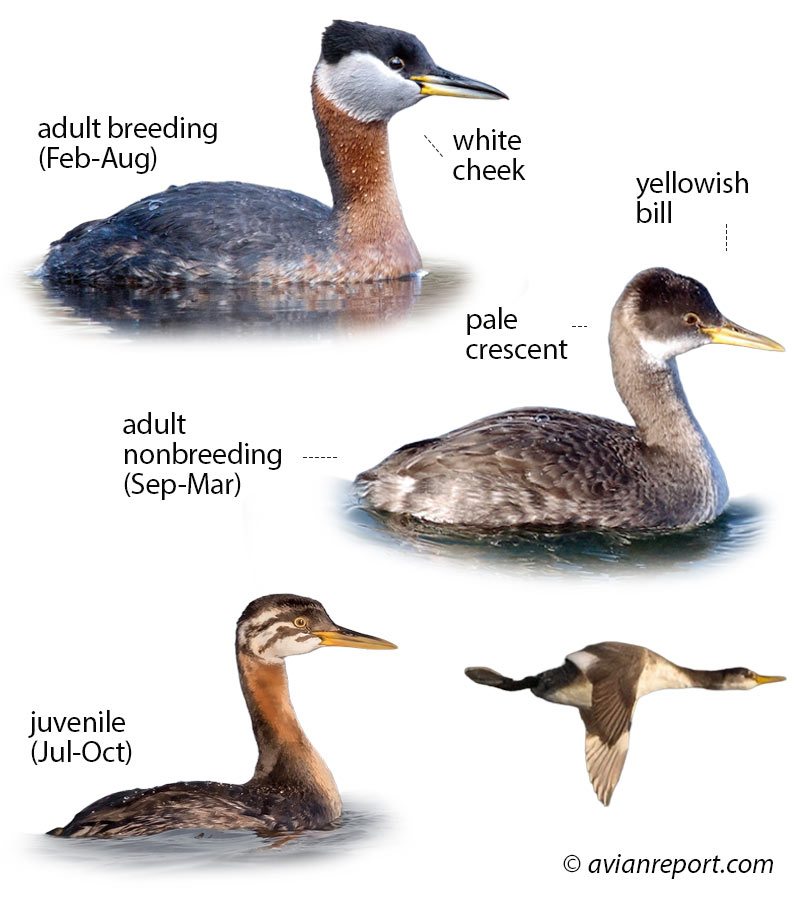
Length: 19″ | Wingspan: 29″ | Weight: 2.4 lb
Identification: Breeding adults: brick red neck, black crown, white cheeks, yellow bill. Nonbreeding: dark gray above, pale cheeks. Juveniles: similar to nonbreeding with less distinct head pattern.
Habitat: The Red-necked Grebe (Podiceps grisegena) favors shallow freshwater lakes, ponds, bogs, marshes, rivers, bays, ocean coastlines.
Status and Movements: The Red-necked Grebe is a common summer resident and transient in Manitoba, present from May through October. It breeds widely on quiet, marsh-edged lakes across the forested and parkland regions.
Behavior: Forages by surface diving. Solitary or small groups in winter; pairs are vocal and territorial during nesting.
Diet: Red-necked grebes feed on fish, crustaceans, insects, salamanders, frogs, tadpoles, amphipods, leeches, crayfish, clams, spiders.
Nest: Bulky pile of aquatic plants floating or anchored to bottom or vegetation.
Breeding: Season: Late Apr-early Sep | Clutch: 4-5 white-bluish eggs | Broods: 1 | Incubation: 27-28 days | Nestling: <1 day.
Lifespan: At least 11 years.
How many are there?: Global breeding population of ~160,000.
Conservation Status: Low Concern.
American Herring Gull
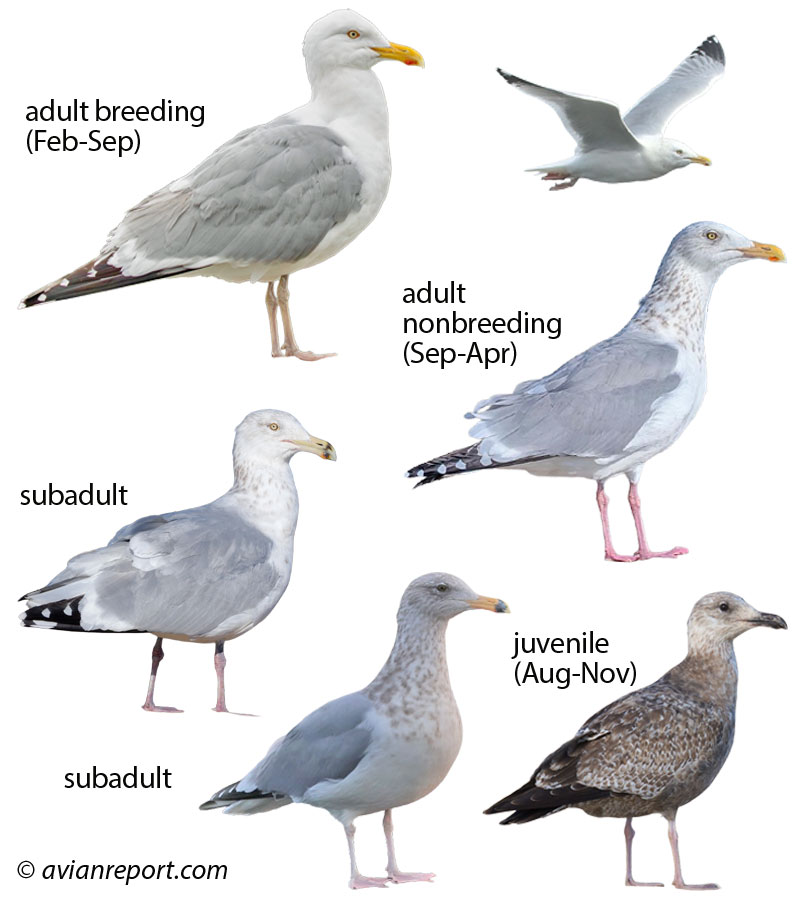
Length: 24″ | Wingspan: 54″ | Weight: 2.3 lb
Identification: Breeding: White head, light gray back, black wingtips with white spots, yellow bill with red spot, pink legs. Nonbreeding: Brown streaking on head and neck. Juvenile: Brown-mottled overall, dark bill, pinkish-brown legs; gradually pales over four years.
Habitat: The American Herring Gull (Larus smithsonianus) favors coasts, lakes, rivers, estuaries, mudflats, fields, landfills, parking lots.
Status and Movements: The American Herring Gull is a common summer resident and transient in Manitoba, present from April through November. It breeds colonially on rocky islands in major lakes and along the Hudson Bay coastline.
Behavior: The American Herring Gull forages by scavenging or stealing. Social, found in large flocks and colonies.
Diet: Fish, crustaceans, mollusks, insects, eggs, refuse, carrion.
Nest: Shallow scrape on ground lined with grass, seaweed, or feathers. Breeds in colonies.
Breeding: Breeding Months: Late April-August | Clutch: 1-3 olive, buff, or bluish eggs | Broods: 1 | Incubation: 27-30 days | Nestling: ~5 days.
Lifespan: At least 29 years, 3 months.
How many are there?: There are ~430,000 breeding American Herring Gulls.
Conservation Status: Least Concern.
Black-crowned Night-Heron
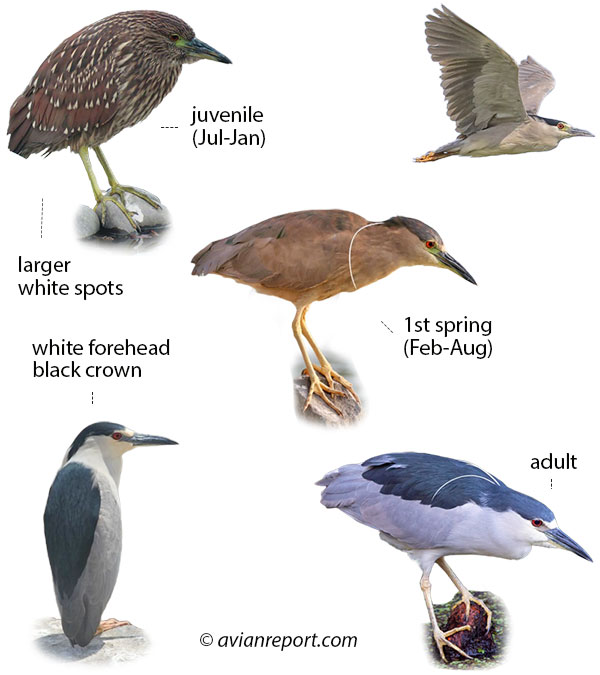
Length: 25″ | Wingspan: 44″ | Weight: 1.9 lb
Identification: Stocky heron with light-gray body, black back and crown, and all-black bill. Immatures are brown with white spots, streaks, and yellow-and-black bills.
Habitat: The Black-crowned Night-Heron (Nycticorax nycticorax) forages in freshwater, brackish, and saltwater wetlands.
Status and Movements: The Black-crowned Night-Heron is an uncommon summer resident and transient in Manitoba, present from May通September. It nests in dense wetland thickets and marshes, primarily within southern Manitoba.
Behavior: Feeds at night or dusk; rests by day perched in trees.
Diet: The Black-crowned Night-Heron feeds on fish, frogs, insects, small mammals, birds, carrion, plant matter, and garbage.
Nest: Stick platform in trees, shrubs, or cattails; nests colonially.
Breeding: Season: January-August | Clutch: 3–5 greenish-blue eggs | Incubation: 24–26 days | Nestling: 29–34 days.
Lifespan: Up to 21 years, 5 months.
How many are there? About 3 million globally.
Conservation Status: Low concern.
American Coot
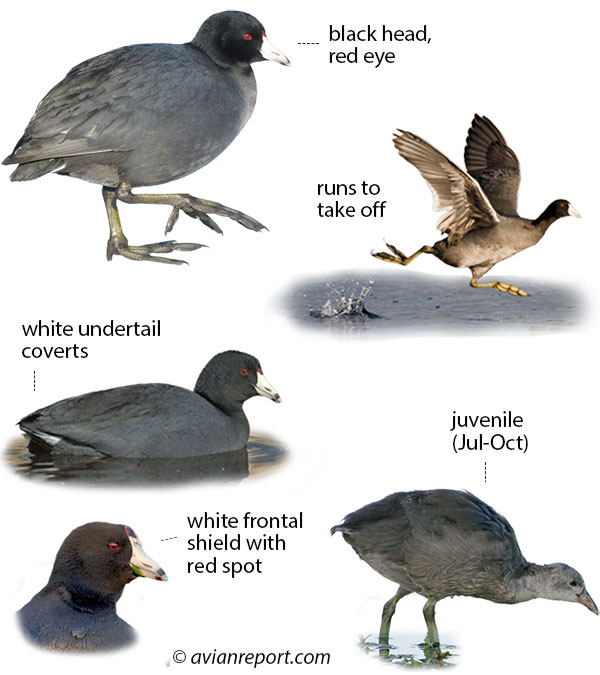
Length: 15.5″ | Wingspan: 24″ | Weight: 1.6 lb
Identification: Adult: Plump, chickenlike, dark gray to black, bright white bill and forehead, small red forehead patch. Juvenile/nonbreeding: Duller gray with less distinct forehead patch.
Habitat: The American Coot (Fulica americana) prefers freshwater wetlands with emergent vegetation. Also found anywhere with standing water; ponds, city parks.
Status and Movements: The American Coot is an abundant summer resident and transient in Manitoba, present from May through October. It nests widely in semi-permanent prairie wetlands, gathering in large rafts prior to autumn migration.
Behavior: The American Coot forages by plucking plants while walking, swimming, dabbling, or diving. Highly social in winter.
Diet: Primarily aquatic plants. Also takes insects, snails, tadpoles, and salamanders.
Nest: Floating platform anchored to emergent vegetation, woven into a shallow basket over water.
Breeding: Season: May-mid-August | Clutch: 8–12 buff with dark speckles eggs | Broods: 1–2 | Incubation: 23–25 days | Chicks: Down-covered, alert, leave nest within 6 hours.
Lifespan: At least 22 years, 4 months.
How many are there? Global breeding population about 7.1 million individuals.
Conservation Status: Low conservation concern.
California Gull
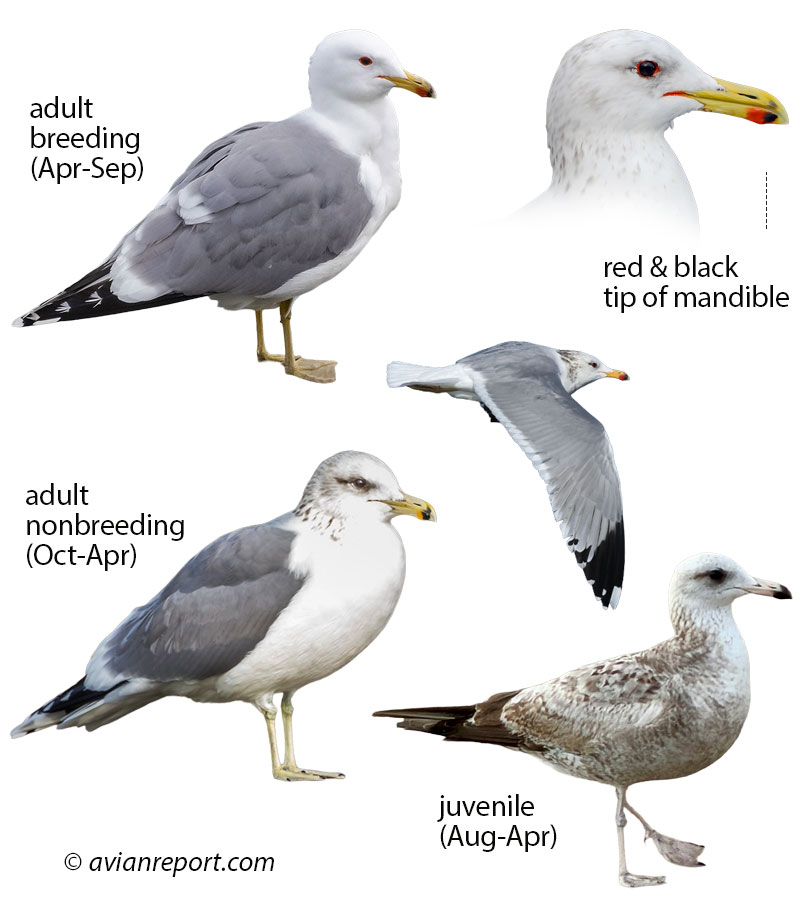
Length: 20″ | Wingspan: 51″ | Weight: 1.6 lb
Identification: Breeding: Medium-gray back, yellow bill with red and black spots, yellow legs. Nonbreeding: Brown-streaked head and nape. Juvenile: Brown-mottled overall, pinkish legs, black-tipped pink bill; second-winter birds show grayer backs and paler heads. Habitat: Lakes, marshes, scrubland, coastlines, estuaries, mudflats, farms, landfills.
Status and Movements: The California Gull is an uncommon summer resident and transient in Manitoba, present from May through October. It nests colonially on isolated lake islands, primarily in western and central regions.
Behavior: The California Gull forages by scavenging or aerial catching. Highly social; nests in large, dense colonies.
Diet: Insects, fish, brine shrimp, eggs, rodents, refuse, carrion.
Nest: Shallow scrape on open ground lined with grass, feathers, or debris. Breeds in colonies.
Breeding: Breeding Months: May-July | Clutch: 1-4 Olive, dark-spotted eggs | Broods: 1 | Incubation: 23-27 days | Nestling: ~3-4 days.
Lifespan: At least 28 years, 1 month.
How many are there?: There are ~1 million California Gulls.
Conservation Status: Least Concern.
American Bittern
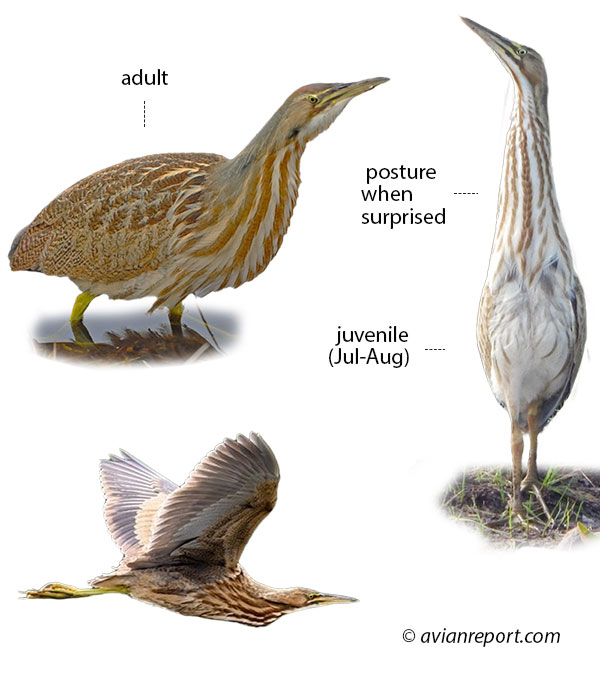
Identification: Medium-sized heron with compact body, short legs, and thick neck. Warm brown and buff with bold streaks.
Habitat: The American Bittern (Botaurus lentiginosus) prefers shallow freshwater marshes with dense reeds and emergent vegetation.
Status and Movements: The American Bittern is a common summer resident and transient in Manitoba, present from May through September. It breeds secretly within extensive cattail marshes, sedge meadows, and boreal peatlands.
Diet: The American Bittern feeds on insects, crustaceans, fish, frogs, lizards, and small mammals.
Nest: Platform of reeds lined with grasses in dense marsh vegetation.
Breeding: Season: April–August | Clutch: 2–7 beige to olive eggs | Incubation: 24–28 days | Nestling: 7–14 days, chicks remain nearby for weeks.
Lifespan: At least 8 years, 4 months.
How many are there? About 2.5 million globally.
Conservation Status: Low concern, though declining in some regions.
Great Egret
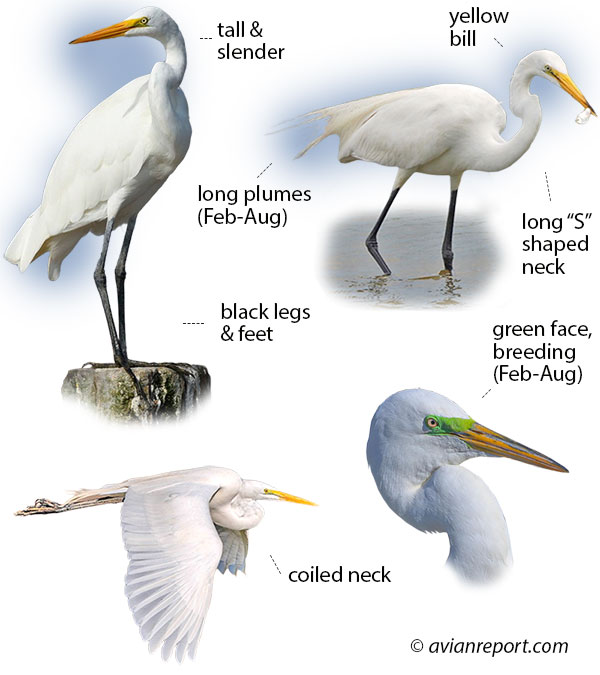
Length: 39″ | Wingspan: 51″ | Weight: 1.5 lb
Identification: Large white heron with long black legs, and yellow bill. Smaller than Great Blue Heron, larger than Snowy Egret. Breeding adults grow long back plumes.
Habitat: The Great Egret (Ardea alba) inhabits freshwater, brackish, and coastal wetlands.
Status and Movements: The Great Egret is an uncommon summer resident and transient in Manitoba, present from May through September. It nests in mixed colonial rookeries on large wetland complexes in the southern counties.
Diet: Great Egrets feed on primarily fish; also amphibians, reptiles, birds, mammals, and invertebrates.
Nest: Large stick platform in trees or shrubs, usually in colonies.
Breeding: Season: March–July | Clutch: 1–6 pale greenish-blue eggs | Broods: 1–2 | Incubation: 23–27 days | Nestling: 21–25 days.
Lifespan: Up to 22 years, 10 months.
How many are there? About 9.5 million in North America.
Conservation Status: Low concern; populations increasing.
Red-shouldered Hawk
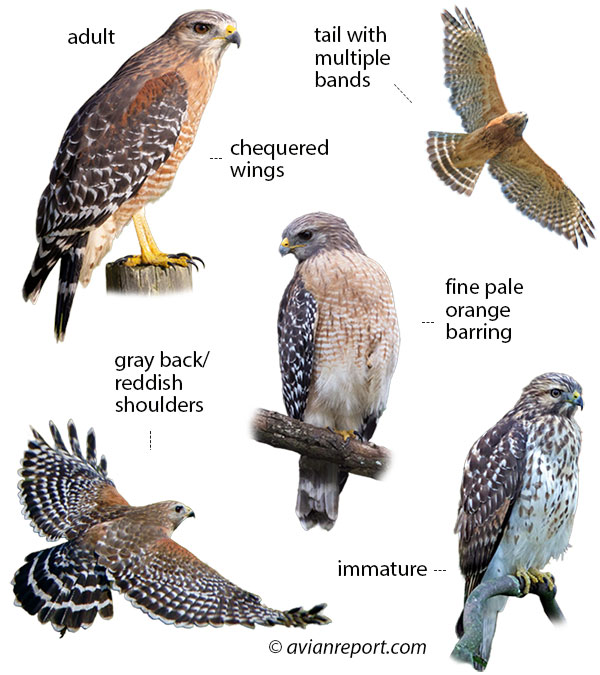
Length: 17″ | Wingspan: 40″ | Weight: 1.4 lb
Identification: Adult: Barred reddish-peach underparts, strongly banded tail, checkered wings, pale wing crescents near tips. Immature: Brown above, white below streaked with brown, pale wing crescents.
Habitat: The Red-shouldered Hawk (Buteo lineatus) inhabits tall woods near water, including swamps, riparian forests, and suburban parks.
Status and Movements: The Red-shouldered Hawk is a rare summer visitor and transient in Manitoba, present from May through August. It exceptionally rarely nests in mature deciduous floodplain forests along southern river valleys.
Behavior: Hunts from perches with swift descents. Soars and glides frequently. Males perform a “sky dance” display during courtship.
Diet: Feeds on small mammals, lizards, snakes, amphibians, voles, chipmunks, and birds.
Nest: Large stick nests (~2 ft diameter), placed in tree crotches near water. Often reused in subsequent years.
Breeding: Season: Late March-July | Clutch: 2–5 dull white to bluish, brown-blotched eggs | Broods: 1 | Incubation: 32–40 days | Nestling period: 42–49 days.
Lifespan: At least 25 years, 10 months.
How many are there? Global breeding population about 1.9 million.
Conservation Status: Low conservation concern.
Caspian Tern
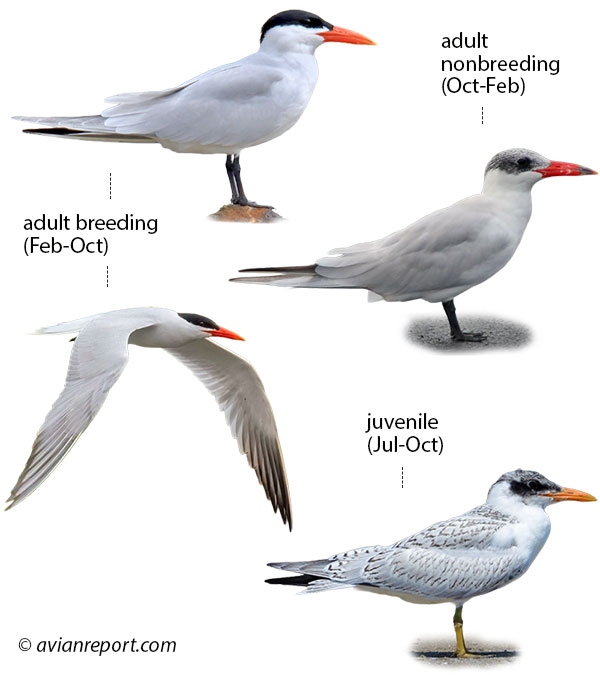
Length: 21″ | Wingspan: 50″ | Weight: 1.4 lb
Identification: Largest tern species. White overall. Breeding adults have a black crown and a coral-red bill. In winter and juveniles, the crown is partially black with grayish speckling.
Habitat: Caspian Terns (Hydroprogne caspia) are found along ocean coasts, barrier islands, interior lakes and rivers.
Status and Movements: The Caspian Tern is a common summer resident and transient in Manitoba, present from May through September. It nests colonially on flat sand or gravel islands within large northern and central lakes.
Behavior: Caspian Terns fly slowly before plunging for fish. Roosts and rests in flocks.
Diet: Primarily fish; also crayfish, large insects, and occasionally scavenged invertebrates.
Nest: A shallow scrape in open areas lined with dried vegetation and ringed with pebbles, or other debris.
Breeding: Season: mid-May-late August | Clutch: 1-3 buff with dark spots eggs | Broods: 1 | Eggs: | Incubation: 25–28 days | Nestling: 1–2 days.
Lifespan: At least 32 years, 1 month.
How many are there? ~530,000 global breeders.
Conservation Status: Low Concern.
White-faced Ibis
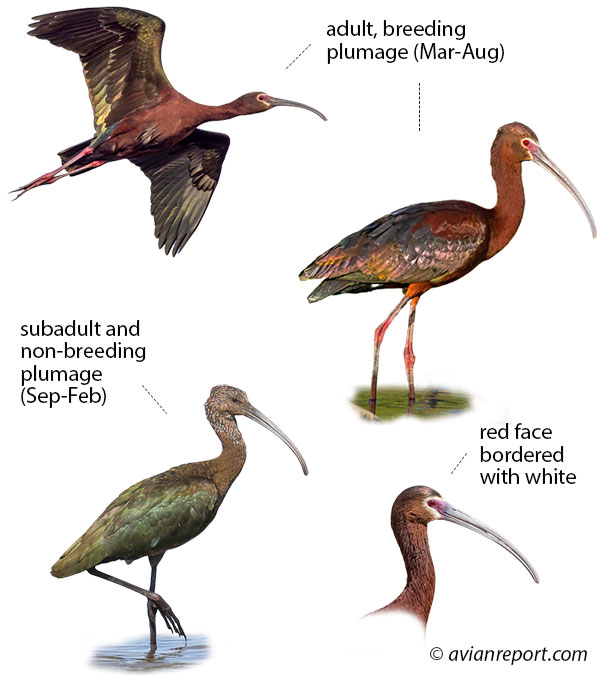
Length: 23″ | Wingspan: 36″ | Weight: 1.3 lb
Identification: Adult: glossy maroon, metallic green/bronze wings. Pink legs, white mask. Juvenile/non
Breeding: matte brown, no white facial outline, duller legs.
Habitat: The White-faced (Plegadis chihi) favors shallow wetlands, marshes. Wet agricultural fields.
Status and Movements: The White-faced Ibis is a rare summer visitor and casual breeder in Manitoba, present from May through September. It has recently expanded its range northward into southern prairie marsh complexes.
Behavior: White-faced Ibises forage by probing in water/mud or picking surface prey. Usually in flocks.
Diet: Earthworms, crayfish, spiders, snails, leeches and insects.
Nest: Flat platform of twigs built in emergent vegetation or shrubs.
Breeding: Season: Mid-May through late July | Clutch: 3-5 bluish green to turquoise eggs | Broods: 1 | Incubation: 17-21 days.
Lifespan: At least 12 years, 3 months.
How many are there? Globally approx. 7.2 million. U.S./Canada
Breeding: 1.3 million.
Conservation Status: Low conservation concern.
Ring-billed Gull
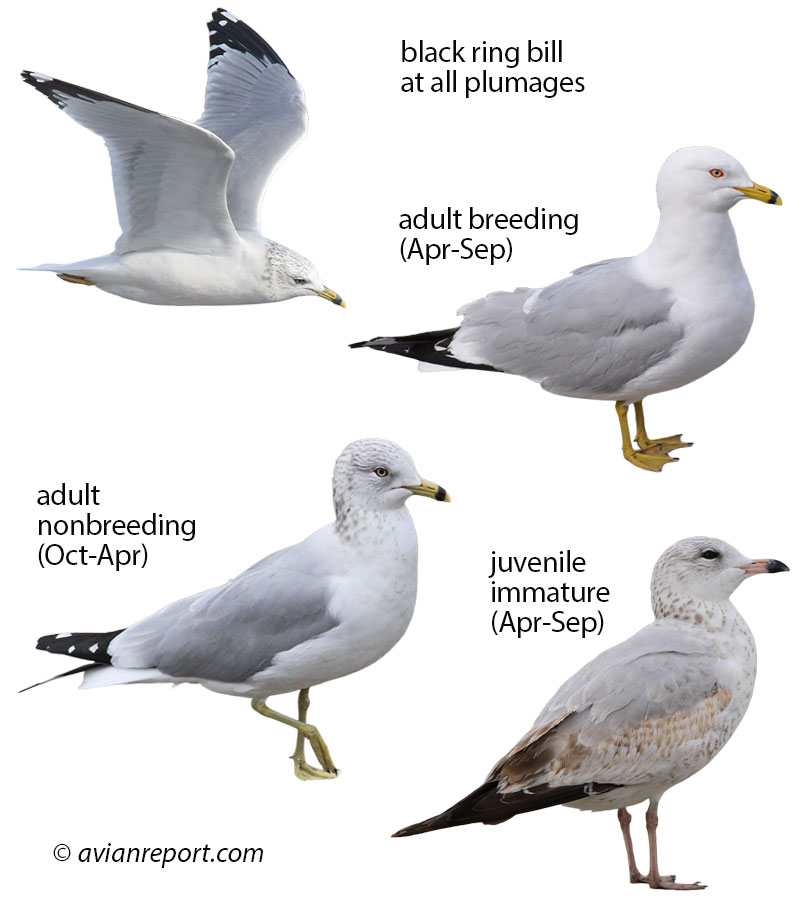
Identification: Breeding: White head, yellow bill with black ring, yellow legs, light gray mantle, black wingtips. Nonbreeding: Streaked brown on head and neck. Juvenile: Brown-mottled overall, pinkish legs, black-tipped pink bill; becomes gray-backed with distinct tail band by second winter.
Habitat:The Ring-billed Gull (Larus delawarensis) is found in lakes, rivers, coasts, mudflats, docks, landfills, parking lots, fields.
Status and Movements: The Ring-billed Gull is an abundant summer resident and transient in Manitoba, present from April through October. Massive, noisy breeding colonies occupy natural islands and rocky shores across the province.
Behavior: The Ring-billed Gull forages by scavenging or dipping. Highly social, nests in large colonies.
Diet: Fish, insects, earthworms, grain, rodents, refuse, carrion.
Nest: Scrape on ground lined with grass, twigs, or lichens. Breeds in large colonies.
Breeding: Breeding Months: late April – mid-August | Clutch: 2-4 olive gray with dark brown spots eggs | Broods: 1 | Incubation: 21-28 days | Nestling: ~5 days.
Lifespan: At least 27 years, 6 months.
How many are there?: There are ~2.5 million Ring-billed Gulls.
Conservation Status: Least Concern.
Pied-billed Grebe
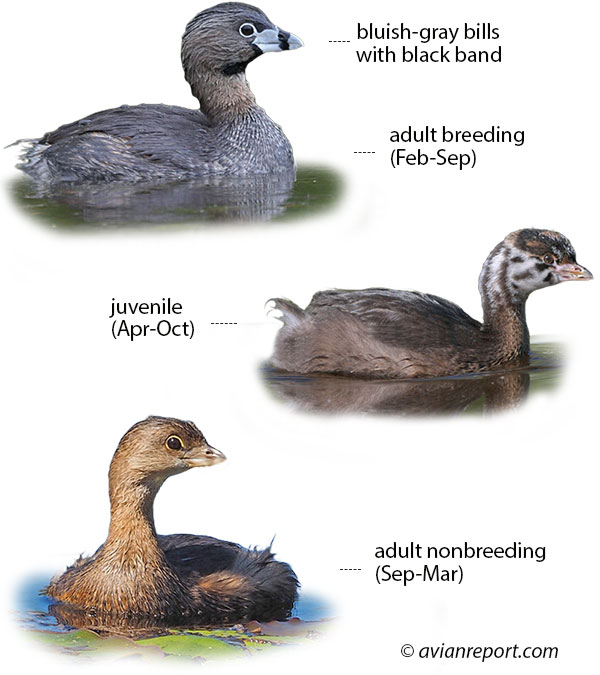
Length: 13″ | Wingspan: 16″ | Weight: 1 lb
Identification: Small, chunky brown waterbird. Adults have a dark crown and nape, and a whitish bill with a black band in breeding season (yellow-brown outside breeding). Juveniles show distinctive striped faces.
Habitat: The Pied-billed Grebe (Podilymbus podiceps) occupies ponds, marshes, lakes, sluggish rivers, and areas with emergent vegetation or open water.
Status and Movements: The Pied-billed Grebe is a common summer resident and transient in Manitoba, present from May through October. It nests widely in small ponds, prairie potholes, and sluggish river bends with emergent vegetation.
Behavior: Forages by diving to pursue prey. Typically solitary but may form small winter flocks.
Diet: Pied-billed Grebes feed on crayfish, shrimps, fish, frogs, tadpoles, and salamanders.
Nest: Floating open-bowl nest built anchored among emergent plants.
Breeding: Season: February-November | Clutch: 2–10 bluish white, unmarked eggs | Broods: 1–2 | Incubation: 23–27 days | Chicks: Leave the nest within 1 day.
Lifespan: At least 4 years, 7 months.
How many are there? Global breeding population about 3.1 million.
Conservation Status: Low conservation concern.
Horned Grebe
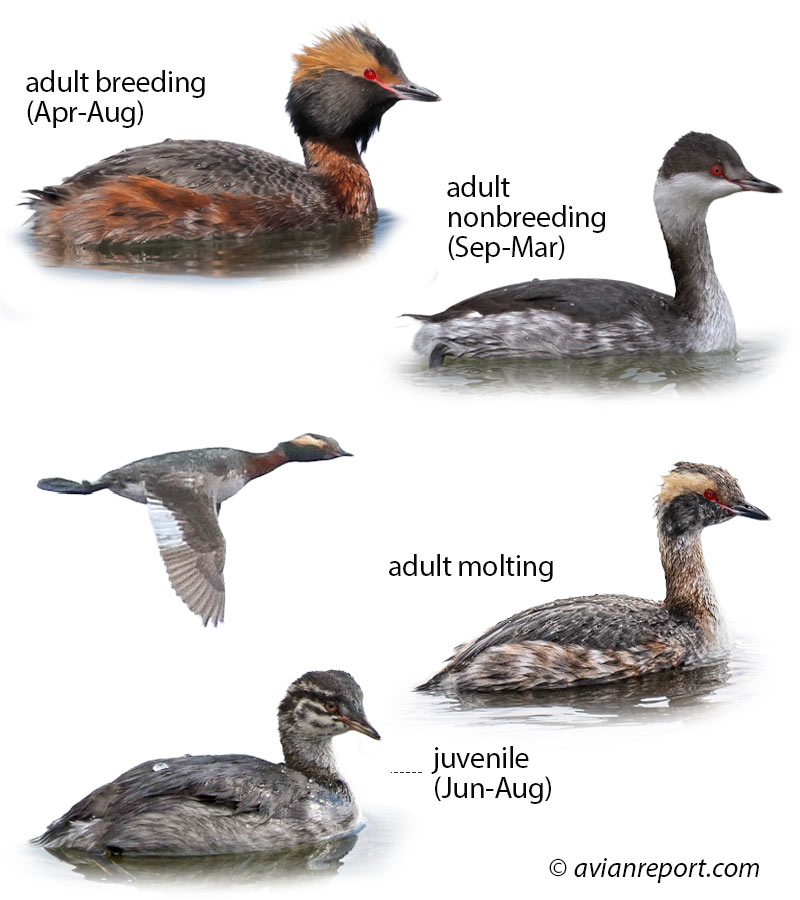
Length: 14″ | Wingspan: 24.2″ | Weight: 1 lb
Identification: Breeding: Dark gray back, cinnamon neck and sides, yellow head-tufts, black head. Nonbreeding: Grayish above, white below, black cap, white cheek.
Habitat: The Horned Grebe (Podiceps auritus) favors freshwater ponds, lakes, rivers, bays, oceans, marshes, emergent vegetation.
Status and Movements: The Horned Grebe is a common summer resident and transient in Manitoba, present from May through October. It breeds on small, permanent and semi-permanent wetlands throughout the parkland and boreal zones.
Behavior: Forages by surface diving. Highly territorial when nesting; forms small flocks during winter and migration.
Diet: Horned grebes feed on fish, crustaceans, insects, larvae, salamanders, frogs, tadpoles, leeches, marine worms.
Nest: Floating mass of aquatic vegetation anchored to plants or bottom near shoreline.
Breeding: Season: Mid May-September | Clutch: 3-8 White, brownish, or bluish-green eggs | Broods: 1 | Incubation: 23-24 days | Nestling: <1 day.
Lifespan: At least 5 years, 11 months.
How many are there?: There are ~620,000 Horned Grebes globally.
Conservation Status: Tipping Point Yellow Alert, due to significant long-term population declines.
Small Wetland Birds of Manitoba (< 1 lb)
This group includes the lightest wetland species in the state, ranging from just under one pound to only a few ounces. Despite their small size, they occupy a wide variety of wetland habitats and can vary noticeably in structure and proportions. Several members of this category are notably secretive, often detected by voice rather than sight as they move quietly through dense marsh vegetation.
Snowy Egret
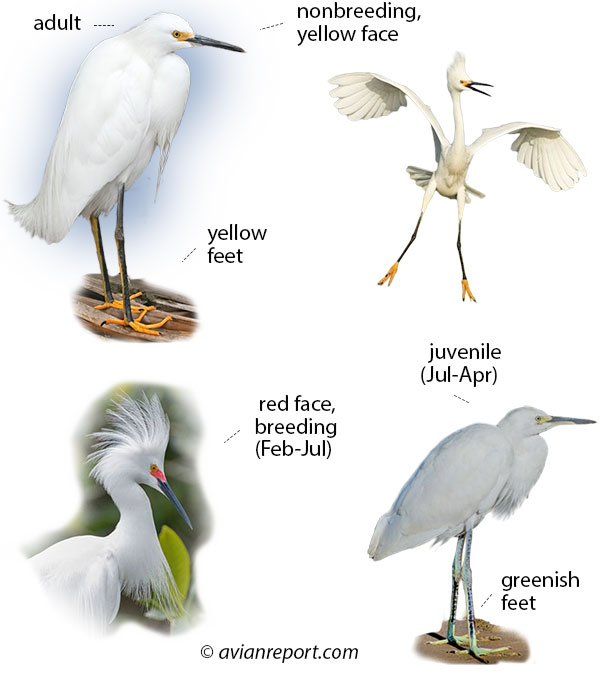
Length: 24″ | Wingspan: 41″ | Weight: 13 oz
Identification: All-white heron with black bill, black legs, and yellow feet. Immatures have duller greenish legs. Breeding adults grow filmy curving plumes.
Habitat: The Snowy Egret (Egretta thula) forages in fresh, salt, and brackish water wetlands.
Status and Movements: The Snowy Egret is a rare summer visitor in Manitoba, present from May through August. It appears irregularly within southern marshes, often during periods of post-breeding dispersal from the south.
Behavior: Hunts in shallow water, spearing or chasing prey; uses yellow feet to stir or herd fish before striking.
Diet: Snowy Egrets feed on small fish, frogs, shrimp, and insects.
Nest: Shallow twig platform, usually over water.
Breeding: Season: March–July | Clutch: 2–6 pale greenish-blue eggs | Incubation: 24–25 days | Nestling: 20–24 days.
Lifespan: At least 17 years, 7 months.
How many are there? About 2.1 million globally.
Conservation Status: Low concern.
Eared Grebe
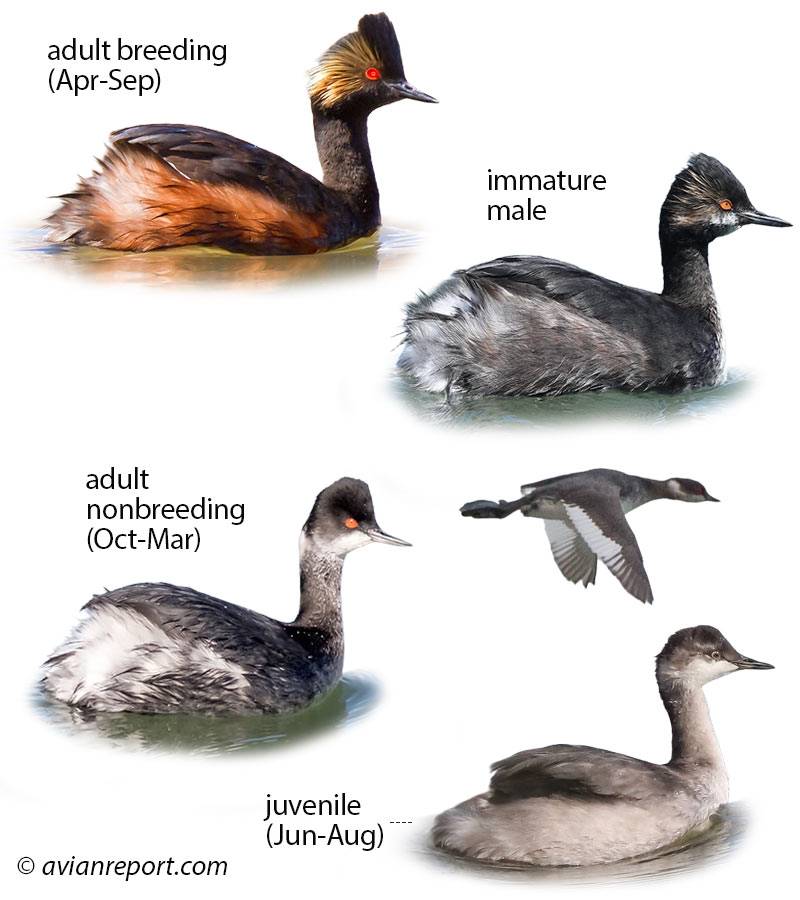
Length: 12″ | Wingspan: 21″ | Weight: 12 oz
Identification: Breeding: Black with chestnut flanks, golden plumes behind red eyes. Nonbreeding: Grayish-black, smudgy cheeks, white neck. Immatures are similar to nonbreeding adults.
Habitat: The Eared (Black-necked) Grebe (Podiceps nigricollis) favors shallow lakes, ponds, wetlands, saline waters, salt ponds, ocean coastlines.
Status and Movements: The Eared Grebe is a common summer resident and transient in Manitoba, present from May through September. It breeds colonially in highly productive, shallow marshes across the southern agricultural zone.
Behavior: Forages by diving or surface pecking. Highly social, breeds in colonies and migrates in massive flocks.
Diet: Eared Grebes feed on brine shrimp, brine flies, aquatic invertebrates, small fish, mollusks, amphibians.
Nest: Floating platform of aquatic plants attached to emergent vegetation. Breeds in colonies.
Breeding: Season: May-Aug | Clutch: 1-8 whitish eggs | Broods: 1 | Incubation: 20-23 days | Nestling: <1 day.
Lifespan: At least 8 years, 7 months.
How many are there?: There are ~2.7 million Eared Grebes globally.
Conservation Status: Low Concern.
Cattle Egret
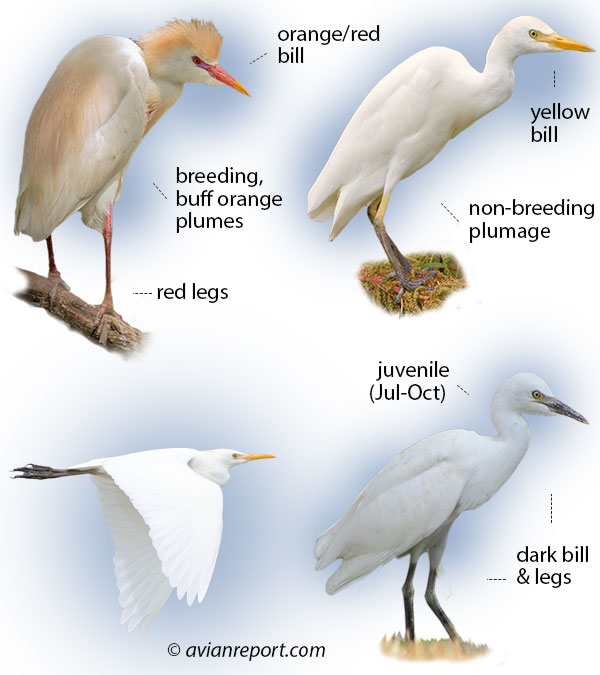
Length: 20″ | Wingspan: 36″ | Weight: 12 oz
Identification: Stocky heron with short, thick neck. Adults are white with buff plumes in breeding season; bill turns bright red before pairing. Juveniles lack plumes and have black bills.
Habitat: The (Western) Cattle Egret (Bubulcus ibis)Wet grasslands, pastures, farmlands; favors drier open areas more than other herons.
Status and Movements: The Cattle Egret is a rare summer visitor in Manitoba, present from May through September. It associates with pastured livestock in southern regions, wandering north irregularly during the warmer months.
Behavior: Walks with a distinctive head-pumping strut. It often follows cattle.
Diet: Cattle Egrets feed on mainly insects and other invertebrates.
Nest: Stick platform in trees, or marsh vegetation; nests colonially with other wading birds.
Breeding: Season: March–June | Clutch: 3–4 pale bluish-white eggs | Broods: 1 | Incubation: 23 days | Nestling: 30 days.
Lifespan: Up to 15 years.
How many are there? 3.8–6.7 million globally.
Conservation Status: Least Concern.
Little Blue Heron
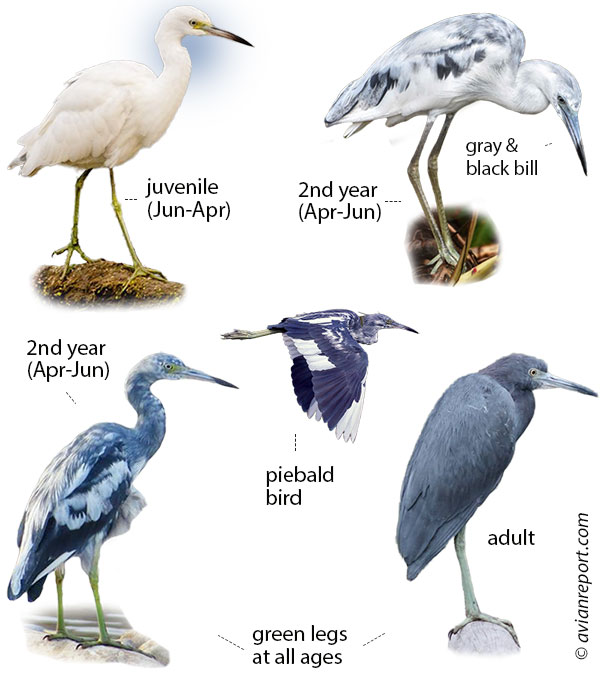
Length: 24″ | Wingspan: 40″ | Weight: 12 0z
Identification: Adults are dark blue-gray with purple-maroon head and neck, greenish legs, and pale gray-and-black bill. Juveniles are all white; immatures are patchy white and blue.
Habitat: The Little Blue Heron (Egretta caerulea) forages in most types of wetlands and flooded fields.
Status and Movements: The Cattle Egret is a rare summer visitor in Manitoba, present from May through September. It associates with pastured livestock in southern regions, wandering north irregularly during the warmer months.
Behavior: Stand-and-wait predator, also moves slowly searching for prey.
Diet: Small fish, frogs, shrimp, insects, and other invertebrates.
Nest: The Little Blue Heron builds a porous twig platform in shrubs or small trees over water; often in mixed colonies.
Breeding: Season: March–October | Clutch: 3–4 pale bluish-green eggs | Incubation: 22–23 days | Nestling: 35–49 days.
Lifespan: Up to 13 years, 11 months.
How many are there? About 1.1 million globally.
Conservation Status: Low concern, though populations have declined.
American Avocet
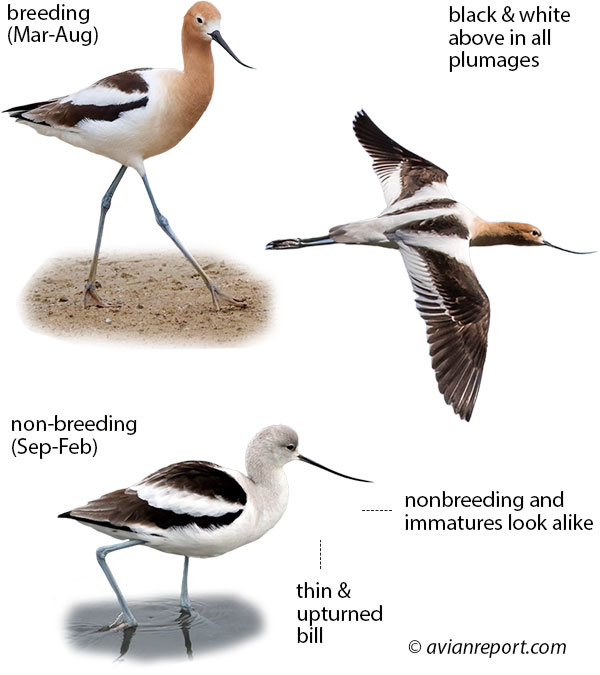
Length: 18″ | Wingspan: 31″ | Weight: 11 oz
Identification: Striking black-and-white body, long upturned bill, and bluish-gray legs. In summer, the head and neck are rusty; in winter, they turn grayish-white.
Habitat: The American Avocet (Recurvirostra americana) forages in shallow freshwater and saltwater wetlands, rice fields, and flooded pastures.
Status and Movements: The American Avocet is an uncommon summer resident and transient in Manitoba, present from May through September. It nests on open mudflats and salt-streaked margins in southwestern prairie regions.
Behavior: Forages by sweeping its bill side to side, pecking, or plunging. Often associated with other shorebirds in flocks.
Diet: American Avocets feed on aquatic invertebrates, plus small fish and seeds.
Nest: A shallow ground scrape, sometimes unlined, located on islands or dikes, with little or no vegetation.
Breeding: Season: late April-early August | Clutch: 3–4 greenish brown with dark spots eggs | Broods: 1 | Incubation: 18–30 days | Nestling: able to walk within 24 hours.
Lifespan: At least 15 years.
How many are there? Global breeding population ~450,000.
Conservation Status: Low Concern.
Common Gallinule
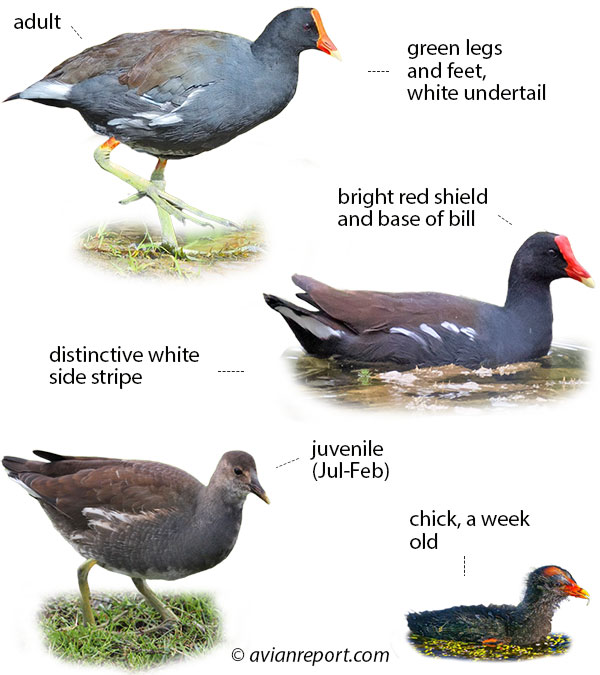
Length: 14″ | Wingspan: 21″ | Weight: 11 oz
Identification: Charcoal gray with a distinct white side stripe. Adults feature a bright red forehead shield and red bill tipped in yellow. Immatures are similar but lack the red shield and bill coloration.
Habitat: The Common Gallinule (Gallinula galeata) inhabits freshwater and brackish wetlands. Also found in ditches, rice fields, sewage, and stormwater ponds.
Status and Movements: The Common Gallinule is an accidental summer vagrant in Manitoba, present from May through August. This species exceptionally rarely reaches northern prairie marshes well outside its normal breeding range.
Behavior: Swims, walks on floating vegetation with a crouched posture, often flicking its tail. Highly territorial during breeding.
Diet: Aquatic vegetation and seeds, plus snails and insects.
Nest: A broad bowl, typically 10–12 inches wide, placed on thick aquatic plant mats.
Breeding: Season: April-August | Clutch: 3–15 light gray with darker specks/spots eggs | Broods: 1–2 | Incubation: 19–22 days | Chicks: leave the nest within 1 day.
Lifespan: At least 9 years, 10 months.
How many are there? Apparently declining.
Conservation Status: Low Concern.
Franklin’s Gull
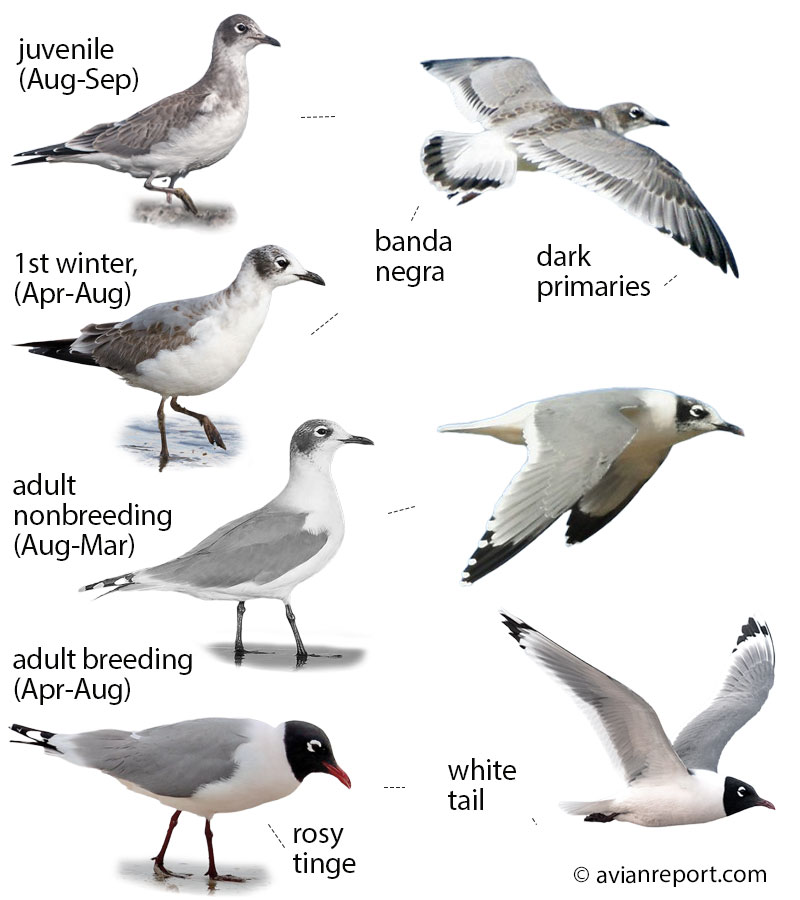
Length: 13″ | Wingspan: 31″ | Weight: 9 oz
Identification: Breeding: Black hood, thick white eye arcs, dark gray mantle, white-tipped black wingtips, pinkish-white breast. Nonbreeding: White face with dark half-hood covering back of head. Juvenile: Brownish-gray back, partial black hood, dark ear patch, black tail band.
Habitatr: Franklin’s Gull (Leucophaeus pipixcan) favors prairie marshes, flooded fields, agricultural lands, coastal estuaries, bays.
Status and Movements: The Franklin’s Gull is an abundant summer resident and transient in Manitoba, present from May through October. Massive colonies nest in extensive marshes, including historic colonies around major southern lakes.
Behavior: The Franklin’s Gull forages by aerial hawking or walking. Highly social, breeds in massive colonies.
Diet: Insects, earthworms, crustaceans, small fish, snails, seeds.
Nest: Floating platform of aquatic vegetation anchored to emergent plants. Breeds in dense colonies.
Breeding: Breeding Months: Late April-July | Clutch: 2-3 Olive, dark-spotted eggs | Broods: 1 | Incubation: 23-26 days | Nestling: ~5 days.
Lifespan: At least 9 years, 4 months.
How many are there?: There are ~1 million to 1.5 million Franklin’s Gulls globally.
Conservation Status: Least Concern.
Bonaparte’s Gull
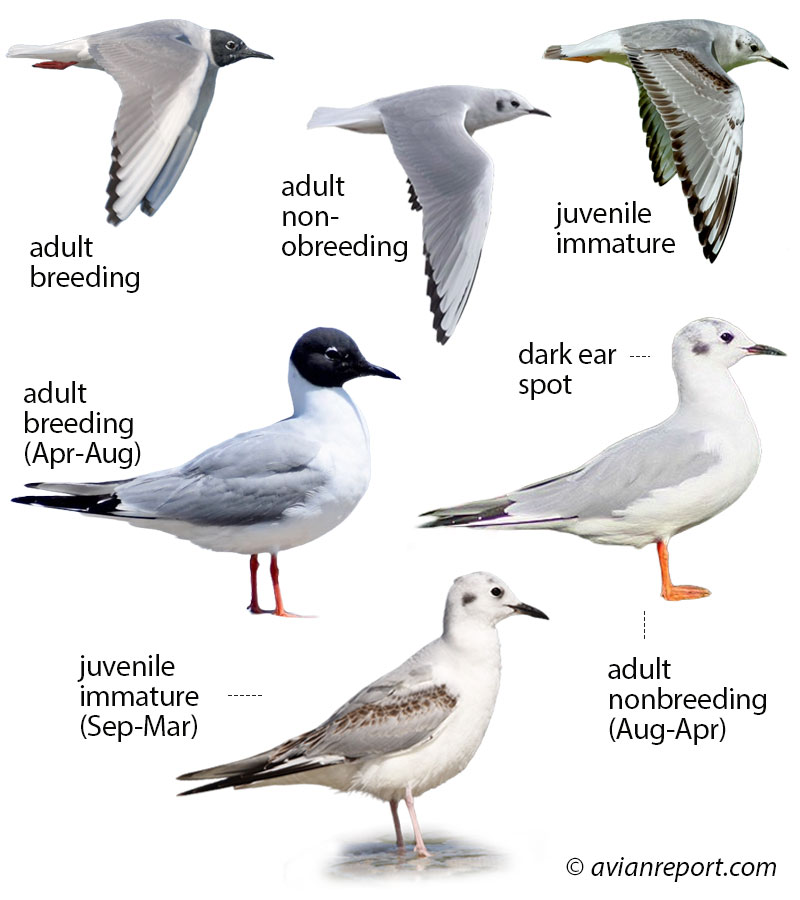
Length: 11.4″ | Wingspan: 37″ | Weight: 8 oz
Identification: Breeding: Black hood, white eye-arcs, red legs, white outer-wing wedges. Nonbreeding: White head, prominent black ear spot, pinkish legs. Juvenile: Brown-scaled upperparts, black “M” pattern across wings, pinkish legs, dark tail band.
Habitat: The Bonaparte’s Gull (Chroicocephalus philadelphia) prefers boreal lakes, rivers, coastal bays, estuaries, mudflats, open ocean, sewage lagoons.
Status and Movements: The Bonaparte’s Gull is a common summer resident and transient in Manitoba, present from May through October. It nests in black spruce bogs up north and passes through southern lakes during migration.
Behavior: The Bonaparte’s Gull forages by surface-picking or plunging. Highly social, often found in large flocks.
Diet: Insects, small fish, crustaceans, marine worms, snails.
Nest: Small platform of sticks and moss built in coniferous trees. Nests solitarily or in loose groups.
Breeding: Breeding Months: Late May-July | Clutch: 2-4 buffy-green with dark blotcher eggs | Broods: 1 | Incubation: 22-25 days | Nestling: ~6-7 days.
Lifespan: At least 18 years.
How many are there?: There are ~475,000 to 700,000 Bonaparte’s Gulls globally.
Conservation Status: Least Concern.
Green Heron
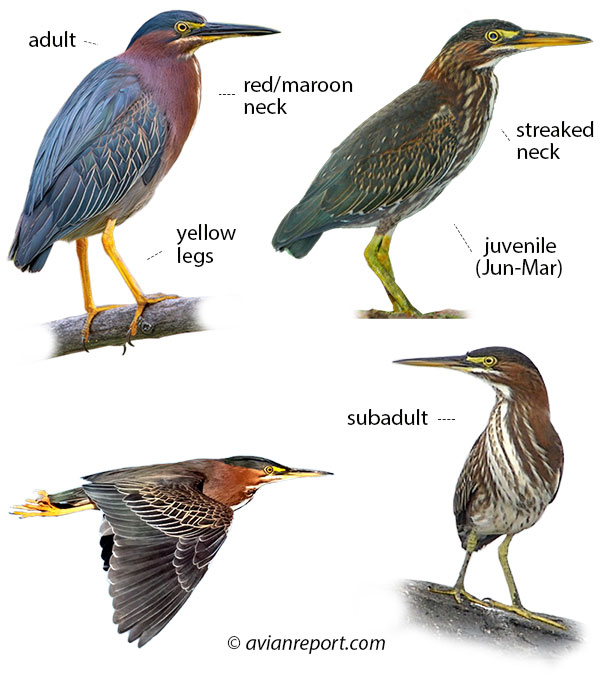
Length: 18″ | Wingspan: 26″ | Weight: 7 oz
Identification: Small heron with velvet-green back, rich chestnut body, and dark cap. Juveniles are browner with pale neck streaks and wing spots.
Habitat: The Green Heron (Butorides virescens) forages in most types of wetlands and ditches.
Status and Movements: The Green Heron is a rare summer resident in Manitoba, present from May through September. It nests solitarily along brushy lake edges and wooded stream corridors in the extreme southeast.
Behavior: Hunts by standing still or walking slowly in shallow water; strikes quickly when prey approaches.
Diet: Green Herons feed on small fish, shrimp, frogs, and insects.
Nest: Simple stick platform, in trees or shrubs. It is a solitary breeder.
Breeding: Season: February–July | Clutch: 3–5 pale green to bluish eggs | Broods: 1–2 | Incubation: 19–21 days | Nestling: 16–17 days.
Lifespan: Up to 8 years, 11 months.
How many are there? About 1.2 million globally.
Conservation Status: Bird in steep decline (~51%).
Black-necked Stilt
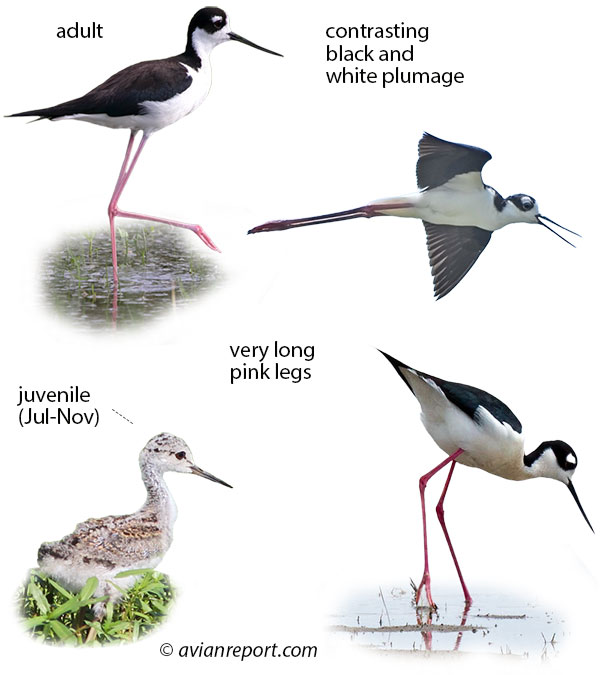
Length: 14″ | Wingspan: 29″ | Weight: 6 oz
Identification: Elegant black-and-white with long rose-pink legs, slender black bill, and a white patch around the eye. Females and juveniles show browner-black plumage in dark areas.
Habitat: The Black-necked Stilt (Himantopus mexicanus) is found in shallow wetlands, mudflats, sewage or evaporation ponds, and mangrove swamps.
Status and Movements: The Black-necked Stilt is a rare summer visitor and accidental breeder in Manitoba, present from May through August. It is observed sporadically on shallow prairie wetland margins and flooded fields.
Behavior: Forages by wading and pecking, sometimes swinging the bill through water. Loud alarm calls and group displays help deter predators.
Diet: Black-necked Stilts eat primarily aquatic invertebrates; also take small amounts of seeds and plant material.
Nest: Shallow ground scrape on islands, in vegetation, or on floating mats.
Breeding: Season: April-August | Clutch: 2–5 tawny olive, dark brown speckling eggs | Broods: 1 | Incubation: 24–29 days | Nestling: Able to run within ~2 hours.
Lifespan: At least 12 years, 5 months.
How many are there? Estimated global, 900,000 individuals.
Conservation Status: Low Concern.
Belted Kingfisher
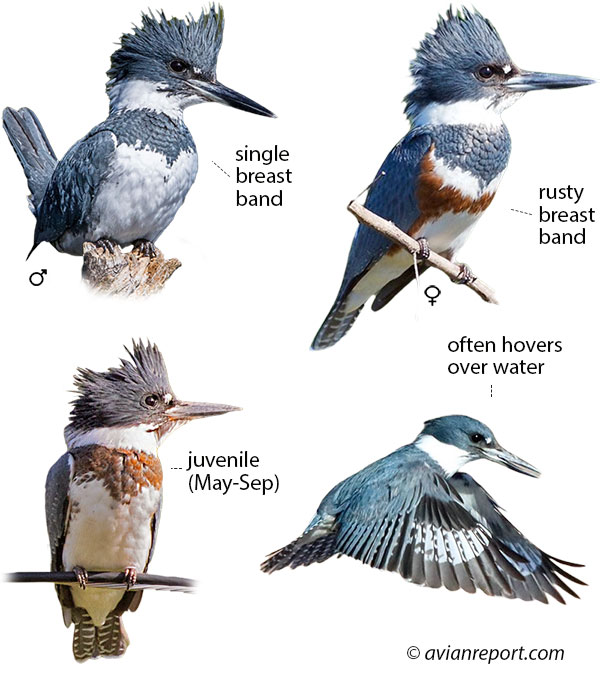
Length: 13″ | Wingspan: 20″ | Weight: 5 oz
Identification: Stocky, large-headed bird with shaggy crest, thick bill. Blue-gray above, white below with blue breast band. Females have rusty belly bands. Juveniles show rusty spotting.
Habitat: The Belted Kingfisher (Megaceryle alcyon) forages at streams, rivers, ponds, lakes, estuaries, and human-made pits.
Status and Movements: The Belted Kingfisher is a common summer resident and transient in Manitoba, present from May through October. It breeds along steep riverbanks, departing south before inland waterways freeze completely.
Behavior: Forages alone from a perch or by hovering, diving for prey. Territorial and solitary. Loud rattling calls.
Diet: Fish, crayfish, insects, amphibians, young birds, small mammals, berries.
Nest: Burrow in earthen bank near water, 3–6 ft deep, sloping upward to unlined chamber.
Breeding: Season: Mid-March-Late July | Clutch: 5–8 pure white eggs | Broods: 1–2 | Incubation: 22–24 days | Nestling: 27–29 days.
Lifespan: Typically 6 to 10 years.
How many are there? Global breeding population ~1.8 million.
Conservation Status: Low Concern.
Forster’s Tern
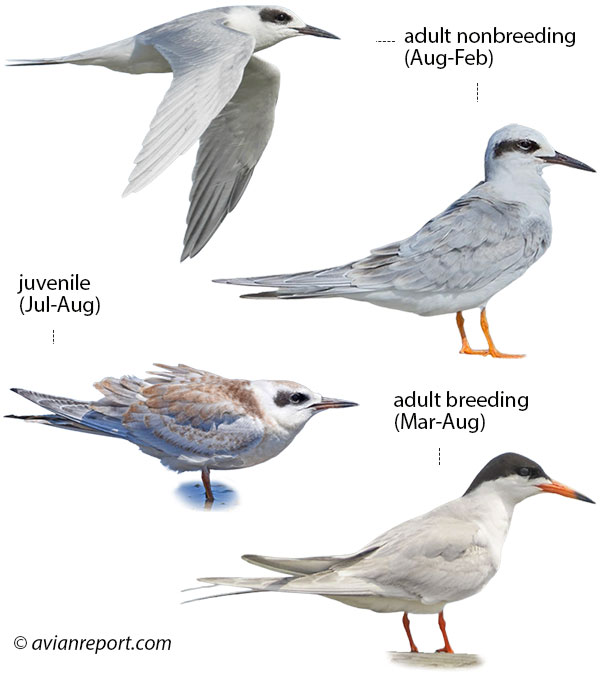
Length: 13″ | Wingspan: 31″ | Weight: 6 oz
Identification: Breeding adults are gray above, white below, with a black cap and an orange bill tipped in black. Nonbreeding adults have a thick black eye patch and a pale head. Juveniles resemble nonbreeding birds but have tan upperparts, a pale bill base, and shorter tails.
Habitat: The Forster’s Tern (Sterna forsteri) uses freshwater, brackish, and saltwater wetlands and bodies of water.
Status and Movements:
Behavior: Forages mainly by plunge-diving for fish; sometimes hunts from perches. Highly social, often in flocks.
Diet: Forster’s Terns feed on small fish and insects.
Nest: A shallow scrape or rough bowl on the ground in marsh vegetation, floating mats, or atop muskrat lodges.
Breeding: Season: May-mid August | Clutch: 1–4 olive with dark spots eggs | Broods: 1 | Incubation: 23–28 days | Nestling period: 2–7 days.
Lifespan: At least 15 years, 10 months.
How many are there? ~98,000 global breeders.
Conservation Status: Low Concern.
Great-tailed Grackle
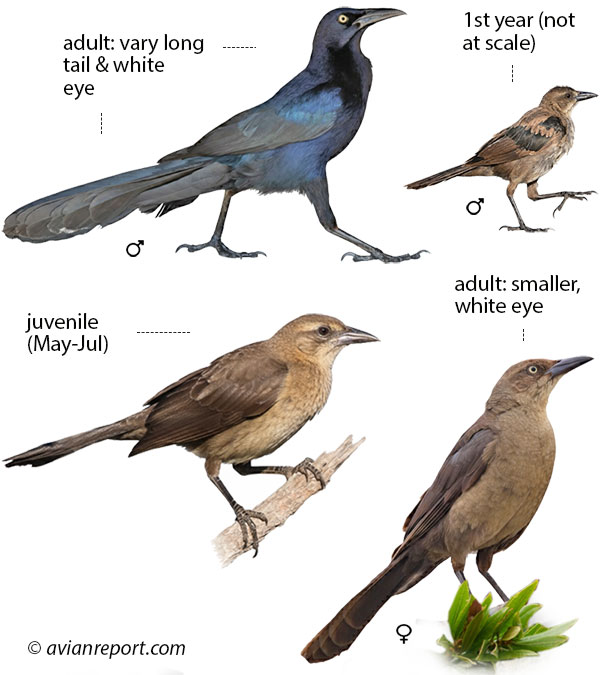
Identification: Male iridescent black, white eyes, massive keel-shaped tail. Female dark brown, white eyes. Juveniles have dark brown eyes. Overlaps with similar Boat-tailed Grackle (above) in coastal Texas, but Boat-tails are confined to salt marshes and have brown eyes, unlike the white-eyed Great-tailed Grackle found in varied habitats.
Habitat: Marshes, lakes, lagoons, agricultural fields, feedlots, suburbs.
Status and Movements: The Great-tailed Grackle is an accidental summer vagrant in Manitoba, present from May through August. This southern blackbird exceptionally rarely wanders north into southern agricultural areas and wetlands.
Behavior: Highly social, loud birds. Often form large flocks. Forages in urban settings.
Diet: Grains, fruits, insects, tadpoles, frogs, fish, small mammals.
Nest: Bulky cup woven from grasses, bark, and weeds. Lined with mud and fine grasses.
Breeding: Breeding Months: mid-March-late July | Clutch: 1-5 bright blue to bluish gray, dark brown splotches eggs | Broods: 1-2 | Incubation: 13-14 days | Nestling: 20-23 days.
Lifespan: At least 7 years, 9 months.
How many are there? Global population ~30 million individuals.
Conservation Status: Low Concern.
Wilson’s Snipe
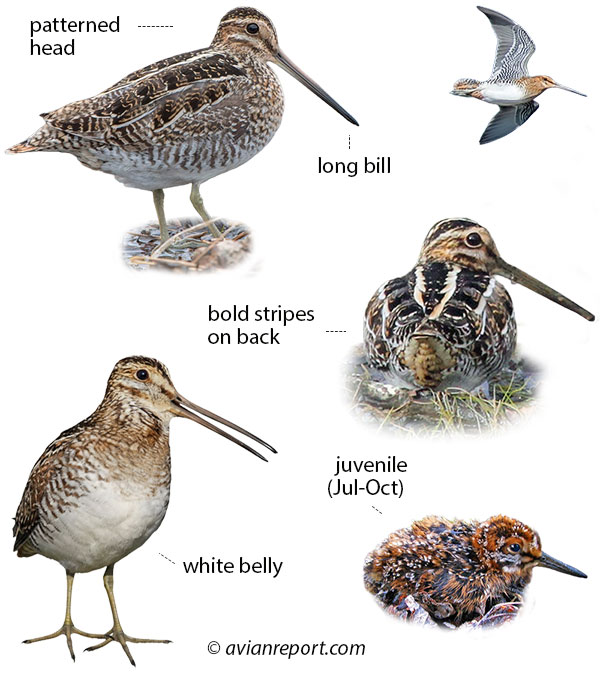
Identification: Pudgy bird, very long straight bill. Intricately patterned. Hatchlings tan/chestnut down, black blotches, white crown streak.
Habitat: The Wilson’s Snipe (Gallinago delicata) forages in marshes, bogs, fens, wet meadows, rivers, ponds, wet pastures, muddy pond edges, and damp fields.
Status and Movements: The Wilson’s Snipe is a common summer resident and transient in Manitoba, present from May through October. It breeds extensively in northern peatlands and wet sedge meadows across the province.
Behavior: Probes wet soil methodically. Swallows prey without removing bill. Elusive. Performs winnowing courtship display.
Diet: Wilson’s snipes feed on aquatic invertebrates, insect larvae, worms, snails, crustaceans. Occasionally lizards, frogs, and fish.
Nest: Shallow scrape in moist soil. Lined with coarse and finer grasses. Hidden on ground near water.
Breeding: Breeding Months: Mid-March-late August | Clutch: 2-4 olive brown splotched dark brown eggs | Incubation: 18-20 days | Nestling: Chicks leave the nest day of hatching.
Lifespan: At least 9 years, 3 months.
How many are there? Global population ~2 million individuals.
Conservation Status: Low Concern.
Killdeer
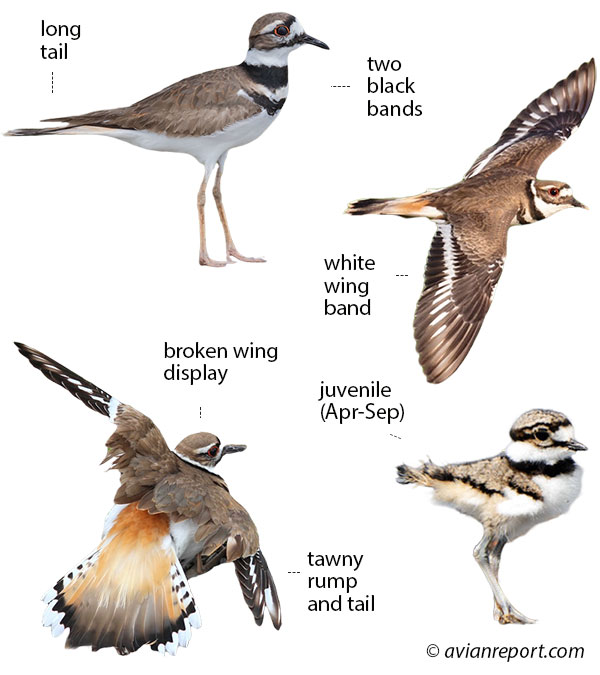
Length: 11″ | Wingspan: 24″ | Weight: 3.3 oz
Identification: Brownish-tan above, white below, with two distinct black breast bands and a black-and-white patterned face. Chicks with a single black breast band.
Habitat: The Killdeer (Charadrius vociferus) forage on lawns, pastures, golf courses, athletic fields, parking lots.
Status and Movements: The Killdeer is an abundant summer resident and transient in Manitoba, present from April through October. It nests widely on gravel shores, pastures, roadsides, and cultivated agricultural fields.
Behavior: Forages by running and stopping to search the ground for food. Famous for the “broken-wing” distraction display to protect nests.
Diet: Killdeer feed on earthworms, grasshoppers, beetles, aquatic insect larvae, seeds, and frogs.
Nest: A shallow ground scrape, often decorated with rocks, shells, sticks, or debris.
Breeding: Season: March-October | Clutch: 4–6 buff with heavy blackish markings eggs | Broods: 1–3 | Incubation: 22–28 days | Nestlings: leave nest as soon as down is dry.
Lifespan: At least 10 years, 11 months.
How many are there? ~2.3 million global breeders.
Conservation Status: Low Concern.
Virginia Rail
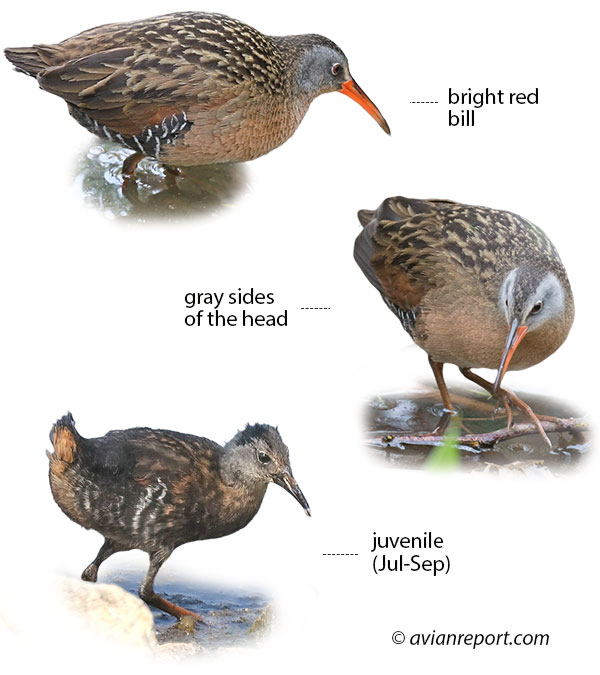
Length: 9.5″ | Wingspan: 13″ | Weight: 3 oz
Identification: Small, chickenlike with bill and short, upturned tail. Rusty overall with a gray face and black-and-white barred sides. Legs and bill are reddish.
Habitat: The Virginia Rail (Rallus limicola) inhabits shallow freshwater wetlands as well as muddy bottoms, saltmarshes, and brackish wetlands.
Status and Movements: The Virginia Rail is an uncommon summer resident and transient in Manitoba, present from May through September. It breeds in shallow emergent wetlands, relying on dense vegetation for concealment.
Behavior: Forages by probing mud for prey. Usually solitary. Notable for jerky movements and frequent tail flicking.
Diet: Virginia Rails feeds on insects, small fish, frogs, and plant material including seeds in winter.
Nest: Woven basket of wetland vegetation, placed on floating mats at or just above the water surface.
Breeding: Clutch: 4–13 white/buff with sparse irregular brown spots eggs | Broods: 1–2 | Incubation: 18–20 days | Young: Leave nest after 3–4 days.
Lifespan: Not available.
How many are there? Trends appear stable, though difficult to estimate due to secretive behavior.
Conservation Status: Low conservation concern.
Sora
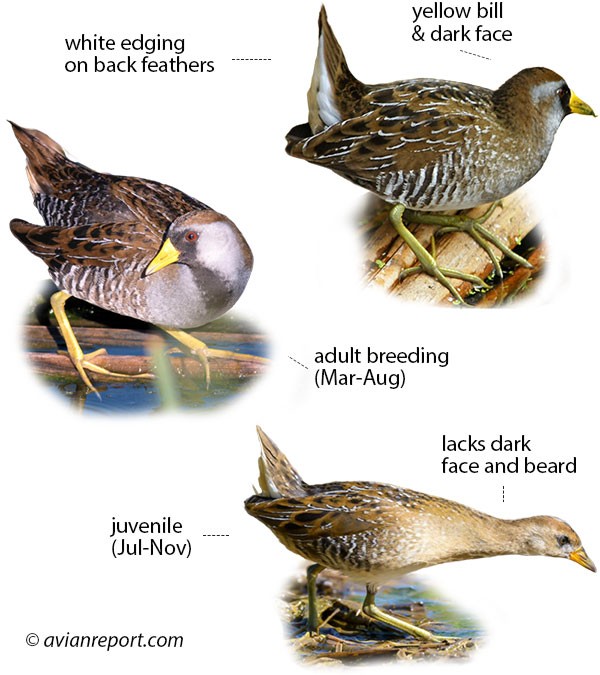
Length: 8.7″ | Wingspan: 14″ | Weight: 2.6 oz
Identification: Small, chubby rail with mottled gray and brown plumage. Distinctive yellow bill, black mask and throat patch. Females are duller with less black on the face and throat; juveniles lack the mask. Short tail is often cocked upward.
Habitat: The Sora (Porzana carolina) inhabits freshwater and brackish wetlands, wet pastures, ditches, and flooded fields during migration and winter.
Status and Movements: The Sora is a common summer resident and transient in Manitoba, present from May through September. It utilizes cattail and sedge marshes statewide for breeding, departing before heavy frosts.
Diet: Soras feed on seeds and aquatic invertebrates.
Nest: Shallow basket of cattails or sedges, built on mounds or attached to stems above shallow water.
Breeding: Season: May-August | Clutch: 6–10 cream to cinnamon with irregular brown spots eggs | Broods: 1–2 | Incubation: 17–20 days | Chicks: Leave the nest within 1 day.
Lifespan: Not available.
How many are there? Stable; Considered abundant.
Conservation Status: Low conservation concern.
Yellow-headed Blackbird
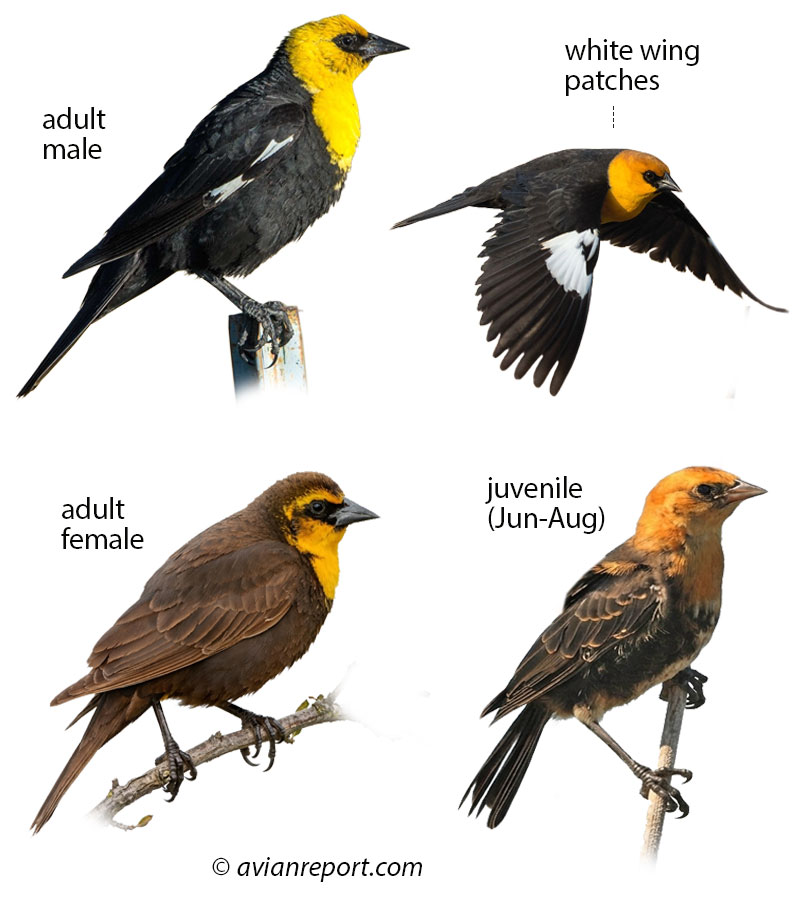
Length: 9″ | Wingspan: 17″ | Weight: 2.5 oz
Identification: Breeding: Adult male black with bright yellow head/breast, white wing patches. Female/Immature male: Dull yellow head/breast, dusky brown body, lacks wing patches. Nonbreeding: Males retain yellow, but feathers tipped with dusky; females/immatures even duller. Juvenile: Buff-colored head and throat, brownish-gray body.
Habiat: The Yellow-headed Blackbird (Xanthocephalus xanthocephalus) uses freshwater marshes, wetlands, agricultural fields, pastures, prairies.
Status and Movements: The Yellow-headed Blackbird is a common summer resident and transient in Manitoba, present from May through September. It breeds colonially in deep-water cattail stands across southern prairie zones.
Behavior: The Yellow-headed Blackbird forages by gleaning and ground-picking. Highly social; breeds in dense, territorial colonies.
Diet: Insects, spiders, seeds, grains.
Nest: Deep, woven cup of wet vegetation lashed to standing marsh plants. Breeds in colonies.
Breeding: Breeding Months: May–July | Clutch: 2–5 Grayish-white, brown-spotted eggs | Broods: 1–2 | Incubation: 11–13 days | Nestling: 9–14 days.
Lifespan: At least 11 years, 8 months.
How many are there?: There are ~11 million Yellow-headed Blackbirds globally.
Conservation Status: Least Concern.
Black Tern
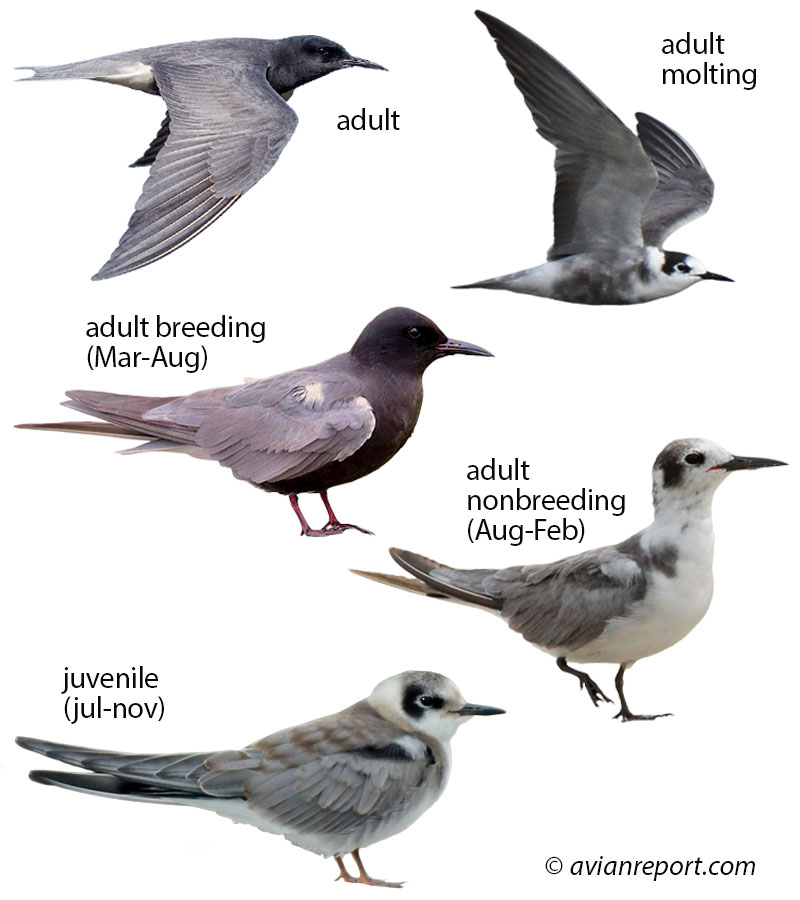
Length: 12″ | Wingspan: 23″ | Weight: 2 oz
Identification: Breeding: Jet-black head and underparts, gray wings and tail, white undertail coverts. Nonbreeding: White face and underparts, dark crown and ear patch, dark smudge on breast sides. Juvenile: Similar to nonbreeding adults but with brown scaling on back and wings.
Habitat: The Black Tern (Chlidonias niger)Freshwater marshes, lake edges, wet prairies, coastal lagoons, open ocean.
Status and Movements: The Black Tern is a common summer resident and transient in Manitoba, present from May through September. It nests on fragile floating vegetative debris inside semi-permanent prairie marshes.
Behavior: The Black Tern forages by hovering and dipping. Social, breeds in loose colonies, migrates in flocks.
Diet: Insects, small fish, spiders, crustaceans, tadpoles.
Nest: Fragile, floating cup of vegetation in shallow water. Breeds in loose colonies.
Breeding: Breeding Months: Mid-May-August | Clutch: 2-4 olive, dark-spotted eggs | Broods: 1 | Incubation: 17-22 days | Nestling: 18-24 days.
Lifespan: At least 11 years, 3 months.
How many are there?: There are ~850,000 Black Terns globally.
Conservation Status: Least Concern.
Red-winged Blackbird
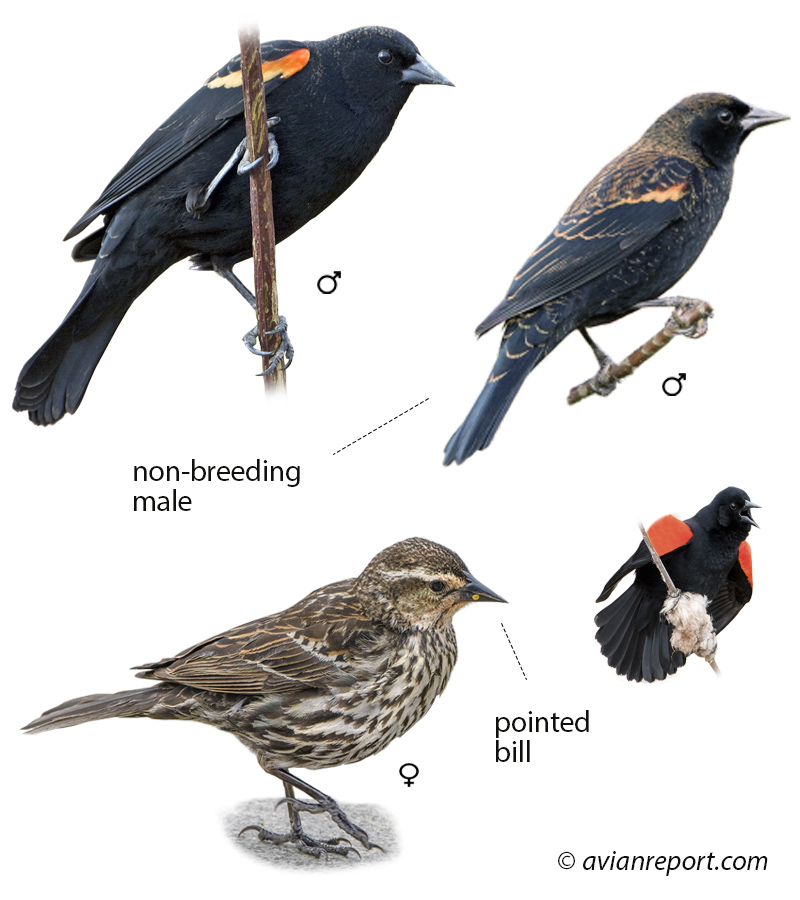
Length: 9″ | Wingspan: 13″ | Weight: 1.8 oz
Identification: Adult males are glossy black with bright scarlet-and-yellow shoulder patches. Females are streaky dark brown with a paler breast and a whitish eyebrow.
Habitat: The Black Tern (Chlidonias niger) uses freshwater or saltwater marshes and the like, agricultural fields, feedlots, wet roadsides, and even golf courses.
Status and Movements: The Red-winged Blackbird is an abundant summer resident and transient in Manitoba, present from April through October. It breeds ubiquitously across every roadside ditch, cattail marsh, and wet meadow.
Behavior: Males sing from high perches and aggressively defend territories. Highly social, with winter roosts often numbering in the millions, mixed with other blackbirds.
Diet: Red-winged Blackbirds feed on insects in summer; seeds and grains in winter.
Nest: Females build a cup-shaped nest in marsh vegetation, shrubs, trees, or crops.
Breeding: Season: April-early August | Clutch: 2–4 pale blue-green to gray with dark markings eggs | Broods: 1–2 | Incubation: 11–13 days | Nestling: 11–14 days.
Lifespan: At least 15 years, 9 months.
How many are there? ~180 million globally.
Conservation Status: Low concern.
Yellow Rail
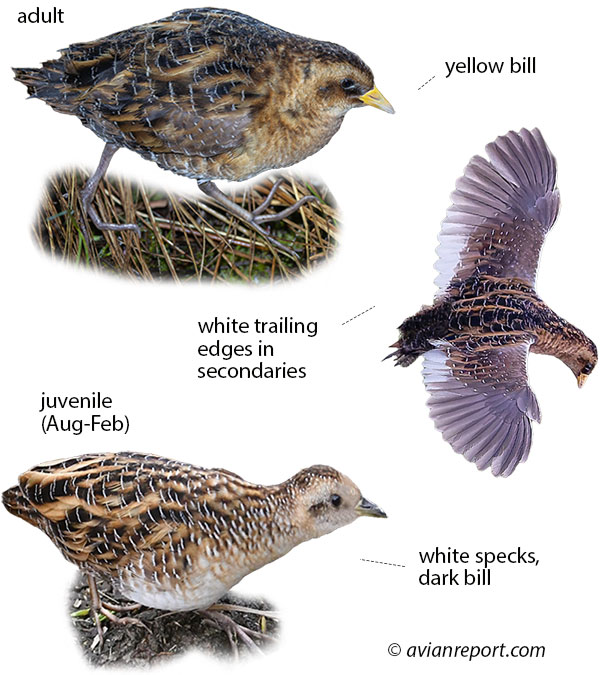
Length: 7.3″ | Wingspan: 11″ | Weight: 1.8 oz
Identification: Small, brownish-yellow plumage. Paler yellowish face and breast with a dark cheek smudge. Juveniles are duller with fine barring on the nape, sides, and breast.
Habitat: The Yellow Rail (Coturnicops noveboracensis) inhabits shallow freshwater sedge marshes, wet meadows, saltgrass marshes, agricultural fields, and grassy cover.
Status and Movements: The Yellow Rail is an uncommon summer resident and transient in Manitoba, present from May through September. It breeds secretly within the vast, shallow sedge fens of central and southern regions.
Behavior: Walks quietly picking invertebrates and seeds. Rarely flies. Runs quickly through grass like a rodent.
Diet: Feeds on aquatic invertebrates, crustaceans, as well as seeds.
Nest: Yellow Rails nest on the ground. Build a small cup (~3.4 in across) covered with a canopy.
Breeding: Season: mid-May-early September | Clutch: 4–10 creamy buff with brown speckling eggs | Chicks: leave the nest within 1 day.
Lifespan: Not available.
How many are there? Global population over 12,000 individuals.
Conservation Status: Species of concern with more than 50% decline in the past 50 years.
Foraging Strategy and Habitat use as tools to Identify Manitoba Wetland Birds
Even though many birds share wetlands, they don’t all feed in the same way. Each species uses specific strategies—diving, wading, probing mud, or hunting from the air—based on its food preferences and adaptations. For birdwatchers, knowing these foraging groups helps predict where certain species are most likely to be found in a wetland, making it easier to spot and identify them.
The table below summarizes the main foraging groups of Manitoba’s wetland birds, their preferred habitats, and representative species.
| Foraging Group | General Description of Strategy | Preferred Habitat Type | Representative Species |
| Diving Birds | Forage by diving beneath the water’s surface to find food. | Open, deep water (lakes, rivers, coastal areas) | Grebes, cormorants, anhingas |
| Open Water Waders | Forage by wading in shallow water with low-density vegetation. | Shallow water with low vegetation | Herons, egrets, ibises, storks, cranes, spoonbills, avocets, stilts |
| Dense Vegetation Waders | Forage by wading in shallow water surrounded by dense vegetation. | Shallow water with dense vegetation | Night herons, green herons, bitterns, rails, limpkin |
| Dipping/Dabbling Foragers | Forage by surface dipping or “tipping” in shallow water. | Shallow water, ponds, marshes with dense vegetation | Coots, gallinules |
| Moist-soil Foragers | Forage in muddy or moist-soil areas along the shoreline. | Muddy areas, moist soil, shorelines | Ibises, killdeer, rails, gallinules |
| Aerial Piscivores/snail eaters | Use perches or flight to spot and dive for prey. | Open water, often near perches or trees | Terns, kingfishers, eagles, osprey |
Manitoba Wetland Bird Hotspots: Top 5 Locations for Viewing
Manitoba’s diverse aquatic habitats support substantial concentrations of herons, rails, coots, grebes, and others. From the iconic prairie potholes to the vast coastal marshes of the north, these northern wetlands provide globally significant breeding and staging grounds.
Oak Hammock Marsh Wildlife Management Area: Located in southwestern Manitoba just north of Winnipeg, this restored 36-square-kilometre marsh features extensive cattail beds, mudflats, and lures millions of migrants. It hosts incredible numbers of nesting and migrating species, including Franklin’s Gulls, Eared Grebes, and Sora Rails.
Delta Marsh: Situated on the south shore of Lake Manitoba, this massive freshwater coastal marsh comprises a dynamic network of shallow bays, channels, and rich beach ridges. It acts as a critical stopover and breeding habitat for specialized species like American Bitterns, Western Grebes, and Canvasbacks.
Whitewater Lake Wildlife Management Area: Positioned in southwestern Manitoba near Deloraine, this large, shallow alkaline lake is flanked by expansive mudflats and emergent marshes. The rich, mineral-heavy waters reliably attract globally significant populations of shorebirds and waterbirds, including American Avocets, White-faced Ibises, and Black Terns.
Netley-Libau Marsh: Located at the southern tip of Lake Winnipeg, this massive 250-square-kilometre freshwater delta contains shallow lakes, channels, and wet meadows. It provides vital foraging and nesting territory for high concentrations of water-dependent species like Great Blue Herons, Double-crested Cormorants, and Pied-billed Grebes.
Churchill River Estuary: Situated in northern Manitoba along the Hudson Bay coast, this unique subarctic tidal estuary boasts expansive mudflats, salt marshes, and shallow marine waters. It serves as a legendary nesting and staging ground for high-value northern species like Pacific Loons, Sabine’s Gulls, and Tundra Swans.
Conclusions
The identification guide for the 51 wetland birds of Manitoba Province is based on the principles of citizen science. Species include Herons, Egrets, and Bitterns, Rails, Coots, Gallinules, and Swamphens, Loons, Gulls & Terns, Pelicans, Cormorants, and Anhinga, Ibises, Cranes, Avocets and Stilts, Snipes & Woodcock, Blackbirds, Grebes, Killdeer, and Kingfishers.
The list of species included in this guide are largely derived from observations submitted by bird enthusiasts participating in the eBird project of the Cornell Lab of Ornithology.
This guide helps you distinguish male, female, and juvenile plumages through clear illustrations. Familiarize yourself with these waterfowl to improve your identification skills and enhance your outdoor experiences.
Photo Credits:
The photographic material used in this guide was made available on various websites. Many thanks to Andrew Morffew, Mark Mochell, Elizabeth Milson, Duzan Brinkhuizen, Dennis Church, Wendy Miller, Rick From Alabama, John Benson, Mick Thompson, Steve Guttman, Victor Espinoza, Kelly Colgan-Azar, Andy Reago, Chrissy McLaren, Garry C., Linda Fortuna, Vicky DeLoach, Paul Hurtado, Tom Murray, Tom Wilberding, Kenneth Cole-Schneider, Doug Greenberg, Brian Garrett, David White, Becky Matsubara, Dan Mooney, Hal Trachtenberg, Lloyd Davis, Denis Fournier, Gregory Heaton, hharryus, Greg Lavaty, Dona Hilkey, Joshua Mayer, Aaron Maizlish, Ashley Tubs, Richard George, Sandra Minica, Nick, Jon valentine, Steve Valasek, Mitch Walters, Kurayba and Julio Mulero.
Voices:
Most recordings were made by Paul Marvin (Xeno-canto https://xeno-canto.org/contributor/RFTXRYBVBX)
References and Sources:
- Allaboutbirds.org
- eBird. (https://ebird.org/)
- Birds of the World: https://birdsoftheworld.org/bow/home
- Gill, Frank B., 1994. Ornithology – 2nd Edition, W. H. Freeman and Company.
- Sibley, David, 2000, The Sibley Guide to Birds. Alfred A. Knopf, Publisher.
- Species Longevity Data: United States Geological Survey (https://www.usgs.gov/)
- The Sibley Guide to Bird Life and Behavior, 2001. Chris Elphick, John Dunning, and David Sibley (eds). Alfred A. Knopf, New York.
Author:
