
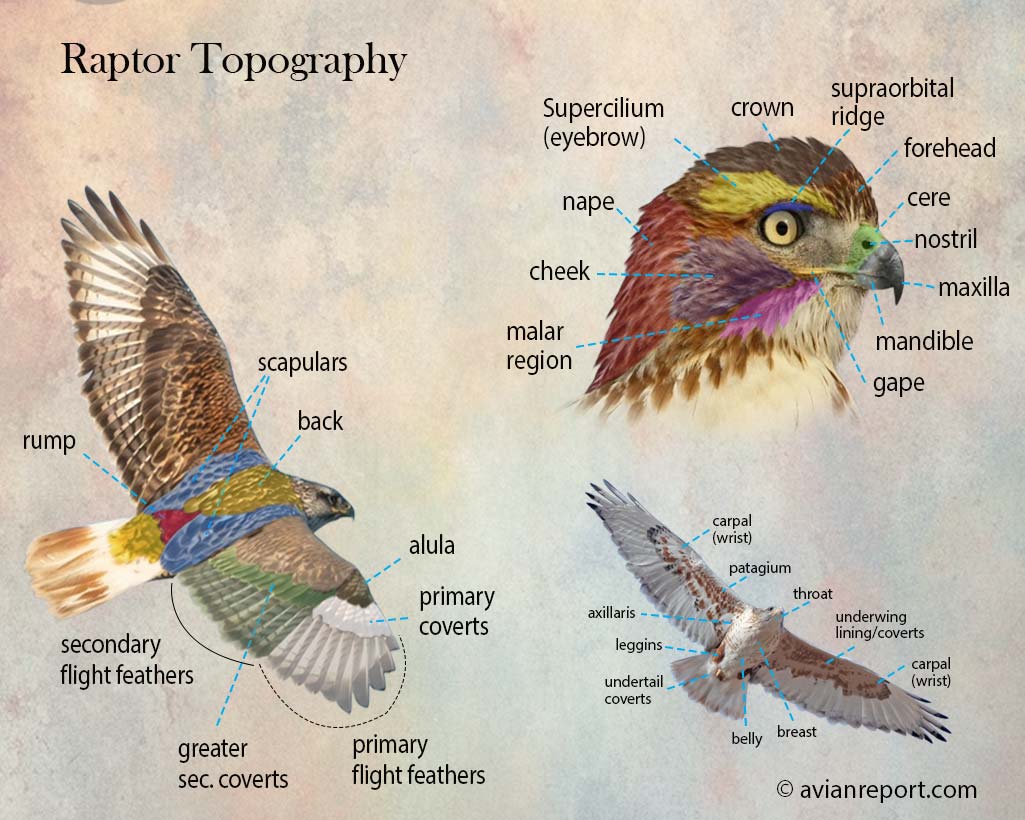
Field identification of “Raptors” or “Birds of Prey” is notoriously challenging. These birds are often seen from a distance, moving at high speeds, or obscured by branches and forest canopies. Relying on color alone frequently fails due to harsh lighting, changing shadows, or regional color morphs.
To transition from guessing to precision birding, you need to understand raptor topography—the systematic mapping of a bird’s external anatomy and plumage fields. Learning the precise layout of a raptor’s body can help you train your eyes to look past distracting variables and focus on consistent structural clues. Once you understand how these physical components vary, you can apply this knowledge to categorize and identify birds of prey in the field.
Raptor Anatomy in Field Identification
Field guides do not just describe birds in vague terms; they rely on a highly specific anatomical shorthand. When a guide instructs you to look for a “dark patagial bar” or a “heavily streaked belly band,” it expects you to know exactly where on the bird’s body those features reside.
Learning raptor topography unlocks three major advantages:
- Overcoming Optical Illusions: A bird seen in backlighting will lose its color, but its structural plumage boundaries remain constant.
- Streamlined Collaboration: Knowing this vocabulary allows you to communicate accurately with the birding or raptor community, write precise field notes, and log high-quality data on citizen science platforms like eBird.
- Rapid Elimination: Recognizing a specific anatomical feature can instantly eliminate dozens of look-alike species in a fraction of a second.
Perched vs. In-Flight Anatomy: Why You Need Both
A single raptor can look radically different depending on its posture. To build a complete identification profile, it is necessary to study the bird in two distinct states:
The Perched Profile (The Static View)
When a raptor is at rest on a telephone pole, a rocky outcrop, or a tree branch, it tucks away its flight feathers. Your focus here shifts to body proportions, facial markings, sensory organs, and the relationship between the folded wings and the tail tips. This view is essential for identifying birds of prey.
The Flight Profile
The moment a raptor takes flight, its entire appearance transforms. Hidden feather fields open up, and aerodynamic structures take center stage. Underwing patterns, the structural composition of the wing linings, and tail configurations become your primary tools. This view is crucial at migratory hawk-watch sites, where birds are viewed almost exclusively from below against an open sky.
The Perched Raptor
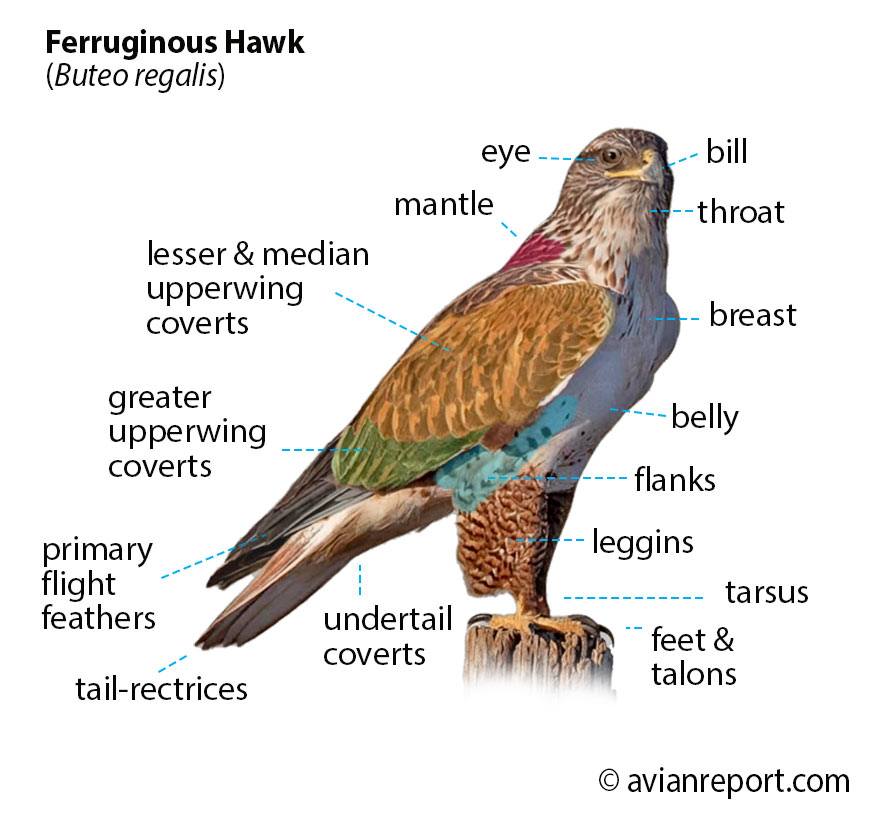
Use the composite plate below to familiarize yourself with a raptor at rest. This section details the core structural zones.
Body & Torso Anatomy
- Bill: The entire bony, keratin-covered jaw structure comprising both the maxilla and mandible, heavily specialized for hooking, tearing, and processing prey.
- ID Field Mark: The Snail Kite features an extraordinarily long, slender, deeply curved bill specifically evolved to reach deep inside Apple Snail shells, distinguishing it from any other North American raptor.
- Throat: The area directly beneath the lower bill, often bordered by malar stripes.
- ID Field Mark: The Peregrine Falcon features a clean, stark white throat that sharply contrasts with its dark hood, while a juvenile Cooper’s Hawk displays fine, vertical brown streaks.
- Chest / Breast: The upper anterior torso located just below the throat and above the abdomen.
- ID Field Mark: The Red-tailed Hawk typically exhibits a pale, unmarked upper breast, creating a strong contrast with its heavily streaked lower belly.
- Belly / Abdomen: The lower central torso bordered by the breast, flanks, and vent.
- ID Field Mark: The Red-tailed Hawk is famously diagnosed by its “belly band”—a horizontal row of dark streaks across this specific region.
- Flanks: The lateral regions of the torso, located on the sides of the body just below the folded wings.
- ID Field Mark: The Merlin and Sharp-shinned Hawk feature heavily barred or streaked flanks that remain highly visible when perched or soaring.
Legs & Feet
- Leggings / Tibial Feathering: The dense feathers covering the tibia directly above the tarsus.
- ID Field Mark: The Ferruginous Hawk boasts deep rufous-colored leggings that contrast sharply against its white underbody, a key feature in flight.
- Tarsus: The lower, typically unfeathered leg segment between the heel joint and toes.
- ID Field Mark: The Rough-legged Hawk and Golden Eagle are “booted,” meaning the tarsus is completely feathered to the toes for insulation, separating them from bare-legged species like the Osprey.
- Talons: The sharp, curved claws at the tips of the toes engineered for gripping, piercing, and dispatching prey.
- ID Field Mark: The Osprey possesses highly curved, specialized talons alongside spiny foot pads (spicules) designed specifically to hold slippery, live fish.
Upper Body & Wings: Perched Bird
- Mantle: The upper back region below the nape, nestled between and flanked by the scapular feathers.
- ID Field Mark: The adult Snail Kite features a uniform, charcoal-slate mantle, whereas the Bald Eagle displays a deep, solid chocolate-brown mantle.
- Lesser & Median Upperwing Coverts: The dense, small feather layers lining the leading edge (shoulder) of the upperwing.
- ID Field Mark: The Golden Eagle develops a prominent, golden-buff diagonal bar across these coverts as it matures, highly visible on perched or soaring birds.
- Greater Upperwing Coverts: The large, elongated row of upper feathers that directly overlays the basal section of the flight feathers (remiges).
- ID Field Mark: In many juvenile Buteos (like the Broad-winged Hawk), pale tips on these coverts create a distinct, light horizontal line across the upperwing.
- Primaries (Flight Feathers / Remiges): The long, outer flight feathers originating from the wing’s “hand” that form the wingtip when open and the wing’s trailing point when folded.
- ID Field Mark: The Turkey Vulture is identified by its silvery-grey primary and secondary remiges, which contrast sharply against its black upperwing coverts.
Tail & Undertail
- Tail Feathers (Rectrices): The structural flight feathers of the tail, occurring in even pairs, with the central pair overlapping on top when folded.
- ID Field Mark: The Northern Harrier is defined by a bright white patch directly above these feathers on its upper rump, while the adult Red-tailed Hawk is named for the solid brick-red coloration across the entire upper surface of these rectrices.
- Undertail Coverts: The soft, protective feathers overlapping the ventral base of the tail feathers.
- ID Field Mark: The Grey Hawk features clean, white undertail coverts, whereas a Northern Goshawk displays fluffy, stark-white undertail coverts that expand visually during courtship displays.
Head & Facial Structure
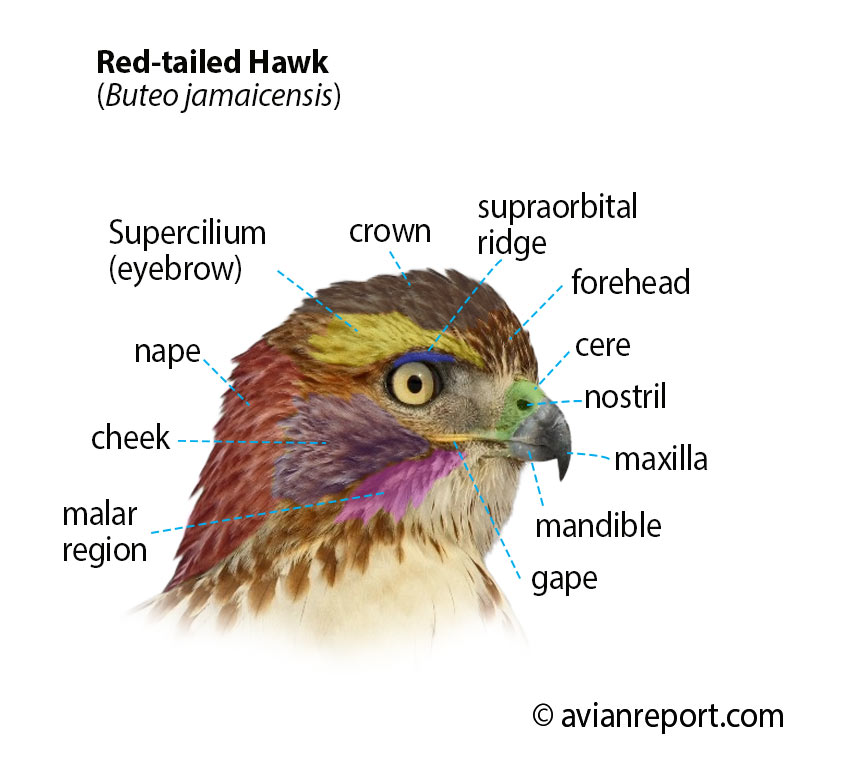
- Cap / Crown: The highest dorsal portion of the bird’s head, extending from above the eyes back to the nape.
- ID Field Mark: The adult Cooper’s Hawk features a dark, contrasting cap that stops sharply at the neck, whereas the Sharp-shinned Hawk has a dark hood that bleeds continuously from the crown down into the nape.
- Supraorbital Ridge: The bony protuberance directly above the eye socket that shades the eye from glare and gives raptors their characteristic fierce expression.
- ID Field Mark: The Golden Eagle possesses a massive, deeply pronounced supraorbital ridge that heavily shades its eyes, helping field observers distinguish its prominent brow line from the flatter profile of a Bald Eagle.
- Forehead: The small facial area situated directly between the base of the upper bill (cere) and the crown.
- ID Field Mark: The adult White-tailed Hawk features a stark, clean white forehead patch that contrasts beautifully with its dark face and crown.
- Cere: The bare, brightly colored, fleshy membrane situated immediately at the base of the upper bill.
- ID Field Mark: The Swainson’s Hawk displays a bright, vibrant yellow cere that creates a stark visual anchor against its dark throat and hood.
- Nostril / Nare: The respiratory opening positioned securely within the fleshy tissue of the cere.
- ID Field Mark: Falcons, such as the Peregrine Falcon, feature a specialized bony tubercle (or cone) inside the nare that deflects high-velocity air, allowing them to breathe normally during high-speed hunting dives.
- Maxilla: The structural framework of the upper bill, typically curved into a sharp, downward hook for tearing flesh.
- ID Field Mark: Falcons possess a unique, sharp protrusion on the cutting edge of the maxilla called a tomial tooth—used to quickly dispatch prey—which is distinctly absent on the smooth bills of hawks and eagles.
- Mandible: The structural framework of the lower portion of the bill.
- ID Field Mark: In the Golden Eagle, the mandible is deep, creating a heavy, oversized silhouette that is unmistakable even at a great distance.
- Gape: The wide, fleshy corner of the mouth opening where the upper and lower jaws meet.
- ID Field Mark: The Ferruginous Hawk features a yellow gape creating a highly visible facial border.
- Supercilium: The row of feathers running from the base of the bill, over the eye, and toward the back of the head; frequently called the “eyebrow.”
- ID Field Mark: The adult Northern Goshawk is famously recognized by its broad, piercing, stark-white supercilium that flashes vividly against its black face mask.
- Nape: The dorsal, or hind, section of the bird’s neck.
- ID Field Mark: The Golden Eagle is named for the beautiful, lanceolate, golden-tawny feathers covering its nape, which glow brightly when caught in sunlight.
- Cheek: The lateral region of the face covering the side of the head, primarily comprised of the auricular feathers protecting the ear.
- ID Field Mark: The American Kestrel displays clean white cheeks framed dramatically by two vertical black bars, texturing its face like a porcelain mask.
- Malar Region / Stripe: The area running down the side of the lower cheek beneath the eye, often highlighted by a dark, vertical “mustache” stripe.
- ID Field Mark: The Peregrine Falcon is universally recognized by its thick, dark, helmet-like malar stripe that slashes down the side of its white face, reducing sun glare during mid-air pursuits.
The Raptor in Flight (Topside View)
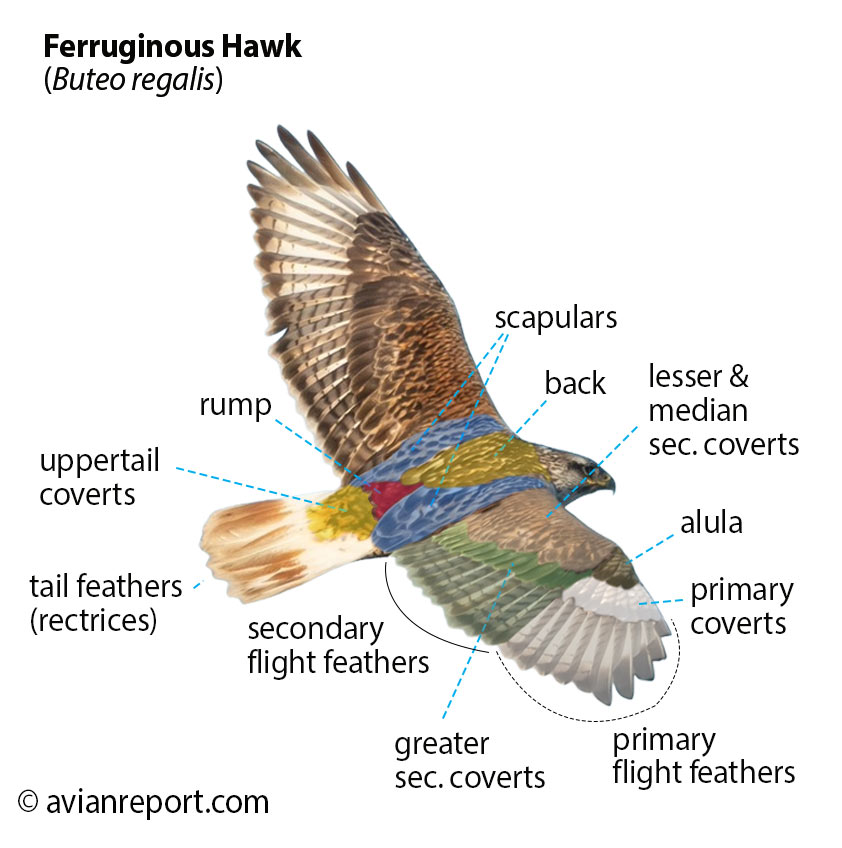
When a bird of prey spreads its wings, its aerodynamic architecture becomes fully visible. Use this section alongside the composite plate to map out an open wing.
Raptors in Flight: Body
- Scapulars: The specific tracts of feathers flanking either side of the dorsal region (back) that cover the shoulder blades.
- ID Field Mark: When soaring overhead, the pale bases of the scapulars on a dark-morph Red-tailed Hawk can create translucent “mottled squares” on its back, while a perched Red-shouldered Hawk shows checkering here.
- Back: The upper dorsal surface of the torso, including the mantle and scapulars, which forms a cohesive “cloak” across the shoulders.
- ID Field Mark: The adult Swainson’s Hawk displays a solid, dark, uniform back that contrasts sharply with its paler underwing linings when it banks mid-air.
- Rump: The distinct lower-back region located directly above the upper tail coverts.
- ID Field Mark: The Northern Harrier is instantly identified at long distances by its brilliant, stark-white rump patch, which flashes vividly against its dark upper body as it quarters low over marshes.
- Uppertail Coverts: The protective layer of feathers that overlaps the upper base of the tail feathers (rectrices).
- ID Field Mark: The Harris’s Hawk features striking white uppertail coverts that, combined with its white rump and white tail tip, sandwich its black tail in a bold, unmistakable flight pattern.
- Rectrices: The long, stiff, structural flight feathers that comprise the tail, acting as a rudder for precise steering and an aerodynamic brake for landing.
- ID Field Mark: The Mississippi Kite is characterized by its solid black, unfanned, slightly notched rectrices, whereas the Zone-tailed Hawk uses its black-and-white banded rectrices to closely mimic the flight silhouette of a Turkey Vulture.
Raptors in Flight: The Anatomy of the Open Wing (Topside view)
- Mantle: The upper back region below the nape, nestled between and flanked by the scapular feathers.
- ID Field Mark: The adult Snail Kite features a uniform, charcoal-slate mantle, whereas the Bald Eagle displays a deep, solid chocolate-brown mantle.
- Lesser & Median Upperwing Coverts: The dense, small feather layers lining the leading edge (shoulder) of the upperwing.
- ID Field Mark: The Golden Eagle develops a prominent, golden-buff diagonal bar across these coverts as it matures, highly visible on perched or soaring birds.
- Greater Upperwing Coverts: The large, elongated row of upper feathers that directly overlays the basal section of the secondary flight feathers.
- ID Field Mark: In many juvenile Buteos (like the Broad-winged Hawk), pale tips on these coverts create a distinct, light horizontal line across the upperwing.
- Alula: A small, distinct cluster of stiff feathers attached to the raptor’s “thumb” at the wrist joint along the wing’s leading edge.
- ID Field Mark: When a Peregrine Falcon is breaking or maneuvering tightly, the dark alula feathers extend outward like a small thumb, breaking the flat line of the wing’s leading edge.
- Primary Coverts: The specialized row of stiff upperwing feathers that directly overlays and protects the bases of the primary flight feathers.
- ID Field Mark: On an adult Northern Harrier, the primary coverts are dark and contrast with the lighter grey inner wing, framing the hand of the wing from above.
- Primaries (Flight Feathers / Remiges): The long, outer flight feathers originating from the wing’s “hand” (carpometacarpus) that form the structural wingtip.
- ID Field Mark: The Turkey Vulture is identified by its silvery-grey primary and secondary remiges, which contrast sharply against its black upperwing coverts.
- Secondary Flight Feathers (Remiges): The inner flight feathers originating from the forearm (ulna) that provide the trailing edge and crucial surface area of the inner wing.
- ID Field Mark: On a soaring Red-shouldered Hawk, the secondaries feature bold, crisp black-and-white checkering, which helps distinguish it from the more subtly patterned wings of a Broad-winged Hawk.
The Raptor in Flight (Underside View)
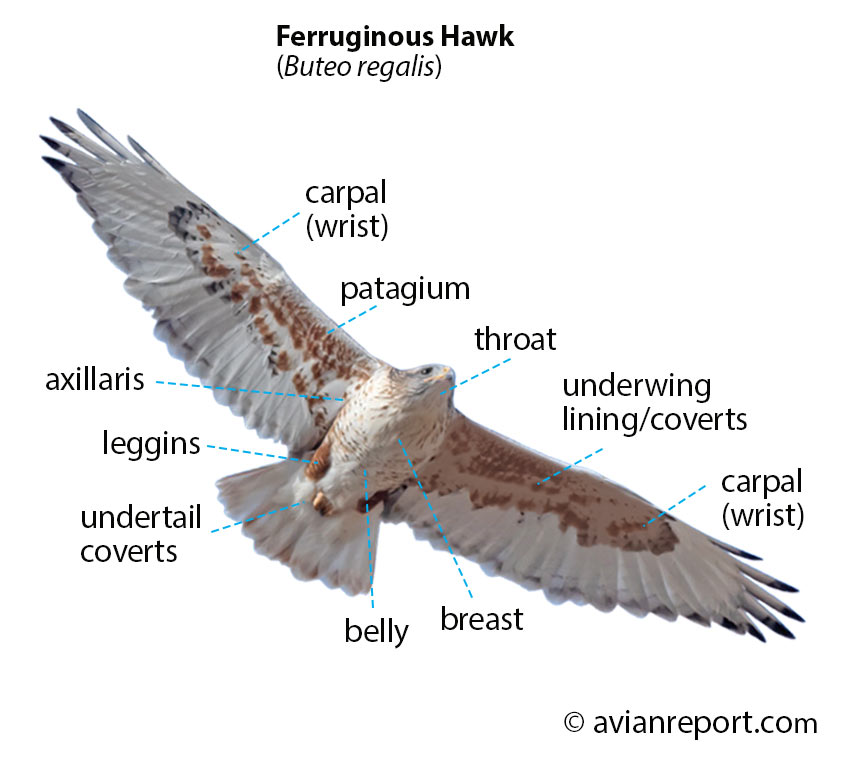
- Lining of the Underwing (Lesser, Median, & Greater Coverts): The feathered inner surface of the wing that blocks air leakage and forms the wing’s contours. In flight, these three stacked layers are typically only distinguishable from one another if they bear contrasting streaks, marks, or color bands that differ from the adjacent flight feathers.
- ID Field Mark: An adult Short-tailed Hawk (light morph) features a stark, completely white underwing lining that contrasts dramatically against its dark, heavily barred flight feathers.
- Patagium: The elastic skin membrane spanning the leading edge of the inner wing from the shoulder to the wrist (carpal area), covered by the forwardmost lesser underwing coverts.
- ID Field Mark: The Red-tailed Hawk is famously identified by its dark “patagial bar”—a heavy, dark horizontal dash running along this leading edge that is visible even from great distances.
- Carpal Area: The prominent “wrist” joint on the forward edge of the wing where the wing bends, acting as the visual and structural anchor point where the inner underwing lining meets the outer flight feathers.
- ID Field Mark: The Osprey and Rough-legged Hawk both display bold, ink-black “carpal patches” (often called squares or commas) precisely at this joint, creating a stark punctuation mark on an otherwise pale wing.
- Axillaries: The cluster of feathers located in the “armpit” at the deepest intersection where the underwing joins the raptor’s torso.
- ID Field Mark: The Prairie Falcon is instantly diagnosed from below by its solid, dark chocolate-brown axillaries, which form a highly visible “dark armpit” against its otherwise pale underbody.
- Undertail Coverts: The soft, protective plumage overlapping the ventral base of the tail feathers (rectrices) behind the legs.
- ID Field Mark: The Gray Hawk features clean, immaculate white undertail coverts, whereas a soaring Cooper’s Hawk displays bright, fluffy white undertail coverts that often flare out sideways past the edges of the tail base.
Conclusion: Building Your Muscle Memory
Mastering raptor topography is not about memorizing a list of words; it is about building visual muscle memory. The next time you find yourself outdoors, practice tracing these boundaries on common birds in your neighborhood—such as local urban Red-tailed Hawks, American Kestrels, or Turkey Vultures. Eventually you will build the instinctual scanning habits required to identify birds of prey in the field in seconds.
For an exhaustive breakdown of all definitions, concepts, and techniques used in this guide, please follow the link below to the main pillar page: Guide to Raptors (Birds of Prey) of North America
References and Sources:
- Allaboutbirds.org
- eBird. (https://ebird.org/)
- Birds of the World: https://birdsoftheworld.org/bow/home
- Gill, Frank B., 1994. Ornithology – 2nd Edition, W. H. Freeman and Company.
- Sibley, David, 2000, The Sibley Guide to Birds. Alfred A. Knopf, Publisher.
- Species Longevity Data: United States Geological Survey (https://www.usgs.gov/)
- The Sibley Guide to Bird Life and Behavior, 2001. Chris Elphick, John Dunning, and David Sibley (eds). Alfred A. Knopf, New York.
Author:
