
Explore Arkansas’ herons, egrets, and bitterns. From the tall and showy Great Blue Heron to the tiny, reclusive Least Bittern, this comprehensive guide covers the full range of species found across the Natural State. The guide features custom identification plates and key aspects of each species natural history. Explore vital coastal and inland habitats, locate the state’s best viewing hotspots, and deepen your appreciation for the State of Arkansas’ wading birds.
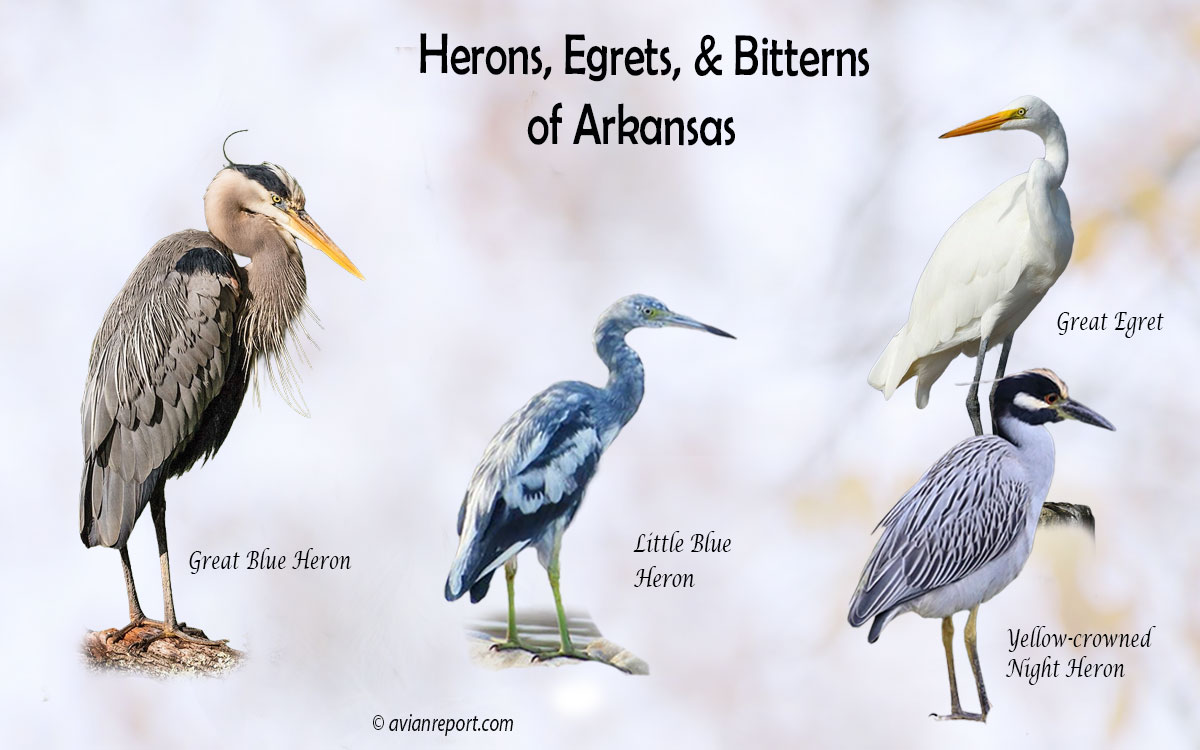
Herons and Egrets: Understanding the Difference
The distinction between “heron” and “egret” is primarily based on traditional naming conventions and visual appearance, particularly plumage color, rather than strict biological classifications. There is no particular set of characters that differentiates one group from the other.
Traditional Naming Conventions:
Historically, the term “egret” has been used to describe members of the Ardeidae family that typically have white plumage, especially those that develop long, decorative plumes “aigrettes” during breeding season, such as the Great Egret and Snowy Egret. In contrast, “heron” is often used for the larger, non-white members of the family.
Exceptions to the Rule:
However, this is not a strict rule, and there are many exceptions. For example:
- The Little Blue Heron is white only as a juvenile, transitioning to a dark gray-blue as an adult.
- The Reddish Egret exhibits both a white color morph and a dark color morph.
- The Great Blue Heron also has a white color morph, as well as individuals with intermediate plumage.
Taxonomic Reality:
From a taxonomic perspective, both herons and egrets belong to the Ardeidae family. Therefore, egrets are, technically, a type of heron, and vice versa. There is no clear-cut scientific division that definitively separates all “herons” from all “egrets.” In fact, the Great Egret (a purely white-plumaged bird) is taxonomically more closely related to the Great Blue Heron than it is to other white-plumaged egrets.
Note: Many people find it tricky to tell the white herons and egrets apart. For help with identification, see my guide: North American White Egrets and Herons: An Identification Guide
Species of Herons, Egrets, and Bitterns in Arkansas
While most North American herons, egrets, and bitterns have been recorded in Arkansas (some as vagrant or accidental), this guide focuses on species whose official range includes the Natural State, as documented by the eBird/Science platform.
Because Arkansas’s wetlands are biodiverse, you will often find herons and egrets sharing these habitats with other bird species. For a complete picture of the state’s avian life, you can explore our dedicated guide to Arkansas’s Ducks, Geese, and Swans, or browse our overview of other Arkansas Wetland Birds, including storks, snipes, ibises, spoonbills, and rails.
| Species | Key Identification Features |
| Great Blue Heron (Ardea herodias) | Largest North American heron; gray, heavy bill, vocal. Includes a white morph. |
| Great Egret (Ardea alba) | Slender, very long neck, yellow bill, black legs. |
| Snowy Egret (Egretta thula) | Small, slender; black bill, yellow face, black legs, bright yellow feet. |
| Tricolored Heron (Egretta tricolor) | Slender, long-necked; very long, slender bill; white belly, dark upperparts. |
| Little Blue Heron (Egretta caerulea) | Slender; bicolored bill; white juvenile plumage, piebald subadult. |
| Cattle Egret (Bubulcus ibis) | Smallest white egret; short neck; often near livestock in highlands. |
| Green Heron (Butorides virescens) | Small, stocky; dark plumage, pointy bill, crouches near water. |
| American Bittern (Botaurus lentiginosus) | Large, secretive; cryptic plumage, long neck, pointed bill. |
| Least Bittern (Ixobrychus exilis) | Tiny, secretive; buffy and black plumage, moves in dense vegetation. |
| Black-crowned Night-Heron (Nycticorax nycticorax) | Stocky, short neck, nocturnal; thick bill, mainly eats fish. |
| Yellow-crowned Night-Heron (Nyctanassa violacea) | Slender, longer neck, nocturnal; stout black bill, feeds on crabs. |
Species accounts: 11 species of herons, egrets, and bittern that occur in the State of Arkansas:
Great Blue Heron

Length: 46″ | Wingspan: 72″ | Weight: 5.3 lb
Identification: Largest North American heron. Gray plumage, large yellow-orange bill. Short black plumes on head. Black and chestnut pattern on shoulder. Immatures: more brownish than adults, dark crown. White form (“Great White Heron”) found in southern Florida and the Caribbean.
Compare: The Little Blue Heron (see below) is much smaller, dark slaty-gray and lacks the large orange bill and patterned head. White form of the Great Blue Heron most similar to Great Egret but has a larger bill and pale legs.
Habitat: Occurs in almost any wetland (ponds, marshes, saltwater bays).
Status & Movements: The Great Blue Heron is Common resident throughout Arkansas, found year-round near permanent water bodies. Numbers often swell during winter due to an influx of northern migrants, making it the most familiar large wader.
Behavior: They wade slowly or stand still, stalking prey in shallow water or open fields. In flight, the neck is tucked in, and legs trail behind.
Diet: Fish, amphibians, reptiles, small mammals, insects, and other birds.
Nest: A simple platform made of small sticks in trees, bushes or the ground. Breeds in multi-species colonies of 500 or more nests.
Breeding: Egg laying: Mid March-early June | Clutch Size: 2-6 eggs | Number of Broods: 1-2 | Egg color: Pale blue | Incubation Period: 27-29 days | Nestling Period: 49-81 days.
Lifespan: The Great Blue Heron lives at least 24 years and 6 months.
How many are there?: The global breeding population is estimated to be 700,000. Species of low conservation concern.
Conservation: Great Blue Heron numbers are stable and increased in the U.S. between 1966 and 2019.
Great Egret
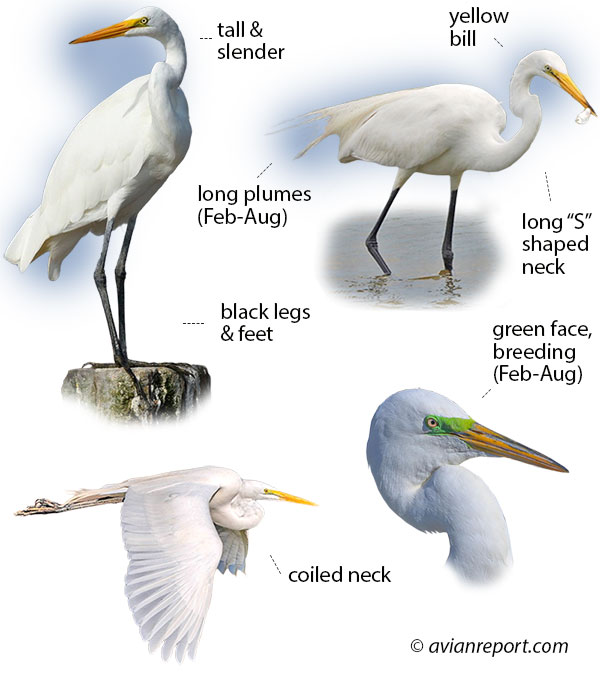
Length: 39″ | Wingspan: 51″ | Weight: 1.5 lb
Identification: Tall, long black legs, all white plumage, and bright yellow bill. Smaller than a Great Blue Heron, larger than a Snowy Egret.
Compare: Size, bright yellow bill, and black legs an feet help separate from other egrets.
Habitat: Freshwater, brackish, and marine wetlands.
Status & Movements: The Great Egret is a common summer resident and transient in Arkansas. It arrives reliably in early spring (March/April) and remains widely distributed near reservoirs and river systems until early fall.
Behavior: Wades in shallow water to hunt, typically standing still and watching for prey, then strikes with a jab of its neck and bill.
Diet: Mainly small fish, but also amphibians, reptiles, birds, small mammals, and invertebrates.
Nest: A platform made of sticks and twigs, up to 3 feet across in or near the top of a shrub or tree. Breeds in colonies.
Breeding: Egg laying: Late March-June | Clutch Size: 1-6 eggs, Number of Broods/year: 1-2. | Egg Description: Pale greenish-blue | Incubation Period: 23-27 days | Nestling Period: 21-25 days.
Lifespan: The oldest known Great Egret was 22 years, 10 months old.
How many are there?: Approximately 9.5 million breeding birds on the continent. The Great Egret is considered a species of low concern.
Snowy Egret
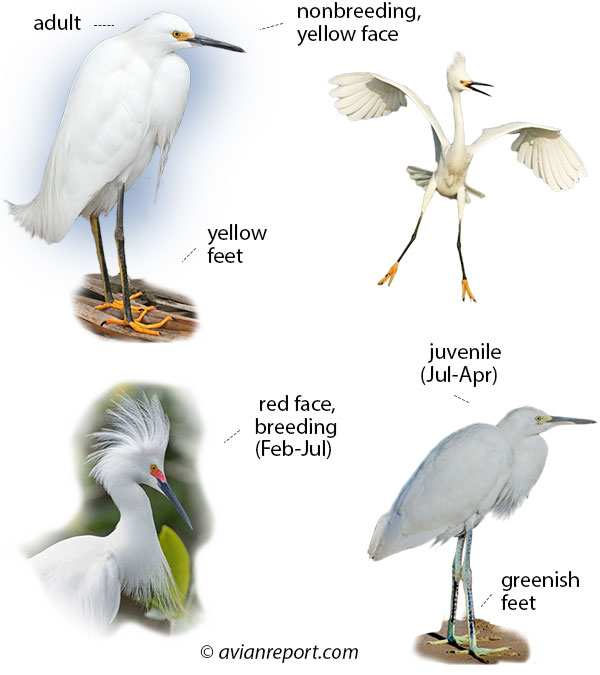
Length: 24″ | Wingspan: 41″ | Weight: 13 oz
Identification: All white with a black bill, black legs, and yellow feet. Immatures are similar with duller, greenish legs. It’s easily identified by its contrasting black bill and distinctive yellow feet, often called “golden slippers.
Compare: Juvenile Little Blue Heron has dull yellow-green legs and a thicker gray and black bill.
Habitat: They can be found in all types of fresh, salt and brackish water wetlands.
Status & Movements: The Snowy Egret is a common transient and summer resident across Arkansas, nesting locally. It can be observed from late March through October, favoring muddy edges and shallow, open marsh habitats in the eastern half of the state.
Diet: Mostly small fish and frogs, worms, crustaceans, and insects.
Nest: A shallow loosely woven platform of twigs 14–18 inches across. The nest is usually over water in the top or outer branches of shrubs or trees.
Breeding: Egg laying: Mid March- early July | Clutch Size: 2-6 eggs | Egg color: Pale greenish blue | Incubation Period: 24-25 days | Nestling Period: 20-24 days.
Lifespan: The Snowy Egret lives for at least 17 years, 7 months.
How many are there?: Global breeding population at 2.1 million. The Snowy Egret is a bird of low conservation concern.
Tricolored Heron
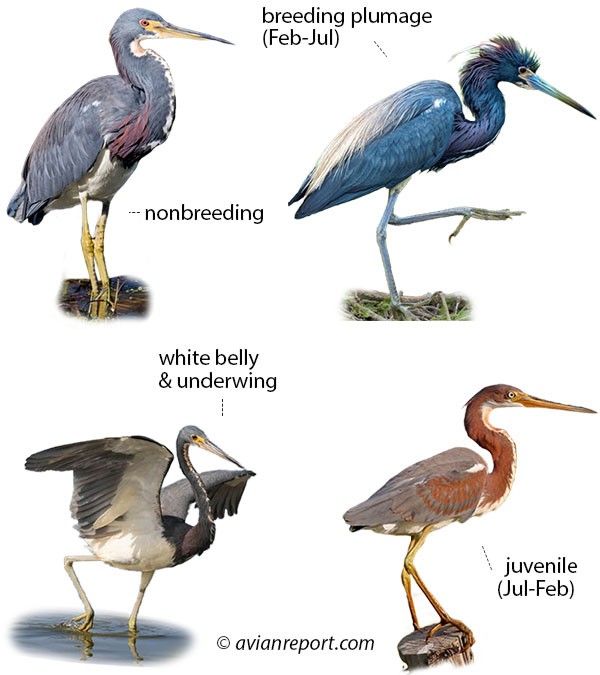
Length: 26″ | Wingspan: 36″ | Weight: 13 oz
Identification: A medium-sized, slim heron with blue-gray, lavender upperparts and white belly, dagger-like bill. Breeding birds have pale plumes. Juveniles have a rusty neck and rusty sides (wing coverts).
Compare: Little Blue Herons are all blue-gray. Tricolored Herons have a white belly.
Habitat: Coastal estuaries, saltmarshes, mangroves, freshwater marshes.
Status & Movements: The Tricolored Heron is an uncommon summer resident in Arkansas, concentrated primarily in the Mississippi Alluvial Plain (eastern lowlands). This slender heron is present during the breeding season, usually from late April until early October.
Behavior: The Tricolored Heron is skilled at stalking, chasing, and standing still to capture its prey. It often pirouettes with sharp stops and flapping wings.
Behavior: The Tricolored Heron is skilled at stalking, chasing, and standing still to capture its prey.
Diet: Eats mostly small fish and other small vertebrates.
Nest: A bulky platform in a shady tree or shrub up to 13 feet above ground or water. Nests in colonies with other herons and egrets.
Breeding: Egg laying: Mid Jan-early Aug | Clutch Size: 3-5 eggs | Number of Broods: 1 | Egg appearance: Pale greenish blue | Incubation Period: 21-24 days | Nestling Period: 17-21 days.
Lifespan: The oldest recorded Tricolored Heron lived at least 17 years and 8 months.
How many are there?: The U.S. breeding population is approx. 194,000 birds. The Tricolored Heron is a bird of low conservation concern.
Little Blue Heron
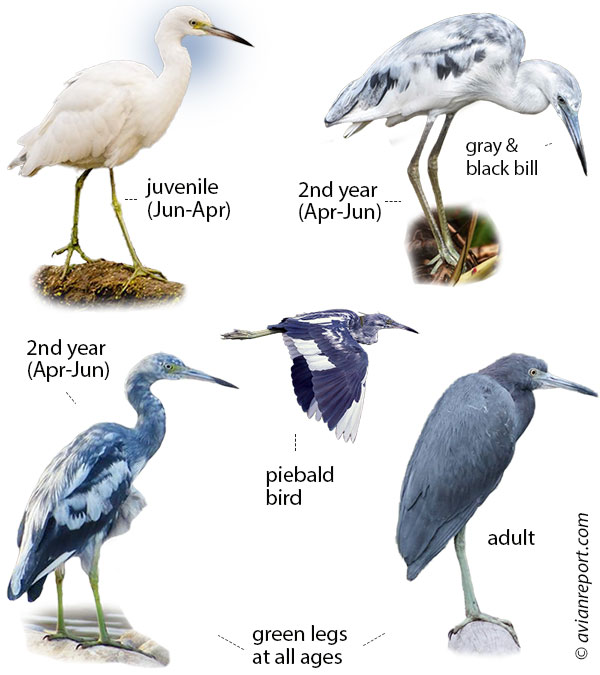
Length: 24″ | Wingspan: 40″ | Weight: 12 0z
Identification: Adults are dark blue-gray with a purple-maroon head and neck. Juveniles are entirely white, transitioning to a patchy “calico” mix and eventually the blue-gray of the adult. Its dark-tipped, blue-based bill helps distinguish it from other egrets. They have greenish legs.
Compare: Snowy Egrets are often mistaken for juvenile Little Blue Herons. Snowy Egrets have an all black bill and legs (with yellow feet) compared with the grayish tipped-black bill and greenish legs in the Little Blue Herons.
Habitat: Little Blue Herons can be found in marshes, swamps, ponds, streams, lagoons, tidal flats.
Status & Movements: The Little Blue Heron, is a common summer resident and transient throughout much of Arkansas, particularly the eastern half. Look for this species from mid-spring until the first major cold fronts of autumn.
Behavior: The Little Blue Heron is a stand-and-wait predator. It watches the water for prey, moving slowly or flying to new locations.
Diet: They primarily eat small fish, but also consume small amphibians, crustaceans, and invertebrates.
Nest: The nest is a porous platform of long twigs and sticks mostly in shrubs and small trees in standing water or on islands. They nest in multi-species colonies.
Breeding: Egg laying: Early March-mid Sept | Clutch Size: 3-4 eggs | Egg appearance: Pale bluish green | Incubation Period: 22-23 days | Nestling Period: 35-49 days |
Lifespan: The oldest known Little Blue Heron was at least 13 years, 11 months old.
How many are there?: The global breeding population is estimated at 1.1 million; populations have declined.
Cattle Egret
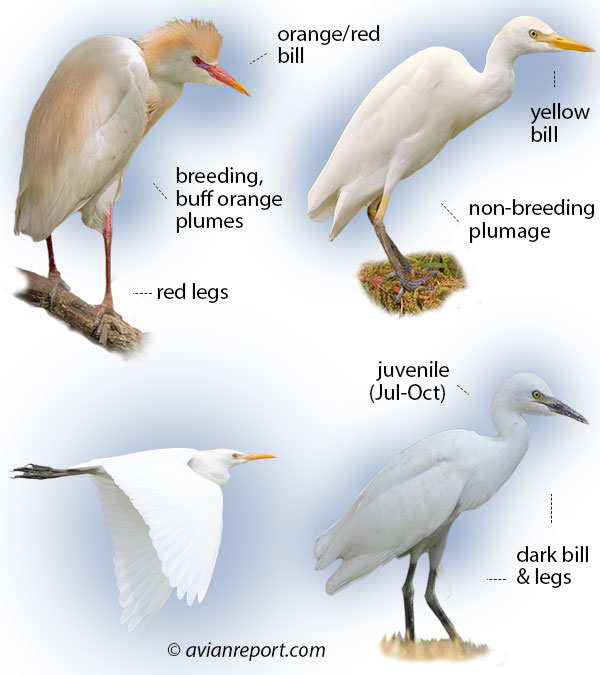
Length: 20″ | Wingspan: 36″ | Weight: 12 oz
Identification: A stocky heron with a short thick neck. Adults are white with buff plumes during breeding season. The bill is yellow turning bright red before pairing. Juveniles lack colored plumes and have a black bill.
Compare: Differ from other egrets, by shorter, thicker neck and shorter legs. Great Egrets are much larger than Cattle-Egrets with a much longer and thinner neck.
Habitat: Inundated grasslands, pastures, farmlands, wetlands, and rice paddies. They exploit drier, open areas more than other heron species.
Status & Movements: The Cattle Egret is a common summer resident in Arkansas. This cosmopolitan wader arrives in mid-spring (April) and departs quickly by the onset of colder weather in fall.
Behavior: Often accompany cattle catching insects and small vertebrates disturbed by these animals. They have a distinctive head-pumping strut.
Diet: Primarily insects like grasshoppers, crickets, flies and any other invertebrate. They may also eat eggs and chicks of small birds.
Nest: A platform of sticks in trees or shrubs in swamps or reed vegetation in marshes. It breeds in colonies with other wading birds.
Breeding: Egg laying: March-June | Clutch Size: 3-4 eggs | Number of Broods: 1 | Egg Appearance: Pale bluish-white | Incubation Period: 23 days | Nestling Period: 30 days.
Lifespan: Can reach a longevity of 15 years.
How many are there?: Estimated global population is 3.8–6.7 million individuals. The Cattle Egret is a species of low conservation concern.
Green Heron

Length: 18″ | Wingspan: 26″ | Weight: 7 oz
Identification: Green Herons have a velvet-green back, rich chestnut body, and a dark cap. Juveniles are browner, with pale streaking on the neck and spots on the wings.
Compare: Green Herons are larger than Least Bitterns, which have straw-colored wings and neck. Green Herons have greenish wings and a chestnut neck.
Habitat: Swamps, marshes, lakes, ponds, impoundments, and other wet habitats with trees and shrubs.
Status & Movements: The Green Heron is widespread summer resident and transient throughout Arkansas. It is reliably present from late April to early fall, favoring dense riparian cover along small creeks and the edges of ponds.
Behavior: Green Herons hunt by standing still or walking slowly at the water’s edge. When a fish approaches, the heron lunges and darts its head.
Diet: Mainly small fish. They also feed on insects, spiders, crustaceans, snails, amphibians, reptiles, and rodents.
Nest: A simple platform made of sticks 8–12 inches across. Pairs choose a secluded site, usually in a tree or bush with overhanging branches to conceal the nest.
Breeding: Egg laying: Mid February-early July | Clutch Size: 3-5 eggs | Number of Broods: 1-2 broods | Incubation Period: 19-21 days | Egg color: Pale green to bluish | Nestling Period: 16-17 days.
Lifespan: The Green Heron lives at least 8 years, 11 months old.
How many are there?: The global breeding population is estimated at 1.2 million. Green Herons are fairly common, but their population has suffered a decline.
American Bittern
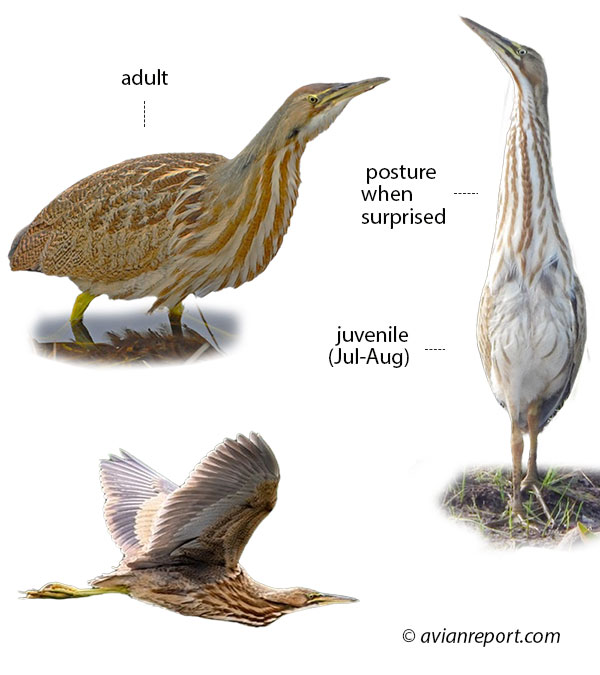
Length: 28″ | Wingspan: 42″ | Weight: 1.5 lb
Identification: Medium-sized heron with a compact body, shorter legs, and a thick neck. Warm brown, buff with strong streaks. When alarmed, it points its bill straight up to blend with reeds.
Compare: Most similar to juvenile night-herons. Note striped neck, plain unspotted wings, and even more secretive behavior. Least Bittern is half the size of an American Bittern.
Habitat: Shallow freshwater marshes with reeds and vegetation, typically near the margins.
Status & Movements: The American Bittern is an uncommon transient in Arkansas and a rare summer resident. Look for this cryptic species primarily during its migration windows in spring and fall.
Diet: Insects, crustaceans, fish, amphibians, reptiles, and small mammals and large insects.
Nest: A mound or platform built among thick stands of cattails or bulrushes on shallow water or on dry ground.
Breeding: Egg laying: April-June | Clutch Size: 2-7 eggs | Incubation Period: 24-28 days | Nestling Period: 7-14 days (chicks linger around nest for weeks) | Egg color: Beige-brown to olive.
Lifespan: The American Bittern lives at least 8 years and 4 months.
How many are there?: The global breeding population is estimated at 2.5 million. The American Bittern is considered a species of low conservation concern.
Least Bittern
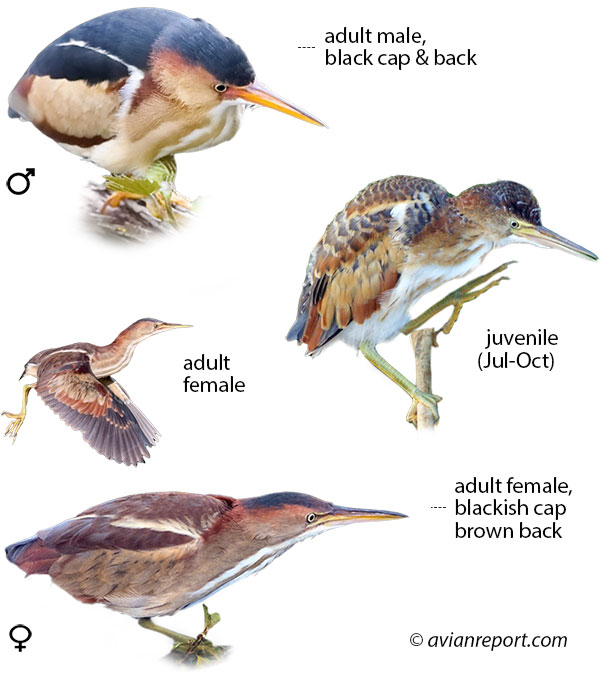
Length: 13″ | Wingspan: 17″ | Weight: 2.8 oz
Identification: The tiny male Least Bittern appears blackish above and buffy-brown below. Females and younger birds are more uniformly buff or brownish. Juveniles have a scaly appearance.
Compare: American Bittern inhabits wetland marshes, whereas Least Bittern typically clings to marsh vegetation. Also, American Bittern is much larger than the Least Bittern.
Habitat: Freshwater and brackish marshes with tall stands of cattails or reed beds.
Status & Movements: The Least Bittern is an uncommon to locally common summer resident in Arkansas. This tiny, secretive heron occupies the densest cattail and rush beds in large marshes, primarily present during the breeding season from May through September.
Behavior: Least Bitterns hunt by standing motionless and watching the water for prey. When disturbed, they may compress the body, distend the neck and bill upward, and sway with the reeds in an attempt at camouflage.
Diet: Eat small fish, small snakes, frogs, tadpoles, salamanders, slugs, crayfish, mice, dragonflies, and leeches.
Nest: The Least Bittern constructs a well-hidden nest, pulling on the reeds and crimping them to form a platform held together with stalks and sticks.
Breeding: Egg laying: May-mid July | Clutch Size: 2-6 eggs | Number of Broods: 1-2 broods | Egg color: Pale blue or green | Incubation Period: 17-20 days | Nestling Period: 6-15 days.
How many are there?: The global breeding population is estimated to be 310,000. It is considered a species of low conservation concern.
Black-crowned Night-Heron
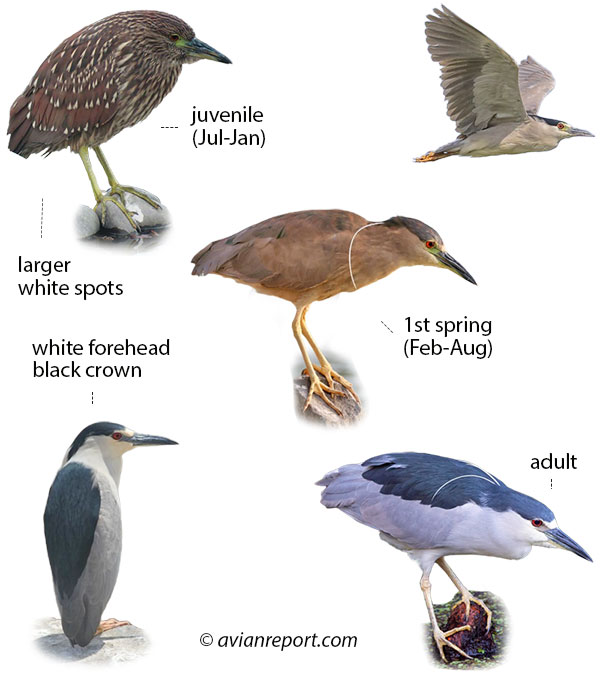
Length: 25″ | Wingspan: 44″ | Weight: 1.9 lb
Identification: Adults have light-gray plumage with a black back and crown. Immatures are brown with white spots and blurry streaks. Adults have all-black bills, while immatures have yellow-and-black bills.
Compare: Adult Yellow-crowned Night-Herons have scaly upperparts whereas Black-crowned Night Herons has a black back and gray and unmarked rest of the body. Juveniles resemble an American Bittern.
Habitat: Saltmarshes, freshwater and brackish water wetlands of all types.
Status & Movements: The Black-crowned Night-Heron inhabits a common summer resident and transient across Arkansas, often nesting in colonies near reservoirs and rivers. It is best searched for at dusk or in daytime roosts from March to November.
Behavior: Most active at night or at dusk. They spend their days perched on tree limbs or concealed among foliage and branches.
Diet: They are opportunistic feeders eating many kinds of terrestrial, freshwater, and marine animals. They also eat carrion, plant materials, and garbage from landfills.
Nest: It nests in a tree or in cattails; a platform of sticks and other woody vegetation.
Breeding: Egg laying: mid Nov-late July, Clutch Size: 3-5 eggs | Egg appearance: Greenish-blue | Incubation Period: 24-26 days | Nestling Period: 29-34 days.
Lifespan: The Black-crowned Night Heron lives at least 21 years, 5 months.
How many are there?: Partners in Flight estimates a global breeding population of 3 million. Species of low conservation concern.
Yellow-crowned Night-Heron
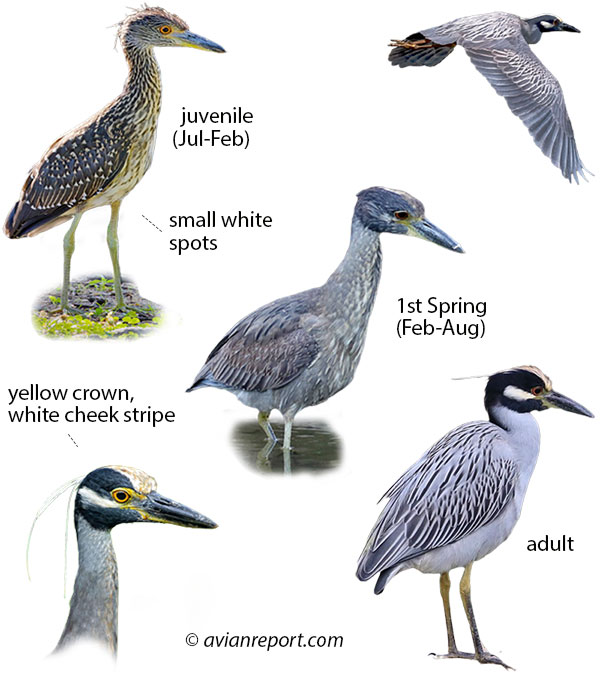
Length: 24″ | Wingspan: 42″ | Weight: 1.5 lb
Identification: Adults have cloudy gray plumage, a black head with white cheek patches, and a creamy yellow crown. Immatures are brown with fine white spots, and streaky underparts.
Compare: Adult Yellow-crowned Night-Herons have scaly upperparts whereas Black-crowned Night Herons has a black back and gray unmarked rest of the body. Juveniles resemble an American Bittern.
Habitat: Most common in coastal wetlands, barrier islands, saltmarshes, and mangroves. They also occur inland along bottomland forests, swamps, and sometimes wet lawns or fields.
Status & Movements: The Yellow-crowned Night-Heron is an uncommon summer resident in Arkansas, found mainly in the eastern and southern portions of the state. This wader specializes in crayfish, inhabiting wooded swamps and river bottoms from mid-spring until fall
Behavior: Yellow-crowned Night Herons slowly stalk prey in or near shallow water. They forage both during the day and at night.
Diet: They feed primarily on freshwater and saltwater crabs, fiddler crabs, and crayfish. Also insects, fish, small snakes, and small mammals.
Nest: The nest is a platform of sticks with a slight hollow in the center. It is built near or over water.
Breeding: Egg laying: Mid March-mid June | Clutch Size: 2-6 eggs | Egg appearance: Pale bluish green | Incubation Period: 24-25 days | Nestling Period: 30-43 days.
Lifespan: Yellow-crowned Night Herons live at least 6 years.
How many are there?: The global breeding population is estimated at 400,000. Species of low conservation concern.
Exploring Heron, Egret, and Bittern Habitats
The aquatic ecosystems in Arkansas supports a moderate concentrations of wading birds. While some species are generalists, appearing in almost any roadside ditch or pond, others are specialized to specific habitats. Knowing the habitats wading birds prefer often helps narrow down the identification. These habitats include:
Estuaries: Where freshwater rivers meet the saltwater of the ocean, creating brackish environments. These are highly productive areas, providing abundant food sources. Expect to see a high diversity of egrets and herons, particularly during low tide when foraging is optimal.
Wetlands: Including salt marshes, freshwater marshes, swamps, and pocosins. These areas are vital for filtering water, preventing floods, and providing habitat. These areas attract species that prefer freshwater prey, such as the American Bittern and Green Herons.
Rivers: From slow-moving coastal rivers to faster-flowing Piedmont and mountain rivers. Riverbanks and floodplains offer foraging and nesting sites. Look for herons along riverbanks and in shallow areas, especially during early morning and late evening.
Lakes, Lagoons, and Reservoirs: Including natural lakes and man-made reservoirs that provide open water and shoreline habitats. Look for herons along riverbanks and in shallow areas, especially during early morning and late evening.
Coastal versus Inland Habitats
The coastal habitats: The mix of saltwater and freshwater are particularly productive for these wading birds. Estuaries, where rivers meet the ocean, offer abundant food sources like fish, crabs, and shrimp. Salt marshes, with their shallow waters and dense vegetation, provide ideal foraging and nesting sites.
Inland habitats: While the coast boasts a high concentration of these birds, inland areas also offer valuable habitats. Freshwater lakes, rivers, and wetlands provide essential foraging and nesting sites.
Arkansas Wading Bird Hotspots: Top 5 Locations for Viewing
Arkansas’s aquatic habitats, dominated by the Mississippi River Alluvial Plain and various reservoir systems, support substantial concentrations of herons, egrets, and bitterns. These regional hotspots offer diverse environments perfect for observing the state’s resident and transient wading birds.
Location List
Holla Bend National Wildlife Refuge (NWR): Located in central Arkansas along the Arkansas River. This refuge features extensive river oxbows and managed moist-soil units. It attracts large feeding flocks of Great Egret, Snowy Egret, and numerous Great Blue Herons.
White River National Wildlife Refuge (NWR): Situated in the eastern lowlands, this large refuge preserves vast bottomland hardwood forests and swamps. It is excellent for viewing nesting colonies of Little Blue Herons, Tricolored Herons, and the secretive Yellow-crowned Night-Heron.
Pond Creek National Wildlife Refuge (NWR): Located in southwestern Arkansas near the Red River. The refuge is known for its shallow lakes and wooded wetlands. It provides prime cover for the Least Bittern, Green Heron, and abundant migrating Great Blue Herons.
Lake Dardanelle: This large reservoir in the western half of the state features extensive shorelines and associated riparian zones. It is a reliable spot for year-round Great Blue Herons, and during migration, it hosts numerous Black-crowned Night-Herons and feeding Great Egrets.
Trusten Holder Wildlife Management Area (WMA): Situated in the central part of the state, this WMA has extensive sloughs and backwater areas of the Arkansas River. Look for the camouflaged American Bittern, along with groups of Cattle Egrets near open fields and Little Blue Herons.
Final Remarks:
The State of Arkansas offers plenty of habitats for herons, egrets, and bitterns. This guide has covered the eleven species of herons, egrets, and bitterns known to occur in the State of Arkansas. While some of these species are widespread and familiar, others are more secretive and local, being associated with specific habitat types. We hope this guide enhances your appreciation for these large and ubiquitous birds.
Photo Credits:
The photographic material used in this guide was made available on various websites. I could not thank enough to Andrew Morffew, Mark Mochell, Elizabeth Milson, Matt Weller, Troy Anderson, Dennis Church, Wendy Miller, Rick From Alabama, Carlos Sanchez, John Benson, Mick Thompson, Steve Guttman, Victor Espinoza, Kelly Colgan-Azar, Andy Reago, Chrissy McLaren, Garry C., Michael Janke, Cuatro77, Linda Fortuna, Vicky DeLoach, Paul Hurtado, Tom Murray, Tom Wilberding, Patricia Pierce, Kenneth Cole-Schneider, Doug Greenberg, Brian Garrett, David White, Victoria Pickering, Becky Matsubara, Dan Mooney, and Julio Mulero.
Voices:
Most recordings were made by Paul Marvin (Xeno-canto https://xeno-canto.org/contributor/RFTXRYBVBX)
References and Sources:
- eBird. (https://ebird.org/)
- Sibley, David, 2000, The Sibley Guide to Birds.
- Species Longevity Data: United States Geological Survey (https://www.usgs.gov/)
- Allaboutbirds (https://www.allaboutbirds.org/news/
To learn more about Herons, Egrets, and Bitterns, please follow the link to the main pillar page: A Complete Guide to North American Herons, Egrets, and Bitterns