
This comprehensive hub serves as your foundational gateway to identifying wetland bird. To ensure targeted utility, these guides focus exclusively on non-Anatidae species. Ducks, geese, and swans are treated in a separate dedicated series, allowing this guide to focus entirely on the diverse array of waders, divers, aerial foragers, and secretive marsh specialists.
Wetlands are the vibrant life-support systems of the North American continent. Across the United States and Canada, these dynamic ecosystems—ranging from the prairie potholes of the Midwest to the sprawling coastal saltmarshes of the Atlantic—purify our water, mitigate flooding, and provide critical sanctuaries for wildlife. For birders and nature lovers, they offer some of the most rewarding and dramatic encounters in the natural world.
Feel free to browse the foundational topics below, or skip directly to the bottom of the page to find state- and province-specific guides.
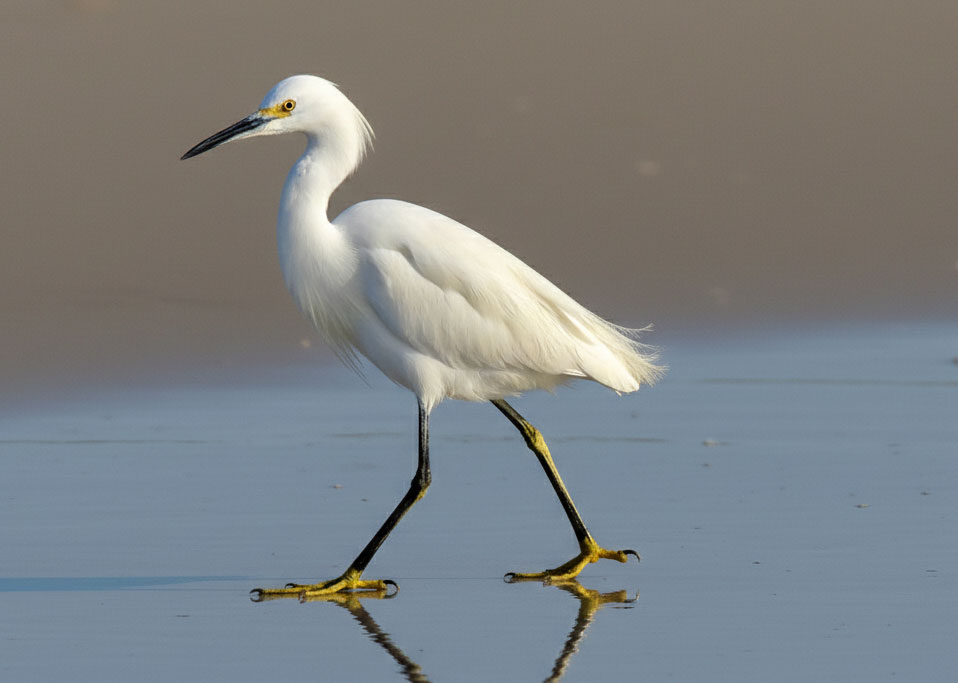
North American Wetland Birds: Species Checklist
Below is the definitive reference list of the 62 core species featured across our regional, state, and provincial identification guides. Use this master checklist to track your sightings as you explore different regions:
American Bittern
American Avocet
American Coot
American Herring Gull
American White Pelican
American Woodcock
Anhinga
Bald Eagle
Belted Kingfisher
Black-crowned Night-Heron
Black Rail
Black-necked Stilt
Black Tern
Boat-tailed Grackle
Bonaparte’s Gull
California Gull
Caspian Tern
Cattle Egret
Clapper Rail
Clark’s Grebe
Common Gallinule
Common Loon
Double-crested Cormorant
Eared Grebe
Forster’s Tern
Franklin’s Gull
Glossy Ibis
Great Blue Heron
Great Egret
Great-tailed Grackle
Green Heron
Horned Grebe
Killdeer
King Rail
Least Bittern
Limpkin
Little Blue Heron
Osprey
Pacific Loon
Pied-billed Grebe
Purple Gallinule
Red-necked Grebe
Red-shouldered Hawk
Red-throated Loon
Red-winged Blackbird
Reddish Egret
Ring-billed Gull
Roseate Spoonbill
Sandhill Crane
Snowy Egret
Sora
Tricolored Heron
Virginia Rail
Western Grebe
White Ibis
White-faced Ibis
Whooping Crane
Wilson’s Snipe
Wood Stork
Yellow-crowned Night-Heron
Yellow-headed Blackbird
Yellow Rail
Taxonomy and Predominant Wetland Bird Groups
Navigating the immense diversity of wetland birds becomes significantly easier when you understand how they are grouped ecologically and taxonomically.
Rather than viewing the marsh as a mix of feathers, experienced birders and naturalists categorize species into distinct operational groups based on how they forage, move, and utilize their environments.
The Major Ecological Groups
- Deep-Water Divers: Built for life beneath the surface, these birds feature dense bones and posteriorly placed legs designed for powerful underwater propulsion. Examples include Loons, Grebes, and Double-crested Cormorant.
- Large Wading Birds: Characterized by long, stilt-like legs and highly specialized necks, these birds stalk the shallows with calculated patience. Key representatives are the Herons, Egrets, and Wood Stork.
- Marsh Birds & Rails: Secretive and structurally compressed to squeeze through dense emergent vegetation, this group relies heavily on camouflage. It includes Rails and Cranes.
- Shorebirds & Aerial Foragers: Highly active birds utilizing mudflats and the airspace immediately above the water to capture prey. This group spans the Black-necked Stilt, Killdeer, Caspian Tern, and Ring-billed Gull.
- Wetland Raptors & Songbirds: Species adapted to nesting or foraging in the immediate vegetative boundaries of wetlands, such as the fish-hunting Osprey and the boisterous Red-winged Blackbird.
Predominant Taxonomic Families
Understanding the scientific families present in North American wetlands gives you an instant advantage in the field. When you can recognize the familial traits of Ardeidae (herons and egrets), you immediately know what hunting behaviors to expect.
Recognizing the compressed body plan of Rallidae (rails, coots, and gallinules) alerts you to look for twitching tails and secretive movements in the reeds.
From the sharp, dagger-like bills of the Gaviidae family (loons) to the hyper-extended legs of the Recurvirostridae family (stilts and avocets), mastering taxonomy provides the structural framework that transforms an unfamiliar shape into a positive identification.
Structural Profiles: Body Shapes and Adaptation
In the unforgiving and highly competitive environment of a wetland, a bird’s physical structure dictates its survival strategy. Every bill curve, leg length, and feather texture is an evolutionary response to a specific ecological niche.
By analyzing these structural adaptations, you can accurately identify birds even in poor lighting or at extreme distances.
Predominant Body Shapes
Wetland birds generally divide into two primary structural archetypes: the elongated, vertical stalkers and the low-slung, horizontal swimmers. A heron displays a sharp, linear silhouette designed to blend in with reeds and strike downward like a javelin.
Conversely, a loon or grebe exhibits a torpedo-shaped profile, keeping a low center of gravity to slice through the water column with minimal resistance.
Essential Anatomy for Field Identification
- Bill Specialization: A bird’s bill is its primary tool. Notice the difference between the heavy spearing bill of a Great Blue Heron, the sensitive, elongated probing bill of a Wilson’s Snipe, the down-curved probing tool of a White Ibis, and the highly unusual flat, straining apparatus of the Roseate Spoonbill.
- Leg and Foot Adaptations: Look closely at how a bird stands. Long, slender legs allow egrets to wade into deeper waters without wetting their bellies. Meanwhile, the lobed toes of the American Coot act like snowshoes on mud and paddles in open water, differing fundamentally from the fully webbed feet of pelicans.
- Plumage Adjustments: Divers like grebes possess densely packed, highly waterproofed feathers that trap air for buoyancy control. Contrast this with the Anhinga, which lacks extensive waterproofing oils; its feathers intentionally absorb water, reducing buoyancy so it can stealthily stalk fish entirely submerged like a submarine.
Master Visual Keys for Field Identification
Field identification in a wetland requires a systematic approach. Environmental factors like heavy morning fog, blinding water glare, and dense reed beds frequently obscure bright colors and fine plumage details. To become a proficient wetland birder, you must learn to rely on structural foundations and non-visual cues.
WETLAND FIELD IDENTIFICATION MATRIX
SILHOUETTE & SHAPE
Neck posture (S-curve)
Relative bill-to-head ratio
Trailing leg length
BEHAVIOR & PROFILE
Water line depth
Wingbeat frequency
Diving vs. Dabbling style
VOCALIZATIONS
Booms & Croaks
Secretive whinnies
Rhythmic marsh clicks
Size, Shape, and Silhouette
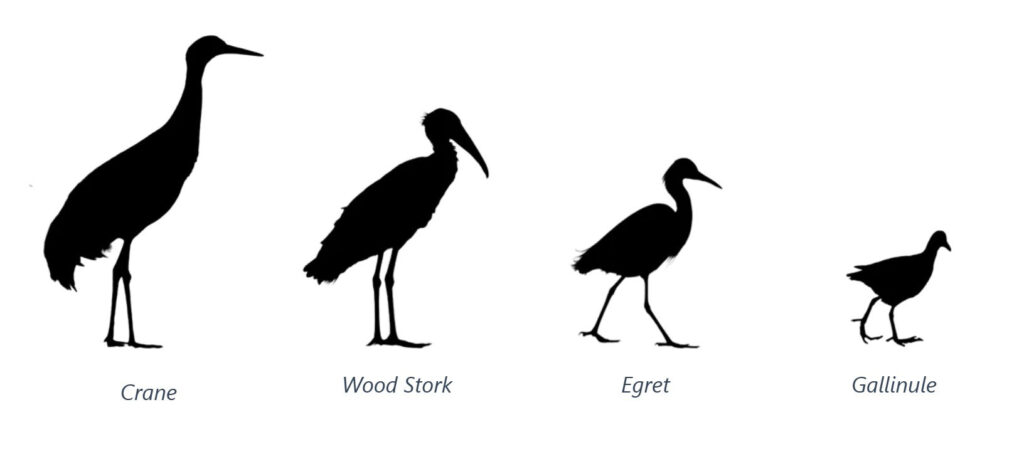
When plumage colors are washed out by backlighting, silhouette is your most reliable asset. Train your eyes to look for relative proportions. Is the neck folded into an “S” shape in flight, or is it extended straight out? A Great Egret flies with its neck tucked tightly, whereas a Wood Stork or Crane flies with its neck completely straight. Look at the bill-to-head ratio: does the bill look disproportionately massive, like an American Woodcock, or small and stout like a Sora?
Water vs. Flight Identification
- On and In the Water: Pay attention to how a bird sits on the water line. Cormorants ride low, often with just their necks and tilted bills exposed, while Coots ride high like corks, nodding their heads rhythmically as they swim.
Watch their diving transitions: does the bird slip smoothly under the surface without a ripple (like a Grebe), or does it perform a noticeable upward leap before submerging (like a Cormorant)? - In the Air: Wingbeat frequency and flight path provide instant clues. Terns fly with buoyant, bouncy wingbeats, constantly pointing their bills downward to scan for fish. Gulls exhibit steady, powerful, rhythmic flapping and glide effortlessly. Look for trailing legs: long-legged waders will have their feet extending far past the tail feathers, creating a distinct rear silhouette.
Deciphering Wetland Vocalizations
Because marsh environments are structurally dense, you will hear a high percentage of wetland birds long before you ever see them. Learning these auditory signatures is vital. Memorize the strange, mechanical, pump-like booming of the American Bittern hidden deep in the cattails.
Listen for the descending, horse-like whinny of the Sora, or the sudden, harsh, prehistoric croaks of a startled Great Blue Heron. Mastering these sounds transforms a seemingly empty marsh into a vibrant, easily mapped community.
Habitats and Ecosystem Profiles
To successfully locate specific wetland birds, you must understand the subtle differences between their preferred habitats. North America’s wetlands are not uniform; they are highly nuanced ecosystems defined by water depth, salinity, flow rates, and vegetation types. Each species on our master list occupies a specific zone within these environments.
WETLAND HABITAT GRADIENT
INLAND FRESHWATER
Prairie Potholes)
Cattail Marshes
Glacial Lakes
ESTUARIES & COASTAL
Tidal Mudflats
Saltmarshes
Mangrove Lagoons
RIPARIAN & FLOODED
Wooded Swamps
River Basins
Bottomland Woods
Inland Freshwater Systems
These systems encompass vast interior lakes, seasonal prairie potholes, and permanent freshwater marshes. Characterized by dense stands of emergent vegetation like cattails and bulrushes, these habitats are the primary breeding grounds for secretive species. Here, Pied-billed Grebes build floating nests, American Coots congregate in open pockets of water, and Least Bitterns stealthily climb between vertical reed stalks.
Coastal and Estuarine Environments
Where rivers meet the sea, tidal mixing creates incredibly nutrient-rich waters. Estuaries, saltmarshes, shallow lagoons, and expansive mudflats are subject to daily tidal fluctuations. These areas are paradise for specialized foragers. As the tide recedes, mudflats expose an abundance of invertebrates, drawing in American Avocets and Black-necked Stilts. The deeper, brackish channels host large concentrations of American White Pelicans, Caspian Terns, and Reddish Egrets.
Riparian Zones and Floodplains
Wooded swamps, river basins, and bottomland hardwood forests represent a unique blend of aquatic and terrestrial life. These shaded, slow-moving waters are dominated by bald cypress, tupelo, and overhanging trees. This habitat provides the vertical structure required by specific apex predators and specialized waders, making it the ideal domain for the Red-shouldered Hawk, the Belted Kingfisher, and the Wood Stork.
Migration, Flyways, and the Annual Cycle
The lives of North American wetland birds are governed by a strict, rhythmic annual cycle driven by the changing seasons. For many species, survival hinges on their ability to travel thousands of miles twice a year, navigating between nesting territories in the far north and wintering grounds in the southern United States, Central America, or South America.
THE NORTH AMERICAN FLYWAY HIGHWAYS
PACIFIC
Coastline to Rock
|
Wintering areas in CA
CENTRAL
Plains & Potholes
|
Gulf Coast
MISSISSIPPI
Great Lakes & Rivers
|
Southern US
ATLANTIC
Eastern Seaboard
|
Central/South America
The Annual Life Cycle
The year is divided into distinct, critical phases. Spring triggers a hormonal rush, driving birds northward to establish territories, build intricate nests, and raise young during the brief summer peak of insect and fish abundance.
Late summer brings the molting phase, a vulnerable period where many waterbirds shed and replace worn feathers. By autumn, dropping temperatures and diminishing food supplies signal the start of the massive migration south.
The Four Major North American Flyways
Migrating birds do not travel aimlessly; they follow highly defined geographic corridors known as flyways. These aerial highways are shaped by major landscape features that provide natural navigation markers and abundant stopover habitats:
- Atlantic Flyway: Follows the eastern coastline and Appalachian mountains, funneling birds down the eastern seaboard into Florida and the Caribbean.
- Mississippi Flyway: A massive aquatic highway centered on the Great Lakes and the vast Mississippi River basin, acting as a direct funnel to the Gulf Coast.
- Central Flyway: Stretches across the expansive Great Plains and the eastern edge of the Rocky Mountains, providing critical stopovers in interior wetlands and prairie potholes.
- Pacific Flyway: Hugs the western coastlines and interior valleys, moving birds seamlessly from Alaska and western Canada down to Mexico.
Phenology
Phenology—the timing of biological events—is everything to a birdwatchers and naturalists. Understanding exactly when species arrive and depart at different latitudes is the secret to successful birding.
A stopover wetland that appears completely empty in July might be teeming with thousands of migrating Franklin’s Gulls, Wilson’s Snipes, or Bonaparte’s Gulls by late September. Our state and provincial guides provide the local timelines you need to intercept these spectacular movements.
Conservation, Status, and Regulations
While wetlands are beautiful, they are also highly threatened environments. The birds on our master list serve as ecological indicators; their population fluctuations directly reflect the overall health of our water, soil, and climate. Protecting these birds requires ongoing monitoring, intensive habitat restoration, and strict international legal frameworks.
Critically Endangered & Threatened Species Spotlight
- Whooping Crane: Towering as North America’s tallest bird, this species stands as a symbol of intensive conservation. Reduced to a perilous low of roughly 20 wild individuals in the 1940s, the species is on a slow path to recovery through multi-agency captive breeding, strict habitat protections at wintering grounds, and innovative ultralight-led flyway reintroduction programs.
- Black Rail & Yellow Rail: These highly elusive marsh dwellers are experiencing alarming population drops. Because they rely on incredibly shallow, muddy “zones” at the absolute edges of marshes, they are the first to disappear when coastal development encroaches or rising sea levels permanently drown their specialized habitats.
- Wood Stork: As the only stork species breeding in North America, its survival is intricately tied to the health of the southeastern wetlands and the Everglades. Shifting water levels caused by human drainage projects regularly disrupt their highly synchronized nesting cycles.
Modern Conservation Challenges
The primary threat to wetland birds remains habitat fragmentation—the draining and filling of interior potholes and coastal marshes for agriculture and urban development. Furthermore, climate change introduces unpredictable weather shifts: prolonged, severe droughts dry up critical interior breeding pools, while rising sea levels erode coastal mudflats. Pollution also poses a major threat, as heavy metals like lead and mercury bioaccumulate up the food chain, impacting apex predators like the Bald Eagle and Osprey.
The Role of Conservation Organizations
Reversing these declines requires coordinated, international effort. Migratory Bird Joint Ventures bring together government agencies, non-profits, and private corporations to conserve habitat at a regional landscape scale. Concurrently, the international Ramsar Convention designates and protects wetlands deemed of global significance, ensuring that critical migratory stopovers are legally preserved across international borders.
Wetland Hunting and Protection Regulations
Avian conservation is underpinned by robust legal protections. The Migratory Bird Treaty Act (MBTA) protects non-game species on our master list from unauthorized taking, capturing, or harming.
Interestingly, sustainable, highly regulated hunting also plays a foundational role in habitat preservation. Through programs like the Federal Duck Stamp and regulated harvest management for specific game birds on our list—such as the American Woodcock, Wilson’s Snipe, and Sora—licensing fees and permit revenues directly fund the purchase and permanent protection of millions of wetland acres. This system ensures that game management directly finances habitat security for every non-game bird sharing the marsh.
Explore State and Provincial Identification Guides
Now that you are armed with the foundational visual keys, structural knowledge, and habitat insights necessary to identify North America’s wetland birds, it is time to take your birding local. Because species distribution varies dramatically across the continent, we have broken down our comprehensive master list into specific, localized field guides.
Click on the links below or browse the regional lists to access a tailored identification guide featuring only the wetland bird species commonly documented in your specific state or province.
Southeast
Guide to the Wetland Birds of North Carolina – ID, Habitat, Sounds
Guide to the Wetland Birds of Louisiana – ID, Habitat, and Sounds
Guide to the Wetland Birds of Texas – ID, Habitat, and Sounds
Guide to the Wetland Birds of Georgia – ID, Habitat, and Sounds
Guide to the Wetland Birds of Florida – ID, Habitat, and Sounds
51 Wetland Birds of Alabama: ID, Habitat, & Sounds Guide
46 Wetland Birds of Arkansas: ID, Habitat, & Sounds Guide
47 Wetland Birds of Tennessee: ID, Habitat, & Sounds Guide
48 Wetland Birds of South Carolina: ID, Habitat, & Sounds Guide
51 Wetland Birds of Mississippi: ID, Habitat, & Sounds Guide
44 Wetland Birds of Oklahoma: ID, Habitat, & Sounds Guide
Northwest
51 Wetland Birds of Oregon: ID, Habitat, & Sounds Guide
Guide to the Wetland Birds of Washington State – ID & Sounds
Guide to the Wetland Birds of Wyoming – ID, Habitat, & Sounds
44 Montana Wetland Birds: ID & Sound Guide
Guide to the Wetland Birds of British Columbia – ID, Habitat, and Sounds
41 Alberta Province Wetland Birds: ID & Sound Guide
Guide to the Wetland Birds of Saskatchewan – ID, Habitat, and Sounds
29 Alaska Wetland Birds: ID & Sound Guide
29 Yukon Province Wetland Birds: ID & Sound Guide
46 Idaho Wetland Birds: ID & Sound Guide
Central
Guide to the Wetland Birds of North Dakota – ID, and Sounds
Guide to the Wetland Birds of Minnesota – ID, Habitat, and Sounds
47 Manitoba Wetland Birds: ID & Sound Guide
Guide to the Wetland Birds of South Dakota – ID and Sounds
Guide to the Wetland Birds of Nebraska
Guide to the Wetland Birds of Iowa
Guide to the Wetland Birds of Missouri
Guide to the Wetland Birds of Kansas
Multi-State Guides
A Guide to the Wetland Birds of Vermont, New Hampshire, Maine, and New Brunswick
Guide to the Wetland birds of Massachusetts, Connecticut & Rhode Island
Understanding Wetlands: An Overview for State Bird Guides
Southwest
51 Wetland Birds of New Mexico: ID & Sound Guide
51 Wetland Birds of Arizona: ID, Habitat, & Sounds Guide
49 Wetland Birds of Colorado: ID, Habitat, & Sounds Guide
45 Wetland Birds of Utah: ID, Habitat, & Sounds Guide
45 Wetland Birds of Nevada: ID, Habitat, & Sounds Guide
52 Wetland Birds of California: ID, Habitat, & Sounds Guide
Northeast
51 Wetland Birds of Virginia: ID, Habitat, & Sounds Guide
45 Wetland Birds of Massachusetts: ID, Habitat, & Sounds Guide
49 Wetland Birds of Pennsylvania: ID, Habitat, & Sounds Guide
51 Wetland Birds of Maryland: ID, Habitat, & Sounds Guide
Guide to the Wetland Birds of West Virginia
51 Wetland Birds of Delaware: ID, Habitat, & Sounds Guide
51 Wetland Birds of New Jersey: ID, Habitat, & Sounds Guide
45 Maine Wetland Birds: ID, Habitat, & Sounds Guide
42 New Hampshire Wetland Birds: ID, Habitat, & Sounds Guide
44 Wetland Birds of Vermont: ID, Habitat, & Sounds Guide
Guide to the Wetland Birds of New York – ID, Habitat, and Sounds
53 Connecticut & Rhode Island Wetland Birds: ID Guide
45 New Brunswick Wetland Birds: ID & Sound Guide
Guide to the Wetland Birds of Kentucky – ID, Habitat, and Sounds
Guide to the Wetland Birds of Ohio: ID & Sounds
Guide to the Wetland Birds of Indiana – ID, Habitat, and Sounds
Guide to the Wetland Birds of Wisconsin – ID, Habitat & Sounds
Guide to the Wetland Birds of Pennsylvania – ID, & Sounds
Guide to the Wetland Birds of Michigan – ID, Habitat, and Sounds
Guide to the Wetland Birds of Illinois – ID, Habitat, and Sounds
Guide to the Wetland Birds of Ontario
Guide to the Wetland Birds of Quebec
44 Nova Scotia and Prince Edward Island Wetland Birds: ID Guide