
This guide covers 59 bird species that regularly visit backyard feeders in the State of Michigan. Use clear illustrations to identify males, females, and juveniles, and learn to recognize each species by its songs and calls. Beyond identification, each account includes key aspects of the species’ natural history. With visual, audio, and ecological insights working together, this guide helps you identify birds more confidently and get more out of your backyard bird feeding and birding experience.
- Click on the links below to jump to a species account, or scroll down and navigate this guide.
- Identifying and Understanding Backyard Feeder Birds in Michigan
- 59 Birds that Regularly visit Backyard Feeders in the State of Michigan
- SPARROWS, FINCHES, GROSBEAKS & ALLIES
- Northern Cardinal
- House Finch
- Purple Finch
- White-winged Crossbill
- Red Crossbill
- Chipping Sparrow
- White-throated Sparrow
- White-crowned Sparrow
- Fox Sparrow
- Song Sparrow
- Field Sparrow
- American Tree Sparrow
- Eastern Towhee
- Dark-eyed Junco
- Indigo Bunting
- Snow Bunting
- Rose-breasted Grosbeak
- Evening Grosbeak
- Pine Grosbeak
- American Goldfinch
- Pine Siskin
- Redpoll (Common Redpoll)
- House Sparrow
- DOVES AND PIGEONS
- BLACKBIRDS, GRACKLES, ORIOLES
- MOCKINGBIRDS & THRASHERS
- STARLINGS
- JAYS & CROWS
- BLUEBIRDS & ROBINS
- WOODPECKERS
- TITMICE & CHICKADEES
- NUTHATCHES & CREEPERS
- WRENS
- WARBLERS
- HUMMINGBIRDS
- KINGLETS
- How do I attract birds to my bird feeder in my state?
- What type of bird feeder should I get to attract birds in Michigan?
- Why Birds Visit—or Avoid—Your Feeders
Identifying and Understanding Backyard Feeder Birds in Michigan
Identifying the birds that visit your feeders can provide hours of enjoyment. This guide highlights key field marks to help you recognize males, females, juveniles, and harder-to-identify species, with illustrations pointing out what to look for.
This guide doesn’t just stop at identification through images. Each species’ account dives into their natural history, giving interesting facts and insights. Learn about their preferred foods and feeders, behavior, habitats, and natural history. It’s a win-win! Learn about the birds that visit your yard, while providing them with food.
Michigan backyard birders will find the guide useful as an identification and reference tool. This information can also be used to engage the local community in bird conservation efforts. Knowing which species visit your yard is not only rewarding—it can also support conservation. By reporting sightings to citizen science databases, backyard birders contribute valuable data for research.
Identification also helps you refine your feeding strategy. By noting which birds visit (and which don’t), you can choose the right foods and feeder types to attract your target species.
59 Birds that Regularly visit Backyard Feeders in the State of Michigan
Most birds that visit backyard feeders in Michigan are widespread species. However, they represent only a small subset of the region’s overall bird diversity.
These feeder birds are primarily seed- and grain-eaters, along with species that have flexible, generalist diets that include insects and fruit. Equally important is their adaptability: these birds have learned to live near humans and take advantage of artificial food sources, unlike many species that do not visit feeders.
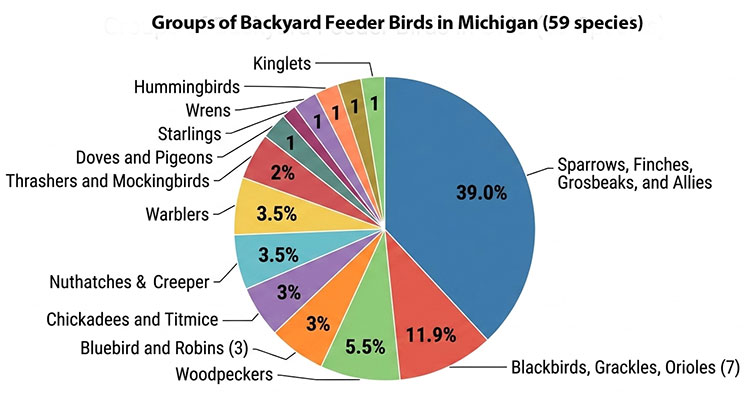
The breakdown is as follows:
| Group Name | Species Count | Percentage of Total |
| Sparrows, Finches, Grosbeaks, and Allies | 23 | 38.98% |
| Blackbirds, Grackles, Orioles | 7 | 11.86% |
| Jays & Crows | 5 | 8.47% |
| Woodpeckers | 5 | 8.47% |
| Bluebird and Robins | 3 | 5.08% |
| Chickadees and Titmice | 3 | 5.08% |
| Nuthatches & Creeper | 3 | 5.08% |
| Warblers | 3 | 5.08% |
| Thrashers and Mockingbirds | 2 | 3.39% |
| Doves and Pigeons | 1 | 1.69% |
| Starlings | 1 | 1.69% |
| Wrens | 1 | 1.69% |
| Hummingbirds | 1 | 1.69% |
| Kinglets | 1 | 1.69% |
SPARROWS, FINCHES, GROSBEAKS & ALLIES
In Michigan, sparrows, finches, and their allies make up the largest group of birds visiting backyard feeders. Most are ground-feeding species that readily use platform, hopper, and tube feeders.
These birds share heavy, conical bills adapted for crushing seeds, which are the primary foods offered at feeders. While seeds and grains dominate their diet for much of the year, many species shift to insects and other invertebrates during the breeding season before returning to seeds afterward.
Northern Cardinal

Identification: The male northern cardinal (Cardinalis cardinalis) is all red with a conspicuous crest and long tail. The female is a warm brown with red on the wings and tail. Juveniles resemble a female.
Food: Attract cardinals with black oil sunflower seeds, hulled sunflower seeds, safflower, cracked corn, peanut hearts, millet, and milo.
Feeder: It favors large tube, large hopper, and platform feeders. It also feeds on the ground.
Presence: The Northern Cardinal is a year-round resident in Michigan. This striking songbird is a common backyard visitor, frequenting feeders daily throughout all months of the year for seeds and suet.
Behavior: Northern cardinals can be aggressive to smaller birds but are displaced by blue jays, woodpeckers, grackles, and larger birds.
Backyard: Favors dense cover and tall shrubs and trees, but will visit just about any type of yard with enough vegetation in or near it.
Nest: Northern cardinals build a cup-shaped nest in a fork of small branches, shrubs, or vine tangle, 1-15 feet above the ground.
Breeding season: The northern cardinal breeds from March through mid-September.
Breeding period: Northern cardinals lay 2-5 grayish to buffy white eggs speckled with light brown. It takes approximately 22 days from egg-laying (incubation period 12 days, nestling period 10 days) until fledging.
Lifespan: Northern cardinals live at least 15 years and nine months.
House Finch
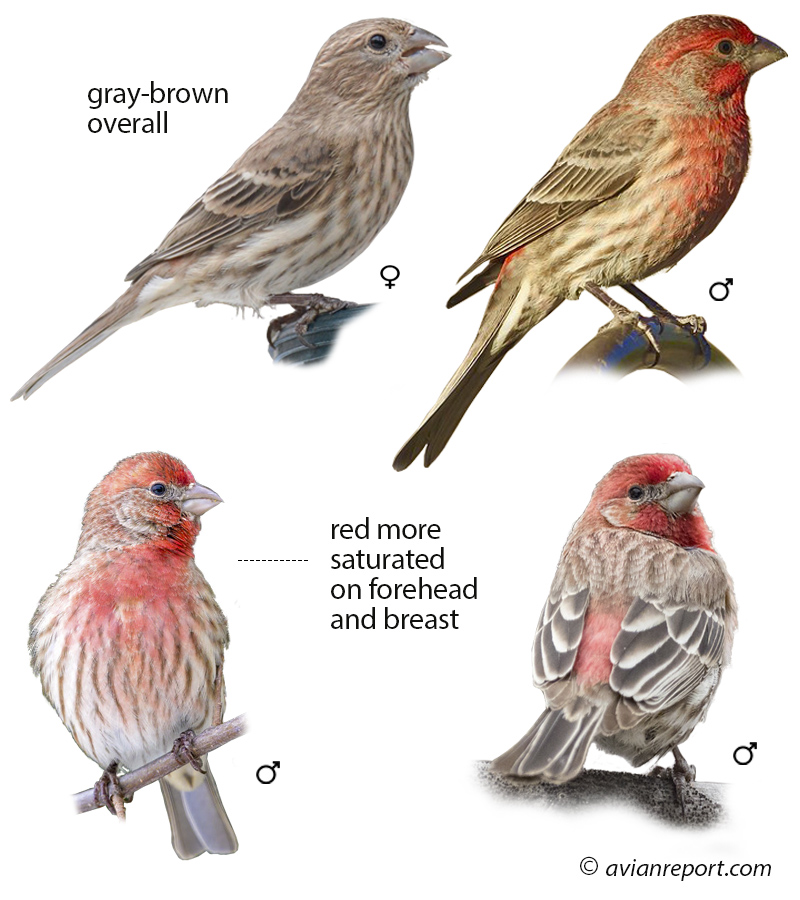
Identification: The male house finch (Haemorhous mexicanus) has red on the head and breast, contrasting with the gray-brown of the rest of the body. A few males have yellow instead of red. Females are gray-brown streaked with black on the back, breast, and belly.
Food: Attract house finches with black oil sunflower seed, hulled sunflower seeds, safflower, and nyjer.
Feeder: It favors large tube feeders, small and large hopper, and platform feeders.
Presence: The House Finch is a permanent resident in Michigan. This adaptable finch is a frequent visitor to backyard feeders, where it remains present and active through every month of the year.
Behavior: House finches are surprisingly submissive to even smaller birds. They generally interact well with other birds at feeders.
Backyard: Favors human-created habitats and are common in suburban settings.
Nest: House finches build an open cup surrounded by twigs in trees, cactus, and rock ledges. It also nests in light fixtures, house decorations, hanging planters, and building ledges.
Breeding season: The house finch breeds from late March through early August.
Breeding period: The house finch lays 2-6 bluish-white eggs dotted with brown. It takes about 29 days from egg-laying (incubation period 13 days, nestling period 16 days) until fledging.
Lifespan: House finches live at least 11 years and 7 months.
Purple Finch
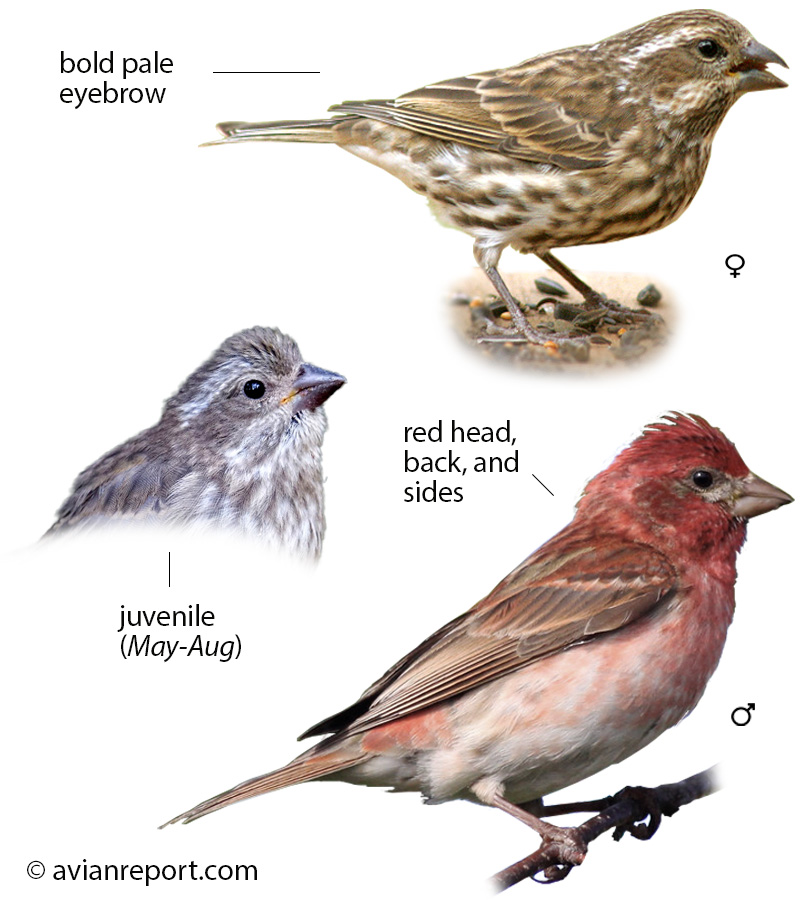
Identification: The male purple finch (Haemorhous purpureus) is raspberry red, more saturated on the head and breast. The female is brown, heavily streaked with black below, and has a patterned head.
Food: Attract purple finches with black oil sunflower seeds, hulled sunflower seeds, nyjer, and millet.
Feeder: It favors large and small tube feeders. It also uses hoppers and platform feeders.
Presence: The Purple Finch is a nomadic winter visitor in Michigan. Expect this species at feeders from September through May during their seasonal movements across the state, with some breeding in the north.
Behavior: It is not aggressive at feeders. The purple finch is a semi-nomadic bird that may visit your feeder in one year but not the next.
Backyard: Purple finch favors edges of woodlands, particularly coniferous ones. Feeders near woodlands are more likely to attract purple finches.
Nest: It builds a cup-shaped nest on branches of coniferous trees or trees in deciduous forests. The height from the ground varies from 5 to 50 feet above the ground.
Breeding season: Purple finches breed from April through August.
Breeding period: The purple finch lays 2-7 grayish eggs with dusky specks. It takes approximately 26 days from egg-laying (incubation period 12 days, nestling period 14 days) until fledging.
Lifespan: Purple finches live at least 12 years and 8 months.
White-winged Crossbill
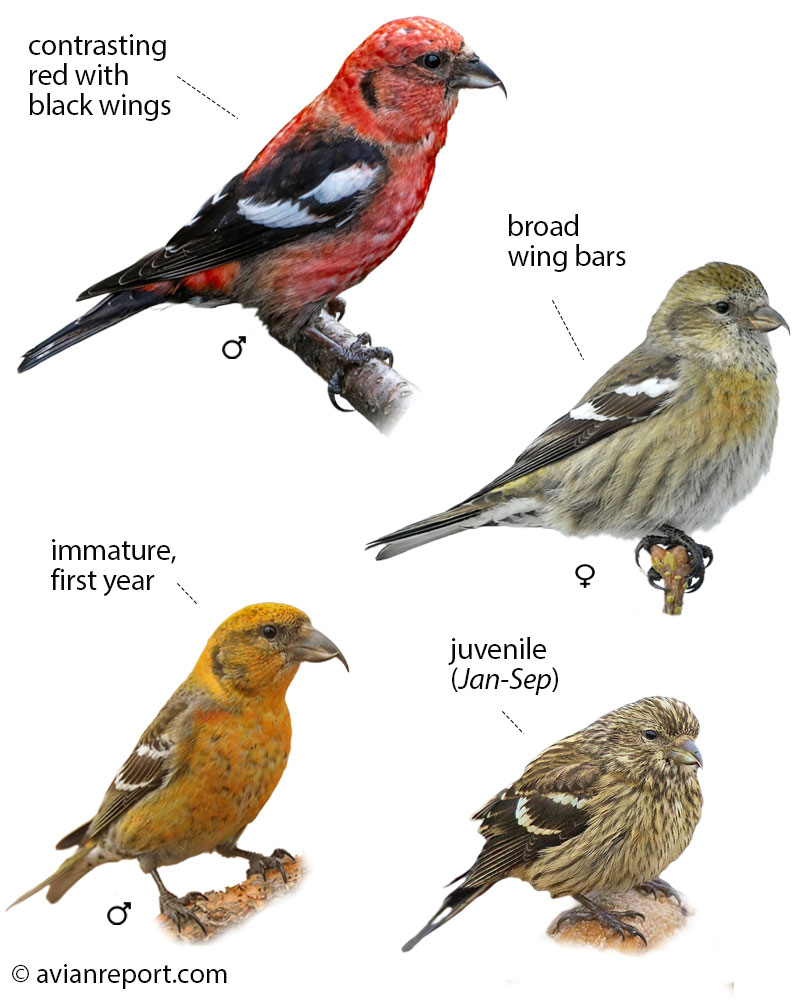
Identification: The male White-winged Crossbill (Loxia leucoptera) is pink-red while the female is yellow-greenish. Both sexes have contrasting black wings with bold white bars. Usually in flocks. Hangs upside down on pine cones.
Food: Attract White-winged Crossbills with black oil sunflower seeds, hulled sunflower seeds, suet, and fruit.
Feeder: This crossbill readily takes to platform feeders, large and small hopper feeders and the ground.
Presence: The White-winged Crossbill is an irruptive winter visitor in Michigan. Arriving in late Fall and departing by Spring, this species occasionally visits feeders for sunflower seeds during colder months.
Behavior: White-winged crossbills move about in flocks and can take over your feeder. They can be aggressive to other birds.
Backyard: This bird occurs in Boreal forest and semi open woodlands. It is more likely to visit backyards near its favorite habitat.
Nest: White-winged crossbills build a cup-shaped nest of twigs, grasses, and bark lined inside with roots, moss, hair and other soft materials.
Breeding season: It breeds throughout the year depending on seasonal availability of food.
Breeding period: The female lays 2-6 whitish with reddish spots eggs. It takes about 30 days from egg-laying (incubation period 14-16 days, nestling period 14-15 days) until fledging.
Lifespan: The white-winged crossbill lives at least 8 years (based on other crossbills of similar size.
Red Crossbill
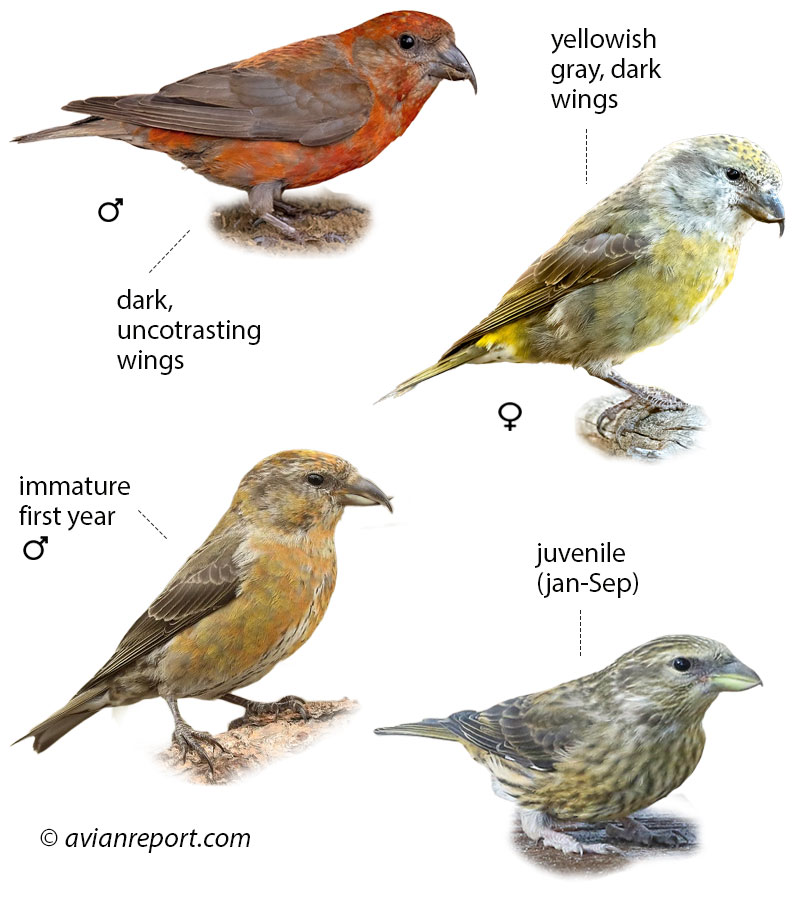
Identification: The male Red Crossbill (Loxia curvirostra) is red to pink-red while the female is yellow-greenish. Both sexes have dark wings, no wing bars and crossed bill tips. Usually in flocks. Hangs on pine cones.
Food: Attract red crossbills with black oil sunflower seeds, hulled sunflower seeds, suet, and fruit.
Feeder: This crossbill readily takes to platform feeders, large and small hopper feeders and the ground.
Presence: The Red Crossbill is an uncommon, nomadic visitor in Michigan. Primarily seen from late Fall through early Spring, this finch occasionally visits feeders during years when natural conifer seed crops fail.
Behavior: Moves about in flocks that can take over your feeders. They can be aggressive to other birds.
Backyard: Red crossbills are found in Boreal forest and semi open woodlands. It is more likely to visit backyards near its favorite habitat.
Nest: Red crossbills build a cup-shaped nest in dense foliage in open woodlands. Nests are placed high (30-70 ft) above the ground.
Breeding season: It breeds throughout the year depending on seasonal availability of food.
Breeding period: Female lays 2-6 whitish with reddish spots/blotches eggs. It takes about 30 days from egg-laying (incubation period 14-16 days, nestling period 14-15 days) until fledging.
Lifespan: Red crossbills live at least 6 years.
Chipping Sparrow

Identification: The chipping sparrow (Spizella passerina) in breeding plumage is grayish below with a rusty cap and black eyeline. Birds in non-breeding plumage have a dusky-brown cap and darker brown plumage. Juveniles are gray-brown with black streaks below.
Food: Attract chipping sparrows with hulled sunflower seeds, nyjer, cracked corn, millet, and milo.
Feeder: It feeds mostly on the ground, eating birdseed spilled by elevated feeders. It also uses platform feeders.
Presence: The Chipping Sparrow is a summer resident in Michigan. Arriving in early April and departing by late October, it is a frequent visitor to ground-level bird feeders during the warmer months.
Behavior: Chipping sparrows are submissive to most other birds at feeders, even birds smaller in size.
Backyard: It favors semi-open habitats, often in suburban areas. Shrubs and small trees at the edges of your yard are used by chipping sparrows for hiding.
Nest: It builds a cup-shaped nest in dense foliage or the tip of a branch, usually within 15 feet above the ground, but sometimes higher.
Breeding season: Chipping sparrows breed in late March through late August.
Breeding period: Chipping sparrows lay 2-7 bluish eggs lightly streaked and spotted with dark gray. It takes about 24 days from egg-laying (incubation period 13 days, nestling period 11 days) until fledging.
Lifespan: Chipping sparrows live at least 10 years and 11 months.
White-throated Sparrow
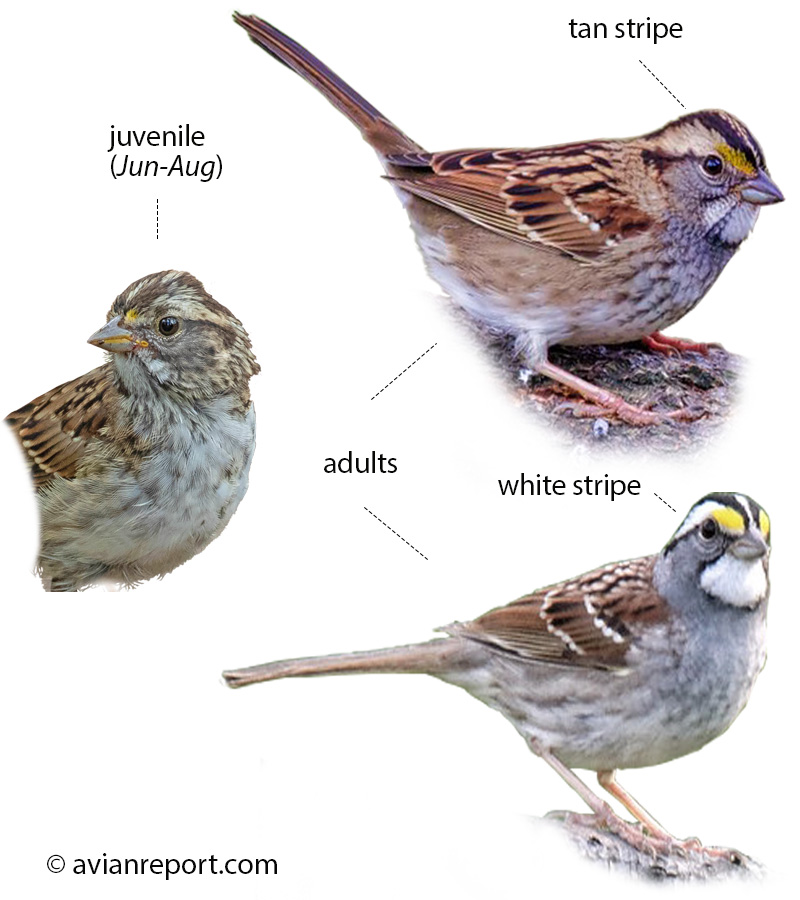
Identification: The white-throated sparrow (Zonotrichia albicollis) has a patterned head showing a yellow patch in front of the eye. This sparrow has two plumage morphs: white-striped and tan-striped.
Food: Attract white-throated sparrows with black oil sunflower seeds, hulled sunflower seeds, safflower, cracked corn, peanut hearts, millet, and milo.
Feeder: It feeds mostly on the ground, eating birdseed spilled by elevated feeders. It also uses platform feeders.
Presence: The White-throated Sparrow is a common transient and winter visitor in Michigan. Typically present from September through May, it frequently visits backyard feeders for millet and sunflower hearts during migration.
Behavior: Not an aggressive bird easily displaced by more aggressive ones.
Backyard: The white-throated sparrow forages in semi-open areas with some vegetation cover. Favors backyards that offer vegetation cover near the feeders.
Nest: White-throated sparrows build a cup-shaped nest on or near the ground.
Breeding season: The white-throated sparrow breeds in late May through mid-August.
Breeding period: The white-throated sparrow lays 2-6 pale bluish-green eggs speckled with chestnut-brown. It takes approximately 23 days from egg-laying (incubation period 12 days, nestling period 11 days) until fledging.
Lifespan: White-throated sparrows live at least 14 years and 11 months.
White-crowned Sparrow

Identification: The white-crowned sparrow (Zonotrichia leucophrys) has black and white stripes on the crown (adults). The head and breast areas are gray. It is a large and relatively long-tailed sparrow. Immature birds have tan and brown head stripes. The bill color varies from yellow-orange to pink.
Food: Attract white-crowned sparrows with black oil and hulled sunflower seeds, cracked corn, millet, and milo.
Feeder: White-crowned sparrows feed mainly on the ground but take platform feeders.
Presence: The White-crowned Sparrow is a transient visitor in Michigan. Passing through during May and again from September to November, this sparrow is a reliable visitor to ground feeders during these periods.
Behavior: Like other ground feeders, white-crowned sparrows interact peacefully with other ground feeders. They can be pushed aside from platform feeders by more aggressive birds.
Backyard: The white-crowned favors overgrown fields and brushy areas, particularly during migration. Yards that resemble this habitat type are likely to attract white-crowned sparrows.
Nest: White-crowned sparrows build a cup-shaped nest in shrubs or bushes at various heights (2-5 feet) from the ground. They can also nest on the ground where tall shrubs are not available.
Breeding season: The white-crowned sparrow’s breeding season varies regionally but is generally from May through mid-August.
Breeding period: The white-crowned sparrow lays 3-7 bluish to greenish eggs spotted with brown concentrated on the wide side of the egg. It takes about 22 days from egg-laying (incubation period 13 days, nestling period 9 days) until fledging.
Lifespan: White-crowned sparrows live at least 13 years and 4 months.
Fox Sparrow

Identification: The Fox Sparrow (Passerella iliaca) has a characteristic rufous ear patch bordered by gray. The upper back is streaked with rufous. The underparts are whitish with streaks formed by arrow-head-like rows, which concentrate in the breast area, forming a cluster.
Food: Attract fox sparrows with black and hulled sunflower seeds, nyjer, cracked corn, millet, and milo.
Feeder: They generally feed on the ground under elevated feeders. They typically use hoppers or platform feeders.
Presence: The Fox Sparrow is a transient visitor in Michigan. This large sparrow arrives in early Spring and returns in late Fall, visiting backyard feeders briefly during its migratory passage through the state.
Behavior: Like other ground feeders, fox sparrows interact peacefully with other ground feeders. They can be pushed aside from platform feeders by more aggressive birds.
Backyard: The Fox Sparrow is a bird that needs cover. They tend to visit feeders close to vegetative cover and are reluctant to visit feeders far away from it.
Nest: It builds a cup-shaped nest on the ground tucked under grasses or shrubs.
Breeding season: Fox sparrows breed in mid-May through late July.
Breeding period: Fox sparrows lay 2-5 bluish-green eggs with brown markings. It takes about 23 days from egg-laying (incubation period 13 days, nestling period 19 days) until fledging.
Lifespan: Fox Sparrows live at least 10 years and 4 months.
Song Sparrow

Identification: The song sparrow (Melospiza melodia) has a patterned back and dark brown or rusty streaks in the underparts. Notice the brown spot in the breast and the unstreaked pale center of the belly. Males and females look alike.
Food: Attract song sparrows with black oil sunflower seeds, hulled sunflower seeds, safflower, cracked corn, peanut hearts, millet, and milo.
Feeder: It typically feeds on the ground eating the seed spilled from the hanging feeders. It can use platform feeders as well.
Presence: The Song Sparrow is a year-round resident in Michigan. This melodic species is common at bird feeders, especially from March through November, though many remain present throughout the winter months.
Behavior: As with other ground feeders, song sparrows are not aggressive to other birds while feeding on the ground.
Backyard: Song sparrows use a wide variety of semi-open habitats. They visit just about any backyard type in their preferred habitat.
Nest: Song sparrows build a cup-shaped nest, usually in tall grass or shrubs on the ground. They also nest on branches above the ground and in flower beds in urban areas.
Breeding season: Song sparrows breed from mid-April to late July.
Breeding period: Song sparrows lay 2-5 greenish spotted with brown eggs. It takes approximately 24 days from egg-laying (incubation period 13 days, nestling period 11 days) until fledging.
Lifespan: Song sparrows live at least 11 years and four months.
Field Sparrow

Identification: The field sparrow (Spizella pusilla) is a small sparrow with a relatively long tail. Adult birds can be gray or brown overall but always have pink bills and white eyering. Juveniles have a dark red bill that turns lighter with age.
Food: Attract field sparrows with hulled sunflower seed, cracked peanuts, and cracked corn. They seem to like millet particularly.
Feeder: Field sparrows regularly feed on the ground but use large hoppers and platform feeders.
Presence: The Field Sparrow is a summer resident in Michigan. Arriving in late March and departing by October, this species occasionally visits backyard feeders for small seeds during its seasonal stay.
Behavior: Field sparrows, like other small sparrows, are non-aggressive to other birds. Larger, more aggressive ones more often displace them.
Backyard: The field sparrow favors overgrown fields and brushy areas. Yards that resemble this habitat are likely to attract field sparrows.
Nest: Field sparrows build a cup-shaped nest on the ground, usually in a clamp of grass or under shrubs.
Breeding season: The field sparrow breeds in May through mid-August.
Breeding period: The field sparrow lays 2-5 white eggs with brown to purple spots. It takes about 23 days from egg-laying (incubation period 15 days, nestling period 8 days) until fledging.
Lifespan: Field sparrows live at least 10 years and 11 months.
American Tree Sparrow

Identification: The American tree sparrow (Spizelloides arborea) has a rusty back streaked with black. It has a rusty cap bordered by gray. The eyeline is rusty. The bill is bicolored. The underparts are pale brown with rusty sides of the breast.
Food: Attract American tree sparrows with hulled sunflower seeds, cracked corn, peanut hearts, millet, and milo.
Feeder: It usually feeds on the ground but can use large hoppers and platform feeders.
Presence: The American Tree Sparrow is a common winter visitor in Michigan. Arriving in late October and departing by April, it is a frequent guest at ground feeders throughout the cold season.
Behavior: The American tree sparrow is not aggressive to other birds on the ground or at feeders. It may be submissive to other, even smaller birds.
Backyard: The American tree sparrow favors overgrown fields and brushy areas. Yards that resemble this habitat are likely to attract field sparrows.
Nest: The American tree sparrow builds an open cup that the birds tuck in grass or shrubs on the ground.
Breeding season: American tree sparrows have a rather narrow breeding season starting in late mid-June through early August.
Breeding Period: American tree sparrows lay 4-6 white eggs with brown spots. It takes about 23 days from egg-laying (incubation period 15 days, nestling period 8 days) until fledging.
Lifespan: American tree sparrows live at least 10 years and 9 months.
Eastern Towhee
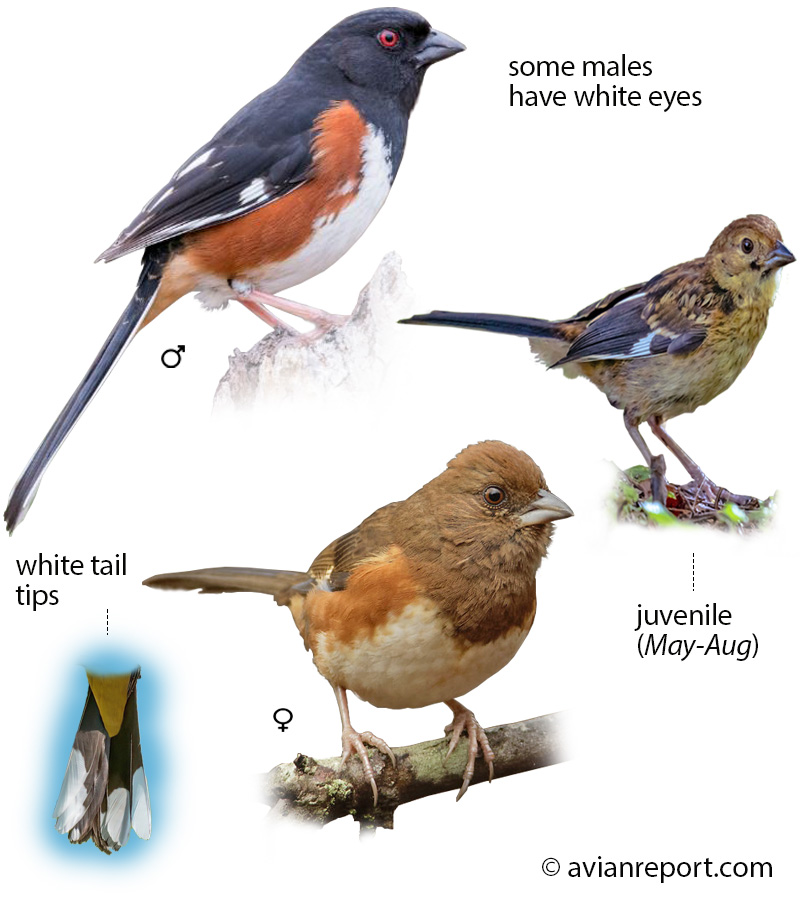
Identification: The male eastern towhee (Pipilo erythrophthalmus) has a black hood and back. The female has brown instead of black. Both sexes have a white belly with rich brown sides.
Food: Attract eastern towhees with black oil sunflower seeds, hulled sunflower seeds, safflower, cracked corn, peanut hearts, millet, and milo.
Feeder: This towhee is largely a ground feeder that takes seeds spilled below elevated feeders. It uses platform feeders and, less often, hopper feeders.
Presence: The Eastern Towhee is a summer resident in Michigan. Arriving in April and departing by October, this secretive bird visits ground feeders for seeds and insects during its seasonal stay.
Behavior: Eastern towhees feed mostly on the ground along with other ground feeders, which are generally not aggressive to each other.
Backyard: This bird occurs in dense low vegetation and is reluctant to venture away from it. It is more likely to visit backyard feeders located adjacent to this habitat type.
Nest: Eastern towhees nest in accumulations of leaf litter on the ground; less often in vine tangles above the ground.
Breeding season: Eastern towhees breed in May through mid-August.
Breeding period: It lays 2-6 creamy or grayish speckled with reddish spots eggs. It takes approximately 24 days from egg-laying (incubation period 12 days, nestling period 12 days) until fledging.
Lifespan: Eastern towhees live at least nine years.
Dark-eyed Junco

Identification: The male dark-eyed junco (Junco hyemalis) is slate gray and white. Females are a dull grayish-brown version of the male. Both sexes have pink bills and white outer tail feathers.
Food: Attract juncos with black oil sunflower seeds, hulled sunflower seeds, safflower, cracked corn, peanut hearts, millet, and milo.
Feeder: It feeds mostly on the ground, eating birdseed spilled by elevated feeders. It readily uses platform and hopper feeders.
Presence: The Dark-eyed Junco is a common winter visitor in Michigan. Arriving in September and departing in May, this “snowbird” is a constant presence at backyard feeders during the winter months.
Behavior: Not an aggressive bird that visits backyards often in flocks. Easily displaced by more aggressive birds.
Backyard: The dark-eyed junco forages in semi-open areas with some vegetation cover. Favors backyards that offer vegetation cover near the feeders.
Nest: The Dark-eyed junco builds a cup-shaped on sloping ground or similar structures, such as among the large roots of upturned trees.
Breeding season: The dark-eyed junco breeds from mid-April through late August.
Breeding period: Dark-eyed juncos lay 3-6 pale greenish spotted with brown eggs. It takes approximately 25 days from egg-laying (incubation period 13 days, nestling period 12 days) until fledging.
Lifespan: Dark-eyed juncos live at least 11 years and four months.
Indigo Bunting
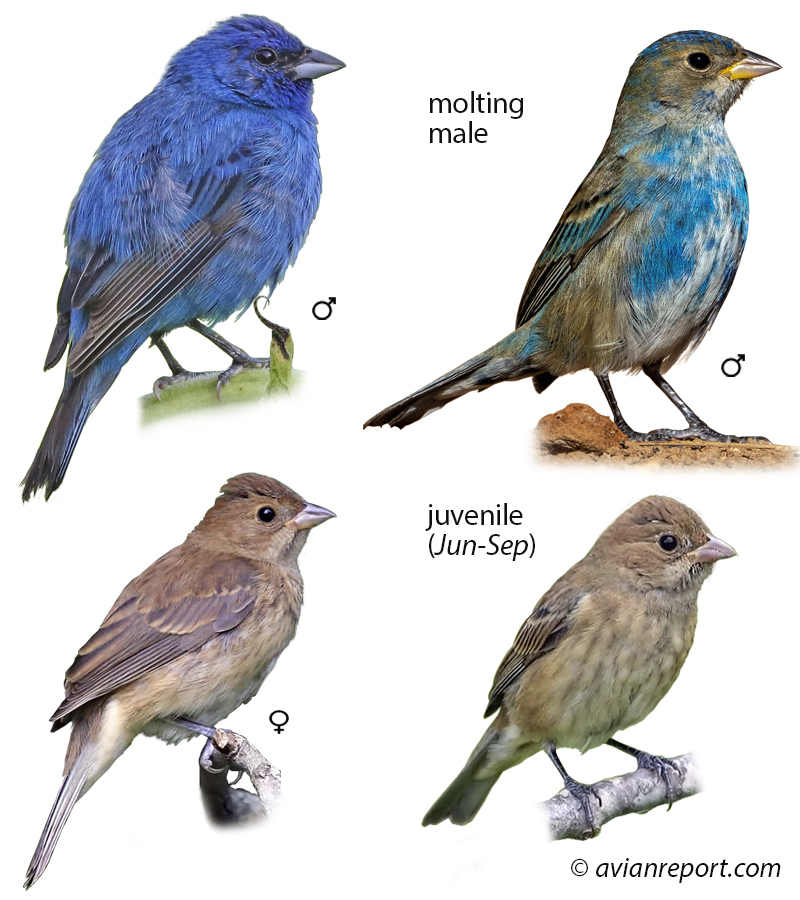
Identification: The male indigo bunting (Passerina cyanea) in breeding plumage is entirely blue. Females are brown with faint dark streaks on the breast and belly.
Food: Attract indigo buntings with hulled sunflower seed, millet, and nyjer.
Feeder: It favors large and small tube, large hopper, and platform feeders.
Presence: The Indigo Bunting is a summer resident in Michigan. Arriving in early May and departing in late September, this vibrant bird visits feeders for nyjer and small seeds during its stay.
Behavior: Nonaggressive and easy-going at feeders. Submissive to other even smaller birds.
Backyard: Favors backyards with dense vegetation around the feeders that they use to approach the feeder and return to cover.
Nest: Indigo buntings build a cup-shaped nest in thick vegetation, usually 3 to 5 feet above the ground.
Breeding season: The indigo bunting breeds in late May through late September.
Breeding Period: Indigo buntings lay 3-4 white unmarked eggs with some or no brownish spots. It takes about 24 days from egg-laying (incubation period 13 days, nestling period 14 days) until fledging.
Lifespan: Indigo buntings live at least 13 years and 3 months.
Snow Bunting
Length 5.9″, Weight 1.3 oz
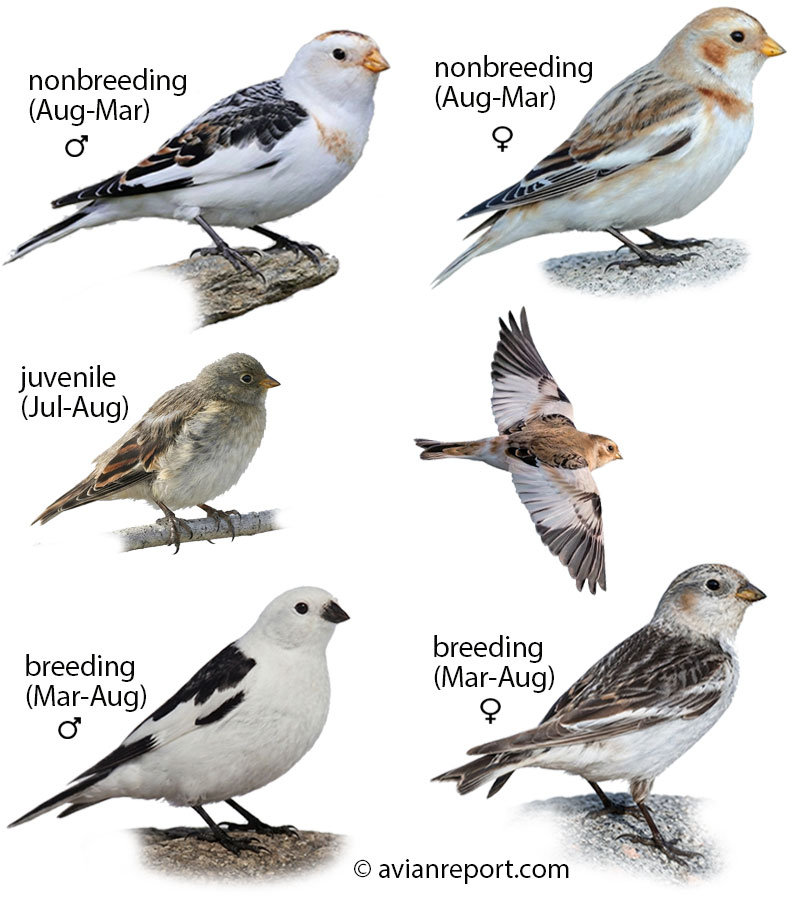
Identification: Breeding male: Pure white with black back, central tail, and wingtips. Breeding female: Streaky brown-gray back, dusky head, white underparts. Nonbreeding: Both sexes show rusty patches on head, breast, and shoulders; bill yellow. Juveniles: Gray body, streaked dark gray above, dark wings and tail.
Food: The Snow Bunting (Plectrophenax nivalis) favors white proso millet, cracked corn, sunflower hearts, nyjer, small mixed seeds.
Feeder: Low platform feeders, tray feeders. Also feeds on ground.
Presence: The Snow Bunting is a winter visitor in Michigan. Arriving in October and departing by March, this hardy species may visit ground-level feeders in open areas during periods of heavy snow.
Behavior: Highly social in flocks; bickering common. Males dominant over females; first-winter birds often dominant over same-sex adults.
Backyard: Snow buntings prefer wide, open spaces like fields or shorelines. Avoids dense trees, shrubs, and fences. Favors rural yards over suburban neighborhoods.
Nest: Thick cup of grass and moss, lined with fur and feathers. Built deep in rock crevices or cavities on the ground.
Breeding Season: Late June through early August.
Breeding Period: Clutch: 2-7 eggs | Appearance: creamy white with variable brown spots and scrawls | Incubation: 10-14 days | Nestling: 9-12 days | Total to Fledging: ~22-30 days.
Lifespan: At least 8 years and nine months.
Rose-breasted Grosbeak
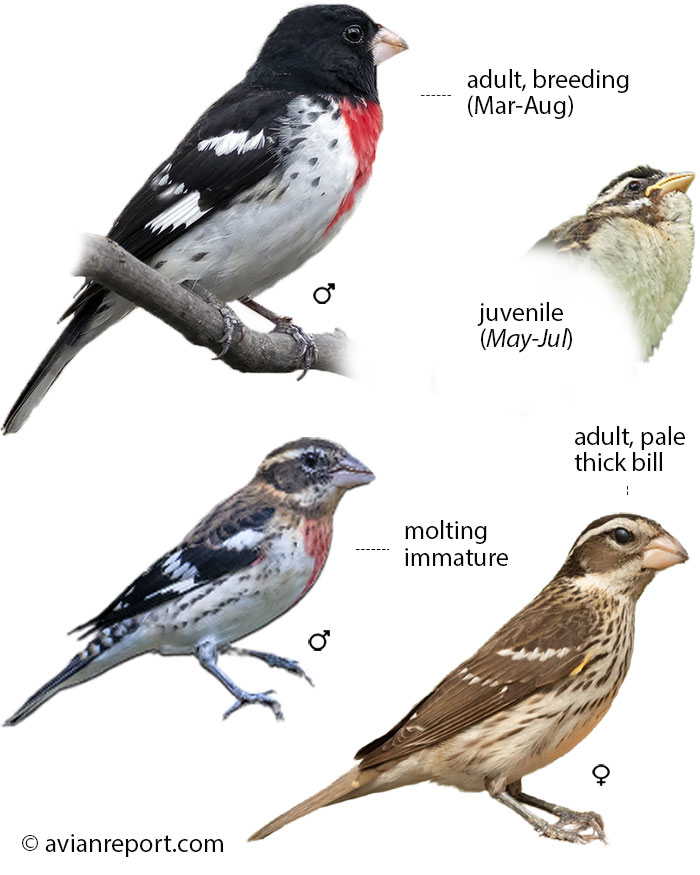
Identification: The Rose-breasted Grosbeak (Pheucticus ludovicianus) is Stocky with a large bill. Males: black and white with a bright red breast chevron. Females/Immatures: streaked brown/white, bold face pattern, large bill.
Food: Attract Rose-breasted Grosbeaks with its favorite food, oil sunflower seeds, and hulled sunflower seeds.
Feeder: It appears comfortable feeding on platform and hopper feeders.
Presence: The Rose-breasted Grosbeak is a summer resident in Michigan. Arriving in early May and departing by late September, it is most likely to visit bird feeders from May through September.
Behavior: Forages in dense foliage/branches, also hovers or hawks insects. Found alone, in pairs, or in loose flocks during migration/winter.
Backyard: Favors forested and semi-open woodland and backyards with plenty of trees.
Nest: The Rose-breasted Grosbeak builds an open cup of sticks/twigs, lined with finer material placed in the vertical fork/crotch of sapling, usually in forest openings, field edges, parks, or residential areas.
Breeding season: They breed from mid-June through mid- August.
Breeding Period: The Rose-breasted Grosbeak lays 1-5 pale green to blue eggs with brown spots. It takes about 24 days from egg-laying (incubation period 12 days, nestling period 12 days) until fledging.
Lifespan: Known lifespan is at least 12 years, 11 months (based on banding records).
Evening Grosbeak
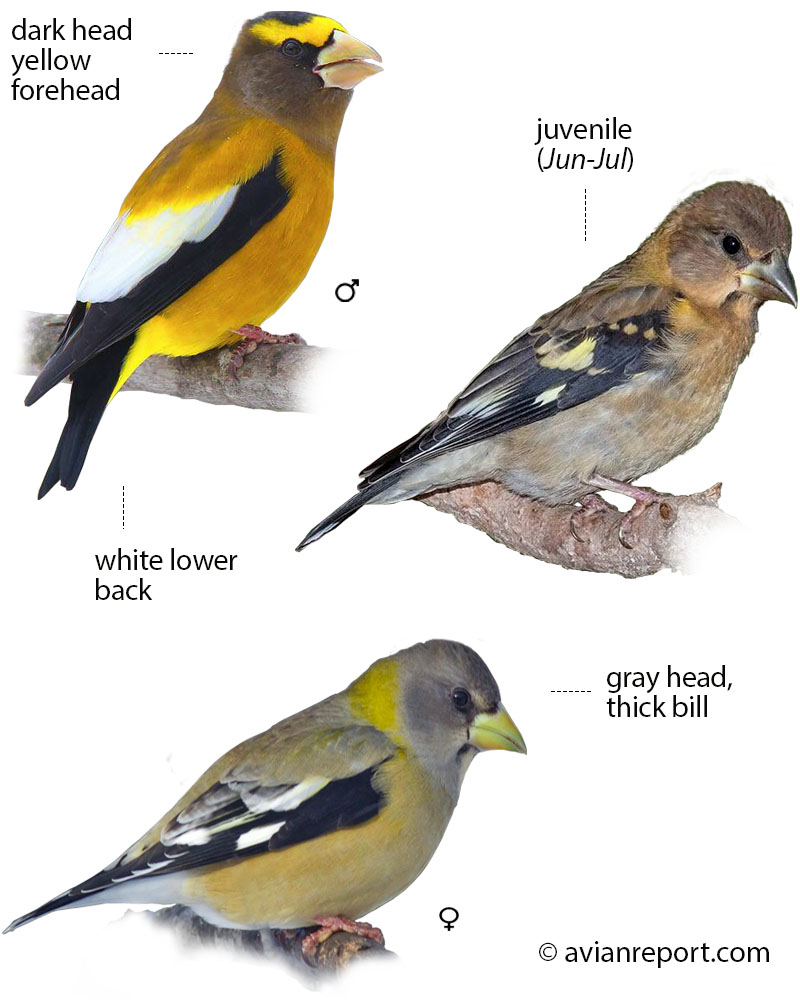
Identification: The male evening grosbeak (Coccothraustes vespertinus) has a yellow forehead and dark head that fades to bright yellow underparts. The wings are mostly black with bright white secondaries. Females are overall gray with some white on the wings. Both sexes have thick pale bills and notched tails.
Food: Attract evening grosbeaks with its favorite food, oil sunflower seeds, and hulled sunflower seeds.
Feeder: It appears comfortable feeding on platform and hopper feeders.
Presence: The Evening Grosbeak is an irruptive winter visitor in Michigan. Typically arriving in late autumn and staying until early spring, it visits feeders from November through April for sunflower seeds.
Behavior: This large grosbeak often travels in flocks and may temporarily overtake feeders driving other birds away.
Backyard: Favors forested and semi-open woodland and backyards with plenty of trees.
Nest: The evening grosbeak builds a relatively large nest made of twigs. It has a central cup lined with fine material.
Breeding season: Evening grosbeaks breed in mid-May through early August.
Breeding Period: The evening grosbeak lays 2-5 bluish eggs with brown spots. It takes about 27 days from egg-laying (incubation period 13 days, nestling period 14 days) until fledging.
Lifespan: The evening grosbeak lives at least 16 years and 3 months.
Pine Grosbeak
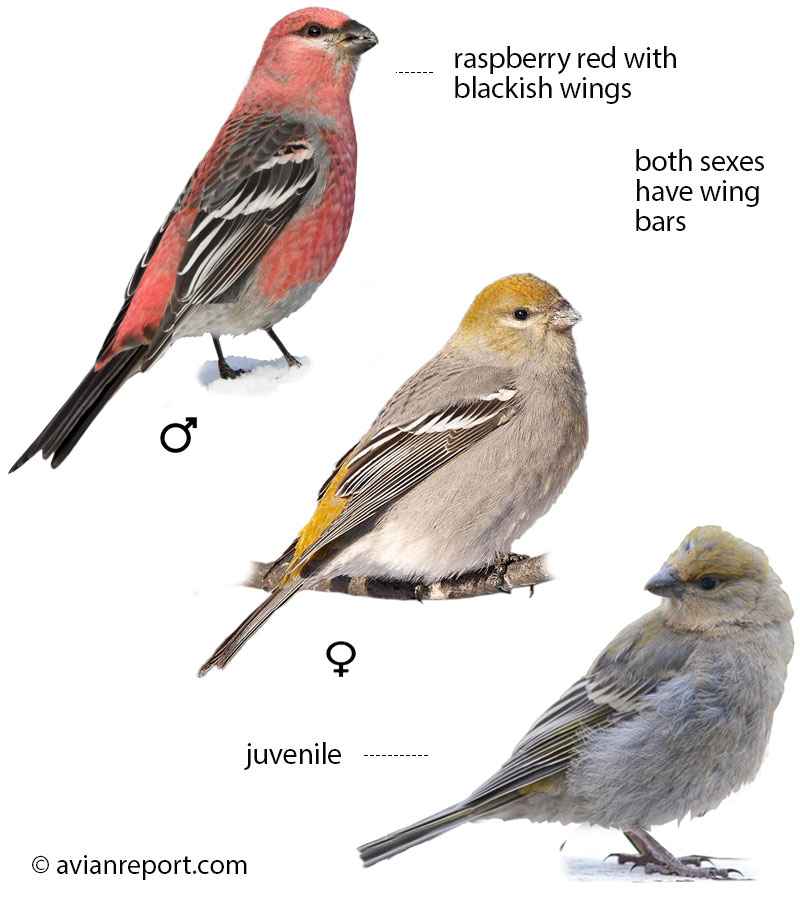
Identification: Males pine grosbeaks (Pinicola enucleator) are raspberry red and gray, with dark wings and white wing bars. Females and immature birds are mostly gray with yellow-brown heads and rumps.
Food: Attract pine grosbeaks with black oil sunflower seeds, hulled sunflower seeds, suet, and fruit.
Feeder: This grosbeak readily takes to platform feeders and the like, including large and small hopper ones.
Presence: The Pine Grosbeak is a winter visitor in Michigan. This large finch arrives in late autumn and departs by early spring, frequently visiting platform feeders from November through March.
Behavior: Pine grosbeaks are unusually tame near people. They are not aggressive and may be displaced by even smaller but more aggressive birds.
Backyard: This bird occurs in Boreal forest and semi open woodlands. It is more likely to visit backyards near its favorite habitat.
Nest: Pine grosbeaks build a bulky nest made of coarse twig on the base. The center has a cup lined with soft materials such as rootlets, hair or feathers.
Breeding season: The pine grosbeak has a short breeding season that goes from mid-May through mid to late July.
Breeding period: It lays 3-4 bluish eggs speckled with brown spots. It takes approximately 30 days from egg-laying (incubation period 13 days, nestling period 17 days) until fledging.
Lifespan: The pine grosbeak lives at least 9 years and 9 months.
American Goldfinch

Identification: The American goldfinch (Spinus tristis) is in its winter plumage consisting of an unmarked brown with blackish wings and two broad pale wing bars. Breeding males replace the brown with bright yellow and a black cap.
Food: Attract American goldfinches to your yards with hulled sunflower and nyjer seeds.
Feeder: It favors large and small tube feeders, large hopper and platform feeders, and the ground.
Presence: The American Goldfinch is a common year-round resident in Michigan. This lively finch is a constant presence at bird feeders, especially favoring nyjer and sunflower seeds throughout every month.
Behavior: Non-aggressive and easy-going at feeders. Submissive to most other feeder birds. Often clings to feeders horizontally.
Backyard: Shrubs, tall weeds, and seed-producing weeds attract American goldfinches.
Nest: American goldfinches build a neat cup-shaped nest on twigs, dense shrubs, and dense foliage in overhanging branches of trees 4 to 15 feet above the ground.
Breeding season: Goldfinches breed in early June through late September.
Breeding period: The American goldfinch lays 2-7 pale bluish-white eggs with brownish dots on the wide side of the egg. It takes about 27 days from egg-laying (incubation period 13 d, nestling period 14 d) until fledging.
Lifespan: American goldfinches live at least 7 years.
Pine Siskin

Identification: The pine siskin (Spinus pinus) is a small finch, all brown and streaked with black. It has a pointed bill and a notched tail. Males show a variable amount of yellow on the wing.
Food: Attract pine siskins with small seeds such as thistle or nyjer, millet, and hulled sunflower seeds. They can also take peanut hearts and suet.
Feeder: Pine siskins tend to cling to vertical stems and also do so on bird feeders. They favor large tube, large hopper, and platform feeders.
Presence: The Pine Siskin is an irruptive winter visitor in Michigan. Arriving in October and departing by May, this streaked finch is commonly seen at thistle feeders from October through May.
Behavior: A nomadic bird, pine siskins can visit feeders one year and disappear the next. Non-aggressive and displaced by larger birds. Thistle feeders exclude most other birds.
Backyard: It is attracted to yards with shrubs and plenty of weeds with small seeds.
Nest: Pine siskins build a cup-shaped nest concealed in dense foliage on overhanging branches. Several pairs may nest in close proximity.
Breeding season: This siskin breeds between March through August.
Breeding period: Pine siskins lay 3-5 greenish with light brown specks eggs. It takes approximately 28 days from egg-laying (incubation period 13 days, nestling period 15 days) until fledging.
Lifespan: They live at least nine years and 2 months.
Redpoll (Common Redpoll)

Identification: Male and female common redpolls (Acanthis flammea) are light gray streaked with black. They have a small red cap, as well as a black face and chin. Males can show pink wash on their breasts. It has a very small yellow bill, a plumb body, and a notched tail.
Food: Attract common redpolls with hulled sunflower seeds, nyjer, and black oil sunflower seeds.
Feeder: It usually feeds at small and large hopper feeders, tube feeders, and ground.
Presence: The Common Redpoll is a winter visitor in Michigan. Often arriving in late fall and departing by early spring, it visits feeders for tiny seeds from November through March.
Behavior: This small siskin-like bird is not aggressive to other birds at feeders. It may be submissive to most birds at feeders.
Backyard: Favors semi-open and deciduous woodlands. Visits feeders located near its favorite habitat. Some years may become erratic and appear in unexpected places.
Nest: The common redpoll builds a neat cup lined inside with bird feathers, hair, and other fine material.
Breeding season: They breed in late May through late August.
Breeding Period: The common redpoll lays 2-6 bluish eggs spotted with brown. It takes about 24 days from egg-laying (incubation period 11 days, nestling period 13 days) until fledging.
Lifespan: Common redpolls live at least 8 years.
House Sparrow

Identification: Males house sparrows (Passer domesticus) have rich-brown and patterned back, chestnut napes, and a black bib that varies with age. The forehead and underparts are gray. Females are brown with a patterned back. Immatures look like females.
Food: House sparrows like black oil sunflower seed, hulled sunflower seed, cracked corn, peanut hearts, millet, and milo.
Feeder: They favor large tube, large hopper, and platform feeders. They also feed on the ground.
Presence: The House Sparrow is a ubiquitous year-round resident in Michigan. This adaptable species is highly common and can be expected at bird feeders during every month of the year.
Behavior: It can be aggressive to other birds at feeders. Dominant over same-sized and smaller birds.
Backyard: Favors open habitats, farmland, and urban areas. Visits all types of backyards.
Nest: House sparrows build large, bulky, and messy-looking nests with a side entrance. It uses cavities, light fixtures, tangled vines, and just about any structure to place a nest.
Breeding season: House sparrows breed in early March through late September.
Breeding Period: House sparrows lay 1-8 variable whitish, bluish, or greenish eggs spotted with gray. It takes about 26 days from egg-laying (incubation period 13 days, nestling period 13 days) until fledging.
Lifespan: House sparrows live at least 15 years and nine months.
DOVES AND PIGEONS
In Michigan, doves and pigeons are regular visitors to backyard feeders, especially those that offer food on the ground or on platform feeders. These birds are primarily vegetarian year-round, feeding on seeds and grains, and occasionally small berries.
They have slender, straight bills adapted for picking up seeds and swallowing them whole, rather than crushing them like finches and sparrows. As a result, they prefer larger seeds and typically forage on the ground beneath feeders, where spilled seed accumulates.
Mourning Dove

Identification: The mourning dove (Zenaida macroura) is all brown with dark spots on the wing. Juveniles have pale edging on feathers.
Food: Attract mourning doves with hulled sunflower seeds, safflower, cracked corn, peanut hearts, millet, oats, and milo.
Feeder: It feeds mostly on the ground, below elevated feeders. The mourning dove also uses platform and large hopper feeders.
Presence: The Mourning Dove is a common year-round resident in Michigan. This graceful dove is a frequent visitor to ground and platform feeders throughout all months of the year.
Behavior: The mourning dove is non-aggressive at feeders but stands its ground against other birds. Submissive to blue jays, blackbirds, and crows.
Backyard: It favors relatively open yards where it usually feeds on spilled seeds on the ground below hanging feeders.
Nest: Mourning doves build a precarious platform of twigs placed in a fork, branch, or dense foliage, usually 10 to 15 feet above the ground.
Breeding season: Mourning doves breed in mid-February through early October.
Breeding period: The female lays 2 white eggs. It takes about 27 days from egg-laying (incubation period 14 days, nestling period 14 days) until fledging.
Lifespan: Mourning doves live at least 30 years and four months.
BLACKBIRDS, GRACKLES, ORIOLES
In Michigan, blackbirds, grackles, and orioles are occasional to frequent visitors to backyard feeders, depending on the season and food offered. This group is made up of adaptable, generalist feeders that consume seeds, grains, fruit, insects, nectar, and other invertebrates.
Blackbirds and grackles often arrive in flocks and will take advantage of almost any available food, sometimes dominating feeders. Orioles, in contrast, are more selective and are especially attracted to fruit and nectar, readily visiting feeders that offer oranges, jelly, or sugar-water solutions.
Red-winged Blackbird
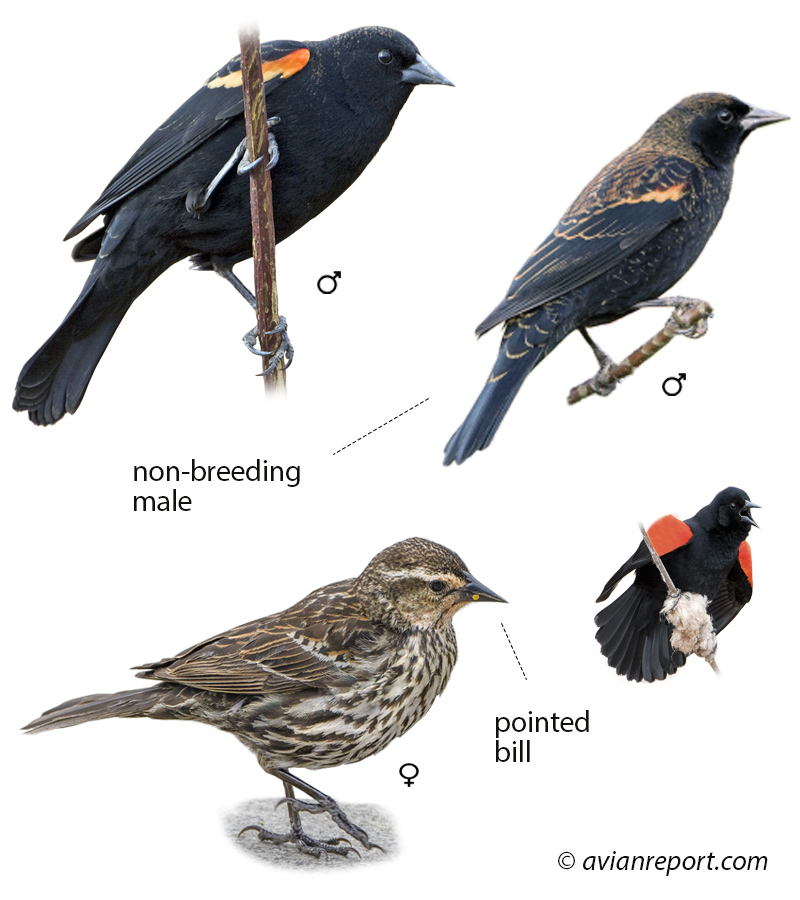
Identification: Adult breeding males red-winged blackbirds (Agelaius phoeniceus) are black with bright red shoulder patches. Non-breeding males have rusty or whitish feather edges in the winter. Females and juveniles are brown with black streaks.
Food: Attract red-winged blackbird with black oil sunflower seeds, hulled sunflower seeds, cracked corn, peanuts hearts, millet, oats, and milo.
Feeder: It favors platform feeders. It uses visits large tube and large hopper feeders. It also feeds on the ground.
Presence: The Red-winged Blackbird is a summer resident in Michigan. Arriving in early March and departing by late November, it frequently visits feeders for grain and seeds from March through November.
Behavior: It is aggressive to other birds taking over the feeders when present in large numbers. Submissive to blue jays, starlings, and red-bellied woodpeckers.
Backyard: Favors backyards near lakes, marshes, and farmland. It is a frequent visitor to feeders in semi-urban areas.
Nest: It builds a cup-shaped nest in vertical shoots of marshes, often mixed with saplings, generally 3 to 6 feet from the water.
Breeding season: The red-winged blackbird breeds from early April through early August.
Breeding period: Red-winged blackbirds lay 2-4 bluish-green eggs with dark markings. It takes about 25 days from egg-laying (incubation period 12 days, nestling period 13 days) until fledging.
Lifespan: Red-winged blackbirds live at least 15 years and nine months.
Rusty Blackbird
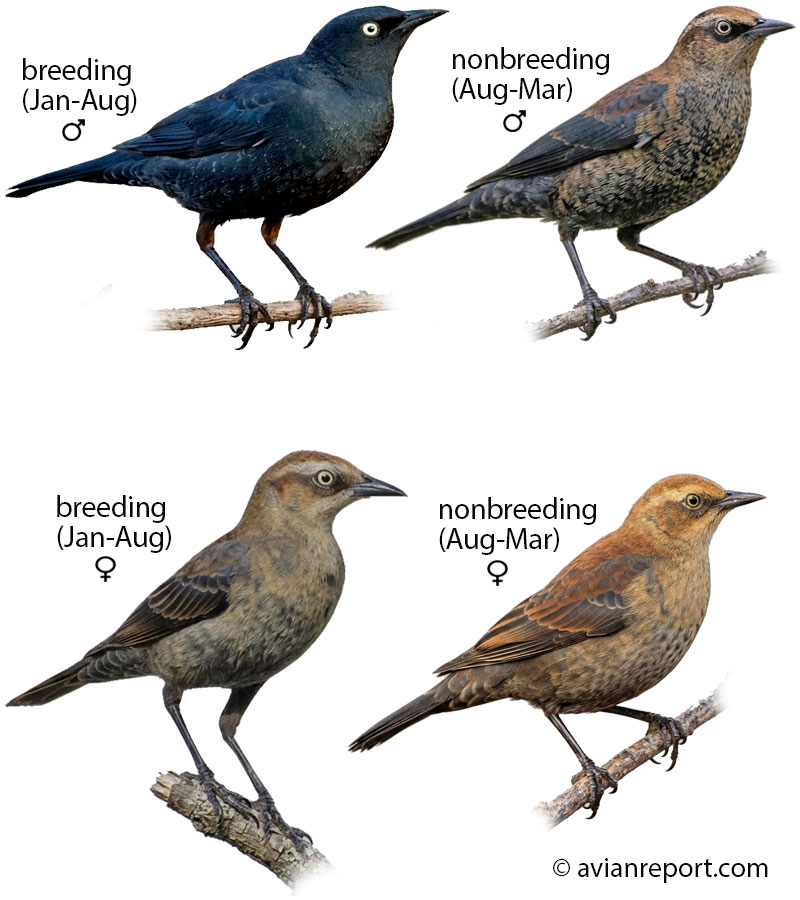
Identification: Breeding male: Glossy black with faint greenish sheen; pale yellow eyes. Nonbreeding male: Rusty edges on black feathers. Female: Slate-gray, rusty-edged feathers; pale eyebrow. Nonbreeding female: Heavily rusted. Juveniles: Dull brownish-gray with dark eyes.
Food: The Rusty Blackbird (Euphagus carolinus) favors Suet, cracked corn, sunflower seeds, mealworms.
Feeder: Large hopper, platform feeders. Feeds primarily on the ground.
Presence: The Rusty Blackbird is a transient visitor in Michigan. Passing through during spring and fall migrations, it may visit ground feeders primarily in April, October, and November.
Behavior: Subordinate to larger blackbirds and grackles. Quiet and less aggressive; often forages in small, shy groups.
Backyard: Favors wet, boggy areas, flooded woods, and pond edges. Prefers brushy cover near shallow water.
Nest: Bulky cup of twigs, grass, and lichens reinforced with wet muck. Built in dense conifers or shrubs. Height: 2-20 feet.
Breeding Season: May through July.
Breeding Period: Clutch: 3-6 eggs | Appearance: Pale blue-green, blotched brown and gray | Incubation: 14 days | Nestling: 11-13 days | Total to Fledging: ~25-27 days.
Lifespan: At least 8 years and 7 months.
Brewer’s Blackbird
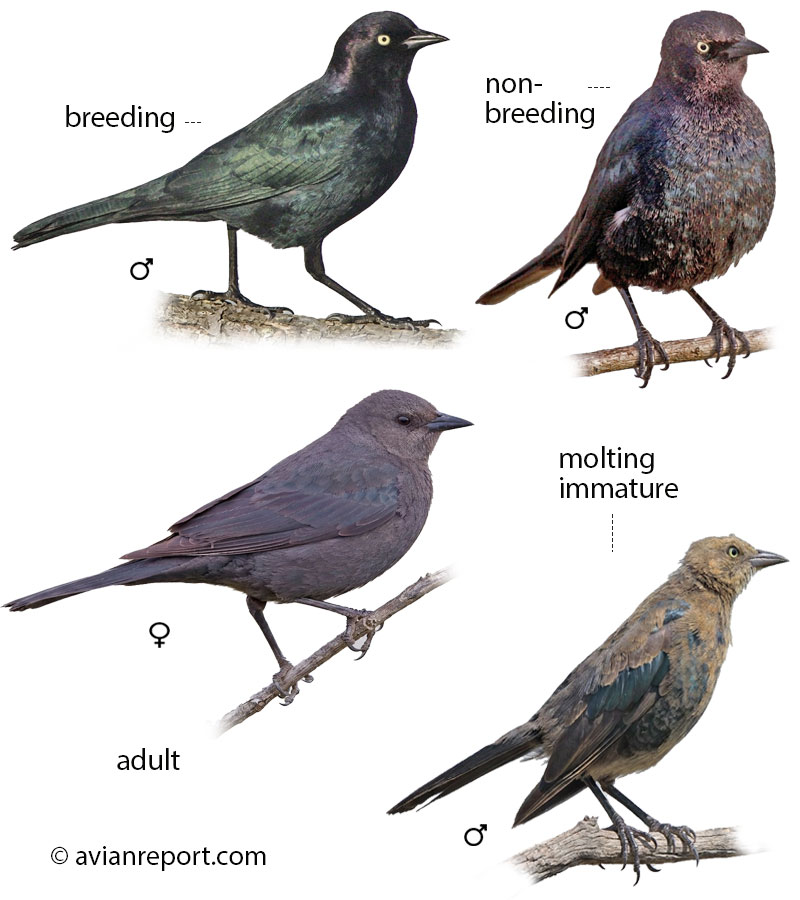
Identification: Male: Iridescent black with purplish-blue head and greenish body sheen; bright yellow eyes. Nonbreeding: Similar. Female: Plain brownish-gray overall, dark eyes, faint pale eyebrow. Juvenile: Resembles female but buffer with scaly appearance.
Food: Cracked corn, millet, milo, sunflower seeds, suet.
Feeder: Platform feeders, tray feeders, large hoppers. Frequently feeds on ground.
Presence: The Brewer’s Blackbird is a summer resident in Michigan. Arriving in April and departing in October, it is most likely to visit bird feeders during the warmer breeding and migration seasons.
Behavior: Highly social; forages in flocks. Bold and aggressive; often displaces smaller songbirds but subordinate to larger birds.
Backyard: Open lawns, short-grass areas, and surfaces near scattered trees or shrubs. Prefers proximity to water or agricultural edges.
Nest: Bulky cup of twigs, grass, and mud lined with fine hair. Located in shrubs, trees, or on ground.
Breeding season: April through June.
Breeding period: Clutch: 3–7 eggs | Appearance: Light gray to greenish, blotched with dark brown | Incubation: 12–14 days | Nestling: 13–14 days | Total to Fledging: ~27 days.
Lifespan: At least 12 years and 6 months.
Common Grackle

Identification: Common grackles (Quiscalus quiscula) look black from a distance. They have a shiny greenish head with shades of purple on the rest of the body. Its plumage is variable. Note the pale eye in adults.
Food: Attract common grackles with black oil sunflower seeds, hulled sunflower seeds, safflower, suet, cracked corn, peanuts, peanut hearts, fruit, millet, oats, and milo.
Feeder: It favors large hopper and platform feeders and feeds on the ground.
Presence: The Common Grackle is a summer resident in Michigan. Typically arriving in March and departing by November, this bold bird is a frequent visitor to feeders from March through November.
Behavior: One of the most aggressive and dominant birds at bird feeders. Takes over feeders when present.
Backyard: Favors open and semi-open habitats. Visit all types of yards often in flocks.
Nest: Common grackles build a bulky nest with an open cup in trees and shrubs, usually 20 feet or less above the ground. It can also nest in barns, rock crevices, and even stored farm equipment.
Breeding season: Common grackles breed in early March through early July.
Breeding period: Common grackles lay 1-7 brownish to pale bluish-gray eggs spotted with brown. It takes about 28 days from egg-laying (incubation period 13 days, nestling period 15 days) until fledging.
Lifespan: Common grackles live at least 23 years and 1 month.
Brown-headed Cowbird

Identification: Males brown-headed cowbirds (Molothrus ater) are glossy black with chestnut-brown heads. Females are gray-brown overall, with faint dark streaks on the breast and belly.
Food: Attract brown-headed cowbirds with black oil sunflower seeds, hulled sunflower seeds, cracked corn, millet, oats, and milo.
Feeder: Brown-headed cowbirds favor large hopper and platform feeders and the ground.
Presence: The Brown-headed Cowbird is a summer resident in Michigan. Arriving in early spring and departing by late autumn, it is most likely to visit bird feeders from March through October.
Behavior: Aggressive to other birds, dominant over smaller birds. Attends feeders usually in flocks.
Backyard: Favors backyards that are open and near open woods and farmlands.
Nest: Brown-headed cowbirds do not build nests but lay their eggs (parasitize) in the nest of other birds.
Breeding season: Brown-headed cowbirds breed in early April through the end of August.
Breeding period: A female cowbird lays 1-7 grayish eggs with brown spots. Birds that take over the parental duties for the cowbirds take about 23 days from egg-laying (incubation period 11 days, nestling period 12 days) until fledging.
Lifespan: Brown-headed cowbirds live at least nine years.
Baltimore Oriole

Identification: Male Baltimore oriole (Icterus galbula) have a black head and back with a bold white wing bar. The breast and belly are bright orange. Females have a variable plumage going from yellowish to orange below, often with blotchy-black marks on the head and back. Juveniles are similar to females.
Food: Attract Baltimore orioles with fruit, jelly, suet, and nectar.
Feeder: Baltimore orioles favor platform and nectar feeders.
Presence: The Baltimore Oriole is a summer resident in Michigan. This striking bird arrives in early May and departs in early September, visiting specialized nectar and fruit feeders from May through September.
Behavior: Non-aggressive at feeders. Submissive to other, even smaller birds.
Backyard: Favors backyards in deciduous and open woodlands. Visit feeders alone or in small flocks.
Nest: It builds a hanging bag-like nest attached to thin branches 20 to 30 above the ground.
Breeding season: The Baltimore oriole breeds from early May through mid-July.
Breeding Period: The Baltimore oriole lays 3-7 pale bluish eggs blotched with dark brown. It takes about 27 days from egg-laying (incubation period 13 days, nestling period 14 days) until fledging.
Lifespan: Baltimore orioles live at least 12 years.
Orchard Oriole
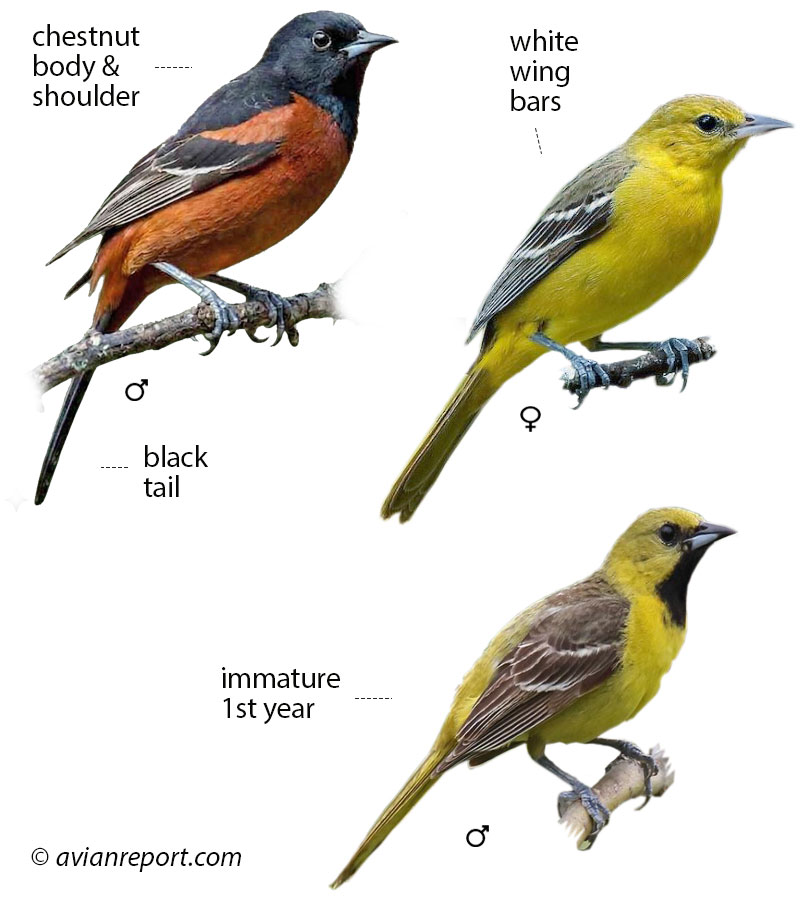
Identification: Adult male: chestnut underparts and shoulder, black hood and back. Adult female: greenish-yellow, olive-toned back, two white wing bars. Immature male: similar to female. No seasonal plumage changes.
Food: The Orchard Oriole (Icterus spurius) favors Nectar, orange halves, grape jelly, sugar water, suet, mealworms.
Feeder: Nectar feeders, fruit feeders, platform feeders. Feeds in flowering trees and shrubs.
Presence: The Orchard Oriole is a summer resident in Michigan. This smaller oriole arrives in May and departs by late August, visiting nectar and fruit feeders from May through August.
Behavior: Social; often nests in loose colonies. Subordinate to larger Baltimore Orioles and woodpeckers at feeders.
Backyard: Orchard orioles prefer open woods, orchards, and yards with mature shade trees, flowering shrubs, and water sources.
Nest: Hanging pouch of woven grasses and fibers; suspended from thin outer branches. Height: 5-70 feet above ground.
Breeding season: Late April through early July.
Breeding period: Clutch: 4-6 eggs | Appearance: Bluish-white, blotched and scrawled with brown/purple | Incubation: 12-14 days | Nestling: 11-14 days | Total to Fledging: ~23-28 days.
Lifespan: At least 11 years.
MOCKINGBIRDS & THRASHERS
In Michigan, mockingbirds and thrashers are occasional visitors to backyard feeders, often more noticeable for their vocal abilities than their feeding habits. These birds are exceptional songsters, and many are skilled mimics, incorporating the songs of other birds into their repertoire.
They feed primarily on insects and fruit, shifting more toward berries outside the breeding season. Rather than feeding directly on seeds, mimids often forage by tossing leaves and probing through leaf litter in search of prey. At feeders, they may scatter seed while searching for preferred items, and are especially attracted to offerings such as fruit and suet.
Brown Thrasher
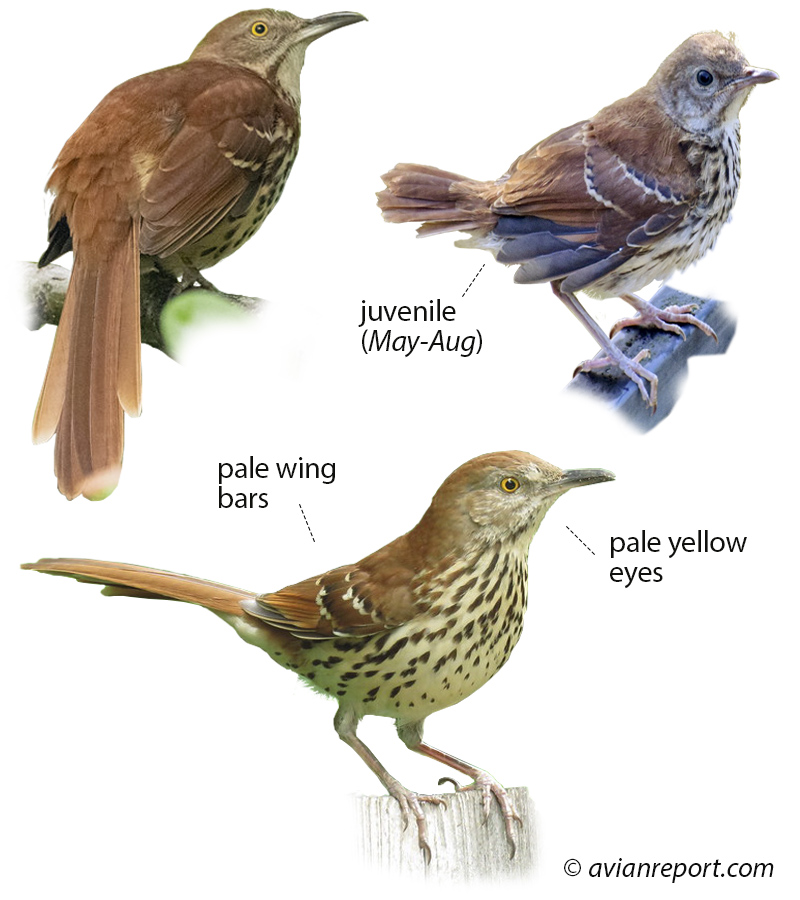
Identification: The brown thrasher (Toxostoma rufum) has a long tail, reddish-brown back, and pale wing bars. The underparts are heavily streaked with black. The eyes are pale yellow.
Food: Attract brown thrashers with hulled sunflower seeds, suet cage, cracked corn, and peanut hearts.
Feeder: It favors platform feeders and also feeds on the ground.
Presence: The Brown Thrasher is a seasonal breeding resident in Michigan. Arriving in late April and departing by October, this skulking mimic visits ground feeders primarily during the spring and summer months.
Behavior: Rather shy and non-aggressive at feeders. Submissive to most other birds.
Feeder: Favors dense vegetation and thickets it uses to approach feeders and hide.
Nest: It builds a relatively large cup-shaped nest in dense vegetation 2-7 feet above the ground.
Breeding season: Brown thrashers breed in mid-April through late August.
Breeding period: Brown thrashers lay 2-6 pale bluish or greenish eggs with reddish-brown speckles. It takes about 25 days from egg-laying (incubation period 13 days, nestling period 14 days) until fledging.
Lifespan: Brown thrashers live at least 10 years and 11 months.
Gray Catbird
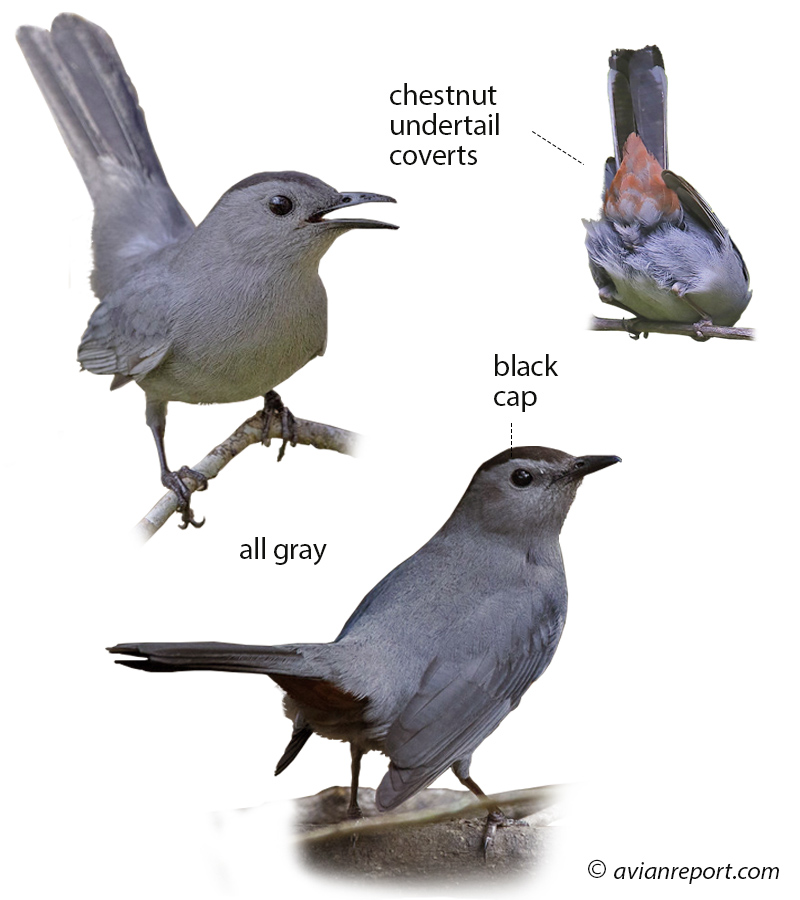
Identification: The gray catbird (Dumetella carolinensis) is uniformly gray with a black cap. Note the chestnut undertail coverts.
Food: Attract gray catbirds with suet, peanut hearts, fruit, and mealworms.
Feeder: It favors platform feeders and also feeds on the ground.
Presence: The Gray Catbird is a common summer resident in Michigan. Arriving in early May and departing by late September, it frequently visits fruit and jelly feeders during these warmer months.
Behavior: Rather shy and non-aggressive. Avoid any confrontation, and it is submissive to other birds.
Backyard: Favors dense thickets and fruit-bearing shrubs.
Nest: It builds an open cup nest on horizontal branches hidden in thick foliage around 4 feet above the ground.
Breeding season: Gray catbirds breed in mid-March through late June.
Breeding Period: The gray catbird lays 1-6 blue-green eggs. It takes about 24 days from egg-laying (incubation period 14 days and nestling period 11 days) until fledging.
Lifespan: Gray catbirds live at least 17 years and 11 months.
STARLINGS
The European Starling is a common and well-established introduced species across North America, including Michigan. Starlings are highly adaptable, feeding on insects, fruits, and grains, and readily taking advantage of backyard feeders. They often arrive in noisy flocks and can dominate feeding areas, displacing smaller birds.
European Starling

Identification: European starlings (Sturnus vulgaris) look dark. A close look reveals iridescent purple and green shades with creamy spots. Both the bill and wings are pointed. A juvenile bird is a plain gray color.
Food: European starlings like all types of bird food, including fruit and suet. Some backyard birders deter starlings from their feeders.
Feeder: It favors platform and large hopper feeders, but it is comfortable feeding on the ground.
Presence: The European Starling is a ubiquitous year-round resident in Michigan. This gregarious species is common at bird feeders throughout the year, often appearing in large, noisy flocks regardless of the season.
Behavior: Starlings are one of the most dominant and aggressive birds at backyard feeders. This is why backyard birders dislike them.
Backyard: Starlings favor all types of mainly human-created habitats, including urban and suburban ones.
Nest: The European starling builds a bulky and messy nest with a central cup. Nesting takes place in cavities, enclosures, or unused woodpecker cavities.
Breeding season: The European starling breeds in mid-April through early July.
Breeding period: Pairs lay 3-6 bluish or pale blue unmarked eggs. It takes about 33 days from egg-laying (incubation period 12 days, nestling period 21 days) until fledging.
Lifespan: European starlings live at least 15 years and 3 months.
JAYS & CROWS
Jays and crows, members of the Corvidae family, are among the most intelligent and adaptable birds, and several species are familiar visitors to backyards across Michigan. The Blue Jay, in particular, is a frequent and conspicuous feeder visitor in the region.
Corvids are true diet generalists, eating seeds, nuts, fruits, insects, and carrion. Jays are especially known for caching food—storing seeds and nuts for later use—which plays a role in seed dispersal and forest regeneration.
Blue Jay

Identification: The blue jay (Cyanocitta cristata) is blue and black above, with white markings. Below can be whitish to pale gray. It has a conspicuous crest and a black necklace.
Food: Attract blue jays with black oil sunflower seeds, hulled sunflower seeds, safflower, suet, cracked corn, suet, peanuts, peanut hearts, fruit, millet, milo, and mealworms.
Feeder: Blue jays favor large tube feeders, suet cages, large hopper feeders, platform feeders, and the ground.
Presence: The Blue Jay is a bold year-round resident in Michigan. This intelligent corvid is a constant presence at feeders from January through December, known for its striking plumage and loud calls.
Backyard: Favors all yard conditions, including urban yards with sufficient trees.
Nest: Blue jays build a cup-shaped nest in various conditions 10-25 feet above the ground.
Breeding season: Blue jays breed in late March through late August.
Breeding period: Blue jays lay 2-7 bluish to brownish eggs with brown spots. It takes about 27 days from egg-laying (incubation period 18 days, nestling period 20 days) until fledging.
Lifespan: Blue jays live at least 26 years and 11 months.
Canada Jay
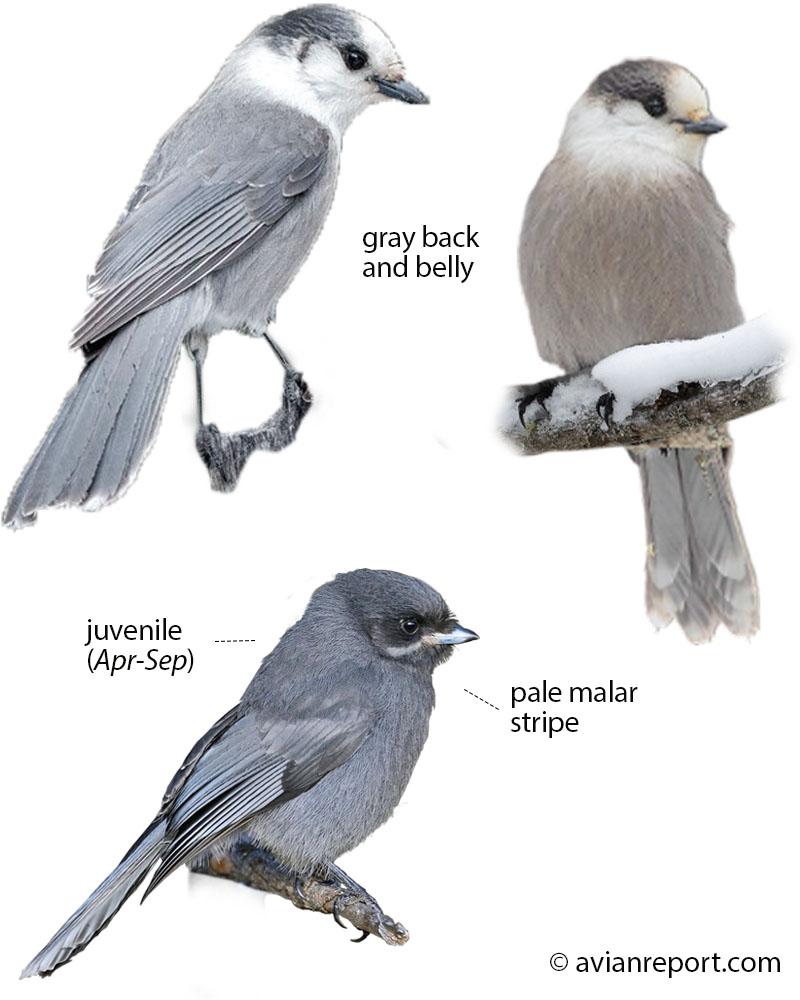
Identification: Canada jays (Perisoreus canadensis) are mostly gray with a white head, throat, and breast and a dark nape. Juveniles are sooty-gray with a white mustache stripe, but this varies regionally.
Food: Attract Canada jays with just about any type of food. Black oil and hulled sunflower seeds, peanuts, suet, cracked corn and other seeds are sure to attract this bird.
Feeder: Canada jays are ground feeders but are flexible and take up to platform, hopper, and even tube feeders.
Presence: The Canada Jay is a hardy year-round resident in northern Michigan. This fearless bird visits feeders throughout the year, especially during the snowy winter months when natural food sources are scarce.
Behavior: They generally move about in pairs and family groups. They can be aggressive to other birds and take over the feeders while in your yard.
Backyard: Canada jays semi-open areas and are flexible to just about any type of backyard types.
Nest: Canada jays build a bulky nest made of coarse twigs with a central cup lined with rootlets, animal fur, and feathers.
Breeding season: Canada jays breed from early March through late May.
Breeding period: It lays 2-5 greenish eggs speckled with reddish-brown spots. It takes approximately 41 days from egg-laying (incubation period 18 days, nestling period 23 days) until fledging.
Lifespan: Canada jays live at least 17 years and 2 months.
Black-billed Magpie
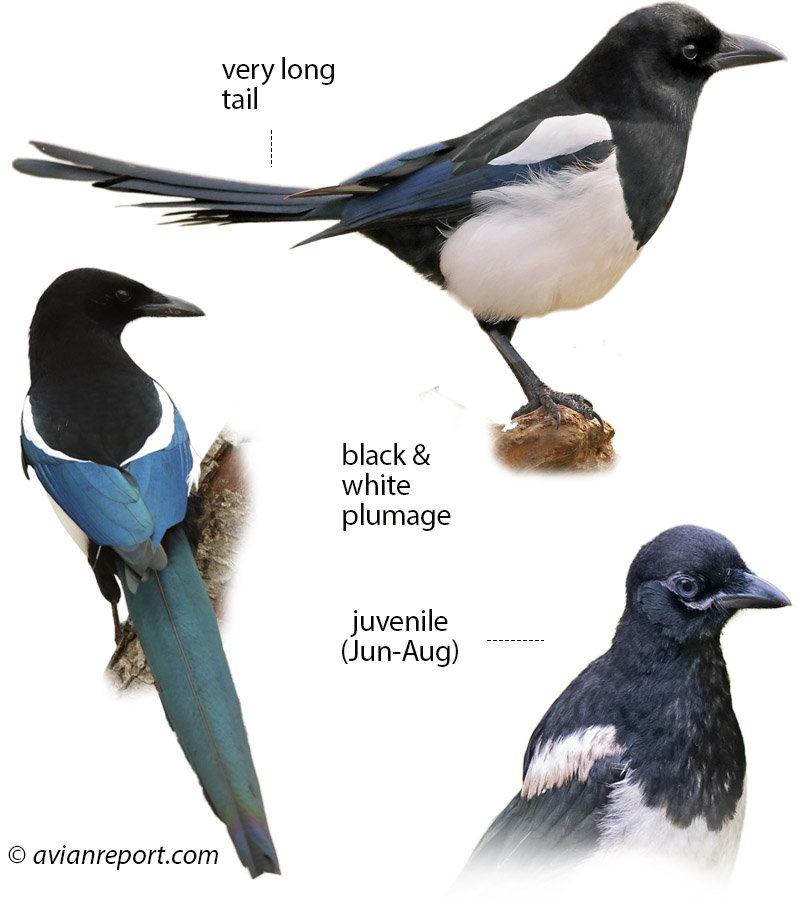
Identification: The black-billed magpie (Pica hudsonia) is unmistakable black and white with a black bill and long tail. In flight it shows flashes of black and white. It is a tame and familiar bird.
Food: Black-billed magpies are food generalists and can be attracted with hulled sunflower seeds, peanuts, milo, suet, black oil sunflower seed or fruit.
Feeder: Black-billed magpies favor platform and hopper feeders but do well feeding on the ground.
Presence: The Black-billed Magpie is an uncommon permanent resident in northwestern Michigan. This striking corvid may visit rural feeders year-round, though its presence is localized and most notable during the winter months.
Behavior: Aggressive at feeders. Submissive only to larger birds such as crows and ravens.
Backyard: Favors all yard conditions, including yards in low-density urban areas with vegetative coverage.
Nest: Black-billed magpies build large and bulky nests with a central cup that may have a rim of mud. The nest is placed in trees at heights of 10-25 feet above the ground.
Breeding season: The black-billed magpie breeds in late March through mid-june.
Breeding Period: It lays 2-8 brownish eggs with brown spots. It takes about 45 days from egg-laying (incubation period 18 days, nestling period 27 days) until fledging.
Lifespan: According to mark and recapture records black-billed magpies live at least 9 years, but are likely to live much longer. Blue jays live up to 26 years and magpies are likely to have a similar lifespan.
American Crow
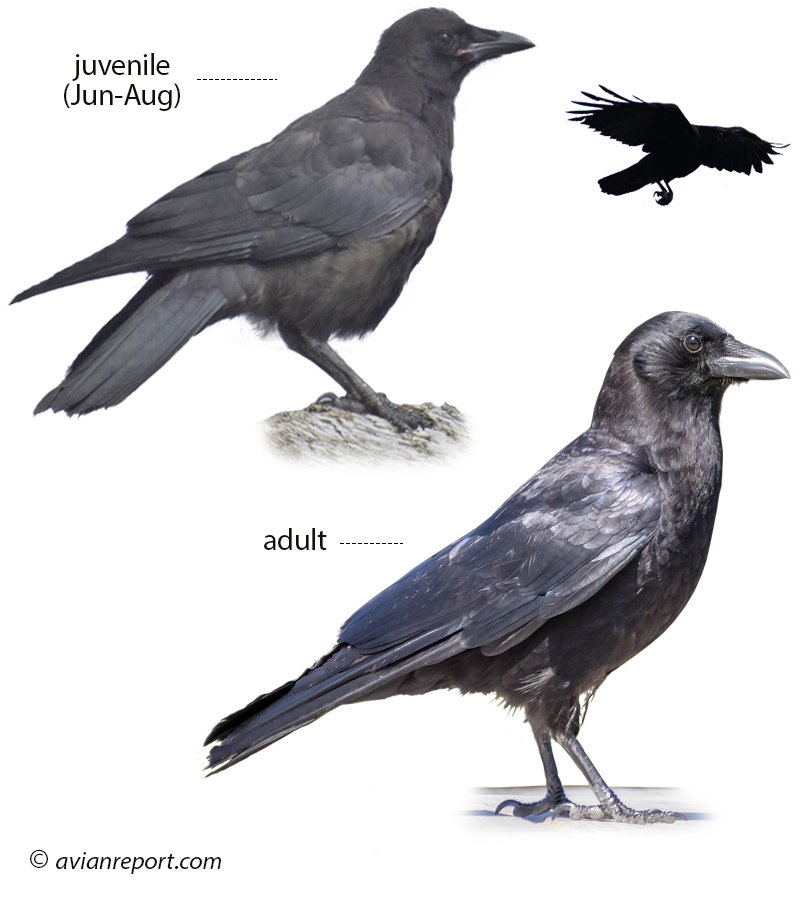
Identification: The American crow (Corvus brachyrhynchos) is all black. It is large and social, moving about in flocks of various sizes. Juvenile birds have dull black plumages without the glossy appearance of the adult.
Food: Attract American crows with oil sunflower seeds, hulled sunflower seeds, safflower, nyjer, cracked corn, peanut hearts, fruit, millet, oats, and milo.
Feeder: The American crow favors platform feeders and the Ground.
Presence: The American Crow is a highly social year-round resident in Michigan. This adaptable species is present at bird feeders in all months, demonstrating significant intelligence and complex group behaviors throughout the year.
Behavior: Aggressive and dominant over most other feeder birds. Takes over feeders when present.
Backyard: Favors open country, agricultural fields, and similar open habitats. Present in some urban areas but not in others.
Nest: It builds a simple platform or accumulation of twigs in trees or tall shrubs 10 to 70 feet above the ground.
Breeding season: American crows breed in mid-March through late July.
Breeding period: The American crow lays 3-9 greenish-olive eggs blotched with brown concentrated on the wide side of the egg. It takes about 47 days from egg-laying (incubation period 17 days, nestling period 30 days) until fledging.
Lifespan: American crows live at least 17 years and five months.
Common Raven

Identification: The common raven (Corvus corax) is all black and nearly unmistakable. It is larger and has a longer and thicker bill than the similar American crow. Usually in pair rather than in flocks.
Food: Common ravens will take just about any type of food offered to smaller birds.
Feeder: The common raven favors platform feeders and the ground.
Presence: The Common Raven is a common year-round resident in Michigan. Larger than the crow, this majestic bird visits feeders for suet or meat scraps consistently throughout the spring, summer, and winter.
Behavior: Aggressive and dominant over most other feeder birds. Takes over feeders when present.
Backyard: Favors open country, agricultural fields, and similar open habitats. Present in some suburban areas but not in others.
Nest: It builds a simple platform or accumulation of twigs in trees or tall shrubs10 to 70 above the ground.
Breeding season: Common ravens breed in mid-February through mid-July.
Breeding period: The common raven lays 3-6 olive-green or bluish eggs blotched with brown concentrated on the wide side of the egg. It takes about 58-60 days from egg-laying (incubation period 23 days, nestling period 35 days) until fledging.
Lifespan: Common ravens live at least 22 years and seven months.
BLUEBIRDS & ROBINS
Bluebirds, robins, and other thrushes belong to the family Turdidae, and a few species are occasional visitors to backyard feeders in Michigan, most notably the Eastern Bluebird and the American Robin.
These birds feed primarily on insects during the breeding season, switching to a greater proportion of fruit in fall and winter. Unlike seed-eating birds, they are more selective at feeders, typically visiting those that offer mealworms, suet, or fruit. Thrushes are also known for their soft, melodious songs and foraging behavior, often seen hopping on lawns in search of insects and worms.
Eastern Bluebird
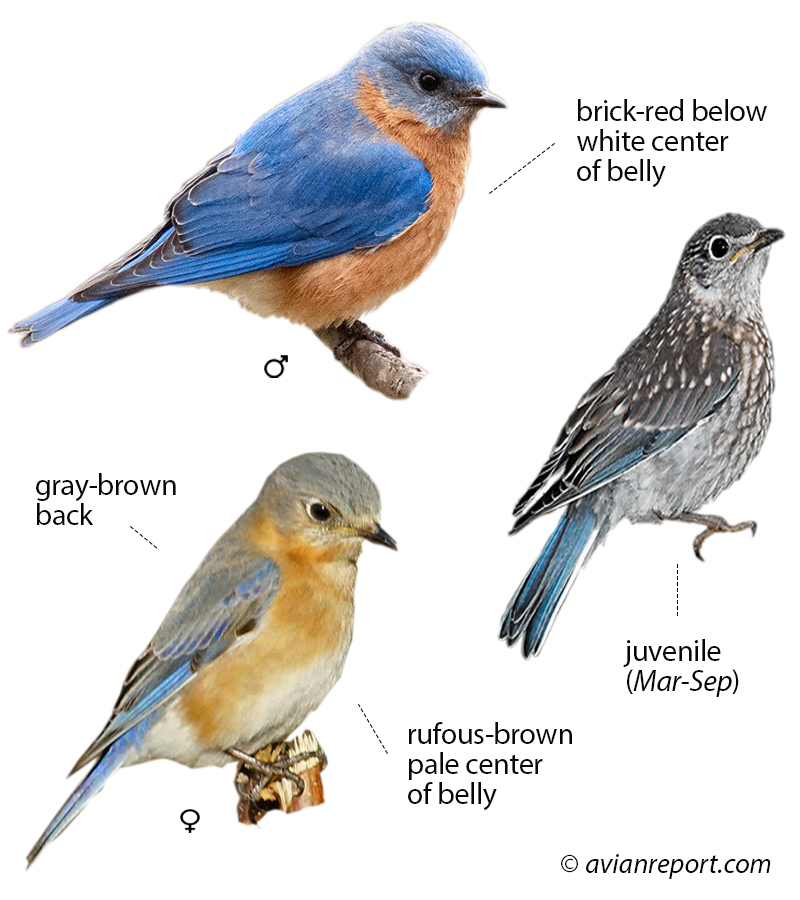
Identification: Adult male eastern bluebirds (Sialia sialis) are deep blue above with a red-brick breast and belly. Females have a bluish-gray back, blue on the wings and tail, and rich brown breasts. Juveniles are a darker gray with white spotting in the breasts.
Food: Attract eastern bluebirds with mealworms, suet, peanut hearts, and fruit.
Feeder: It favors platform feeders and the ground.
Presence: The Eastern Bluebird is a common year-round resident in southern Michigan. While some migrate, many remain and visit mealworm feeders throughout the year, with peak activity from March through November.
Behavior: Non-aggressive and easy-going at feeders. Submissive to others, even smaller birds.
Backyard: Favors open fields, open woodlands, and park-like habitats. Favor feeders in open spaces.
Nest: It builds a cup-shaped nest within natural or woodpecker-excavated cavities at any height from the ground. It readily takes nesting boxes.
Breeding season: The eastern bluebird breeds from mid-February through late September.
Breeding period: Eastern bluebirds lay 2-7 pale blue or rarely white or pink eggs. It takes about 35 days from egg-laying (incubation period 16 days, nestling period 14 days) until fledging.
Lifespan: Eastern bluebirds live at least 10 years and 6 months.
American Robin

Identification: The American robin (Turdus migratorius) is gray above with a blackish head and yellow-orange bill. Reddish-brown below. Colors are more saturated during the breeding season.
Food: Attract American robins with hulled sunflower seeds, suet, peanut hearts, fruit, and mealworms.
Feeder: It favors platform feeders and the ground.
Presence: The American Robin is a familiar year-round resident in Michigan. Though many migrate, hardy individuals visit fruit feeders during winter, with sightings peaking from March through October each year.
Behavior: Non-aggressive at feeders. Usually feeds on the ground and jumps to platform feeders.
Backyard: Favors relatively open habitats and yards with feeders in open spaces.
Nest: It builds a well-shaped cup on forks or horizontal branches 5-25 feet above the ground. They can also nest on the ground, light fixtures, house ledges, and bridges.
Breeding season: American robins breed in April through mid-August.
Breeding period: The American Robin lays 3-5 distinctively blue eggs with no markings. It takes about 26 days from egg-laying (incubation period 13 days, nestling period 14 days) until fledging.
Lifespan: American robins live at least 13 years and 11 months.
Hermit Thrush
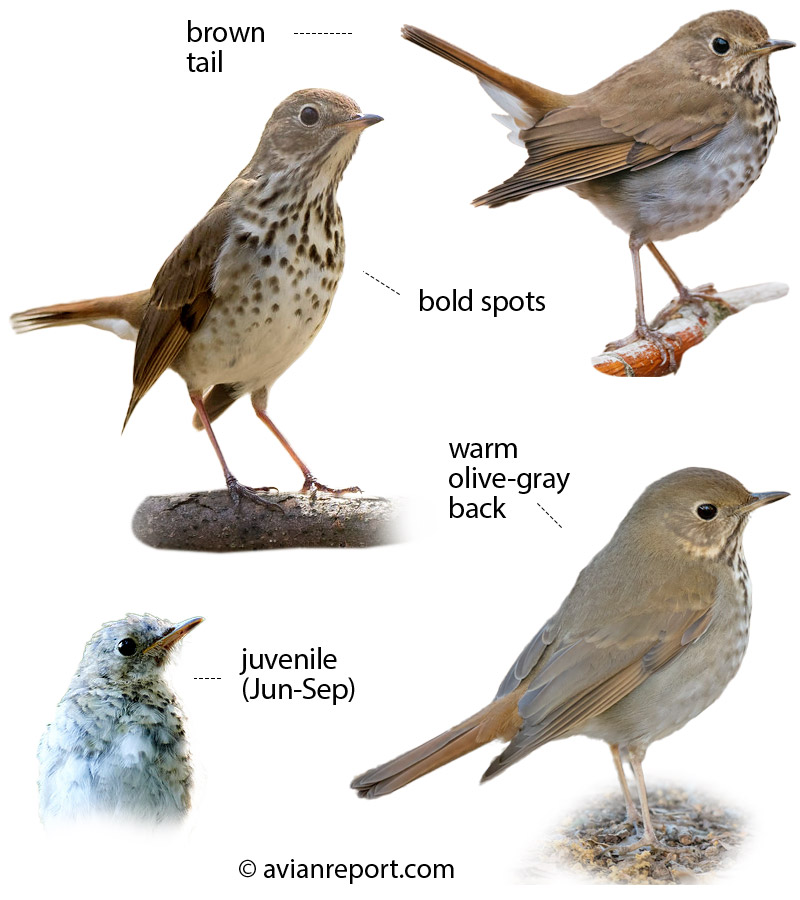
Identification: The Adult Hermit Thrush (Catharus guttatus) has brown upperparts, distinct reddish tail, white underparts with dark spotting on breast; white eye ring. Sexes similar; plumage stable year-round. Juvenile: Resembles adult but with buffy spots on back and wings.
Food: Suet, peanut hearts, hulled sunflower seeds, raisins, dried currants, grapes, mealworms.
Feeder: Platform feeders. Also feeds on the ground.
Presence: The Hermit Thrush is a common summer resident in Michigan. Arriving in mid-April and departing by late October, this spotted thrush occasionally visits ground feeders for suet or fruit during migration.
Behavior: Hermit Thrushes are quiet and solitary; generally non-aggressive, easily displaced by robins, jays, or woodpeckers.
Backyard: The Hermit Thrush prefers wooded yards with dense undergrowth, leaf litter for foraging, and berry-producing shrubs or conifers for cover.
Nest: Compact cup of moss, leaves, and mud; lined with fine fibers. Typically on ground or low in conifers. Height: 0-10 feet.
Breeding season: April through August.
Breeding period: Clutch: 3-6 eggs | Appearance: Pale blue, occasionally flecked brown | Incubation: 11-13 days | Nestling: 10-15 days | Total to Fledging: ~25 days.
Lifespan: At least 10 years and 10 months.
WOODPECKERS
In Michigan, woodpeckers are regular visitors to backyard bird feeders. These birds are specialized for extracting food from bark and wood, feeding mainly on insects and other arthropods, but also consuming fruit, nectar, and seeds.
Woodpeckers are well adapted to clinging vertically and using their strong bills to probe crevices for food. Several species readily visit suet and peanut feeders, making them familiar backyard guests.
Downy Woodpecker
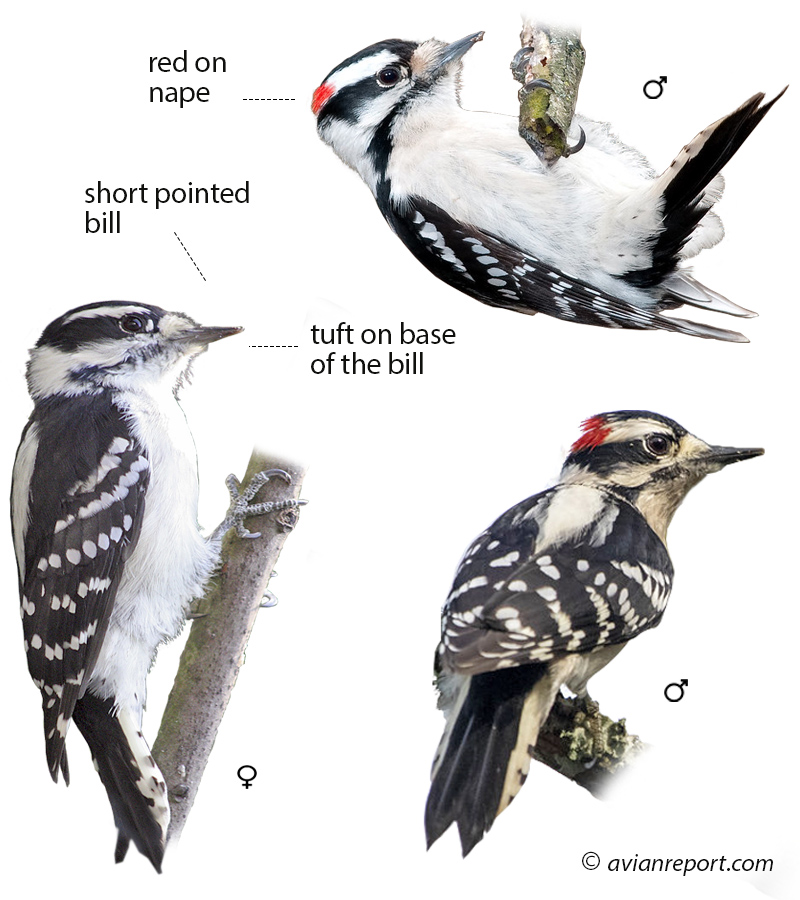
Identification: The downy woodpecker (Dryobates pubescens) is a tiny black and white woodpecker. Males have a red spot on the nape, which is missing in the female. Note the relatively short bill.
Food: Attract downy woodpeckers with suet, black oil sunflower seeds, hulled sunflower seeds, peanuts, peanut hearts, and mealworms.
Feeder: Downy woodpeckers favor suet cages, large and small hopper, and platform feeders.
Presence: The Downy Woodpecker is a diminutive year-round resident in Michigan. This agile species is a constant visitor to suet feeders from January through December, appearing in both urban and rural backyards.
Behavior: Generally non-aggressive but dominant over smaller birds and submissive to larger ones.
Backyard: Downy woodpeckers favors semi-open woodlands and wooded urban areas. They are more likely to visit backyard feeders located in or near these habitat types.
Nest: Downy woodpeckers nest in cavities they excavate in dead branches at variable heights from the ground.
Breeding season: Downy woodpeckers breed in early March through early July.
Breeding period: Downy woodpeckers lay 3-8 white round eggs. It takes about 31 days from egg-laying (incubation period 12 days, nestling period 19 days) until fledging.
Lifespan: Downy woodpeckers live at least 11 years and 11 months.
Hairy Woodpecker
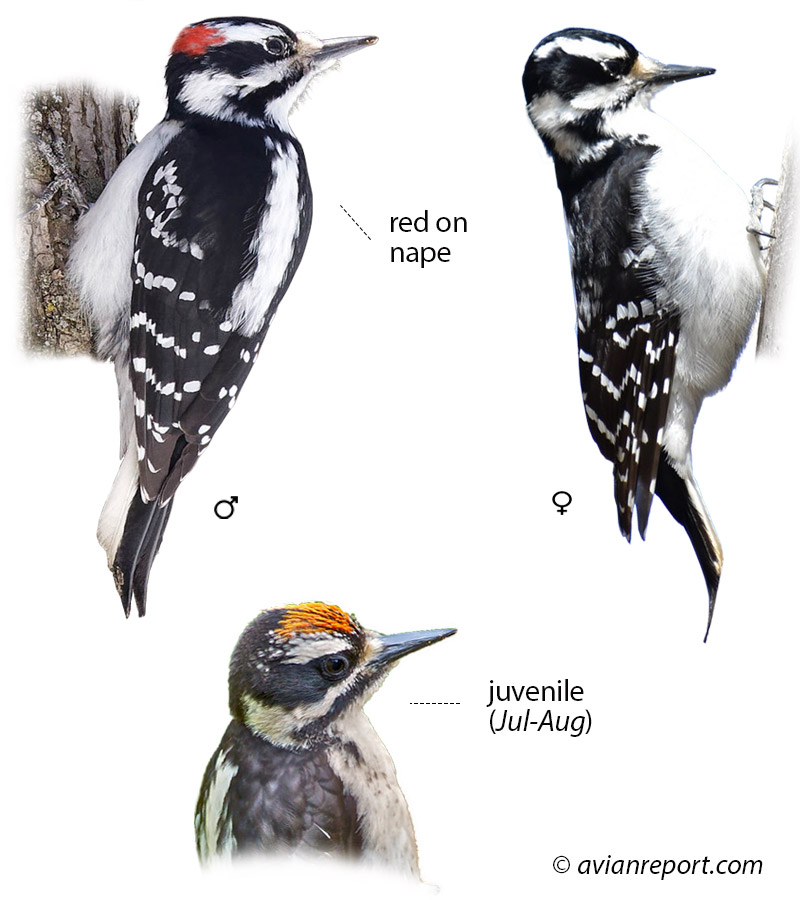
Identification: The hairy woodpecker (Leuconotopicus villosus) has a black and white head, back, wings, and white underparts. Adult males have a red nape patch, which is missing in females. It is larger and longer-billed than the downy woodpecker.
Food: Attract hairy woodpeckers with suet, peanut, and black oil sunflower.
Feeder: It favors suet cages, large hopper, and platform feeders.
Presence: The Hairy Woodpecker is a year-round resident in Michigan. This large woodpecker is common and visits suet feeders throughout all twelve months of the year, showing no seasonal migration patterns.
Behavior: Hairy woodpeckers are not aggressive at feeders. It is submissive to grackles, American robins, blue jays, and red-bellied woodpeckers. It is dominant over smaller birds.
Backyard: Like other woodpeckers, it favors wooded areas. It is more likely to visit feeders located in its favorite habitat.
Nest: Hairy woodpeckers excavate their cavities in dead wood. Nest cavities are approximately 10 in deep and typically have a slightly oblong entrance hole of about 2 in high and 1.5 in wide.
Breeding season: Hairy woodpeckers breed in mid-March through late July.
Breeding period: This woodpecker lays 3-6 white round eggs. It takes about 31 days from egg-laying (incubation period 12 days, nestling period 29 days) until fledging.
Lifespan: Hairy woodpeckers live at least 15 years and 11 months.
Yellow-bellied Sapsucker

Identification: The adult male Yellow-bellied sapsucker (Sphyrapicus varius) has a black and white barred back, red crown and throat, yellowish belly. Female: similar to male, but with white throat. Juveniles: brownish-gray overall, lacks distinctive head pattern of adults but shows white wing patch.
Food: Suet, peanut butter, sugar water (nectar), grape jelly, fruit slices.
Feeder: The Yellow-bellied Sapsucker favors suet cages, bark-mimicking feeders, nectar feeders. Prefers vertical surfaces on tree trunks.
Presence: The Yellow-bellied Sapsucker is a summer resident in Michigan. This migrant arrives in early April and departs by October, visiting suet or specialized sap feeders during these warmer months.
Behavior: Subordinate to larger woodpeckers; often solitary. May defend sap wells from hummingbirds and other small birds.
Backyard: Deciduous and mixed forests. Attracted to yards with birch, maple, or fruit trees and water sources.
Nest: Cavity excavated in live trees, often infected with tinder fungus. Height: 6–60 feet above ground.
Breeding season: Mid-May through mid-July.
Breeding period: Clutch: 4–6 eggs | Appearance: White, smooth, slightly glossy | Incubation: 12–13 days | Nestling: 25–29 days | Total to Fledging: ~40 days.
Lifespan: At least 7 years and 9 months.
Northern Flicker

Identification: The northern flicker (Colaptes auratus) is one of the largest woodpeckers in the region. It is warm brown with black barring on the back and wings and large black spots on the belly. It has a conspicuous black crescent on the chest. Males have a black malar stripe, which is missing in the female.
Food: Attract Northern flickers with black oil sunflower seed, hulled sunflower seeds, and suet.
Feeder: Northern flickers favors suet cages, large hopper, and platform feeders.
Presence: The Northern Flicker is a common summer resident in Michigan. Arriving in March and departing in November, this ground-feeding woodpecker frequently visits backyard suet feeders during its stay.
Behavior: Northern flickers are not particularly aggressive to other birds at feeders but are dominant over smaller-sized birds.
Backyard: Favors semi-open habitats with plenty of open ground, including suburban areas.
Nest: The northern flicker nest in cavities it excavates in rotten wood.
Breeding season: The northern flicker breeds from May through early August.
Breeding period: The northern flicker lays 5-8 pure white and unmarked eggs. It takes about 37 days from egg-laying (incubation period 12 days, nestling period 25 days) until fledging.
Lifespan: Northern flickers live at least 9 years and 2 months.
Pileated Woodpecker
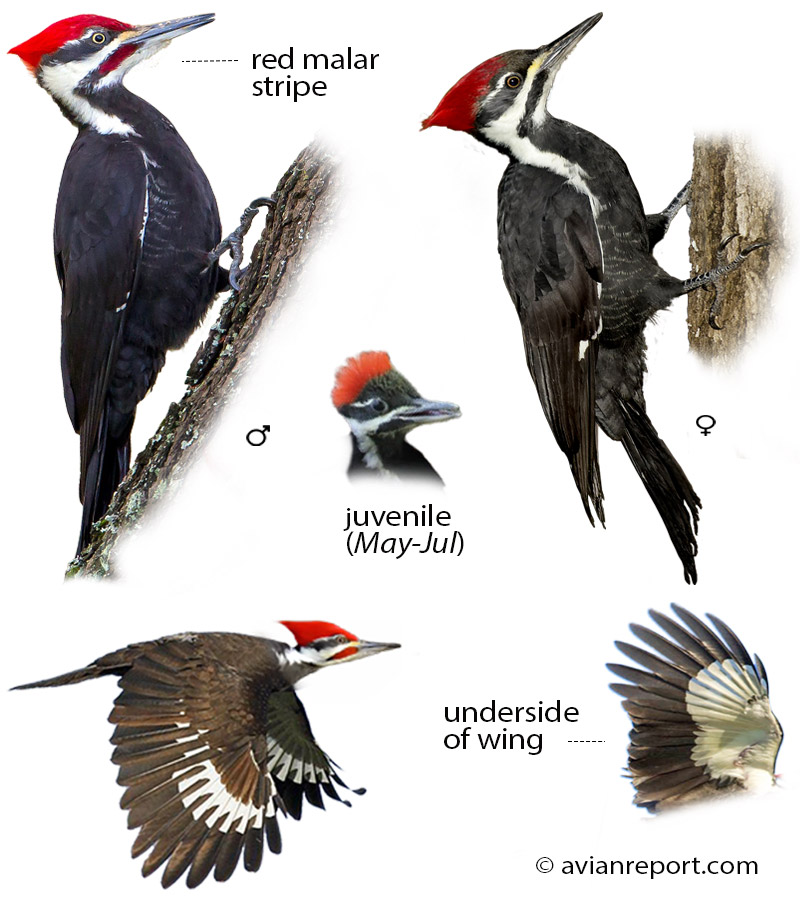
Identification: The pileated woodpecker (Dryocopus pileatus) is mostly black with white stripes on the head and neck. Males and females have red crests, but only the male shows a red malar stripe. In flight, the extended wings show white patches and white underneath.
Food: Attract pileated woodpeckers with black oil and hulled sunflower seed, suet, and mealworms.
Feeder: Suet cages are the preferred feeder type for pileated woodpeckers.
Presence: The Pileated Woodpecker is a year-round resident in Michigan. This striking, crow-sized bird is found in mature forests and visits large suet feeders consistently throughout every month of the year.
Behavior: Pileated woodpeckers’ size is enough to dominate the feeder when they visit one. They may be submissive only to crows or ravens.
Backyard: Favors wooded areas, including suburban areas that have enough trees.
Nest: Pileated woodpeckers can excavate a nesting cavity in 3-6 weeks. After excavating and using a cavity, it rarely reuses the same cavity after use for breeding.
Breeding season: Pileated woodpeckers breed in early March through mid-July.
Breeding period: The pileated woodpecker lays 3-5 white round eggs. It takes about 45 days from egg-laying (incubation period 17 days, nestling period 28 days) until fledging.
Lifespan: Pileated woodpeckers live at least 12 years and 11 months.
TITMICE & CHICKADEES
In Michigan, titmice and chickadees are among the most familiar and active backyard feeder birds. They feed primarily on insects during the warmer months, but readily switch to seeds, buds, and fruit when insects become scarce.
As winter approaches, Titmice and Chickadees often cache food, carrying seeds from feeders to hidden spots in trees or bark crevices for later use. These small birds are bold, agile, and highly vocal, frequently the first to discover new feeders and alerting other birds with their calls.
Tufted Titmouse
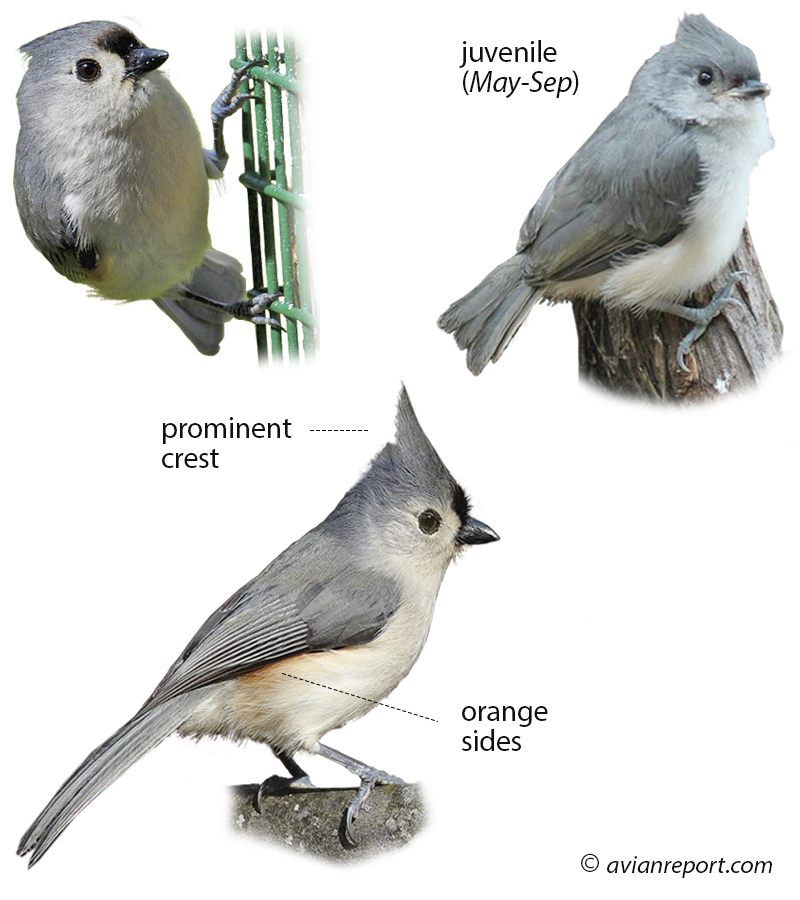
Identification: The tufted titmouse (Baeolophus bicolor) is gray above with pale breast, belly, and orange-brown flanks. It has a conspicuous gray crest and black forehead.
Food: Attract tufted titmouse with black oil sunflower seeds, hulled sunflower seeds, safflower, nyjer, suet, peanuts, peanut hearts, and mealworms.
Feeder: It favors large and small tube feeders, suet cages, large hopper, small hopper, and platform feeders.
Presence: The Tufted Titmouse is a year-round resident in Michigan. Common at feeders, this crested songbird is present during all twelve months, showing peak activity from January through December.
Behavior: Nonaggressive and submissive to most larger birds.
Backyard: The tufted titmouse is a bird of woodlands. It visits feeders placed in its habitat and hardly ever ventures out to bird feeders in open habitats.
Nest: The tufted titmouse nests in natural tree cavities and cavities excavated by woodpeckers. They also use nest boxes.
Breeding season: Tufted titmice breed in early April through mid-July.
Breeding period: The tufted titmouse lays 3-9 white to creamy white eggs spotted with rich reddish-brown. It takes about 29 days from egg-laying (incubation period 13 days, nestling period 16 days) until fledging.
Lifespan: Tufted titmice live at least 12 years and five months.
Black-capped Chickadee
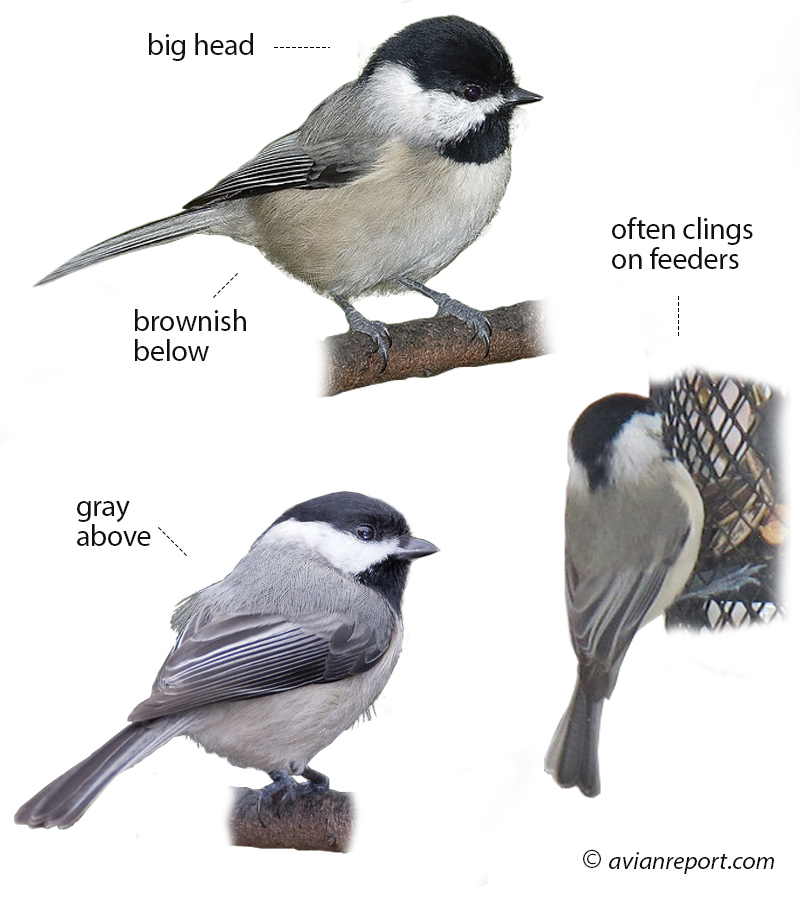
Identification: The black-capped chickadee (Poecile atricapillus) is bluish gray above and grayish-brown below with a pale center of the belly. It has a distinctive black cap and throat separated by broad white sides of the head.
Food: Attract black-capped chickadees with black oil sunflower seeds, hulled sunflower seeds, safflower, nyjer, suet, peanuts, peanut hearts, and mealworms.
Feeder: It favors Large and small tube feeders, suet cages, large hoppers, and platform feeders.
Presence: The Black-capped Chickadee is a year-round resident in Michigan. This ubiquitous species is a feeder staple, found during every month of the year and across all seasons in the state.
Behavior: Non-aggressive at feeders. It usually takes one seed at a time and leaves to eat it or store it before it returns to the feeder for more. Submissive to most birds visiting feeders.
Backyard: Chickadees are birds of woodlands. Readily visit the feeder placed within its natural habitat.
Nest: It nests in cavities pairs excavate in rotten soft wood. I also use existing cavities, such as those excavated by woodpeckers.
Breeding season: Black-capped chickadees breed in late March through mid-September.
Breeding period: Black-capped chickadees lay 3-10 eggs, white with brown spots concentrated on the wide side of the egg. It takes about 27 days from egg-laying (incubation period 13 days, nestling period 14 days) until fledging.
Lifespan: The black-capped chickadee lives at least 10 years and 8 months.
Boreal Chickadee
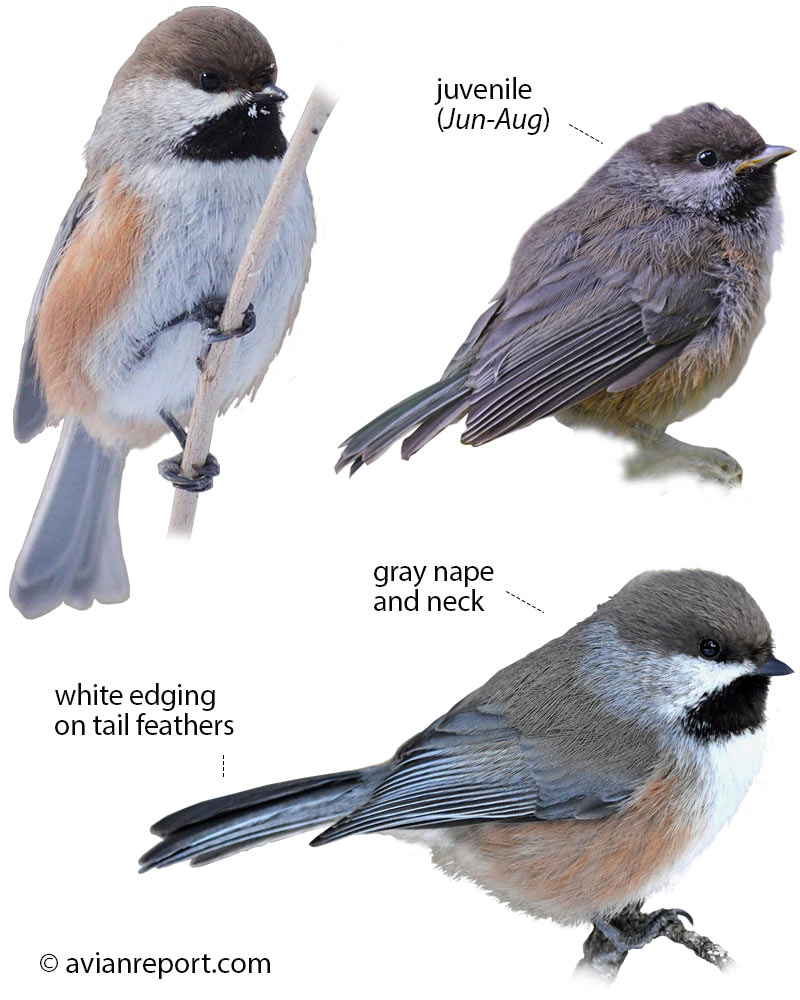
Identification: The boreal chickadee (Poecile hudsonicus) has a brown cap rather than the black or blackish brown cap of other chickadees. It also has rufous flanks and white edging on the tail feathers.
Food: Attract boreal chickadees with hulled sunflower seeds, black oil sunflower seed, nyjer, suet, peanuts, peanut hearts, and mealworms.
Feeder: It favors Large and small tube feeders, suet cages, large hoppers, and platform feeders.
Presence: The Boreal Chickadee is a rare winter visitor in northern Michigan. Arriving from the north in late autumn, it may visit feeders from November through March before returning to Canada.
Behavior: Non-aggressive at feeders. It usually takes one seed at a time and leaves to eat it or store it before it returns to the feeder for more. Submissive to most birds visiting backyard feeders.
Backyard: Chickadees are birds of woodlands. They readily visit feeders placed within its natural habitat.
Nest: Boreal chickadees nest in cavities that pairs excavate in rotten or soft wood. I also use existing cavities such as those excavated by woodpeckers.
Breeding season: Boreal chickadees breed in mid-May through mid-August.
Breeding period: Boreal chickadees lay 5-9 white eggs. It takes about 35 days from egg-laying (incubation period 16 days, nestling period 19 days) until fledging.
Lifespan: Boreal chickadees live at least 6-10 years.
NUTHATCHES & CREEPERS
In Michigan, nuthatches and brown creepers are fascinating visitors to backyard feeders, especially in wooded or mature forest habitats. Although they share a similar lifestyle—searching for insects along tree trunks and branches—they are not closely related and belong to separate bird families. Their similarities make a classic example of convergent evolution.
Nuthatches are small, stocky birds with relatively long, pointed bills. They move in all directions along tree trunks, including headfirst downward, using only their strong legs and feet, unlike woodpeckers, which use their tails for support.
White-breasted Nuthatch
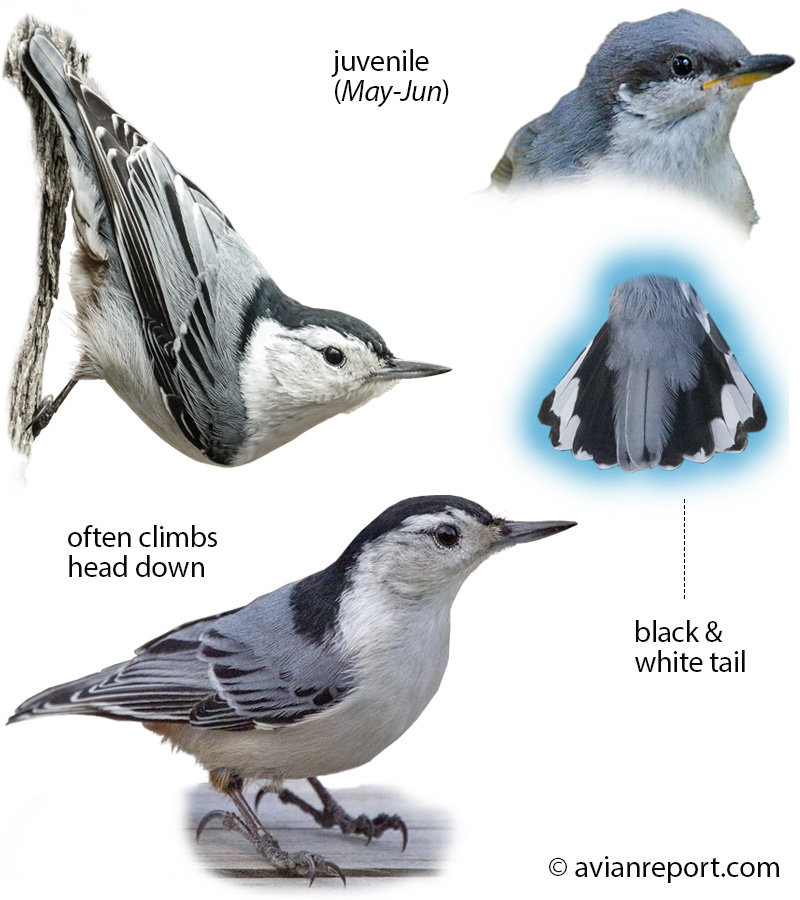
Identification: The white-breasted nuthatch (Sitta carolinensis) has white sides of the head, throat, and belly. It has a black narrow cap and a bluish-gray back. The lower belly is chestnut.
Food: Attract white-breasted nuthatch with peanut hearts, hulled sunflower seeds, and suet. It also takes millet.
Feeder: It clings, often head-down, to large tube, large hopper, and platform feeders.
Presence: The White-breasted Nuthatch is a year-round resident in Michigan. This agile bird is a constant presence at seed and suet feeders, visible during all twelve months of the year.
Behavior: This small nuthatch can be feisty and aggressive toward other birds but loses to cardinals, woodpeckers, grackles, and blue jays.
Backyard: The white-breasted nuthatch is a bird of deciduous and semi-open woodlands. It tends to visit backyard feeders located in or near these habitat types.
Nest: Nesting pairs excavate cavities in decayed wood. They also use existing cavities excavated by woodpeckers.
Breeding season: The white-breasted nuthatch breeds in June through September.
Breeding period: The white-breasted nuthatch lays 5-9 creamy white speckled with light brown eggs. It takes approximately 39 days from egg-laying (incubation period 13 days, nestling period 26 days) until fledging.
Lifespan: The white-breasted nuthatch lives at least nine years and nine months.
Red-breasted Nuthatch
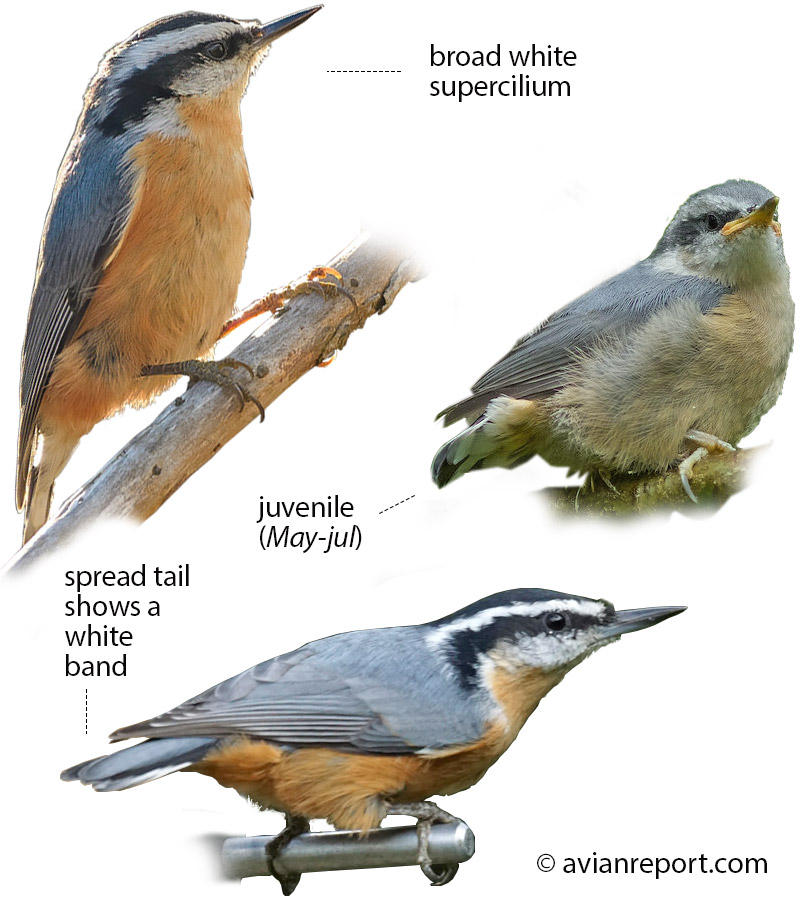
Identification: The Red-breasted Nuthatch (Sitta canadensis) has blue-gray upperparts and brown-orange underparts. It has a distinctive black-and-white head pattern. It typically creeps along tree trunks and branches.
Food: Attract red-breasted nuthatches with black oil and hulled sunflower seeds, suet, and mealworms.
Feeder: They typically feed on large and small tube feeders, suet cages, and hopper and platform feeders.
Presence: The Red-breasted Nuthatch is a year-round resident in Michigan. This conifer-loving bird is most frequent at feeders from September through May, though it remains in-state throughout all seasons.
Behavior: Red-breasted nuthatches are feisty birds; they are not aggressive to others but stand their ground against similar-sized birds at feeders.
Backyard: The red-breasted nuthatch is a forest bird. It is more likely to visit feeders surrounded by woodlands or various types.
Nest: The red-breasted nuthatch excavate their nesting cavities in rotten wood or use existing woodpeckers or natural cavities.
Breeding season: They breed in late April through early August.
Breeding period: A female red-breasted nuthatch lays 2-8 pinkish-white eggs spotted with brown. It takes about 32 days from egg-laying (incubation period 12 days, nestling period 20 days) until fledging.
Lifespan: Red-breasted nuthatches live at least 7 years and 6 months.
Brown Creeper
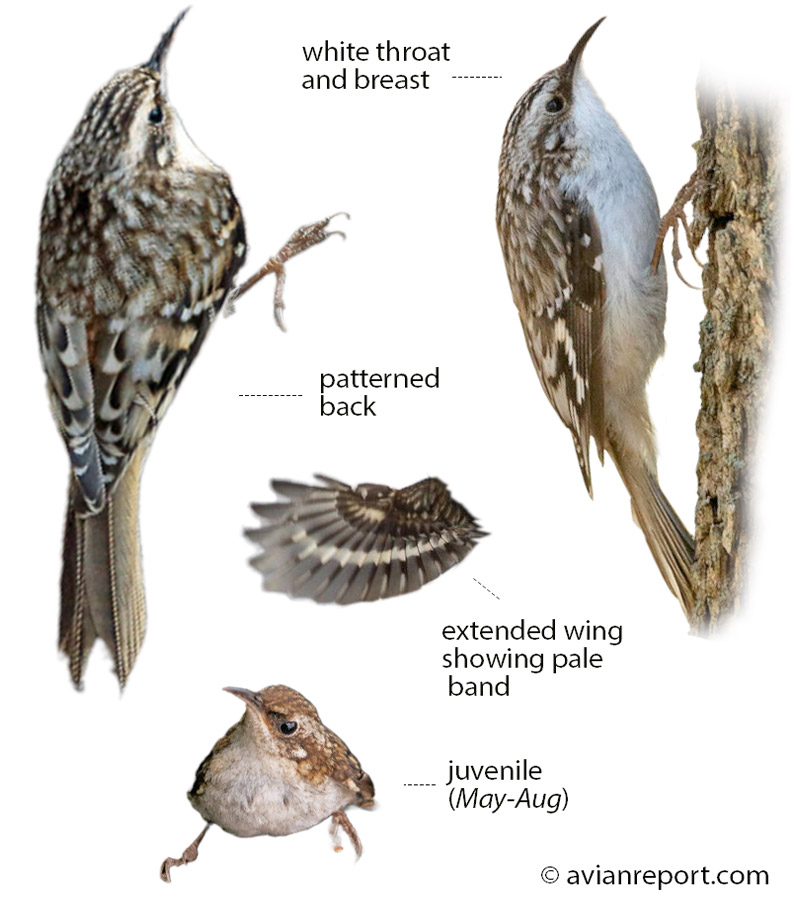
Identification: The brown creeper (Certhia americana) has patterned upper parts with shades of brown, gray, and black. The underparts are white. It has a curved thin bill. The extended wing shows a broad pale band. Males and females look alike.
Food: Attract brown creepers, particularly in the winter, when they visit bird feeders with suet, peanut butter, and hulled sunflower seed.
Feeder: It clings vertically to suet cages and other structures where food is offered.
Presence: The Brown Creeper is a year-round resident in Michigan. Primarily seen at suet feeders from October to April, it remains present in the state’s woodlands during all twelve months.
Behavior: Brown creepers are small, cryptic, and inconspicuous. They are more likely to visit bird feeders during the wintertime when food is scarce. Generally dominated by most other feeder visitors.
Backyard: Brown creepers favor wooded areas with large and old trees. It is more likely to visit feeders where this habitat type occurs.
Nest: Brown creepers nest inside split bark or other condition that creates a concealed area. They build a nest with a central cup.
Breeding season: Brown creepers breed in late April through early August.
Breeding period: The brown creeper lays 5-6 white eggs spotted with brownish. It takes about 32 days from egg-laying (incubation period 15 days, nestling period 17 days) until fledging.
Lifespan: Brown creepers live at least 5 years and 5 months.
WRENS
In Michigan, wrens are generally uncommon at backyard feeders, but the Carolina Wren is a regular and increasingly familiar visitor in many areas of the state. Wrens are small, active birds known for their loud, rich songs that often seem surprising for their size.
They forage mainly for insects and other small invertebrates, probing dense vegetation, leaf litter, and brushy areas close to the ground. While insects make up most of their diet, they may also take berries and occasional seeds, especially in colder months.
Carolina Wren
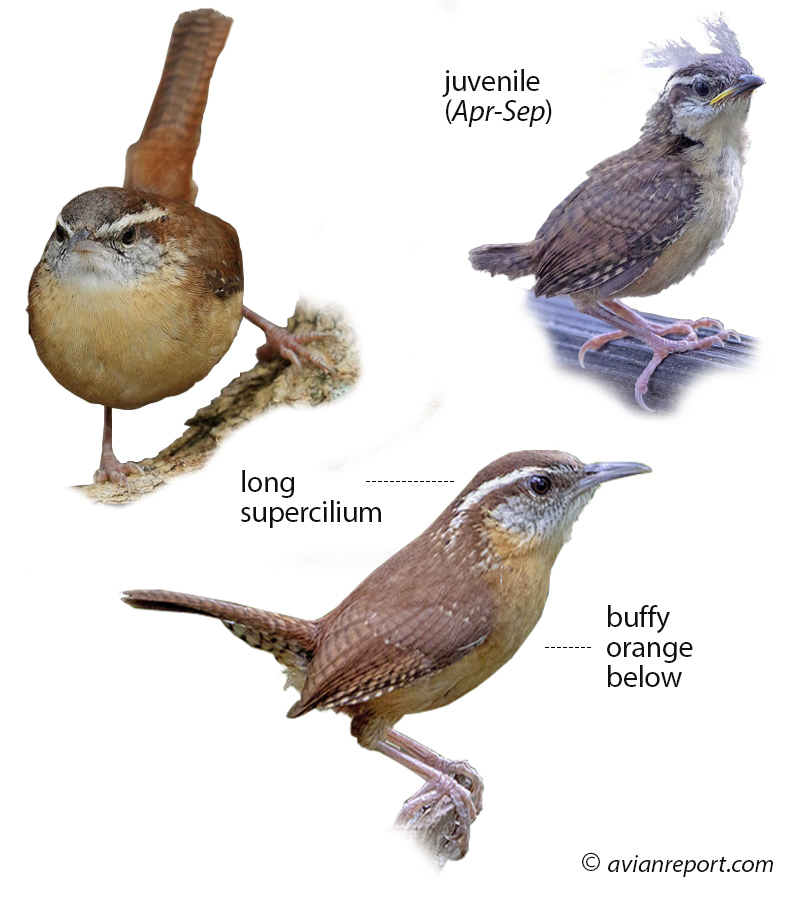
Identification: The Carolina wren (Thryothorus ludovicianus) is Reddish-brown on the back wings and tail, with dusky markings. It has buffy-brown underparts. Note the bold white eyebrow and slightly decurved bill. It is a great songster.
Food: Attract Carolina wrens with hulled sunflower seeds, suet, peanuts, and mealworms.
Feeder: It favors large and small tube feeders, suet cages, large hopper, platform, feeders, and the ground.
Presence: The Carolina Wren is a year-round resident in southern Michigan. This vocal wren visits suet feeders consistently during all twelve months, though populations fluctuate based on winter severity.
Behavior: It is often shy at feeders and does not stay out of dense vegetation for long. Submissive to most other birds.
Backyard: Carolina wrens favor dense vegetation, tangled understory, or brush piles that they use to approach bird feeders and return for cover.
Nest: The Carolina wren builds a bulky oven-shaped nest with a side entrance. The nest is placed in broken-off stumps and limbs 3-6 feet above the ground. It often nests in hanging planters and hanging decorations on porches.
Breeding season: Carolina wrens breed in late March through early October.
Breeding period: Carolina wrens lay 3-7 creamy-white eggs with brown spots. It takes about 27 days from egg-laying (incubation period 13 days, nestling period 14 days) until fledging.
Lifespan: Carolina wrens live at least 7 years and 8 months.
WARBLERS
In Michigan, warblers are only occasional visitors to backyard feeders, as most species prefer to forage naturally rather than rely on artificial food sources. These small, active birds feed primarily on insects and other invertebrates, gleaning them from leaves and branches, often high in the canopy.
During migration and in the non-breeding season, some warblers expand their diet to include fruit, nectar, and occasionally small seeds. A few species are more likely to visit feeders—especially those offering suet—making them notable exceptions in a group otherwise rarely seen at backyard feeding stations.
Pine Warbler
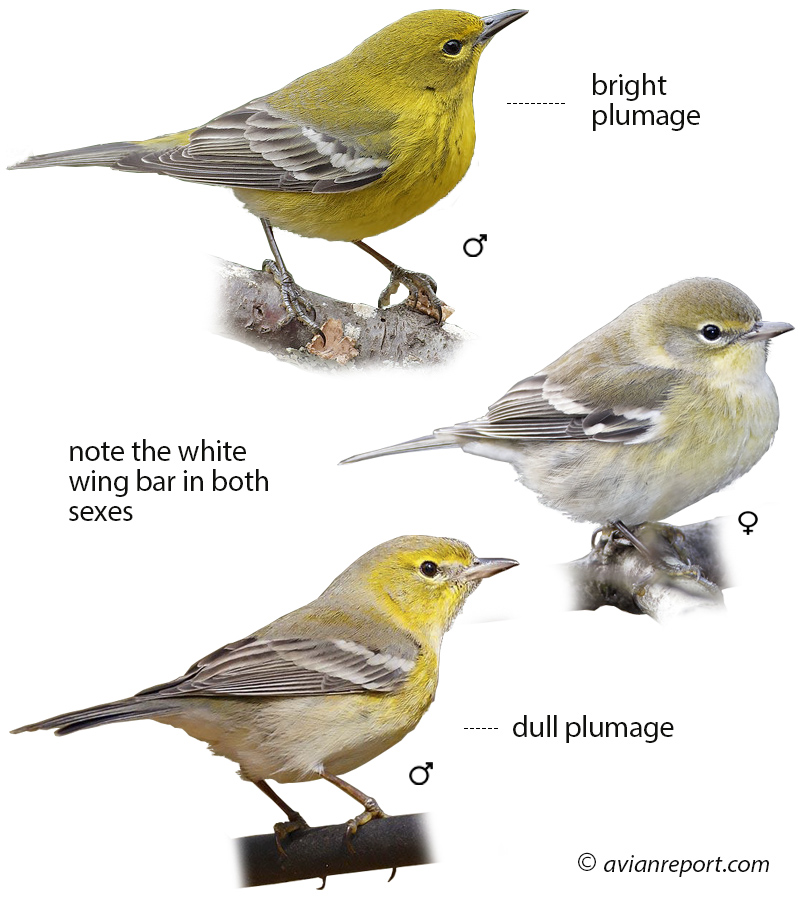
Identification: The pine warbler (Setophaga pinus) has a yellow throat, yellow-olive belly, head, and back. The wings are gray with pale markings and two wing bars. Females and immatures are dull gray-brown. Note the two white wing bars in both sexes and ages.
Food: Attract pine warblers with hulled sunflower seeds, suet, peanuts hearts, and mealworms.
Feeder: It favors large and small tube feeders, suet cage, large and small hopper, and platform feeders.
Presence: The Pine Warbler is a summer resident in Michigan. Arriving in late April and departing by September, this warbler occasionally visits suet or hulled sunflower feeders during its breeding season.
Behavior: Nonaggressive at feeders. Submissive to other larger birds.
Backyard: Favors pine woodlands. It tends to visit birdfeeders located in or near pine woodlands.
Nest: Pine warblers build an open cup, usually in pine trees or hardwoods 30 to 55 feet above the ground.
Breeding season: Pine warblers breed in late March through late July.
Breeding period: Pine warbler lay 3-5 grayish eggs with brown spots. It takes about 22 days from egg-laying (incubation period 12 days, nestling period 14 days) until fledging.
Lifespan: Pine warblers live at least 7 years and 10 months.
Yellow-rumped Warbler
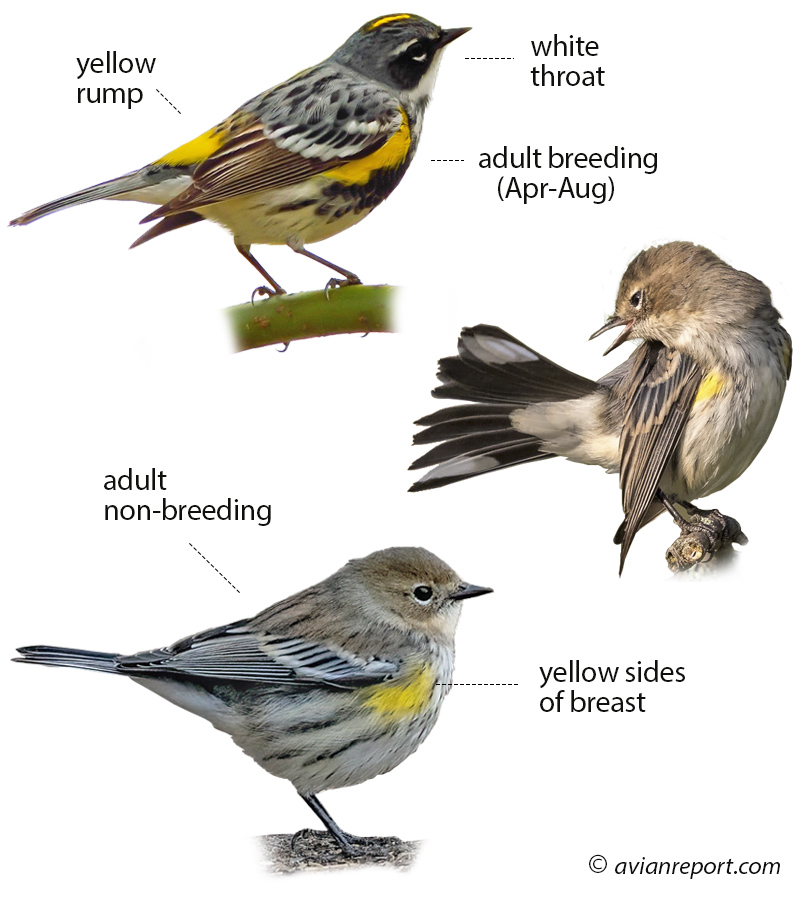
Identification: The yellow-rumped warbler (Setophaga coronata) in winter plumage is grayish-brown with blackish streaks. The throat is whitish. The rump and sides of the breast and belly are yellow. It has two distinctive white wing bars.
Food: Attract yellow-rumped warbler with hulled sunflower seeds, suet, peanuts, peanut hearts, nectar, fruit, and mealworms.
Feeder: It favors large and small tube feeders, suet cage, large and small hopper feeders, fruit, and nectar feeders.
Presence: The Yellow-rumped Warbler is a common transient in Michigan. Most frequent from April to May and September to October, this versatile warbler occasionally visits suet feeders during migration periods.
Behavior: A non-aggressive visitor to feeders. It is submissive to most other birds at feeders.
Backyard: Yellow-rumped warblers favor semi-open woodland and yards where it moves about in flocks.
Nest: It builds an open cup on horizontal branches in coniferous forests 4-50 feet above the ground.
Breeding season: The yellow-rumped warbler breeds in mid-May through late August.
Breeding Period: Yellow-rumped warblers lay 1-6 whitish eggs speckled with reddish-brown. It takes about 25 days from egg-laying (incubation period 12 day, nestling period 12 days) until fledging.
Lifespan: Yellow-rumped warblers live at least 10 years.
Orange-crowned Warbler
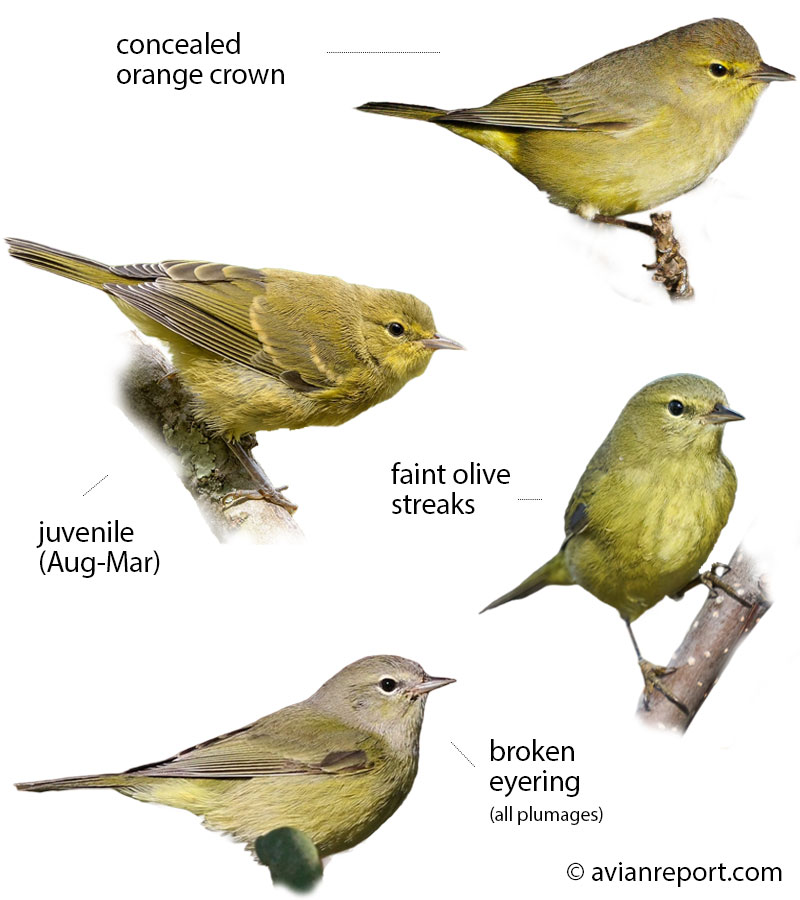
Identification: The orange-crowned warbler (Leiothrypis celata) is a relatively nondescript bird. Four populations with slightly different plumages ranging from yellowish to yellowish-gray are involved. The image shows the most common plumages.
Food: Attract orange-crowned warblers with hulled sunflower seeds, suet, peanut hearts, nectar, fruit, and mealworms.
Feeder: It favors large and small tube feeders, suet cages, large and small hopper feeders, fruit and nectar feeders.
Presence: The Orange-crowned Warbler is a transient visitor in Michigan. This subtle warbler arrives in early May and returns in September, occasionally visiting suet feeders during these brief migratory windows.
Behavior: A non-aggressive visitor to feeders. It is submissive to most other birds at feeders.
Backyard: The orange-crowned warbler is a bird that favors semi-open woodlands.
Nest: It builds a cup-shaped nest on or near the ground.
Breeding season: The orange-crowned warbler breeds from April through mid-July.
Breeding period: It takes about 25 days from egg-laying (incubation period 12 days, nestling period 12 days) until fledging..
Lifespan: The orange-crowned warbler lives at least 8.5 years.
HUMMINGBIRDS
In Michigan, the Ruby-throated Hummingbird is the only hummingbird species regularly encountered, arriving in spring and departing by early fall. Despite their tiny size, these birds are highly active and are among the most specialized feeder visitors.
Hummingbirds feed primarily on nectar, both from flowers and backyard feeders, but they also rely on small insects and spiders for essential protein. They are attracted to nectar feeders filled with sugar-water solutions. Males are especially territorial, often defending feeders and flowering plants from other hummingbirds.
Ruby-throated Hummingbird
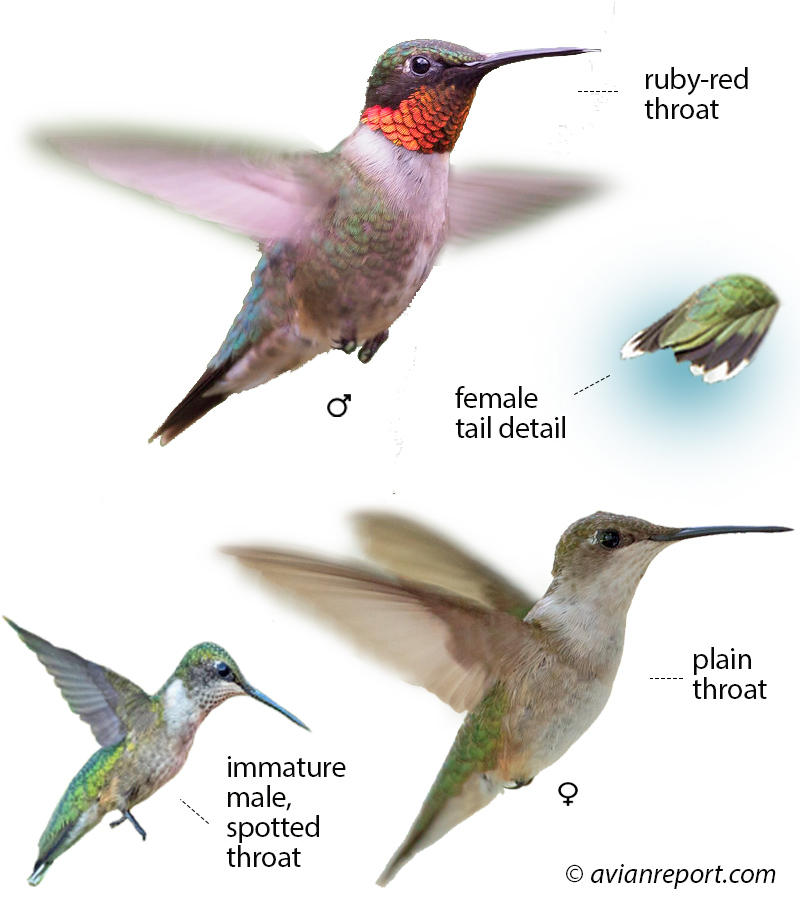
Identification: The male ruby-throated hummingbird (Archilochus colubris) has a shiny green back and greenish belly. The throat is iridescent ruby-red and bordered by a broad pale breast band. Females have similar shiny green backs, but the throat, breast, and belly are whitish-brown.
Food: Attract ruby-throated hummingbirds with nectar offered in nectar feeders.
Feeder: It favors exclusively nectar feeder.
Presence: The Ruby-throated Hummingbird is a summer resident in Michigan. Arriving in early May and departing by late September, this nectar-feeder is a seasonal visitor to backyard sugar-water stations.
Behavior: Ruby throats are aggressive to other hummingbirds at feeders.
Backyard: Favors shrubbery and semi-open habitats with plenty of flowers.
Nest: It builds a tiny cup-shaped nest on a thin branch 10 to 40 feet above the ground.
Breeding season: The ruby-throated hummingbird breeds in May through early October.
Breeding Period: The ruby-throated hummingbird lays 1-3 white eggs. It takes about 34 days from egg-laying (incubation period 13 days, nestling period 14 days) until fledging.
Lifespan: The ruby-throated hummingbird lives at least nine years and 2 months.
KINGLETS
kinglets are small but energetic winter visitors, best known for their constant motion and delicate appearance. These tiny, mostly greenish-gray birds are among the smallest songbirds in North America and are often seen flitting restlessly through trees and shrubs.
Kinglets feed primarily on insects and spiders, which they pick from foliage or even hover briefly to capture at the tips of branches. During the colder months in Michigan, they may also take advantage of backyard feeders, especially those offering suet, though they rarely linger long in one spot.
Ruby-crowned Kinglet
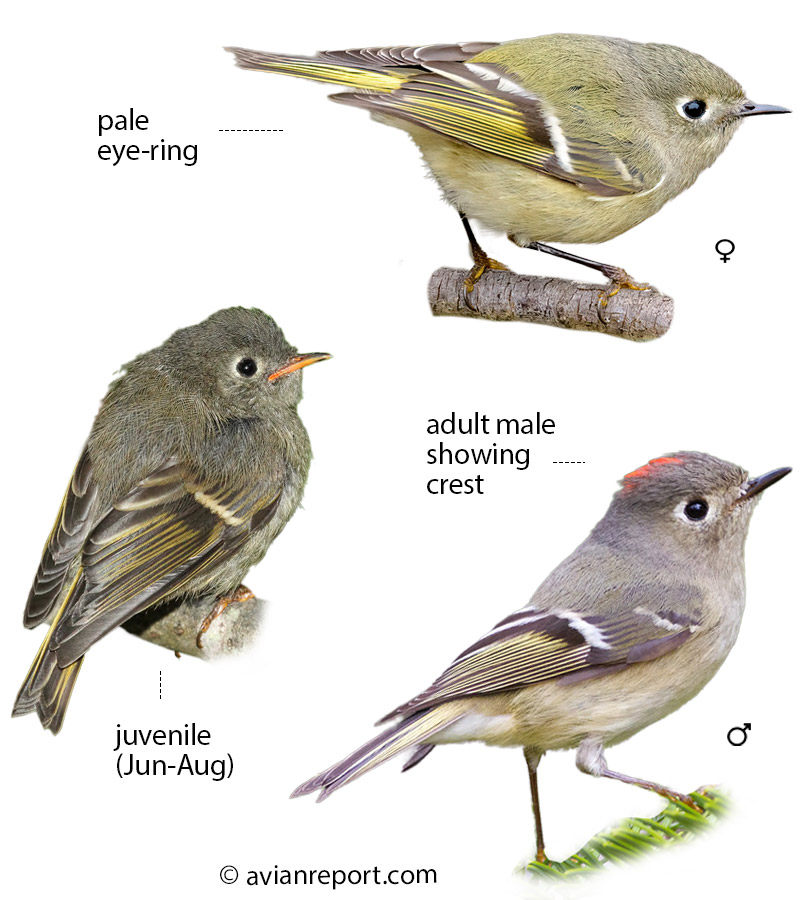
Identification: The ruby-crowned kinglet (Corthylio calendula) is tiny and hyperactive. It is plain yellow-olive and has an eye-ring. The ruby color in the crown is present in males only, and it is usually concealed except for occasions when the bird gets excited. Except for the ruby crown, males and females look alike.
Food: Attract ruby-crowned kinglets with suet, hulled sunflower seeds, peanuts, and mealworms.
Feeder: It favors suet cages, large hopper, and platform feeders.
Presence: The Ruby-crowned Kinglet is a transient visitor in Michigan. Passing through primarily in April and October, this tiny bird occasionally visits suet feeders during its brief migratory windows.
Behavior: Ruby-crowned kinglets are infrequent visitors to backyard bird feeders. Their tiny size makes them vulnerable to larger, more aggressive birds at feeders.
Backyard: The ruby-crowned kinglet favors wooded areas. It is more likely to visit feeders located in its favorite habitat.
Nest: Ruby-crowned kinglets build large nests with a central cup. The exterior of the nest is lined with moss and lichen. The interior is lined with fine fibers and hair.
Breeding season: Ruby-crowned kinglets breed in mid-May through early August.
Breeding period: The ruby-crowned kinglet lays 5-12 whitish eggs spotted with brown concentrated on the wide side of the egg. It takes about 30 days from egg-laying (incubation period 13 days, nestling period 17 days) until fledging.
Lifespan: Ruby-crowned kinglets live at least 8 years and 8 months.
How do I attract birds to my bird feeder in my state?
Attracting birds to your bird feeders is as simple as putting up a feeder with food or simply spraying birdseed on the ground. Once one or two birds find the food source, other birds see them coming and going from your yard to the feeder and follow them.
It is very important to be consistent. Once you put birdseed out for the birds, they will make visiting your backyard a part of their daily routine. If food is unavailable for several days, they will drop your backyard as a reliable source of food and visit it only sporadically.
The time it takes for the birds to discover your feeders depends on the vegetation in your yard and around it. Bushes and trees attract birds, and more birds around are more likely to notice your feeders.
The bird feeder should be located in a place visible to the birds. As indicated above, I recommend spraying food on the ground and putting food on a platform feeder. If you have grass in your yard and food is unlikely to be seen by the birds, you can simply use a piece of plywood to place birdseed.
Once you have a few birds visiting your yard, you can implement a hopper or tube feeder. You can gradually move the bird feeder to a location in your yard where you can enjoy them from your home, for instance, outside the kitchen window.
What type of food do I need to attract birds in Michigan?
My preferred food for beginners is birdseed mixes available in stores. Bird seed mixes include several seeds and grains that appeal to a wider variety of birds.
Once you get birds coming to your feeders, you can begin to offer the type of food that is more likely to attract the birds you want to see in your feeders.
What type of bird feeder should I get to attract birds in Michigan?
The type of bird feeder to get in Michigan is a platform feeder or hopper feeder, particularly if one is starting to feed backyard birds.
I analyzed the type of feeder most used by backyard feeder birds. The results apply to Michigan and other states as these birds have wide ranges in North America.
According to the data analyzed, most (92.5%) birds use platform feeders, followed by large hopper feeders (64.8%). Many birds (32%) are comfortable feeding on the ground.
The analysis consisted of tallying bird species by bird feeder type used. The data comes from reports from folks that feed backyard birds in the region reported to the FeederWatch Project of the Cornell Laboratory of Ornithology.
The table below shows the bird feeder types most frequently used by backyard birds in North America.
| Feeder Type | Number of Species that use it | Percentage |
|---|---|---|
| Platform | 50 | 92.5 |
| Large Hopper | 35 | 64.8 |
| Ground | 32 | 59.2 |
| Large Tube | 20 | 37.0 |
| Suet Cage | 20 | 37.0 |
| Small Tube | 15 | 27.7 |
| Small Hopper | 9 | 16.6 |
Why Birds Visit—or Avoid—Your Feeders
In the State of Michigan, bird activity at feeders can vary widely from day to day and across seasons. Understanding what attracts birds—or drives them away—can help you interpret these changes and manage your feeders more effectively.
Reasons Birds Visit Feeders
- Bad weather: Birds are more likely to visit feeders when the weather is poor.
- Winter season: While birds can visit year-round, there is a noticeable increase in activity during the winter months.
Reasons Birds Stop Visiting Feeders
- Presence of predators: This is often the most common reason birds suddenly disappear; species like the Cooper’s Hawk or Sharp-shinned Hawk may be hunting in the area.
- Abundance of natural food: Birds generally prefer natural food sources over bird feeders and will choose them if they are readily available.
- Seasonal diet changes: Bird shift their diet during the breeding season to focus on insects, spiders, and caterpillars. These protein-rich foods are essential for the rapid growth and development of their nestlings.
- Seasonality and mild weather: Changes in the seasons or periods where the weather is not particularly harsh can lead to a decrease in feeder visits.
- Stopover Visits: Birds often use backyard feeders as quick “refueling stations” to gain the necessary fat and protein to continue their flight. You may notice species that do not live in your area year-round appearing for just a few days or weeks during the spring and fall before moving on.
- Food quality: Birds may avoid feeders if the seed is no longer fresh.
- Feeder hygiene: If feeders are not cleaned regularly, birds may stop coming to them.
Final thoughts:
The identification guide to the 59 bird species that visit backyard feeders in the State of Michigan based on the concept of citizen science. The species included in this article were obtained from citizen reports from bird enthusiasts participating in the FeederWatch Project of the Cornell Laboratory of Ornithology.
This guide helps you distinguish male, female, and juvenile plumages with clear illustrations. Familiarize yourself with these birds to become a bird expert and enhance your backyard birding experience.
References and Sources:
Information and bird-specific data used in this guide comes from various sources. The photographic material used as model and reference for a hybrid AI production of the illustrations comes from multiple sites and photos taken by the author. Sources include:
- eBird. (https://ebird.org/)
- Project Feederwatch (https://feederwatch.org/)
- Sibley, David, 2000, The Sibley Guide to Birds.
- Species Longevity Data: United States Geological Survey (https://www.usgs.gov/)
- Allaboutbirds.
- Voices: Personal recordings and xeno-canto.org
Author:
