
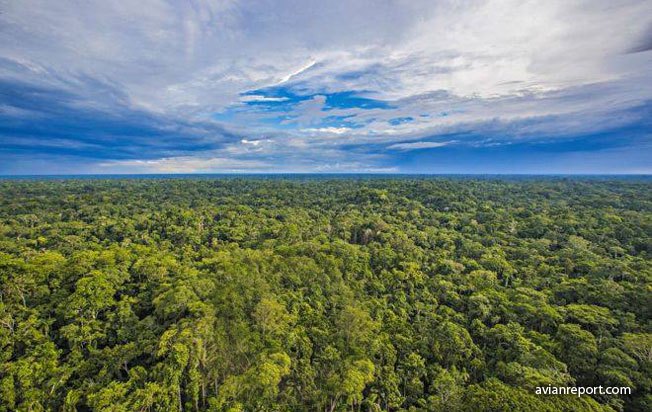
When seen from above, the Amazon Rainforest appears homogenous.
The high diversity of life in the Amazon Rainforest is mainly attributed to a combination of a mild non-seasonal environment and high humidity, which results in a rich and highly diverse plant life.
The Amazon rainforest climate is typically hot and humid throughout the year, with an average annual temperature of 27°C (80.7°F). There is not a summer or winter season as the mean temperatures ranges within about 2°C throughout the year. In fact, the difference between day and night temperature (2 to 5°C) is greater than the difference between any two seasons.
It rains throughout the year. There is a rainy season (60-180 inches of rain) and a not-so rainy season (30-100 inches of rain), with rain showers occurring just about any time.
The prevailing high humidity in the Amazon Rainforest results from the intense evaporative power of the sun, which draws moisture from the soil by way of the foliage of trees. This process is called transpiration and constitutes nature’s recycling mechanism for water. The moisture resulting from plant transpiration charges the atmosphere with abundant moisture, which forms massive cloud banks before condensing into downpours generally in the afternoon hours.
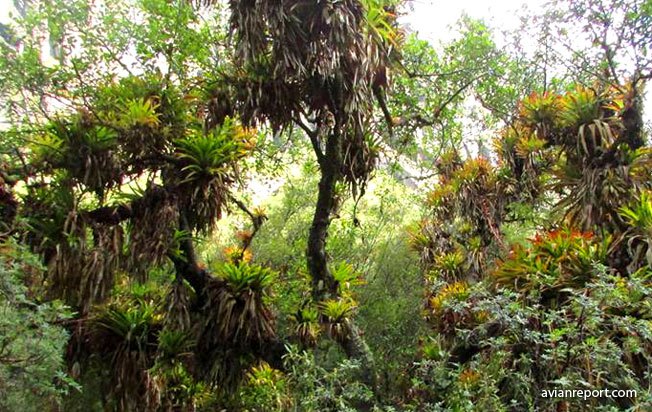
Exuberant plant life that results from high humidity throughout the year.
High moisture and a mild non-seasonal environment create the perfect conditions for the growth of trees, shrubs, vines, bromeliads and countless forms of plant life. Nurtured for eons in a spacious and physically benign environment an equally diverse animal life evolved and depended directly or indirectly on this plant life for food and shelter.
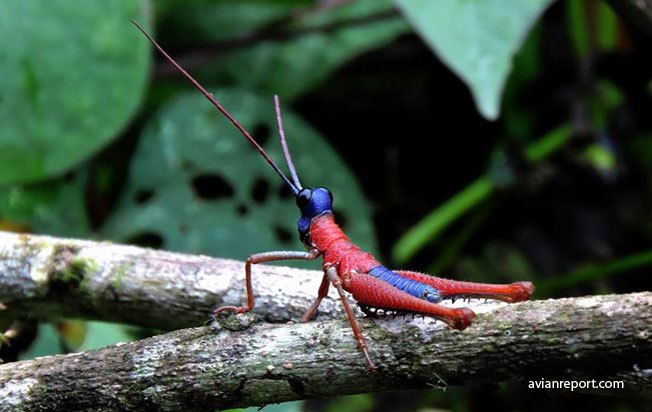
Colorful forms that constitute the web of competition, mimicry, parasitism, and mutualism.
The imposing diversity of trees, birds, insects, and other groups has led to the formation of intricate predator-prey webs and the refinement of interspecific interactions between two or more species that may include competition, mimicry, parasitism, and mutualism.
Biodiversity studies in the Peruvian Amazon have shown a stunning number of plant and animal species packed in small areas in the Amazon Rainforest. For instance, a hectare contained 200 species of trees. A hundred hectares provides breeding habitat for 230 species of land birds, more than breed in most U.S. states. Ninety species of frogs and toads can be found in a few square kilometers, more than in all SO states. The crown of a single large tree was fumigated an all insect life was trapped with netting. Up to 54 species of ants were determined to live in a single large tree. Up to 1200 species have been recorded in a single locality. Such extravagant diversity characterizes almost any group of organisms inhabiting the Amazon Rain Forest.
Why is the Biodiversity of Life in the Amazon Rainforest Difficult to observe?
To the untrained eye, the biological diversity of the Amazon Rainforest may be indiscernible. Aside from the buttressed trees, a few palms, lianas, and epiphytes, the forest looks the same in all directions. Although each plant may be a different species, a glance at the crowns rises out of sight, hidden by several intervening layers of foliage.
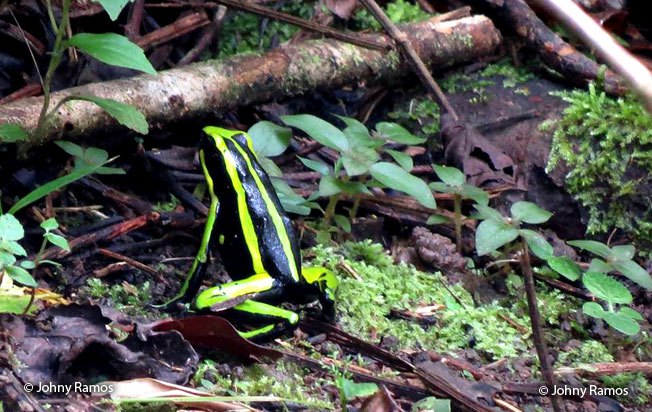
Three-striped Poison Arrow Frog (Epipedobates trivitattus).
There is a strong sense of verticality. The predominant view is of dozens of trunks or various diameters disappearing into the leafy canopy above. One hears the chirping and droning of insects and occasional bird calls, but the sources of the sounds seem invisible. Visitors wonder if the diversity of the Amazon Rainforest is just a fantasy.
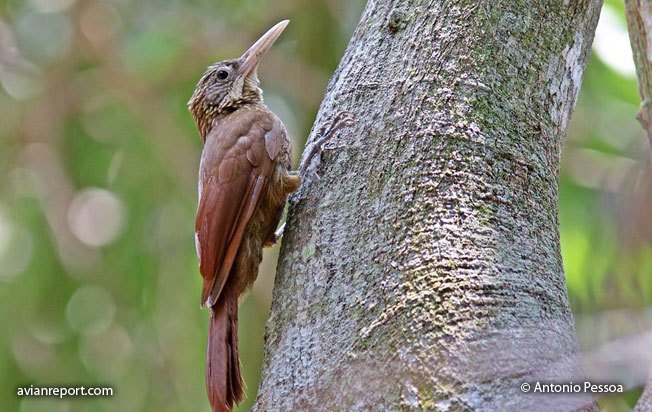
Buff-throated Woodcreeper is one the many woodcreeper species adapted to a specific foraging niche along the vertical length of the Amazon Rainforest.
The diversity is there, but most of it is hidden, often in subtle ways. While a high number of species of tree and bird species can occur within a few hectares, the numbers of each species are represented by only one of or a few individuals. Often it takes years to discover all species of plants and animals.