
King vultures’ nesting habits are little known. For such a large and conspicuous bird, there are only a few studies and known nests of this bird. King vultures occur in huge expanses in low numbers and are very secretive when it comes to their nesting sites.
- The king vulture breeds throughout the year
- Breeding activity peaks regionally at separate times
- They appear to breed once every two years
- King vultures appear to mate for life
- They do not build nests but lay eggs on a bare surface
- The female lays a single eggs
- The incubation ranges from 53 to 58 days
- Both parents incubate and care for the young
- The nesting period lasts for about 4.3 months
Photo Credits: Ealasaid
In what months do king vultures breed?
A study conducted by Ferguson-Lees and Christie (2001) indicates that king vultures nest in almost any month of the year. They reported king vulture nests with eggs in the months of February, July, October, and December.
Ornithologists Mendes de Carvalho and collaborators found king vulture nests with eggs in the months of October and November.
Our review of the Wikiaves Brazil bird photo repository using photo evidence as records of breeding activity indicates the following:
| Nest Activity | Date | Locality |
| Nest with grown chick | 2/18/2018 | Mata Grande/AL |
| Nest with small chick, juvenile plumage beginning to emerge | 2/17/2018 | Miguel Calmon/BA |
| Nest with small chick, juvenile plumage beginning to emerge | 11/15/2017 | Curvelo/ MG |
| Adult bird standing at a cave entrance. Large chick observed. | 10/16/2016 | Iapu/MG |
| Nesting activity at a cave in a cliff | 9/16/2012 | Almas/TO |
| Adult king vultures were photographed at the entrance of a large cave. Likely nesting. | 9/20/2010 | Dourado/SP |
Length of the king vulture breeding season
The king vulture breeding period, measured on wild birds, lasted approximately 130 days or 4.3 months from when the first egg was laid to when the chick left the nest.
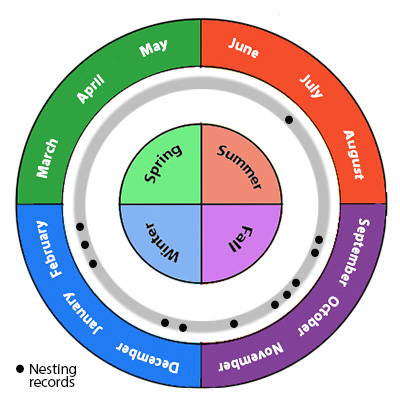
- King vulture biologists suggest that the king vulture nest throughout the year (gray bar)
- The available king vulture nesting records occurred between the months of September and February.
- September through February corresponds to the Spring and Summer in the Southern Hemisphere.
Do king vultures breed every year?
King vultures breeds once every two years. Mendes and colleagues monitored a king vulture nest between October 2001 and April 2003 and observed that the pair laid eggs and raised a young once every two years. Nonetheless, in one instance, a pair of king vultures kept in a zoo bred for two consecutive years.
Based on other birds with similar breeding habits that include a long nesting period followed by a long period of parental care after fledgling, king vultures are more likely to breed once every two years.
Adult king vultures frequently appear at carcasses as a family unit, including the juvenile of the year. The time the juvenile stays with its parents is unknown, but it is presumed to last a few months and perhaps a year after fledging.
King vulture pair formation
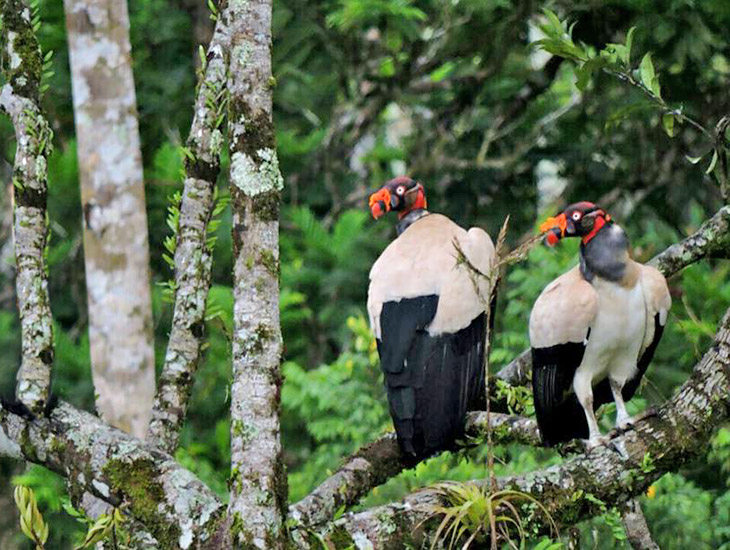
- Male and female king vultures engage in on-the-ground and trees courtship displays.
- King vultures do not appear to offer food nor build a nest to attract potential mates.
- Mated pairs stay together throughout the year.
- Existing pairs generally return to the same breeding site.
There is little information available on the king vulture’s pair formation and mating behavior. The fact that vultures do not build nests and set up territories to attract mates means that pair formation occurs before the pair finds a nest site.
Field observations indicate that males begin to perform courtship displays prior to the month of July.
Courtship display involves a male opening his wings wide and closing them as he lowers his head showing its colorful head and neck. Courtship displays take place when birds are side by side on a branch or on the ground.
Details of nest selection by a mated pair are unknown. Based on the behavior of better-known vultures living in similar ecosystems, once the pair is formed it goes together to prospect for suitable nest sites.
Signs of pair formation
An obvious sign that a pair has formed is that male and female king vultures spend time together and perch side by side.
The presence of two individuals together continually visiting and spending time at a particular area is likely to be a sign that the pair is prospecting a nest site or already has one there.
While nesting one adult usually stays near the nest while the female incubates or to protect the chick in the nest.
Do king vultures mate for life?
It is not known whether the king vulture mate for life, but based on the species’ natural history, it is highly likely that they are monogamous and mate for life for as long as the two members of the pair survive.
Most of what we know about the king vulture’s breeding biology comes from about 6 nests studied in the wild and additional information from birds kept at zoos. There is no long-term study on breeding king vultures.
King vultures are large birds that occupy wide expanses of land in low numbers. A pair lays only one egg every two years, and have a long breeding period lasting over 4 months from egg-laying to fledging.
Additionally, the only chick fledged stays with its parents for several months before becoming nutritionally independent. Their complete reproductive cycle is likely to last nearly a year.
All of these aspects are typical of K-selected bird species which are characterized by having only one or a few offspring, having a high parental care investment, forming monogamous breeding systems, and mating for life.
The Nest of the king vulture

- King vultures nest in places that resemble a dark enclosure or a cave. These can be large tree holes, caves in cliffs, or under large fallen trees. They have been recorded nesting in an enclosure in Mayan Ruins.
- King vultures do not build nests.
- Eggs are laid on bare ground or over debris.
Where do king vultures nest?
King vultures nest in places that resemble a dark enclosure or a cave including large tree holes, caves in cliffs, and under large fallen trees or similar structures. They have been recorded nesting in an enclosure in Mayan Ruins.
King vultures do not build nests. The female lays eggs on the bare ground or over debris.
Do king vultures defend nesting territories?
King vultures do not keep nor defend nesting territories. A pair picks a nest site and keeps it as secret as possible so as not to attract potential predators to the nest.
King vultures can nest close to each other if adequate nesting sites, such as caves in cliffs, occur in close proximity.
Birds in general keep nesting territories to protect the food resources in an area that serves as a food source for the breeding pair and its offspring.
King vulture’s food is unpredictable in time and distributed in huge expanses of habitat. There is no reason to spend energy on protecting an unpredictable food source.
Whether it’s an egg or a chick, king vultures fiercely defend the contents of their nest. Researchers studying king vulture nests have experienced excited parents’ aggressive behavior upon approaching their nests.
In one instance, excited king vultures approached researchers as close as three meters. Other pairs jump from branch to branch around the intruders making croaking noises leaning their open wings forward.
Do king vultures use the same nest?
King vultures are likely to use the same nest site every time they breed, particularly if they successfully raise a young there. Suitable nest sites are often difficult to find, hence adult king vultures are likely to reuse the same nest site that has potential for successful breeding.
No study has monitored a king vulture nest long enough to confirm that the same pair returns to the same nest location every year.
However, suitable known large cavities in trees and caves in cliffs have been known to be used repeatedly by king vultures, although there was no way to know if they were the same pair over the years.
King vultures are likely to lay a second egg in the same year if they lose the first one. In the wild, it is not known whether king vultures lay a second egg in the same year after losing the first one. King vultures kept in a zoo laid a second egg about 6 weeks after they lost the first one.
What are king vultures’ nest predators?
There is no documentation regarding which predators are responsible for the loss of king vultures’ eggs and chicks. However, terrestrial predators such as snakes, foxes, and possums, are likely to be the culprits.
Tropical forest climbing mustelids such as tayras (Eyra barbara) is a major predator of bird nests.
Where do king vultures roost at night?
King vultures roost at predetermined tall and emergent trees that offer easy access and take-off.
Only one or two king vultures use roost sites where the birds tend to return every evening. This is in contrast to small vultures that tend to roost in one place in large numbers.
Egg-laying and Incubation
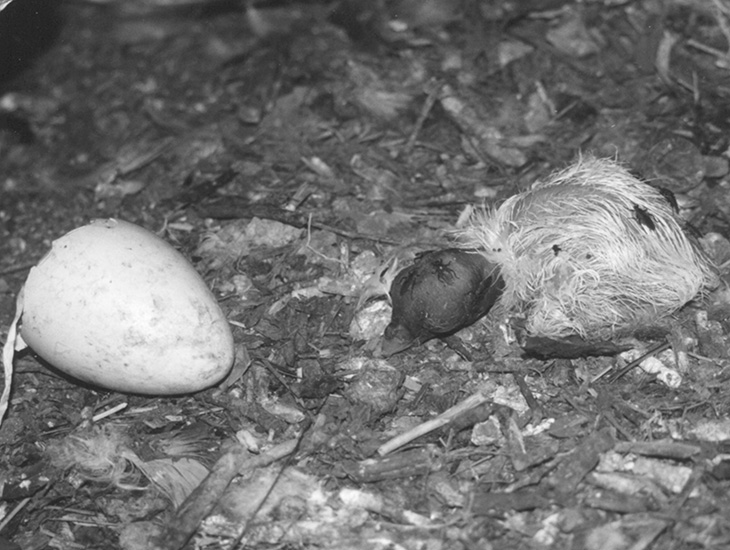
- The female usually lays one egg.
- The female initiates full incubation after she lays the egg.
- The King vulture’s egg is white and unmarked.
- In some pairs both the male and female incubate the eggs in others, the female does most of the incubation.
Do males and females king vultures incubate the eggs?
In what seems unusual in birds, in some king vulture pairs both, the male and female take turns incubating the eggs. In other pairs, the female does most of the incubation while the male brings food and stays around the nest to protect it.
It is unclear what motivates this behavior in some pairs. A possible explanation is that in times and regions where food is readily available, both birds incubate because finding food is relatively easy.
When food is scarce and requires long travel, the male may have to spend more time searching for it. Therefore, the female must remain in the nest.
Regardless of the situation, the female will always incubate the eggs overnight and shares the responsibility of incubating the eggs with the male-only during the day.
Incubation period and hatching
King vultures incubate their eggs for 56 days on average until they hatch.
Because king vultures lay only one egg, there are no issues brought about by asynchronous hatching of the eggs.
How many eggs does a female king vulture lay?
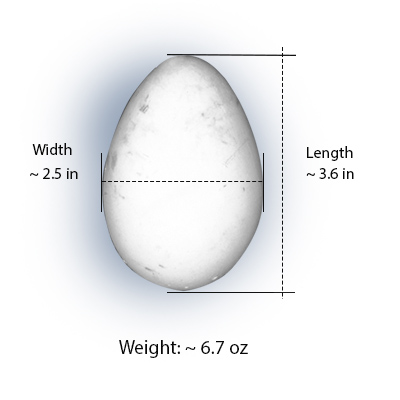
The female king vulture lays a single egg. The egg is white to creamy white and unmarked.
Over time, the egg may appear stained and dirty due to contact with the parents’ body fluids and dirt.
Egg measurements are as follows:
- Egg length ranges from 3.5 to 3.7 inches
- Egg width ranges from 2.48 to 2.5
- Egg weight is 6.7 oz.
Egg-hatching and care of young
- Black vultures hatch with a coat of white down.
- Both parents feed the young a liquid diet for the first two weeks or so days and solid food after that.
- Nestlings are fed frequently during the first month and only once per day when they are ready to fledge the nest.
What does a newly hatched king vulture chick look like?
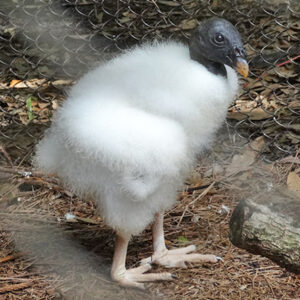
Baby king vultures hatch with semi-open eyes and a (wet at first) white coat of down.
In the first two weeks, the chick grows rapidly and looks like a white cotton ball. Baby king vultures have a dusky head and neck at hatch, but they turn black within one or two weeks after hatching.
Care of the baby king vultures
After hatching, the mother continues brooding the chick all the time.
After about three weeks after hatching, the baby king vultures begin to be able to thermoregulate their body temperature. The parents spend less or any time brooding the young during the day and may continue to do so during the night.
The parents may continue to brood the chicks overnight for about the first month. After a month the parents spend less time in the nest and more time foraging for food for the growing chick.
Once the night brooding stops, the parents may or may not spend the night in the nest, and the young vultures are left alone overnight.
After fledging, the young king vulture still depends on the parents for food and all travel as a family. After a few months, the chick becomes nutritionally independent and begins to separate from the parents gradually.
Feeding of young king vultures
Male and female king vultures feed the newly hatched nestlings a liquid diet they produce in their crops. The parent reaches down and touches the nestling’s bill, so this raises its bill to receive the liquid food.
Unlike other birds of prey, king vultures bring food in their crops. They have an expandable crop where they can store a substantial amount of food.
King vultures (and all other vultures) are physically unable to grab and carry objects with their feet.
After about two to three weeks, the parents begin to mix the liquid with semi-solid and continue doing so until they feed the young solid food.
As shown in the video, to feed the young, the adult king vulture regurgitates to their mouth and the chick reaches inside to get the food. The parents can also regurgitate on the nest floor so that the chick picks up the food.