
Distinguishing Common from Barrow’s Goldeneye is a challenging waterfowl identification problem. Both species belong to the genus Bucephala, characterized by large heads and bright amber eyes, and are nearly indistinguishable at long distances on open water. In winter, mixed flocks on coastal bays and large rivers and lakes often appear as little more than white-sided ducks with dark heads.
Accurate identification depends on recognizing a combination of subtle field marks rather than a single diagnostic feature. This article synthesizes the key characteristics that distinguish these diving ducks, outlining the most reliable visual differences between Bucephala clangula and Bucephala islandica, from male plumage patterns to fine details of female bill shape.
Why Properly Identifying Both Goldeneyes Matters
Understanding these subtle field marks ensures that your sightings contribute meaningfully to our knowledge of both species. Accurate identification is fundamental to conservation, particularly for the fragile eastern population of Barrow’s Goldeneye.
Distribution and Conservation Significance
Geographic distribution provides an essential context clue for identification. Although both species occur in North America, they occupy different ranges and follow distinct migratory and ecological patterns.
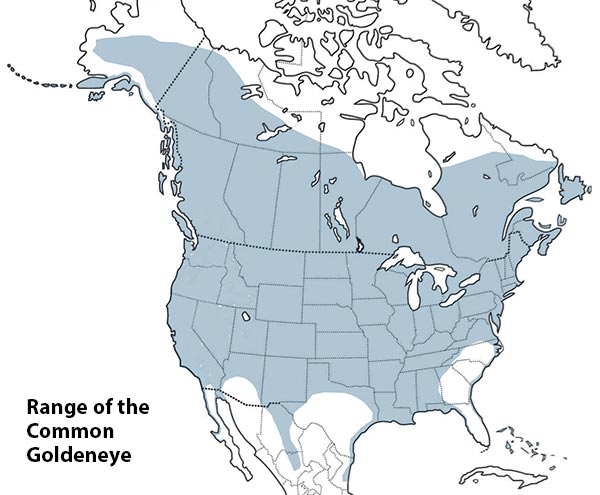
The Common Goldeneye is one of the most widespread diving ducks in the Northern Hemisphere.
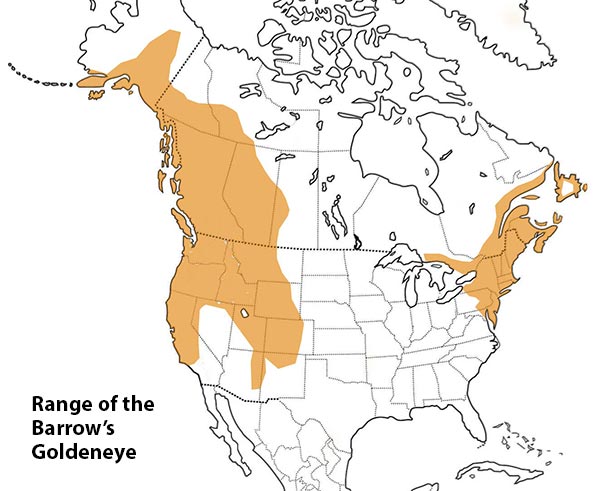
The Barrow’s Goldeneye has a much more restricted and fragmented distribution. However, it can be found outside its normal range as a vagrant.
The Common Goldeneye: A Widespread Generalist
In North America, the Common Goldeneye breeds across the vast boreal forests and tundra of Canada and Alaska. During the winter, the species is found throughout much of the United States and southern Canada, inhabiting everything from the Great Lakes to the Gulf Coast and both oceanic shorelines.
The Barrow’s Goldeneye: A Fragmented Specialist
In contrast, the population of the Barrow’s Goldeneye, in North America, is divided into two distinct, largely isolated groups.
| Population Group | Breeding Range | Wintering Range | Estimated Numbers |
| Western North America | Rocky Mountains, BC, Alaska | Pacific Coast (Alaska to California) | 200,000 – 250,000 |
| Eastern North America | Eastern Quebec, Labrador | St. Lawrence Estuary, New Brunswick, New England | 4,000 – 11,000 |
Identifying Adult Males: The “Big Three” Features
Adult drakes in breeding (alternate) plumage are the most easily identified age/sex class. To simplify the process, focus on three primary visual markers, often referred to as the “Big Three.”
1. The Facial Spot: Shape and Placement
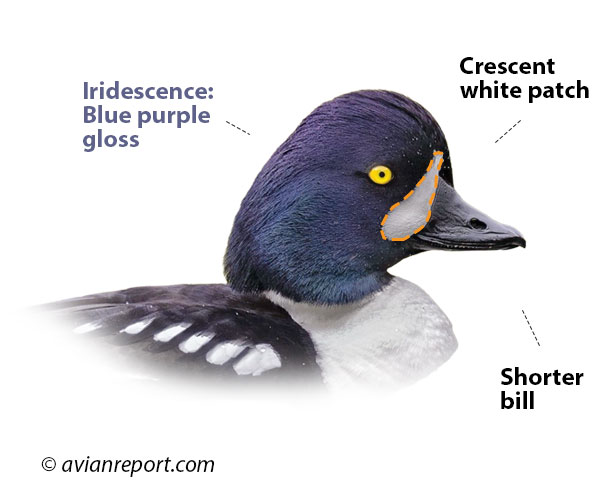
The white patch located between the bill and the eye is the most iconic field mark for both species.
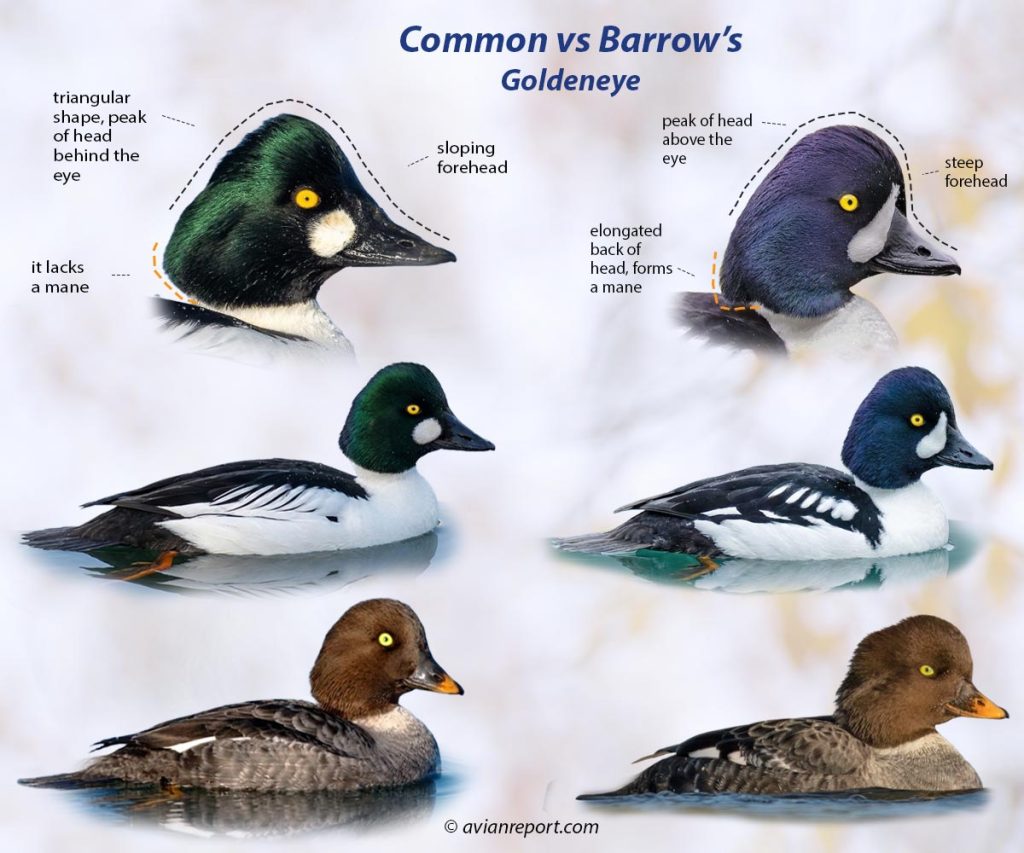
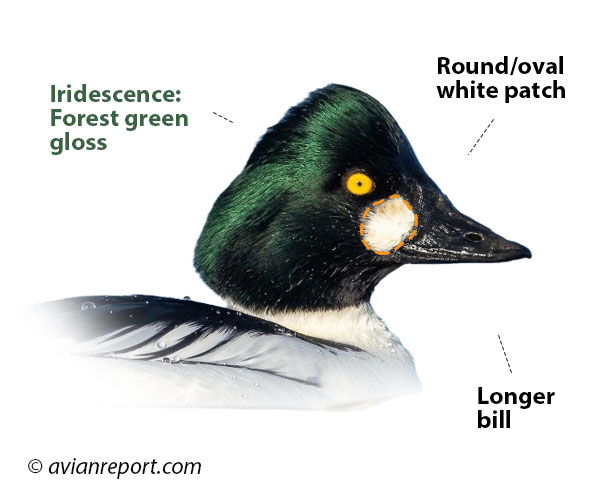
- Common Goldeneye: The spot is typically round or slightly oval. It is positioned centrally between the base of the bill and the eye, rarely extending significantly above the line of the bill.
- Barrow’s Goldeneye: The spot is shaped like a crescent, an apostrophe, or a “teardrop.” It is taller than it is wide and curves upward toward the forehead. In some individuals, the crescent is so tall it appears to “push” the forehead back.
2. Head Iridescence: Purple vs. Green
The dark head feathers of goldeneyes contain microscopic structural elements that produce iridescence in direct sunlight.
- Common Goldeneye: Displays a rich, forest-green gloss.
- Barrow’s Goldeneye: Displays a deep, blue-purple or violet gloss.
Note: Iridescence is notoriously light-dependent. In flat light or shadow, both heads look black. Conversely, at certain extreme angles, a Common Goldeneye’s green head can reflect purple. Therefore, this mark should only be used as a secondary confirmation in good lighting.
3. Body Color Ratio: The “Black Spur” and the “White Side”
At a distance, the overall balance of black and white on the bird’s body is a reliable indicator of species.
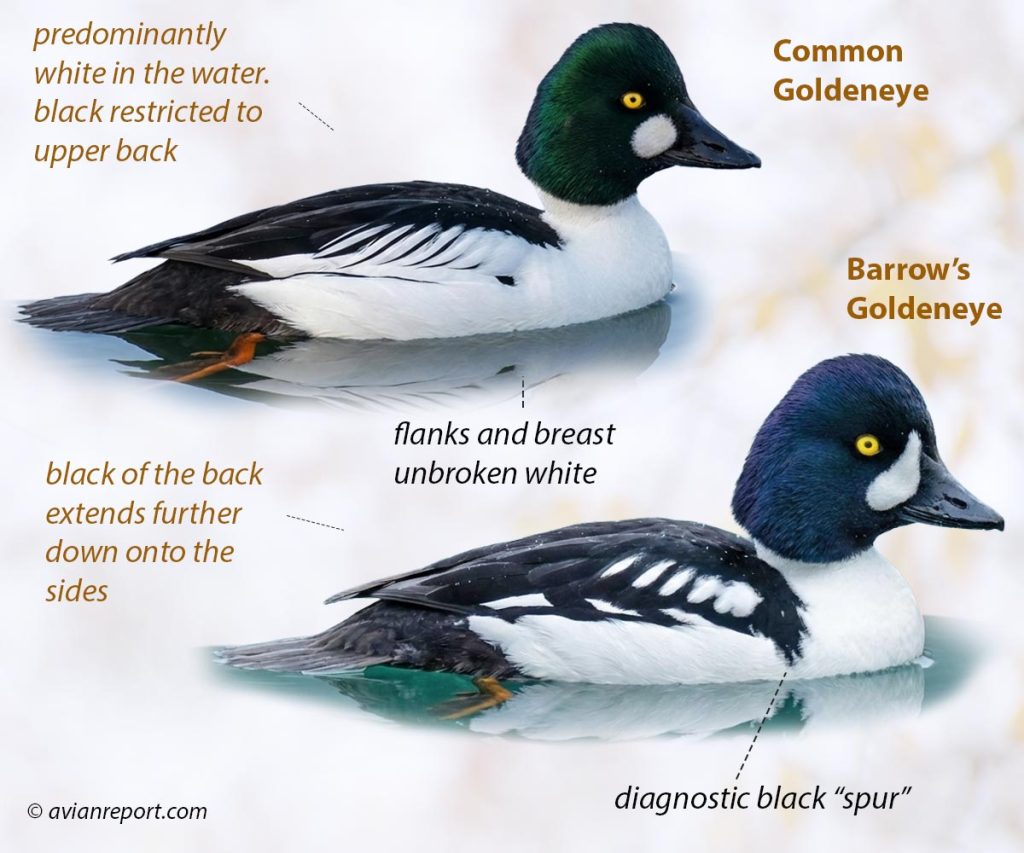
- Common Goldeneye: Appears predominantly white on the water. The black is largely restricted to the ridge of the back, while the sides are white with long, thin black streaks creating a “zipper” look. The flanks and breast are a brilliant, unbroken white.
- Barrow’s Goldeneye: Appears significantly darker. The black of the back extends further down onto the sides, creating a pattern often described as a series of white “windows” or spots on a background. Most critically, the Barrow’s drake possesses a diagnostic black “spur” or shoulder patch—a protrusion of black feathers that extends downward from the wing into the white of the breast, just forward of the wing.
Male Structural Details and Flight Marks
Structural differences are often more reliable than plumage because they do not change with the lighting. These differences stem from the specific skull morphology of the two species.
Head Shape: Triangular vs. Hammerhead
The cranial profile of a goldeneye is its “signature” in the water.
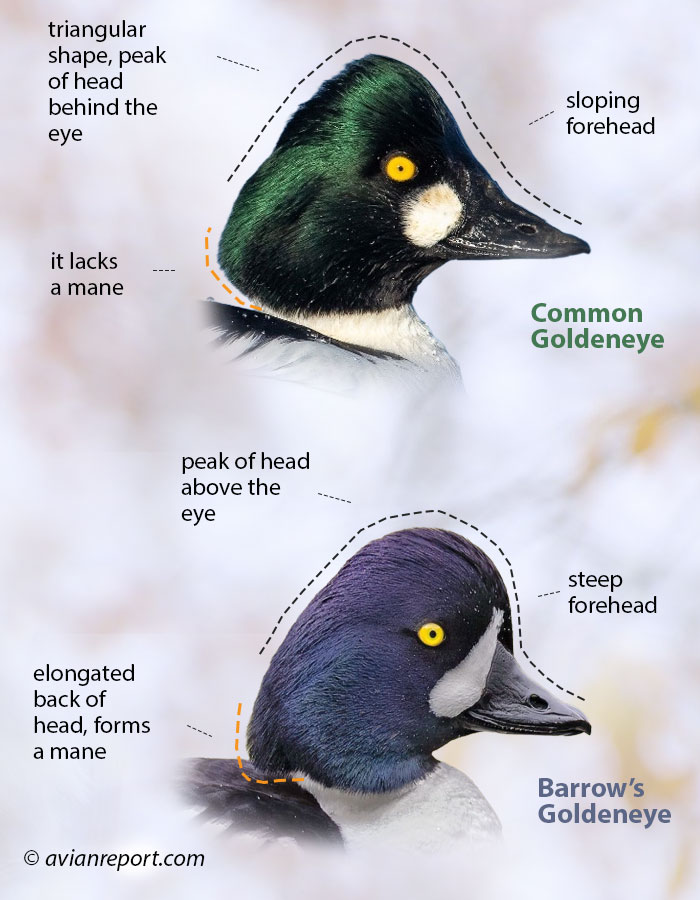
- Common Goldeneye: The peak of the crown is located in the center of the head if one traces a vertical imaginary line across the eye. This results in a tall, balanced, and distinctly triangular or “peaked” head shape. The forehead slopes gradually down to meet the bill.
- Barrow’s Goldeneye: The peak of the crown is shifted forward, sitting just above the eye, if one traces a vertical imaginary line across the eye. The forehead is steep—nearly vertical—and the top of the crown is flatter. The back of the head is elongated into a prominent “mane” or “hammerhead” shape.
Caution: Head shape is ephemeral. If a bird is alert or has just surfaced from a dive, it will sleek its feathers, causing the forehead of a Barrow’s to look sloped and the peak of a Common’s to look flattened. Observers must watch the bird until it is relaxed and the feathers are “puffed” to their natural state.
Bill Structure and Forehead Angle
The bill of the Common Goldeneye is larger and more robust, with a bridge that continues the sloping line of the forehead. The Barrow’s Goldeneye has a smaller, more petite bill that meets the steep forehead at an abrupt, nearly 90-degree angle.
Identification in Flight: The Wing Patch
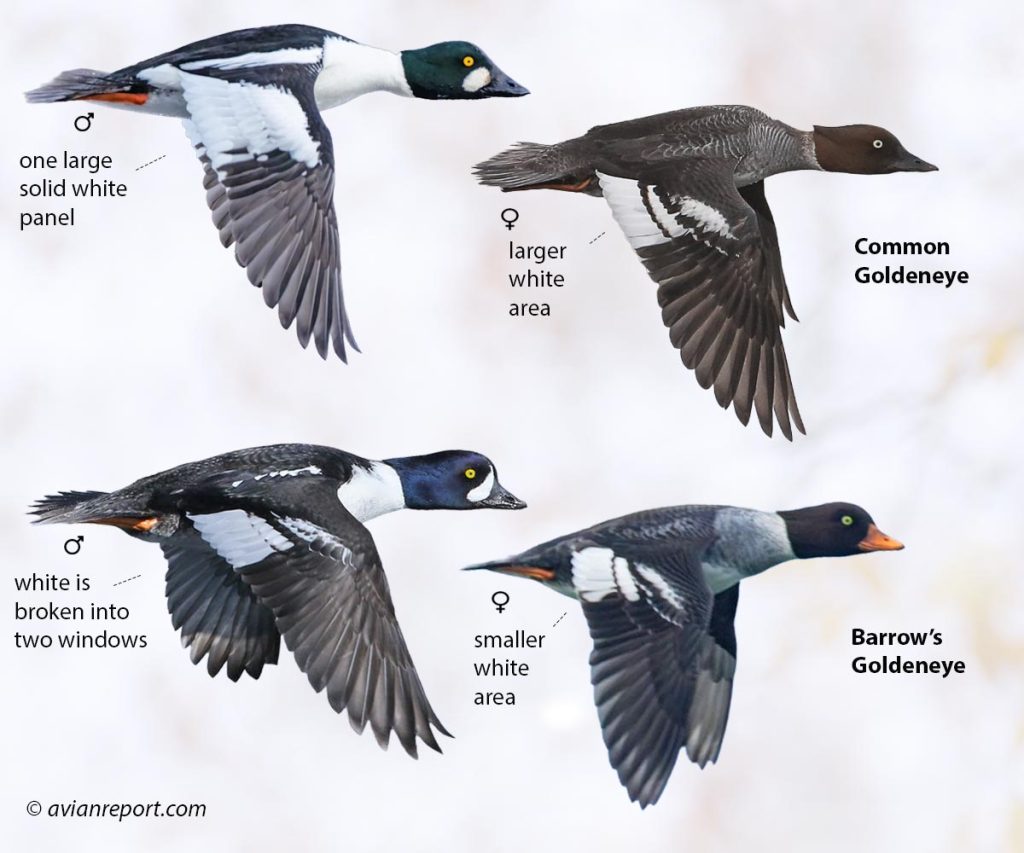
Goldeneyes are known as “whistlers” because their rapid wingbeats produce a loud, metallic whistling sound. In flight, the distribution of white on the wings provides another point of differentiation.
| Species | Primary Wing Mark | Secondary Feather Pattern |
| Common Goldeneye | Large, solid white block on the inner wing | 5 to 8 pure white secondaries |
| Barrow’s Goldeneye | White is broken into smaller spots or “windows” | 0 to 4 pure white secondaries |
Identifying Females: The Subtle Challenge
Identifying female goldeneyes is perhaps more difficult. For the female, identification relies on a “template of impressions” rather than a single field mark.
The Primary Mark: Bill Coloration and Seasonality
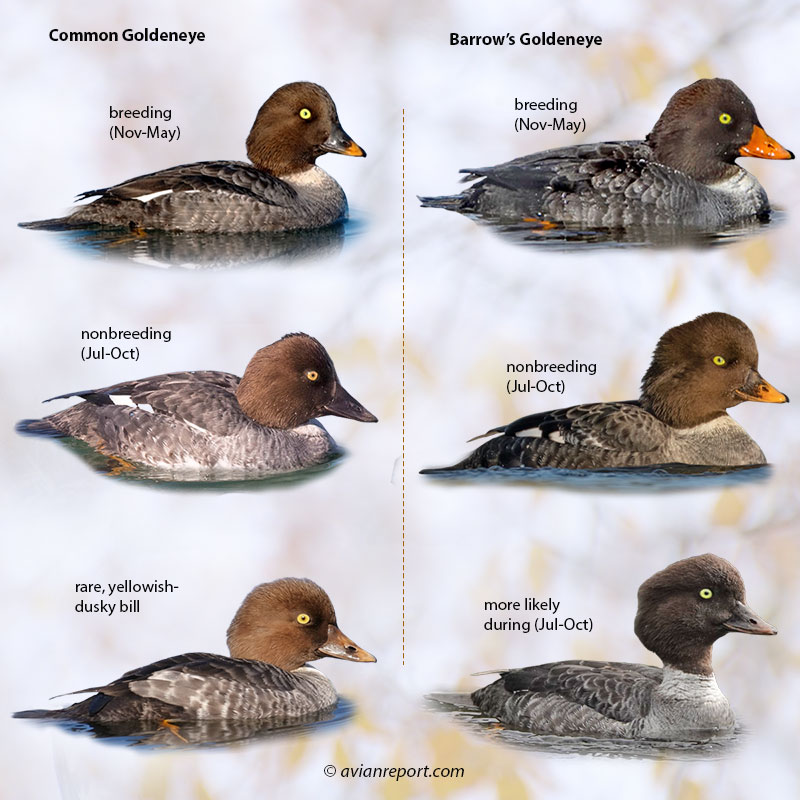
The color of the bill is the most cited mark, but it is also the most frequently misinterpreted.
- Common Goldeneye (Hen): The bill is typically black or dark dusky, with a yellow band or patch near the tip. In some individuals, the yellow is so restricted it is barely visible.
- Barrow’s Goldeneye (Hen): In adult breeding plumage (November to May), the bill is almost entirely bright orange-yellow, often described as “pumpkin” orange.
Identification Pitfall: From June through October, both hen species have dark, dusky bills. Furthermore, a small percentage of female Common Goldeneyes exhibit “variant” all-yellow bills, which can lead to frequent misidentifications of the rare Barrow’s in areas where it is a vagrant.
The Secondary Mark: Head Shape and Posture
Structural differences in the head are more consistent than color but require patient observation.
- Common Hen: Shows a sloping forehead and a triangular head peaked in the center.
- Barrow’s Hen: Shows a steep, vertical forehead and a flatter, more oblong head with a “mane” at the nape.
Caution: Head shape is ephemeral. If a bird is alert or has just surfaced from a dive, it will sleek its feathers, causing the forehead of a Barrow’s to look sloped and the peak of a Common’s to look flattened. Observers must watch the bird until it is relaxed and the feathers are “puffed” to their natural state. The female Barrow’s Goldeneye in the image above (top-right) illustrates this. That female was photographed just when it came out of a dive, hence the sloping forehead.
Detailed Female Morphology (Close-Range)
For birders using high-quality optics, photography, or for birds in hand, several fine-scale morphological details can confirm an identification.
Bill Shape, Depth, and the “Nail”
Measurements by Fjeldsa (1973) and Pyle (2008) indicate that while the Common Goldeneye averages a longer bill (31–37 mm), the Barrow’s bill is proportionally deeper and stouter (29–33 mm).
- The Nail: The nail (the plate at the tip of the bill) is larger, broader, and more raised on a Barrow’s Goldeneye. When viewed from the side, the lower edge of the Barrow’s bill curves smoothly upward toward the tip, giving the bill a slightly “upturned” appearance. The Common Goldeneye has a straighter bill with a slightly “spatulate” (shovel-like) tip.1
The “See-Through” Nostrils
A highly technical and controversial field mark involves the anatomy of the nostrils. Documentation from Environment Canada suggest that the nostrils of the Barrow’s Goldeneye are larger and more “open,” allowing an observer at exactly the right angle to see light passing through the bill.15
On a Common Goldeneye, the internal structure of the nasal cavity reportedly prevents this. While theoretically diagnostic, this mark is rarely visible under field conditions and is best reserved for birds in hand or extremely close-range macro-photography.1
Head and Eye Coloration
While both species have chocolate-brown heads, the shade differs in direct comparison.
- Common Hen: The head is a paler, more “orange-brown” or “cinnamon-brown.” The iris is a lighter, pale yellow.1
- Barrow’s Hen: The head is a darker, richer, “dark chocolate” brown. The iris is a deeper, more saturated yellow or gold.1
Extent of Dark Neck Feathering
In the Barrow’s Goldeneye, the dark brown feathering of the head tends to extend further down the neck than it does in the Common. However, this is highly variable based on how the bird is stretching its neck and is considered a “weak” field mark by many experts.1
Pitfalls: Juveniles and Hybrids
Even for experts, certain goldeneyes remain “unidentified” due to age-related plumage transitions or genetic mixing.
Juvenile Confusion
Through their first winter, juvenile females of both species are extremely difficult to distinguish.
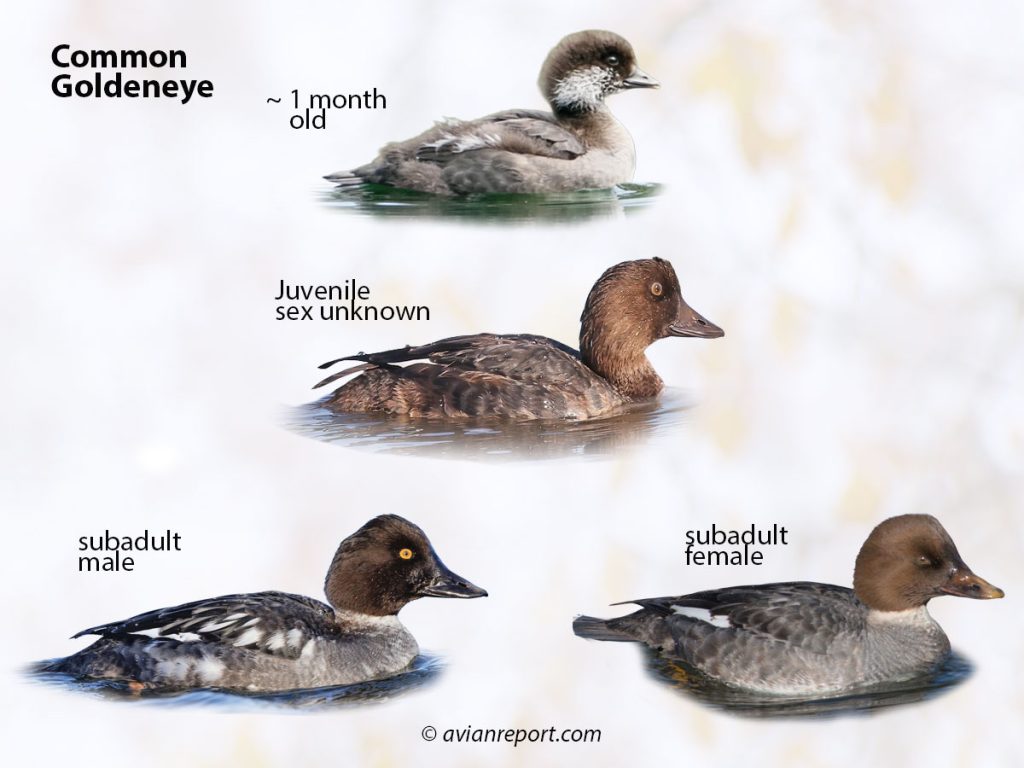
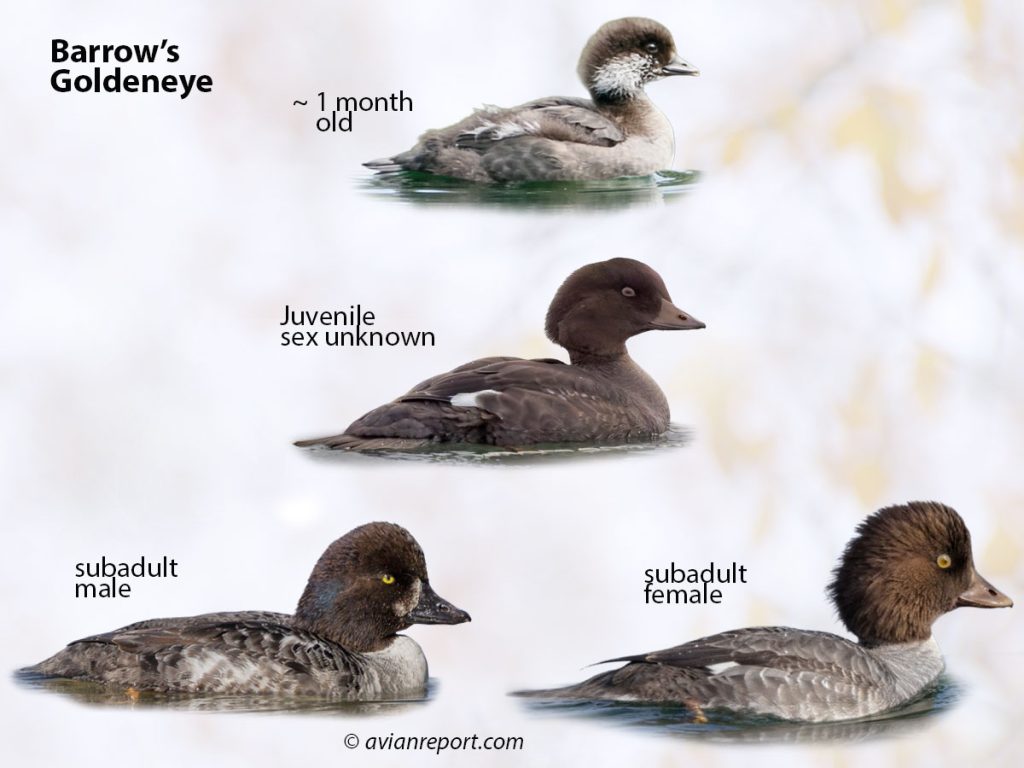
- Eyes: Their eyes are a drab grayish-brown or olive-yellow, lacking the brilliant gold of the adults.1
- Bills: Juvenile Common Goldeneyes frequently develop drab yellowish or olive-colored bills, which mimics the adult Barrow’s bill color. Furthermore, juveniles of both species have smaller, more rounded heads, making structural assessment less reliable.1
The Hybrid Factor
Common and Barrow’s goldeneyes occasionally interbreed, particularly in eastern North America where the Barrow’s is rare. Identifying a hybrid Bucephala clangula x islandica requires looking for a “mismatch” of traits. In a pure species, the field marks are a package deal; in a hybrid, those packages break apart.
- Hybrid Males: Often show intermediate traits. A common hybrid presentation is a drake with a crescent-shaped facial spot (Barrow’s trait) but all-white sides without a black spur (Common trait).
- The Golden Rule: As recommended by Di Labio et al. (1997), any goldeneye that shows a confusing mixture of traits should be left unidentified. Forcing a “rare bird” identification on a hybrid individual undermines the accuracy of citizen-science data.1
1. The facial white patch (The “Smoking Gun”)
This is usually the first thing an observer notices. It is almost always intermediate in shape.
- Common: Round/oval white patch.
- Barrow’s: Crescent or teardrop shape, extending above the level of the eye.
- Hybrid: An “ovoid-crescent.” It often looks like a round patch that has been slightly stretched upward or a crescent that is too fat. It rarely reaches the sharp “points” seen in a pure Barrow’s.
2. Head shape and iridescence
The skull structure of these two ducks is significantly different, and hybrids sit right in the middle.
- Common: Triangular head; peak is toward the back. Gloss is typically green.
- Barrow’s: Low, flat crown with a steep forehead (the “mane” effect); peak is roughly above the eye. Gloss is typically purple/blue.
- Hybrid: Often shows a “shaggy” nape like a Barrow’s but retains the sloping forehead of a Common. The iridescence is often a muddied bronze—neither purely green nor purely purple, changing depending on the light angle.
3. The scapulars (The “Shoulder” Pattern)
Look at the white streaks on the black back.
- Common: Long, thin black streaks creating a “zipper” look.
- Barrow’s: A row of distinct white squares or “windows” on a black background.
- Hybrid: The white markings are typically shorter than a Common’s but more elongated than a Barrow’s squares. It often looks like a “dashed line” rather than a solid streak or a square.
4. The “Spur” (Shoulder Mark)
This is a critical, often overlooked mark located at the leading edge of the wing/breast.
- Common: Lacks a black vertical spur; the white breast meets the gray/black wing cleanly.
- Barrow’s: Has a prominent black vertical “spur” or bar extending down from the shoulder into the white breast.
- Hybrid: Usually shows a vestigial spur—a dark smudge or a partial bar that doesn’t quite cross the breast but is clearly visible compared to the clean white of a Common. Some birds do not show any trace of a spur.
Identification of Hybrid Female Goldeneyes
Distinguishing the females is notoriously difficult, as they lack the dramatic plumage of the drakes. The identification of a hybrid female relies on the interaction between bill color and structural head shape.
- The Bill Color Reliability: In winter, the bill is the most conspicuous field mark.
- Common: Black bill with a small yellowish patch localized at the tip.
- Barrow’s: Bill is almost entirely orange-yellow.
- The 99% Rule: While bill color works for over 99% of wintering birds, a small percentage of female Commons will exhibit an almost entirely yellow bill, while some Barrow’s may show a darker pattern. In summer, both species revert to dark dusky bills, making color-based identification nearly impossible.
- The Hybrid Mismatch: A hybrid female often presents as a “mismatch” of head and bill.
- Example: A bird with the mostly yellow bill of a Barrow’s but the head shape (sloping forehead/rear peak) of a Common.
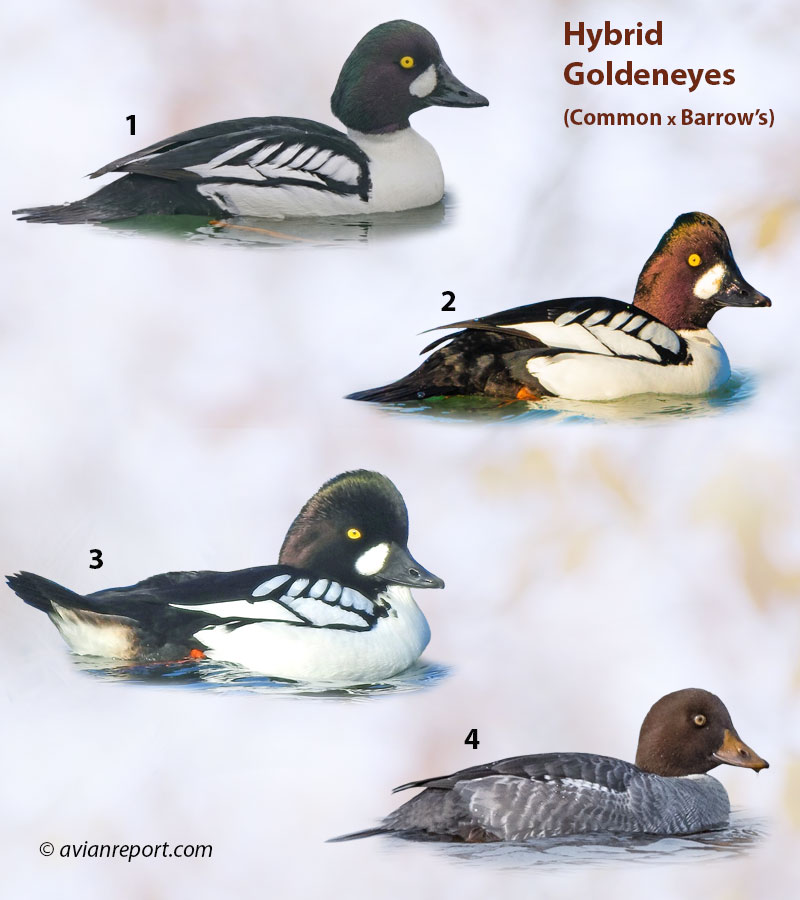
1 This bird has the sloping forehead of a Common, head with shades of green and purple o both species. The facial white patch leans towards a Barrow’s. The scapular (shoulder pattern) is a mix of both species. Finally, it shows a vestigial black “spur” of a Barrow’s.
2 This bird shows the triangular head of a Common, a unique bronze iridescent, an intermediate facial white patch, and a Barrow’s white windows on the shoulder. It has a very small spur of a Barrow’s.
3 This bird has the steep forehead and bill size of a Barrow’s but has a green iridescent of a Common. The white windows on the shoulder are of a Barrow’s. No noticeable black spur.
4 This female bird has a yellow bill of a Barrow’s but the sloping forehead and bill structure of a Common. The deep chestnut color of the head and body plumage leans towards a Barrow’s. It appears to be a hybrid female but the possibility of being a rare yellow-billed female Common may not be discarded.
Note: The “Giss”
In the field, we often refer to “Giss” (General Impression of Size and Shape). A hybrid often feels like a Common Goldeneye that is “trying” to look like a Barrow’s. If you see a duck with a purple/bronze head but a round patch, or a green head with a crescent patch, you are almost certainly looking at a hybrid.
VIII. Conclusion: The Holistic Approach
The identification of goldeneyes is a masterclass in the “holistic” approach to birding. One cannot rely on bill color alone, as it varies with age and season. One cannot rely on head iridescence alone, as it varies with the sun. Instead, the successful observer evaluates the bird’s GISS (General Impression of Size and Shape), weighing structural markers like forehead slope and bill depth against plumage details like the “black spur” or facial crescent.20
For the blog reader, the takeaway is simple: patience is the birder’s greatest tool. Spend time watching the bird move, dive, and interact with its peers. Only by observing the bird in various postures and lightings can one truly solve the “Goldeneye Conundrum.”
| Identification Priority | Common Goldeneye | Barrow’s Goldeneye |
| 1. Structure | Triangular head; sloped forehead | Oblong head; steep forehead |
| 2. Male Marks | Round spot; white sides | Crescent spot; black spur |
| 3. Female Marks | Dark bill (mostly); sloped head | Orange bill (winter); steep head |
| 4. Flight | Solid white wing patch | Divided white wing spots |
References:
allaboutbirds.org: Barrow’s Goldeneye Overview, All About Birds, Cornell Lab of Ornithology
allaboutbirds.org: Common Goldeneye Identification, All About Birds, Cornell Lab of Ornithology
canada.ca: Barrow’s goldeneye: know how to recognize it – Canada.ca
data-donnees.az.ec.gc.ca: CWS Atlantic Barrow’s Goldeneye Surveys – ECCC Data Catalogue
ducks.org: Barrow’s Goldeneye | Ducks Unlimited
ducks.org: Common Goldeneye – Ducks Unlimited
eBird.org/science: Barrow’s Goldeneye
eBird.org/science: Common Goldeneye
eontbird.ca: Goldeneyes: Cryptic Barrow’s & “Yellow-billed” Common – Eastern Ontario Birding
flockingaround.com: Common Goldeneye vs Barrow’s Goldeneye Identification – Flocking Around
naturenb.ca: Barrow’s Goldeneye Survey 2020
open.canada.ca: CWS Atlantic Barrow’s Goldeneye Surveys – Open Government Portal
sibleyguides.com: Distinguishing female Barrow’s and Common Goldeneyes – Sibley Guides
sibleyguides.com: Identification of (hybrid?) female Goldeneyes – Sibley Guides
Photo Credits:
The photographic material used in this article comes from photos licensed under “Creative Commons” and mostly from birders and photographers. I am profoundly grateful for your generous support in making these images available; they have truly made this article possible. Many thanks to Andrew Morffew, Mark Mochell, Elizabeth Milson, Emily Chen, Dennis Church, Wendy Miller, Ken Slade, John Benson, Mick Thompson, Steve Guttman, Nicole Beaulac, Andy Reago, Chrissy McLaren, Garry C., Shawn Taylor, Steve Kersting, Gary Leaven, Vicky DeLoach, Don Hoechlin, Tom Murray, Kevin Krebs, Deborah Freeman, Kenneth Cole-Schneider, Doug Greenberg, Ian Preston, Brian Garrett, John Strung, Becky Matsubara, Judy Gallagher, Bob Jensen, Veit, Sand Diego Zoo, David Inman, Dan Mooney, Ian Preston, Lloyd Davis, Denis Fournier, Gregory Heaton, Greg Lavaty, Dona Hilkey, Alain Doyle, Aaron Maizlish, Ashley Tubs, Richard George, Ethan Gosnell, Nick, , Steve Valasek, Mitch Walters, , and Julio Mulero.
Author:
