
Correctly identifying Tundra Swans vs. Trumpeter Swans is one of the most challenging tasks in North American waterfowl identification. Unlike the easily recognized Mute Swan, the two native species—Tundra Swan (Cygnus columbianus) and Trumpeter Swan (Cygnus buccinator)—are remarkably similar in appearance, often overlapping in size, range, and habitat during migration and winter.
Historically, this confusion contributed to widespread misidentification, masking the true decline of the Trumpeter Swan during the early 20th century. Today, accurate identification is essential for both birders and conservation efforts. This guide explains the key field marks used to separate Tundra and Trumpeter Swans, including bill shape, head profile, vocalizations, plumage, age-related traits, and geographic context, providing a clear, practical framework for confident identification in the field.
- The North American trio: Mute, Trumpeter and Tundra swans
- Tundra vs. Trumpeter Swan Identification: Historical and Conservation Context
- Distribution and Seasonal Phenology
- Morphological Identification of Adult Tundra and Trumpeter Swans
- Advanced Structural Analysis: Head Shape and Body Carriage
- Juvenile Identification and Developmental Phenology
- Bioacoustics: The Gold Standard for Identification
- Regional Rarities: The Bewick’s Swan and Leucism
The North American trio: Mute, Trumpeter and Tundra swans
Three distinct swan species can be found in North America: the Trumpeter Swan (Cygnus buccinator), the Tundra Swan (Cygnus columbianus), and the non-native Mute Swan (Cygnus olor). While all three are massive white waterfowl, they occupy different rungs on the size ladder.
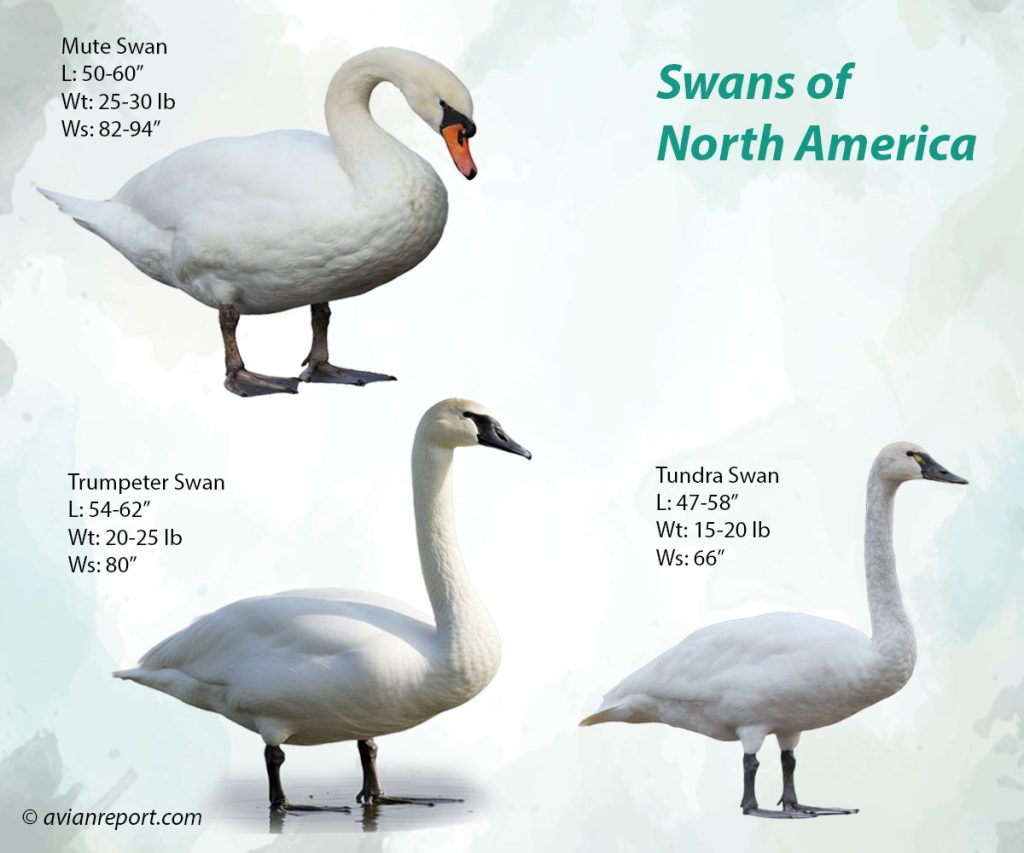
In a side-by-side comparison, the weight and bulk of these birds serve as a primary (though often subtle) differentiator:
- Mute Swan: The heaviest of the three, typically weighing between 25 and 30 lbs. They are easily identified by their bright orange bills and prominent black basal knobs.
- Trumpeter Swan: North America’s largest native waterfowl, weighing roughly 20 to 25 lbs (though large males can reach up to 28 lbs). They possess a massive, entirely black bill.
- Tundra Swan: The smallest and most agile of the trio, weighing in at 15 to 20 lbs. Like the Trumpeter, they have black bills, which is the primary source of identification confusion.
Tundra vs. Trumpeter Swan Identification: Historical and Conservation Context
Distinguishing Tundra Swans from Trumpeter Swans is one of the most challenging problems in swan identification. Both species are strikingly similar in appearance, and their migratory routes and wintering ranges overlap extensively across North America. This challenge is not new, but its importance has grown as swan populations and distributions have changed.
For much of the 20th century, the Trumpeter Swan was considered one of the rarest birds in North America. By the 1930s, fewer than 100 individuals remained south of Canada, largely confined to the Greater Yellowstone Ecosystem. As a result, most large white swans observed by birders were historically assumed to be Tundra Swans (then commonly called Whistling Swans).
That assumption is no longer reliable. Trumpeter Swan reintroduction programs in states such as Minnesota, Wisconsin, and Ohio have successfully restored populations across much of the Midwest and Pacific Northwest. Today, Trumpeters are regular residents or wintering birds in many regions, making accurate swan identification essential for monitoring population recovery and informing conservation decisions.
Meanwhile, Tundra Swans remain more abundant and strongly migratory, breeding on the Arctic tundra and traveling south in large, vocal flocks to winter along both the Atlantic and Pacific coasts. Their migration corridors frequently intersect with areas now occupied by Trumpeter Swans, increasing the likelihood of misidentification.
Correctly identifying these species requires moving beyond single “shortcut” field marks—such as the presence or absence of a yellow loral spot—and adopting a holistic identification approach. Evaluating head shape, bill structure, overall proportions, and vocalizations together provides the most reliable method for separating Tundra and Trumpeter Swans in the field.
Distribution and Seasonal Phenology
Understanding when and where a swan is observed provides the first layer of identification. While Trumpeters and Tundras overlap, their breeding and migratory strategies differ significantly. Trumpeters are generally more sedentary or short-distance migrants, often remaining as far north as open water allows. Tundras are long-distance migrants with strict schedules.
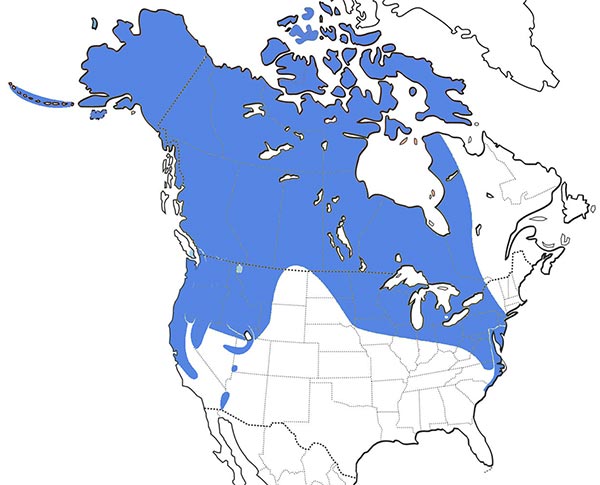
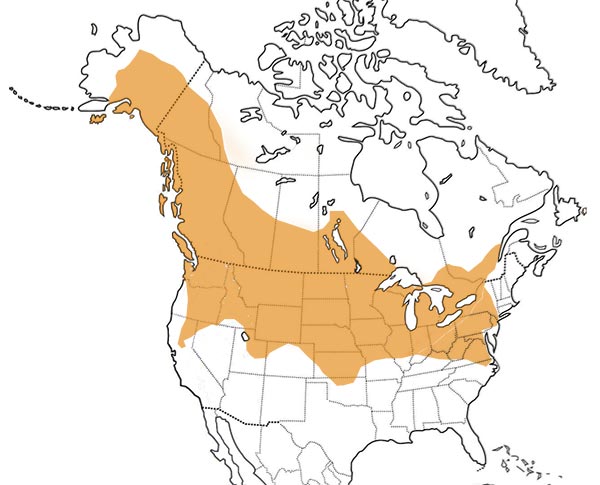
Comparative Regional Presence
| Region | Trumpeter Swan (C. buccinator) | Tundra Swan (C. columbianus) |
| Breeding Range | Temperate wetlands, forested lakes (AK, NW, Midwest) | High Arctic tundra, coastal wetlands |
| Wintering Range | Partially ice-free rivers, estuaries, agricultural fields | Chesapeake Bay, California, Pacific NW |
| Migration Timing | Often stays year-round or moves short distances | Strong pulses: March–May and October–November |
| Social Structure | Pairs, family groups, or small flocks | Large, gregarious flocks (hundreds to thousands) |
In states like Montana or New York, the timing of a sighting can be a powerful diagnostic. For instance, in western New York, Tundra Swans are most numerous between mid-March to early May and mid-October to late November; sightings outside these windows significantly increase the probability of the bird being a Trumpeter. Furthermore, the social behavior is telling; a flock of 500 white swans in an agricultural field is almost certainly Tundras, as Trumpeters rarely congregate in such massive numbers.
Morphological Identification of Adult Tundra and Trumpeter Swans
Size Differences
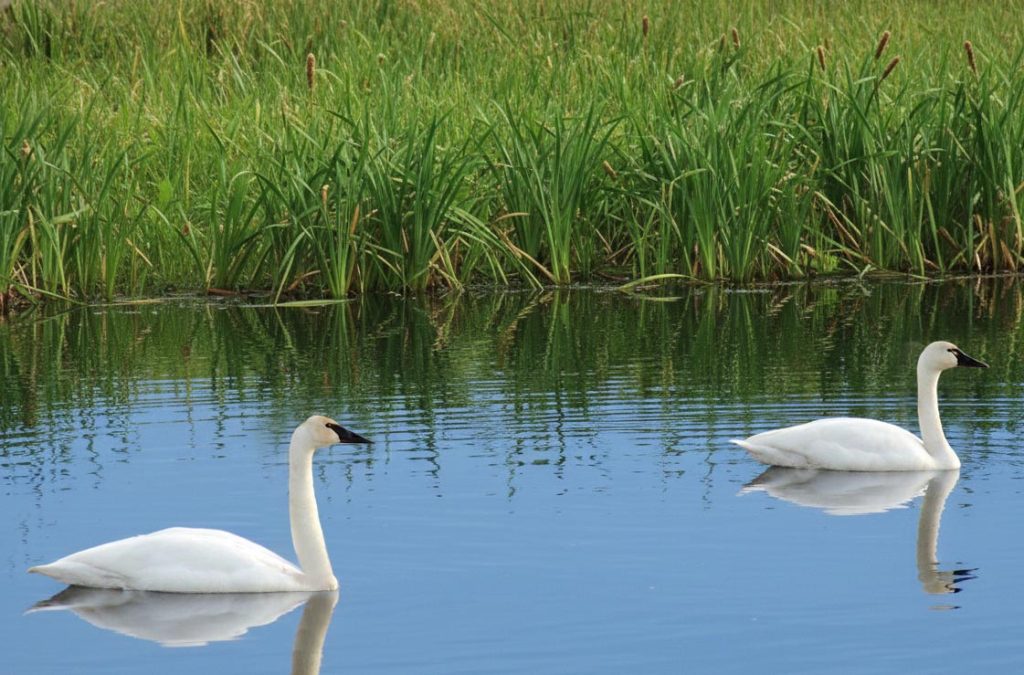
While size is a factor, it is often misleading. The Trumpeter Swan is significantly larger, weighing up to 28 pounds compared to the Tundra’s maximum of 20–23 pounds. However, a large male Tundra can overlap in size with a small female Trumpeter, and size is notoriously difficult to judge in isolation on open water. Instead, the observer must focus on the geometric relationship between the bill, the eyes, and the forehead.
The Head and Bill
The primary field marks for adult swan identification are concentrated on the head and facial region.
Head Shape Profiles
The head shape of these two species is influenced by their underlying skeletal structure and the volume of their jaw muscles.
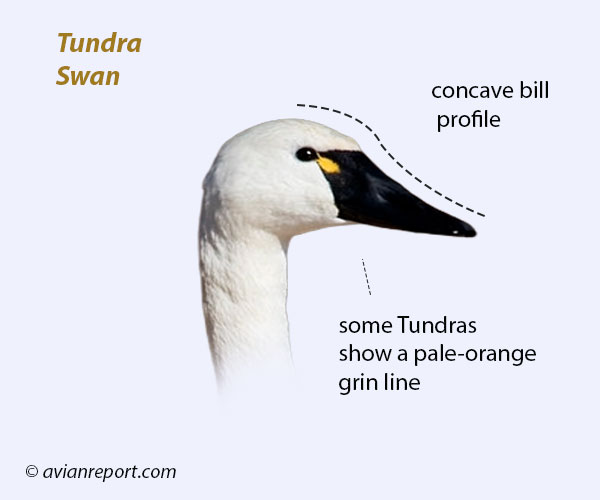
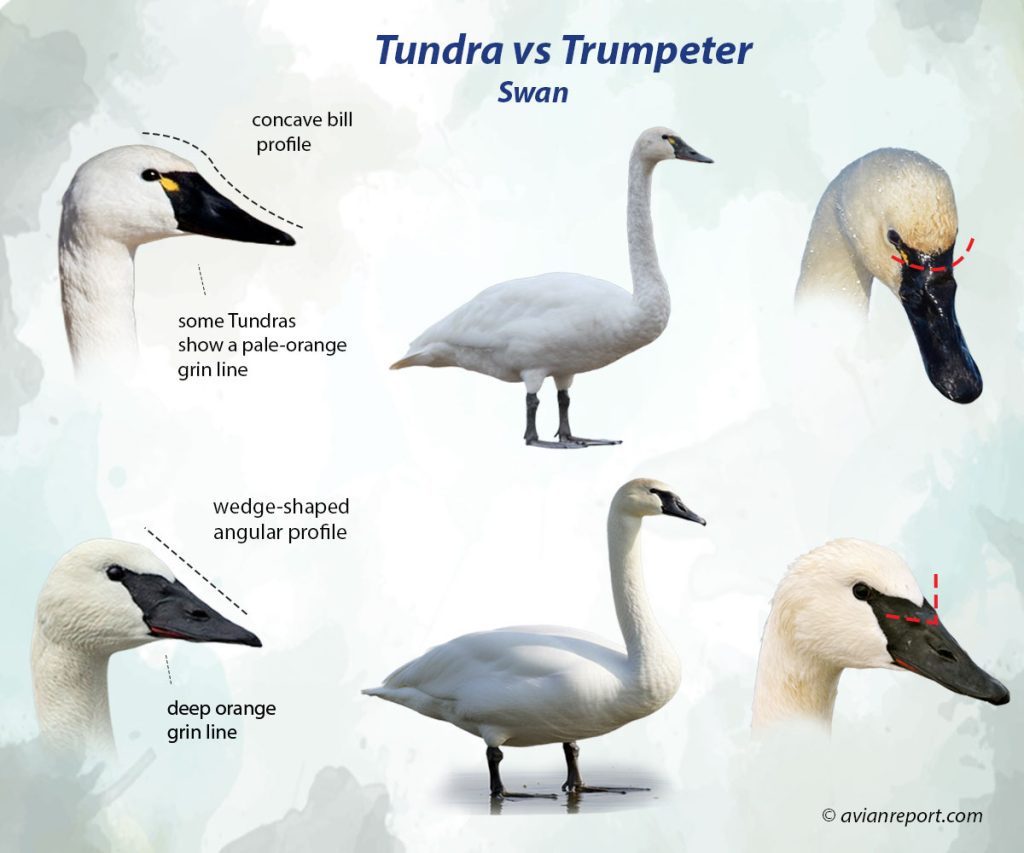
- Tundra Swan: The head is more globular and rounded. The peak of the crown is more centered, and the forehead rises more steeply from the bill. This gives the Tundra a “cuter,” more goose-like appearance.
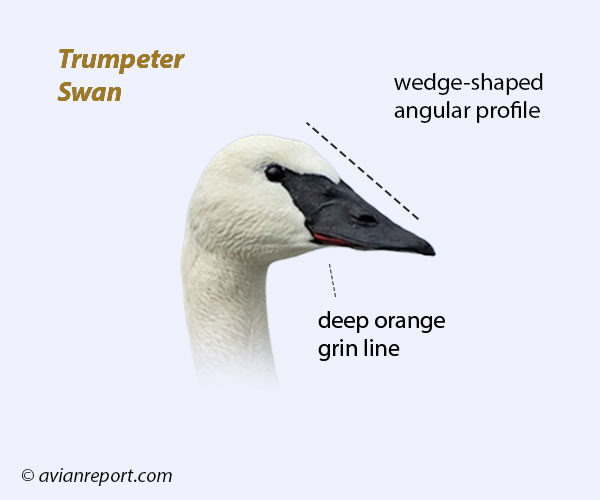
- Trumpeter Swan: The head is often described as “Canvasback-like.” It features a flat crown that slopes gradually from the bill to a peak at the very back of the head. This creates an elongated, angular look.
The “Lipstick” Line and Gape Anatomy
The Trumpeter Swan often exhibits a bright salmon-red or deep orange line along the “grin line” where the upper and lower mandibles meet. This “lipstick” mark is a strong indicator of a Trumpeter, especially when the line is vivid and extends nearly the full length of the gape.
While some Tundra Swans may show a hint of dull red or pink in this area, it is rarely as bright or extensive as in the Trumpeter. Furthermore, the Trumpeter’s gape is usually straight from the eye to the mouth, whereas the Tundra’s gape may show a slight curve.
The Eye-to-Bill Connection
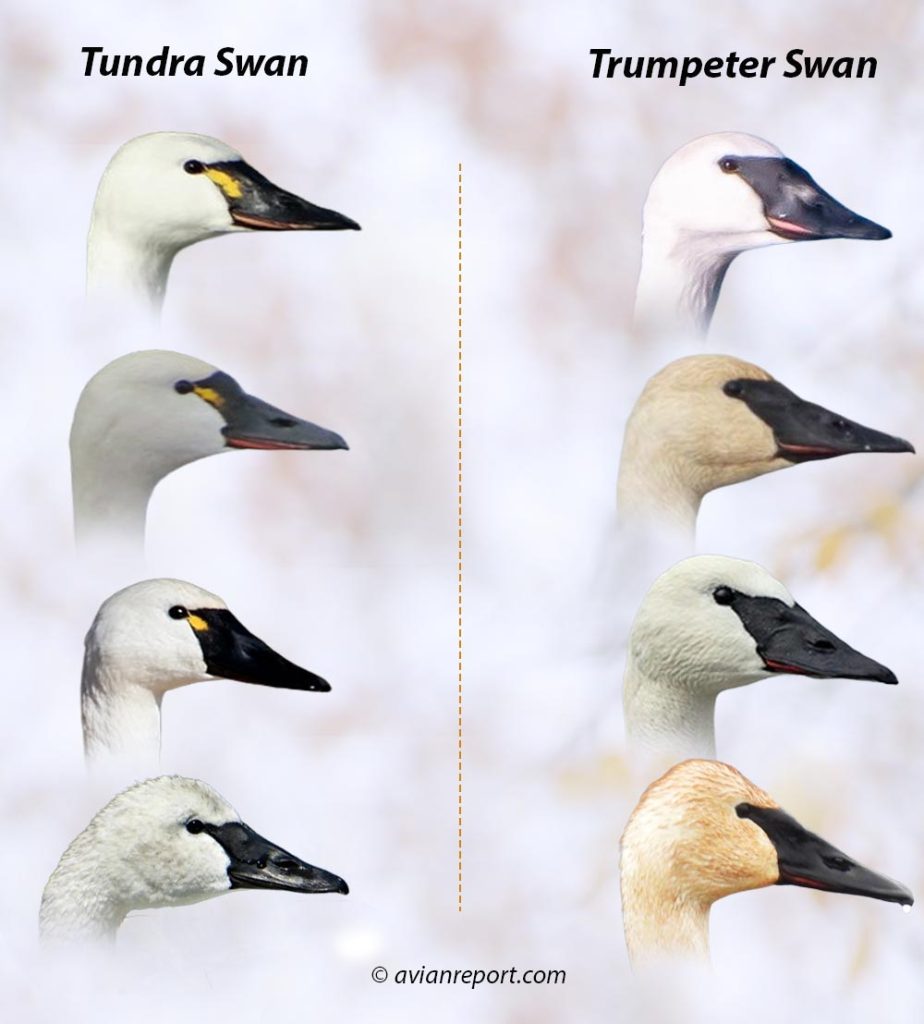
One of the most reliable structural marks involves the black facial skin (lores) and its interaction with the eye. In the Trumpeter Swan, the black skin is broad and fully encompasses the eye. To the observer, the eye appears to be “integrated” into the black mask of the face, making it difficult to distinguish the pupil from the surrounding skin at a distance.
In contrast, the Tundra Swan has a much more constricted area of black skin in front of the eye. This creates a “separate” appearance, where the eye stands out clearly against the white feathers of the head. Even when a Tundra Swan lacks a yellow loral spot, the eye remains much more distinct than that of a Trumpeter. This distinction is often the most consistent mark when viewing birds from a side profile.
The Yellow Loral Spot: A Variable Mark
The yellow spot located on the lores of the Tundra Swan is perhaps the most famous field mark, but it requires careful qualification. Approximately 80–90% of Tundra Swans exhibit this mark, which can vary from a small, nearly invisible fleck to a large, prominent teardrop. However, the remaining 10–20% of Tundras lack any yellow whatsoever, appearing with an entirely black bill similar to a Trumpeter.
Conversely, some Trumpeter Swans have been reported with pale spots on their lores, though this is exceptionally rare and usually lacks the vivid yellow hue of a Tundra. Therefore, the absence of yellow cannot be used to confirm a Trumpeter identification; it must be paired with structural indicators.
The Forehead and Culmen Interface
The shape of the featherline where the forehead meets the bill provides a diagnostic view, particularly from a head-on or three-quarter perspective.
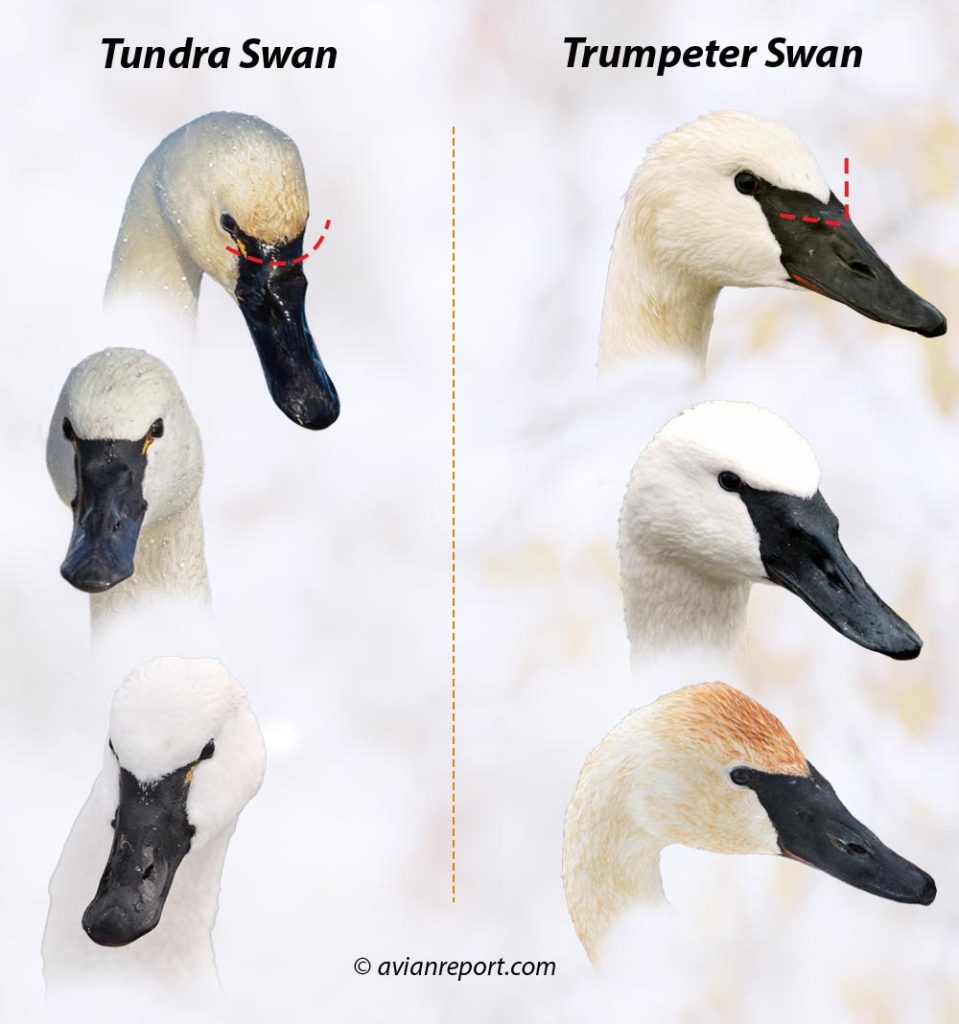
- Trumpeter Swan: The forehead feathers typically come to a sharp “V” shape at the base of the bill. This “V” is formed by the more swollen or robust facial anatomy of the Trumpeter. The culmen (the upper ridge of the bill) is straight, forming a continuous, wedge-like slope that extends from the tip of the bill to the crown of the head.
- Tundra Swan: The forehead feathers usually form a rounded or broad “U” shape. The culmen is typically concave or “scooped,” giving the bird a dish-faced profile that breaks the straight line seen in Trumpeters.
Advanced Structural Analysis: Head Shape and Body Carriage
Body Posture and Movement
Because of the Trumpeter’s massive size and weight—reaching up to 12,700 grams—its movements are characterized by a ponderous, methodical quality.
- On the Water: Trumpeters often hold their necks in a slight “C” curve, while Tundras tend to hold their necks more vertically and straight. When foraging, Trumpeters droop the base of their necks more noticeably and often tip up like a dabbling duck to reach deeper vegetation.
- In Flight: The Trumpeter’s neck is thicker and may droop slightly at the base. Their wingbeats are slower and more powerful than the Tundra’s.
- On Land: Tundra Swans are much more agile on their feet, sometimes described as “prancing,” whereas Trumpeters walk slowly and carefully.
Technical Measurements of the Bill
For research applications involving captured birds or high-resolution photogrammetry, the ratio of the bill length to the position of the nares (nostrils) is diagnostic.
In the Trumpeter Swan, the bill is elongated, and at least 50 mm usually separate the bill tip from the anterior edge of the nares. In the Tundra Swan, this distance is almost always less than 50 mm.
Juvenile Identification and Developmental Phenology
Differentiating juvenile swans (cygnets) is arguably the most difficult task in swan identification, as the diagnostic facial colors of adults have not yet developed. However, the timing of their first-year molt and the specific patterns of their bill transition offer a reliable path to identification.
Plumage Tones and Molt Timing
Both species spend their first fall and winter in gray-brown plumage, but the quality of that gray differs.
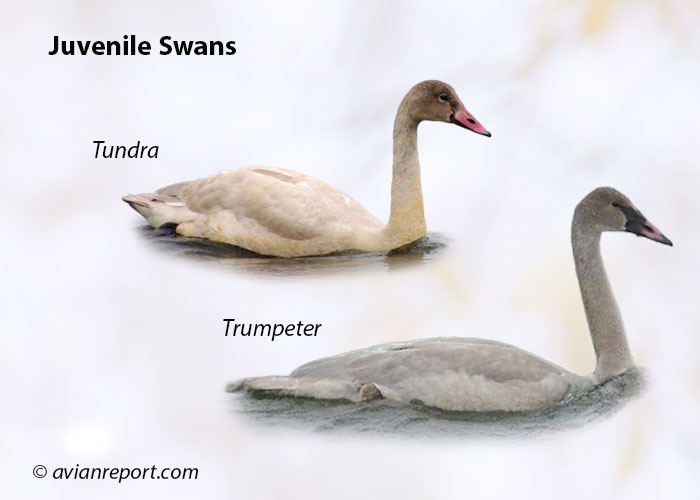
- Trumpeter Cygnets: These birds are a darker “sooty” gray, particularly on the head and neck. They are late molters; their gray feathers often persist through the entire first winter and into the following spring. They typically do not acquire fully white plumage until their second summer.
- Tundra Cygnets: These birds are a lighter “silvery” gray. They are “early bloomers” in terms of plumage development. By late December, Tundra cygnets begin showing white patches on their backs (scapulars). By mid-March, most Tundra juveniles have turned nearly entirely white, appearing much more like adults than Trumpeter juveniles of the same age.
Juvenile Bill Pigmentation Transition
The bill of a young swan is initially pink and gradually turns black over the first year. The pattern of this blackening is species-specific.
- Trumpeter Juveniles: The bill is black at the very base and the tip, with a pink middle. The presence of black at the base is a key differentiator from Tundras.
- Tundra Juveniles: The bill is mottled pink with a black tip, but importantly, there is very little to no black at the base early in the winter. As they age, the future yellow spot of the adult may appear as a blurry, pale whitish area on the lores.
Summary of Juvenile Field Marks
| Feature | Trumpeter Juvenile | Tundra Juvenile |
| Plumage Tone | Dark, sooty gray | Light, silvery gray |
| Molt to White | Starts 2nd summer | Starts late December |
| Bill Base | Black | Pink or mottled |
| Leg Color | Pink to yellowish to dusky | Black |
Bioacoustics: The Gold Standard for Identification
When visual marks are obscured by distance, fog, or backlighting, vocalization remains the most definitive method of species separation. The common names “Trumpeter” and “Whistling” (for the Tundra) are directly derived from these distinct acoustic profiles.
The Tundra Quaver
The Tundra Swan lacks the deep tracheal loop of the Trumpeter, resulting in a higher-pitched, more varied vocalization. Their calls are often described as a quavering “oo-oo-oo” or a series of whistled barks that resemble a Snow Goose or a Sandhill Crane. While not as loud as the Trumpeter, the sheer volume of a Tundra flock creates a constant, high-pitched “whistling” chatter that is unmistakable.
Voice recording of a flock of Tundra Swans
An individual Tundra in the foreground, more in the background.
The Trumpeter Bugle
The Trumpeter Swan’s call is produced by a uniquely long trachea that coils into the sternum, creating a resonance chamber nearly three feet long. This results in a low-pitched, sonorous, and nasal sound, often compared to a French horn or a “taxi horn”. The call is typically delivered as a single, resonant note or a short series such as “do-do-doo”. It can be heard from over two miles away in open terrain.
Loud calls by Trumpeter Swans.
A small flock of Trumpeter calling while flying.
Acoustic Comparison Chart
| Parameter | Trumpeter Swan | Tundra Swan |
| Pitch | Low, deep | High, treble |
| Tone | Nasal, resonant, “brassy” | Mellow, quavering, “whistling” |
| Complexity | Simple bugle | Varied barks, rattles, and yips |
| Mnemonic | French horn / Taxi horn | Snow Goose / Sandhill Crane |
Regional Rarities: The Bewick’s Swan and Leucism
Advanced birding in North America occasionally requires the identification of two rare variants: the Eurasian subspecies of the Tundra Swan and the leucistic color phase of the Trumpeter Swan.
Bewick’s Swan (Cygnus columbianus bewickii)
The Bewick’s Swan is the Eurasian counterpart to our Tundra Swan. While identical in size and voice, they are distinguished by the amount of yellow on the bill.
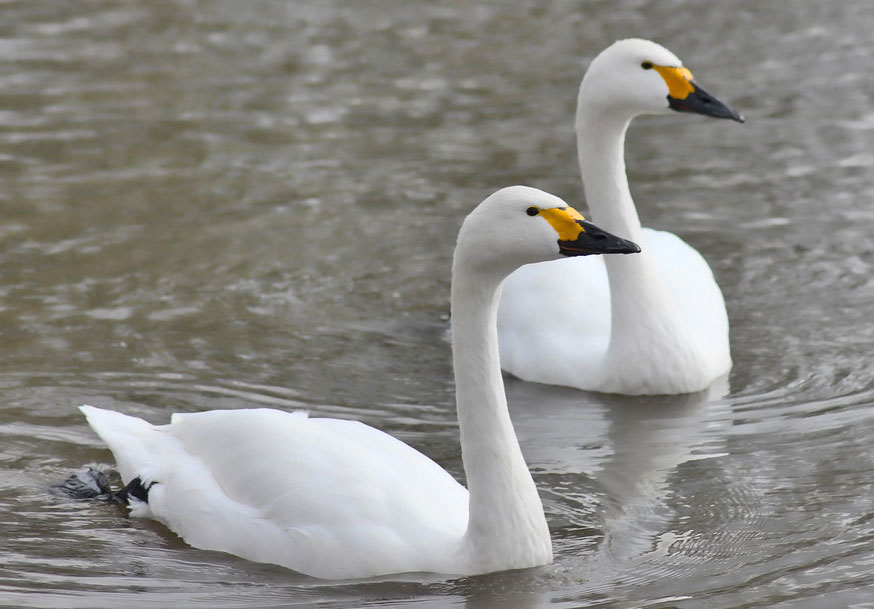
- Yellow Pattern: On a standard North American Tundra (Whistling) Swan, the yellow is restricted to a small loral spot. In a Bewick’s Swan, the yellow is extensive, covering more than half of the bill base and often forming a large, bright wedge that may even meet across the top of the culmen.
- Occurrence: Bewick’s Swans are rare but regular visitors to the Pacific Coast, usually found in the company of large Tundra Swan flocks.
Leucistic Trumpeters: The “Yellow Leg” Pitfall
Most swans have black legs and feet as adults. However, a small percentage of Trumpeter Swans exhibit a rare leucistic color phase. These birds are born pure white rather than gray and do not go through the typical juvenile plumage transition.
- Diagnostic Mark: Leucistic Trumpeters often have bright yellow or orange-yellow legs as adults.
- Potential Confusion: A birder might misidentify a yellow-legged swan as a rare or hybrid species, but if the bill is entirely black with a “V” forehead and a wedge-shaped profile, it is simply a leucistic Trumpeter.
Addressing Common Pitfalls
A common mistake in swan identification is confirmation bias—assuming any large swan without a visible yellow loral spot is a Trumpeter. In many regions, the safer starting point is the “Tundra default”, identifying a bird as a Tundra Swan unless multiple structural or vocal traits indicate otherwise.
Another frequent source of confusion is mud staining. Iron-rich sediments can stain the head and neck orange, mimicking or obscuring key facial features. Observers should focus on the underlying skin pattern, not discolored feathers.
Future Outlook: Expanding Trumpeter Range
As Trumpeter Swan populations expand, mixed flocks with Tundra Swans are becoming more common, increasing the importance of accurate identification. While rare hybridization has been documented, most “intermediate” birds reflect natural variation rather than hybrids.
For content creators, this shift offers opportunities for regular updates, such as tracking fall arrivals of Tundra Swans alongside resident Trumpeters—supporting both birders and ongoing conservation monitoring.
Conclusion
Identifying Tundra and Trumpeter Swans is not about spotting a single feature, but about disciplined, holistic observation. By prioritizing head and bill structure, juvenile molt timing, and distinctive vocalizations, birders can move beyond unreliable markers like the yellow loral spot and make confident, defensible identifications.
This article establishes a clear, evidence-based framework that positions the blog as a trusted authority on swan identification. By combining morphology, behavior, and distribution with accessible field guidance, it provides lasting value for birders, researchers, and conservationists alike—whether observing a gray cygnet in a frozen Midwest marsh or a bugling adult in a Pacific Northwest estuary.
Photo Credits:
The photographic material used in this article comes from photos licensed under “Creative Commons” and mostly from birders and photographers. I am profoundly grateful for your generous support in making these images available; they have truly made this article possible. Many thanks to Andrew Morffew, Mark Mochell, Elizabeth Milson, Emily Chen, Dennis Church, Wendy Miller, Ken Slade, John Benson, Mick Thompson, Steve Guttman, Nicole Beaulac, Andy Reago, Chrissy McLaren, Garry C., Shawn Taylor, Steve Kersting, Gary Leaven, Vicky DeLoach, Don Hoechlin, Tom Murray, Kevin Krebs, Deborah Freeman, Kenneth Cole-Schneider, Doug Greenberg, Ian Preston, Brian Garrett, John Strung, Becky Matsubara, Judy Gallagher, Bob Jensen, Veit, Sand Diego Zoo, David Inman, Dan Mooney, Ian Preston, Lloyd Davis, Denis Fournier, Gregory Heaton, Greg Lavaty, Dona Hilkey, Alain Doyle, Aaron Maizlish, Ashley Tubs, Richard George, Ethan Gosnell, Nick, , Steve Valasek, Mitch Walters, , and Julio Mulero.
References:
allaboutbirds.org: Trumpeter Swan/Tundra Swan Identification, All About Birds, Cornell Lab of Ornithology.
audubon.org: Trumpeter Swan | Audubon Field Guide
Birds of the World: [https://birdsoftheworld.org/bow/home]
birds.cornell.edu: Swan identification
bitterrootstar.com: How to tell a Trumpeter from a Tundra Swan – Bitterroot Star
blackfootchallenge.org: Trumpeters and Tundras – Blackfoot Challenge
digitalcommons.usf.edu: Identification Challenge: Trumpeter vs. Tundra Swan
dnr.state.mn.us: Cygnus buccinator: Trumpeter Swan | Rare Species Guide | Minnesota DNR
eBird. ([https://ebird.org/)
Gill, Frank B., 1994. Ornithology – 2nd Edition, W. H. Freeman and Company.
Sibley, David, 2000. The Sibley Guide to Birds. Alfred A. Knopf, Publisher.
sibleyguides.com: Distinguishing Trumpeter and Tundra Swans – Sibley Guides
The Sibley Guide to Bird Life and Behavior, 2001. Chris Elphick, John Dunning, and David Sibley (eds). Alfred A. Knopf, New York.
trumpeterswansociety.org: All About Trumpeter Swans | Trumpeter Swan Society
Author:
