
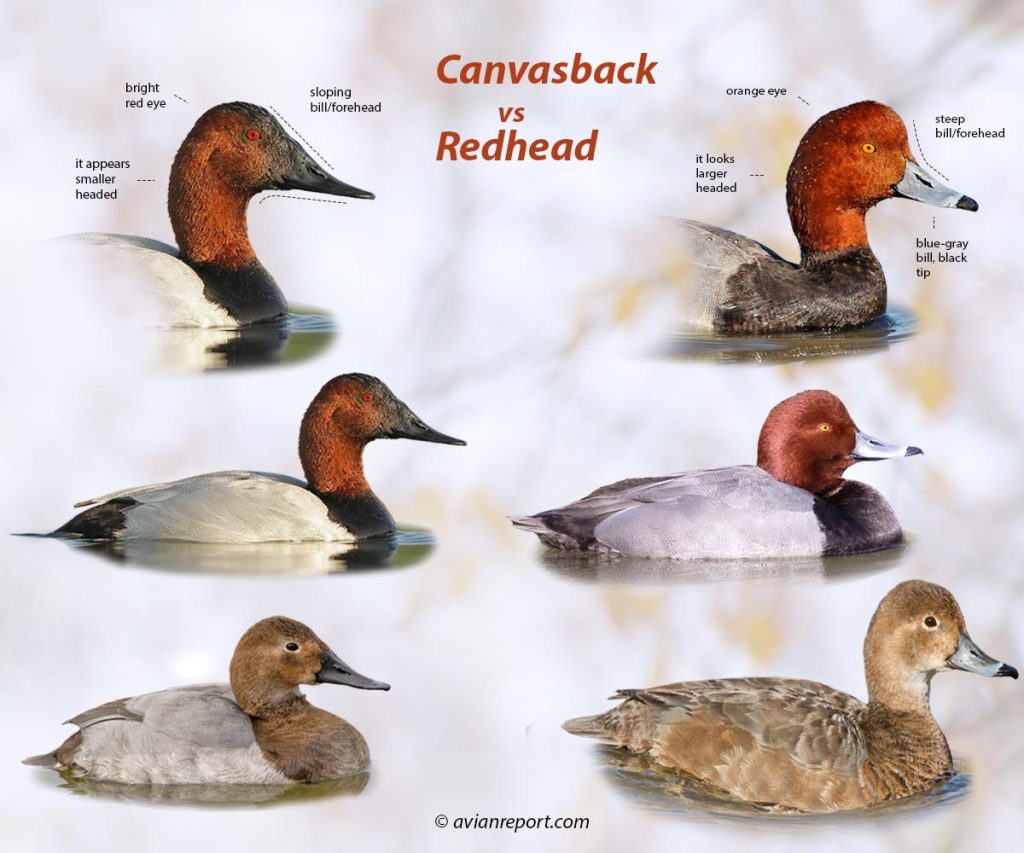
The identification of the Canvasback Duck (Aythya valisineria) from the Redhead Duck (Aythya americana) is a common challenge for birders, especially at distance or in mixed flocks. While both species share chestnut-headed males and similar female plumage, they differ in key structural, behavioral, and ecological traits that allow for reliable field identification. The Canvasback—the largest North American diving duck—is defined by its sloping forehead, long wedge-shaped bill, and powerful profile, whereas the Redhead is smaller, rounder-headed, and notably more social. This guide breaks down the most important field marks and identification clues, covering adults, females, and juveniles, to help observers confidently separate Canvasbacks from Redheads in any season.
- Evolutionary Lineage and Taxonomic Divergence
- Structural Foundations: The Head and Bill Profile
- Field Identification of Adult Breeding Males
- The Eclipse Molt: Late Summer Identification
- The Complexity of Brown Ducks: Females and Immatures
- Comparative Measurements and Biometrics
- Aerial Identification: Flight Marks and Flock Behavior
- Vocalizations in the Field
- Ecological Partitioning: Foraging Depth and Diving Techniques
- Dietary Specialization and Salinity Tolerance
- Reproductive Strategies and Nest Parasitism
- Conclusions: Field Identification Synthesis
Evolutionary Lineage and Taxonomic Divergence
A common misconception among casual observers is that the Canvasback and the Redhead are each other’s closest relatives within the Aythya genus. However, modern genetic analysis, including research conducted at Boston University, has revealed that these two species represent distinct evolutionary branches. The Canvasback is more closely related to the Common Pochard (Aythya ferina) of Eurasia, suggesting a more recent common ancestor that likely crossed into North America from the Old World. In contrast, the Redhead is most closely allied with the Ring-necked Duck (Aythya collaris). This divergence is physically manifested in their structural proportions; the Redhead and Ring-necked Duck share a more “classic” duck silhouette with rounded heads and steep foreheads, whereas the Canvasback and its European relatives exhibit the elongated, sloping profile adapted for deep-substrate excavation.
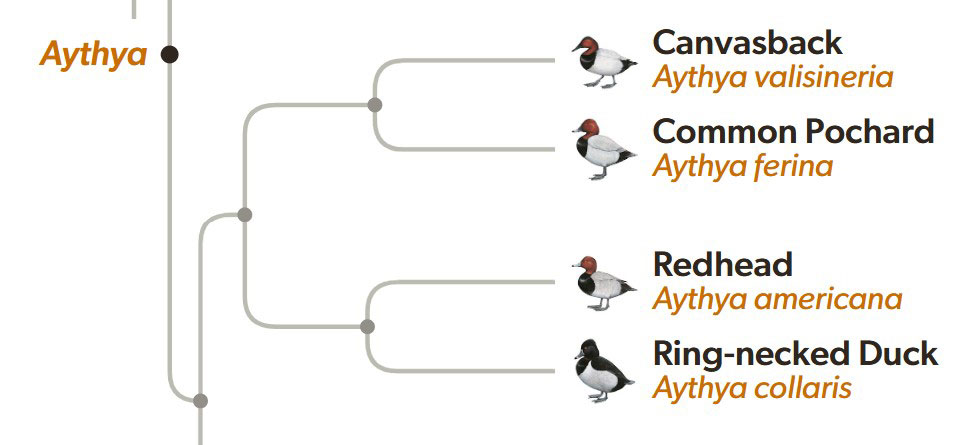
The scientific naming of these birds reflects their unique ecological connections. The Canvasback’s specific epithet, valisineria, is derived from Vallisneria americana, the scientific name for wild celery, which constitutes the primary winter food source for the species. This specialized diet has driven the evolution of a bill structure capable of extracting deep-seated tubers.
The Redhead, americana, although widespread, is more of a generalist in its breeding season diet but shows a high degree of specialization for hypersaline wintering grounds such as the Laguna Madre, where it feeds on shoal grass.
Structural Foundations: The Head and Bill Profile
When identifying these ducks in the field, especially under poor lighting conditions where color is obscured, structural morphology provides the most reliable diagnostic data. The geometry of the head and the transition to the bill are consistent characters that persist throughout the year, even during the eclipse molt and juvenile development.
The Canvasback Architectural Wedge
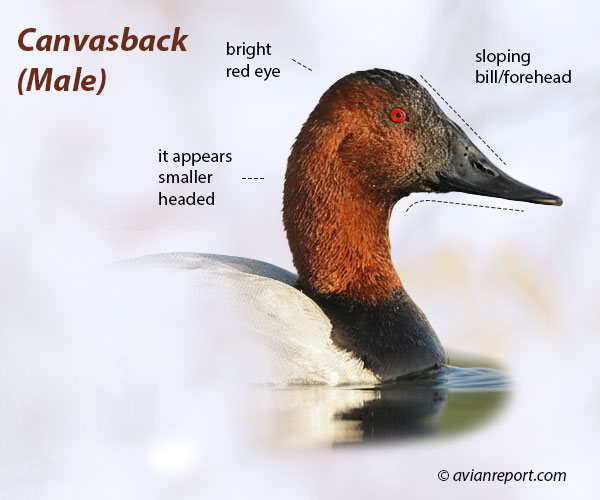
The Canvasback is defined by a long, wedge-shaped head that lacks a distinct break between the forehead and the bill. This creates a seamless, gently sloping line from the top of the crown down to the tip of the bill. The neck is notably long and thick, earning the species the nickname “bull-neck”.
Morphological measurements indicate that the Canvasback’s bill is narrow and deep, a shape perfectly suited for probing and grasping plant tubers from underwater substrates.
The Redhead Architectural Curve
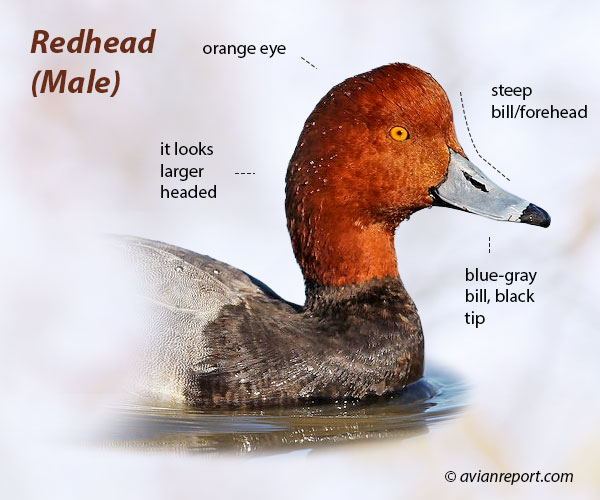
In contrast, the Redhead possesses a “puffy,” rounded head that creates a well-defined angle at the junction of the forehead and the bill. The forehead is steep and prominent, providing the bird with a more traditional duck-like appearance compared to the Canvasback’s streamlined profile. The bill of the Redhead is shorter and relatively wider than that of the Canvasback, optimized for a broader diet that includes more grazing and surface-skimming behaviors.
| Structural Feature | Canvasback (A. valisineria) | Redhead (A. americana) |
| Head Shape | Long, wedge-shaped; seamless slope | Rounded, “puffy”; steep forehead |
| Forehead-to-Bill | Continuous straight line | Abrupt angle at the bill base |
| Neck Proportions | Long, stout “bull-neck” | Medium-length, more slender |
| Bill Profile | Long, tapering, and triangular | Shorter, slightly concave, and blunt |
| Body Size | Large (18.9–23.0 inches) | Medium (16.5–21.3 inches) |
Field Identification of Adult Breeding Males
During the breeding season, drakes of both species exhibit a striking combination of a reddish head, a black breast, and a pale body. While they may look identical from a significant distance, a closer examination reveals distinct color patterns and eye colors that facilitate a quick identification.
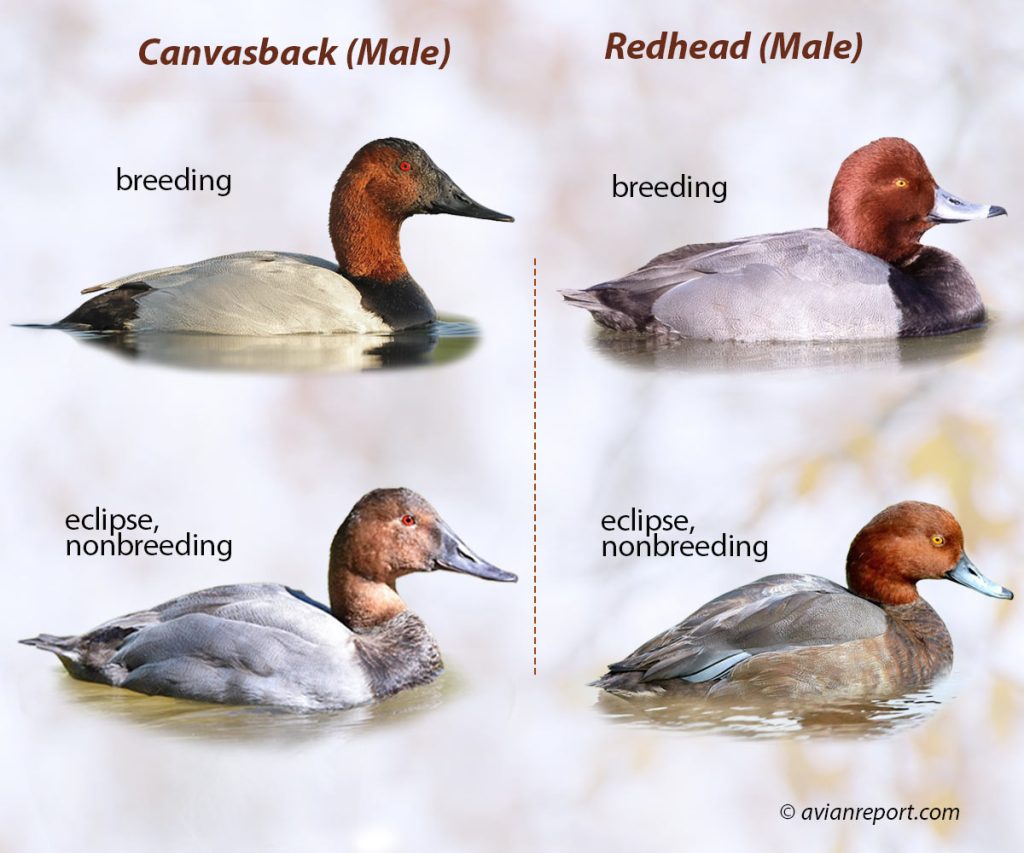
The Canvasback Drake
The male Canvasback in alternate (breeding) plumage is a study in high contrast. The head and neck are a deep, dark chestnut or russet-red, which terminates sharply at a solid black breast. The body is the most diagnostic feature; the back and sides are a brilliant, stark white, which is actually composed of extremely fine silver-gray vermiculation that resembles woven canvas. The tail and rump are black, framing the white body on both ends.
Perhaps the most piercing field mark is the drake’s bright red (vermilion) eye, which stands out against the dark chestnut of the head. The bill is entirely black.
The Redhead Drake
The male Redhead is more subdued in its coloration. Its head is a brighter, more cinnamon-red or coppery hue, lacking the dark chestnut depth of the Canvasback. The body is a medium, sooty gray, appearing much darker and more uniform than the white back of the Canvasback. Like the Canvasback, the Redhead has a black breast and rear, but the transition from the gray body to the black breast is often less jarring.
The drake Redhead possesses a distinctive yellow-to-golden eye, which is a major point of differentiation from the red-eyed Canvasback. The bill is a pale bluish-gray with a conspicuous black tip, often separated by a thin white band.
| Male Identification Mark | Canvasback Drake | Redhead Drake |
| Head Color | Deep chestnut/maroon | Bright cinnamon-red |
| Back/Side Color | Stark white (silver vermiculation) | Medium sooty gray |
| Eye Color | Red (Vermilion) | Yellow to Golden-orange |
| Bill Color | Entirely black | Blue-gray with black tip |
| Body Silhouette | Oval, sitting higher in water | Rounded, sitting lower in water |
The Eclipse Molt: Late Summer Identification
Waterfowl undergo a specialized molt in late summer known as the “eclipse” phase, during which males lose their bright breeding colors and enter a flightless period. This period is often confusing for birders, as drakes temporarily resemble females or immatures.
Eclipse Male Canvasback
During late summer and early fall, the male Canvasback loses his brilliant white back and deep chestnut head. He becomes much browner overall, with a head that is a duller, warmer brown than the female’s but significantly darker than his own breeding plumage. Despite this shift, the drake retains his red eye and long black bill, which remain the best ways to identify him during this cryptic phase.
Eclipse Male Redhead
The eclipse male Redhead likewise adopts a brownish, female-like appearance. His head is a warmer, more rufous brown than the female’s, and he retains the rounded head structure and the bluish-gray bill with a black tip. He also retains his yellow eye, which is a critical diagnostic mark to separate him from both females and eclipse Canvasbacks.
| Feature | Eclipse Male Canvasback | Eclipse Male Redhead |
| Head Profile | Sloping, wedge-shaped | Rounded, steep forehead |
| Head Color | Dull brown to warm brown | Warm, rufous brown |
| Eye Color | Red (Retained) | Yellow (Retained) |
| Bill Color | All black | Blue-gray with black tip |
| Back Pattern | Grayish-brown mottled | Sooty gray-brown |
The Complexity of Brown Ducks: Females and Immatures
Identifying female Aythya ducks can be a hurdle, as both species appear primarily as medium-to-large brown ducks. However, by focusing on the same structural principles used for the males, and noting subtle plumage variations, an accurate identification is possible.
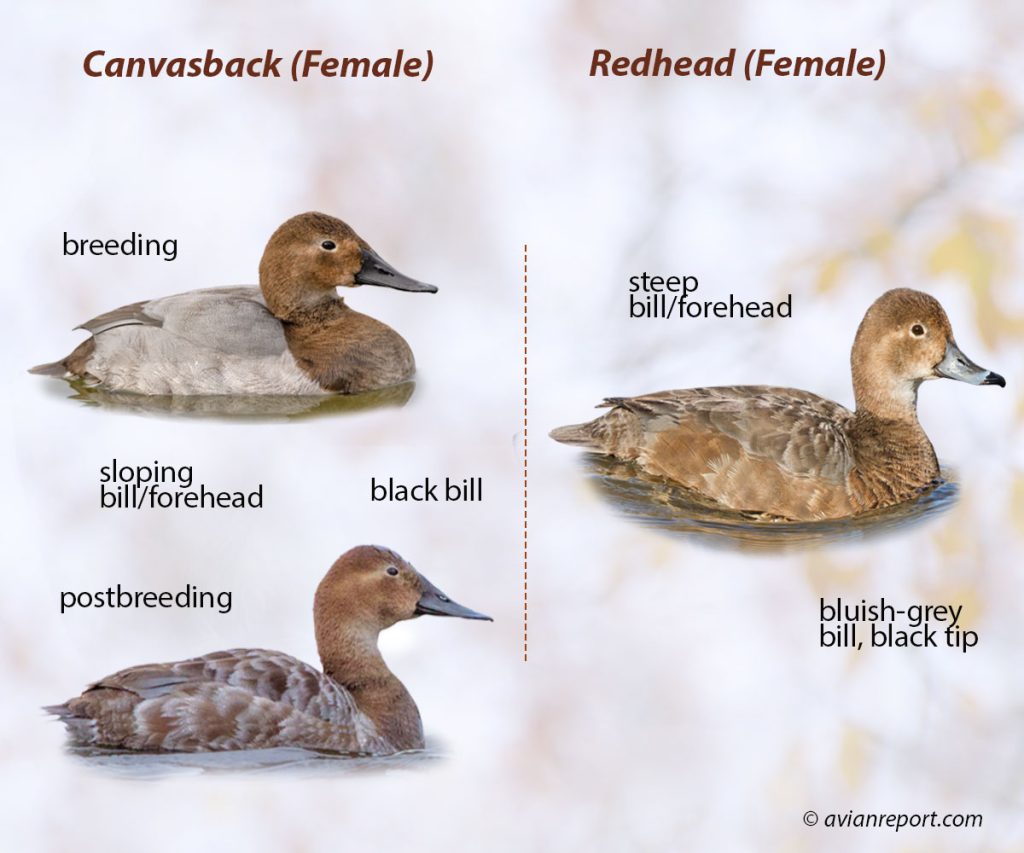
Identifying the Female Canvasback
The female Canvasback is characterized by her signature sloping profile and long black bill, which are identical in shape to the male’s. Her plumage is a muted, pale grayish-brown. The head and neck are a warm sandy-brown, often showing a slightly paler or whitish throat and chin.
A key distinction is her back, which is a lighter, salt-and-pepper gray-white that is noticeably paler than the back of a female Redhead. Her eyes are dark brown, lacking the red intensity of the male.
Identifying the Female Redhead
The female Redhead is a more uniform, medium chocolate-brown duck. She retains the rounded head and steep forehead of the male, which immediately sets her apart from the sloping profile of the Canvasback. Her bill is bluish-gray with a black tip, matching the male’s color pattern. A useful field mark for the female Redhead is a pale, buffy patch at the base of the bill, which is more pronounced than in the Canvasback. Her eyes are dark brown.
Juvenile Field Marks
Juvenile birds of both species are similar to adult females with browner plumages. This makes them difficult to distinguish until they begin to acquire adult plumage characteristics.
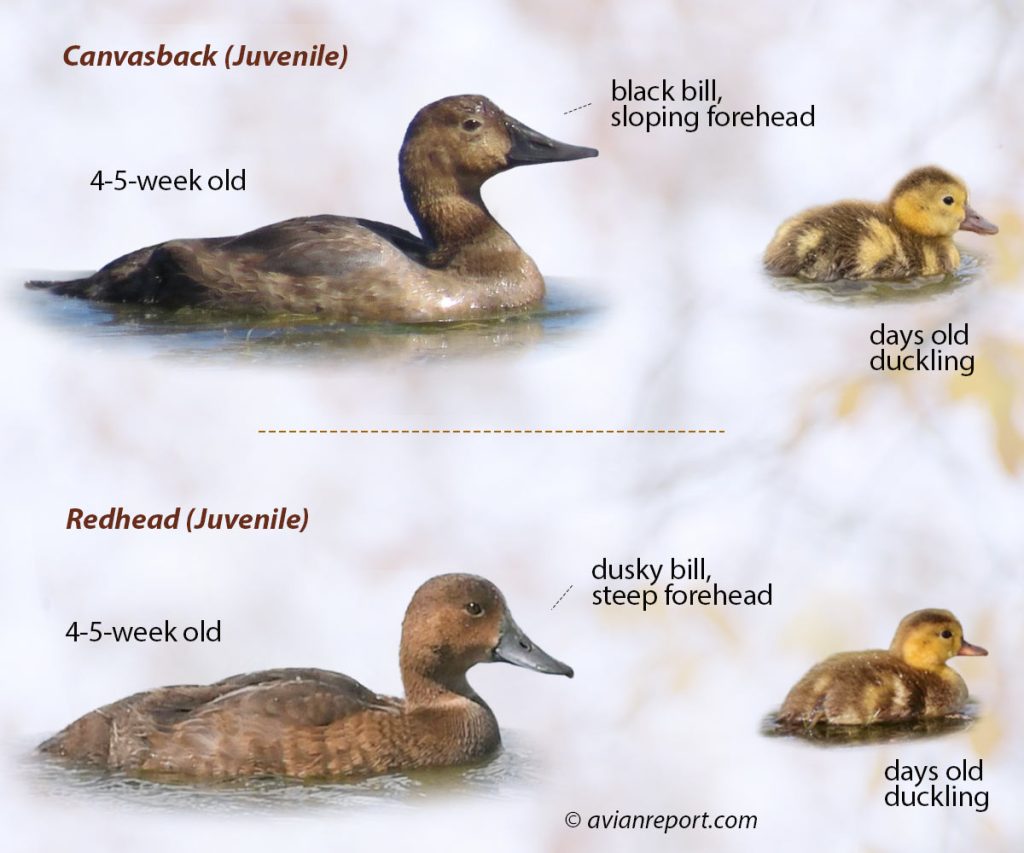
- Consistency of Structure: Because juvenile plumages are highly variable and mottled, observers must rely on the “bill and head shape” as the primary diagnostic tool. Even in young birds, the Canvasback will show the long, straight forehead-to-bill slope, while the Redhead will show the rounded crown and abrupt forehead.
- Eye Color Development: It is important to note that the red eye of the male Canvasback and the yellow eye of the male Redhead are not present in very young juveniles. For the first 10 to 12 weeks of life, the eyes of both species are a non-diagnostic yellowish-brown.
- Plumage Texture: Juvenile Canvasbacks show less distinction between the head, neck, and body color than adult females, appearing more uniform. Juvenile Redheads are a plain, almost entirely uniform brown.
Comparative Measurements and Biometrics
While field identification relies on visual cues, understanding the physical dimensions of these birds can aid in direct comparison when they are found in mixed flocks. The Canvasback is consistently larger and heavier than the Redhead.
| Metric | Canvasback (Both Sexes) | Redhead (Both Sexes) |
| Total Length | 18.9–22.1 in (48–56 cm) | 16.5–21.3 in (42–54 cm) |
| Body Weight | 30.4–56.0 oz (862–1588 g) | 22.2–52.9 oz (630–1500 g) |
| Wingspan | 31.1–35.0 in (79–89 cm) | 29.5–31.1 in (75–79 cm) |
| Avg. Male Weight | ~2.7 lbs (1.2 kg) | ~2.4 lbs (1.1 kg) |
| Avg. Female Weight | ~2.5 lbs (1.1 kg) | ~2.1 lbs (0.95 kg) |
Beyond general size, research into the bill morphology of Aythya species has quantified the differences in their feeding apparatus. Canvasbacks possess a significantly greater culmen length and a higher bill base than Redheads. These measurements reflect the Canvasback’s need to exert high force during deep-substrate probing.
Conversely, the Redhead has a higher density of lamellae on the bill’s edge, making them more similar to Ruddy Ducks in their ability to strain fine food particles from the water column.
Aerial Identification: Flight Marks and Flock Behavior
Observing these ducks in flight requires a different set of identification skills, focusing on wingbeat speed, vocalizations, and aerial formations.
Identifying the Flying Canvasback
Canvasbacks are legendary for their speed and power in flight, often clocked at up to 56 miles per hour. In the air, they show a slender silhouette with long necks.
- Wing Pattern: The most prominent mark is the white body of the male, which contrasts sharply with the black breast and tail. The secondary feathers of the wing are pearl-gray or white, forming a pale stripe that has very little contrast with the rest of the light-colored wing.
- Flight Sound: The wingbeat is rapid and “noisy,” often described as a steady “rushing” sound.
- Formations: Migrating Canvasbacks frequently fly in organized lines or V-formations, similar to geese. In feeding areas, however, they may shift to compact, indefinite formations.
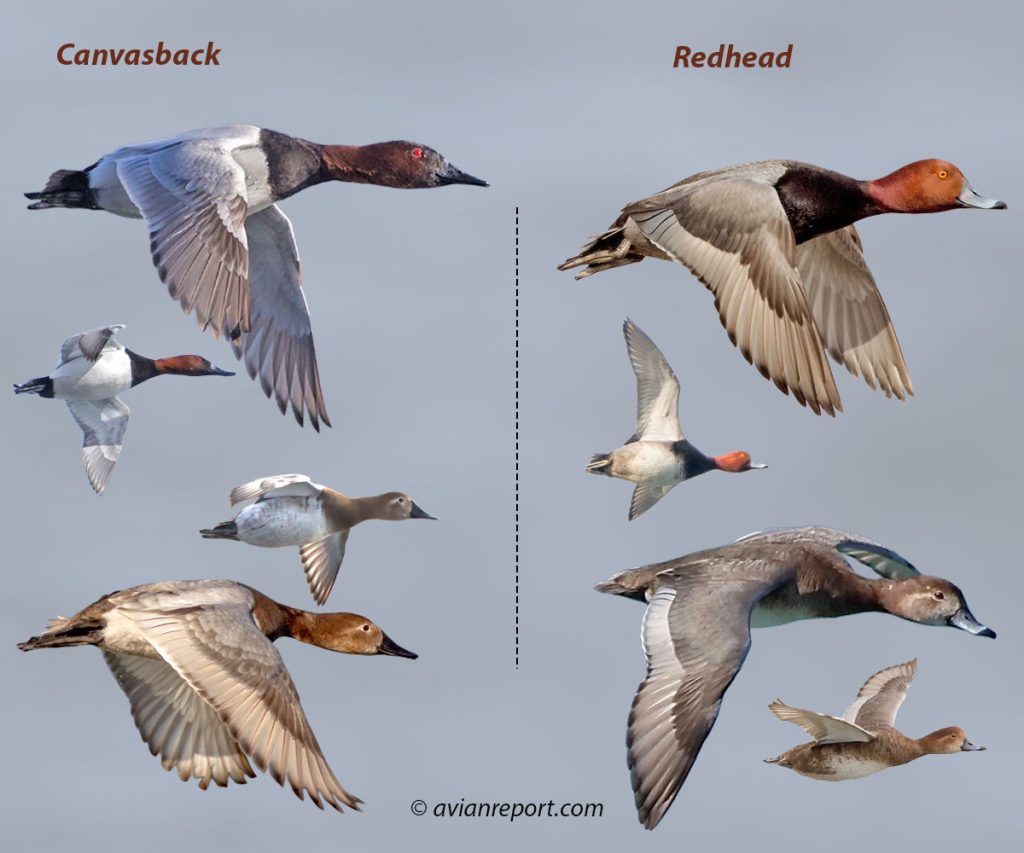
Identifying the Flying Redhead
Redheads in flight give the impression of “always being in a hurry”. They are fast but lack the immense, driving speed of the Canvasback.
- Wing Pattern: The Redhead’s wingstripe is grayish rather than white, providing a more subtle appearance in the air. The dorsal view of the drake shows a gray back, which is a definitive way to separate it from the white-backed Canvasback in flight.
- Wingbeat Mechanics: Redheads fly with a more rapid, shallower wingbeat than scaups or mallards.
- Formations: While they use V-formations for long-distance migration, they are famous for “boiling up” in short, irregular flights between resting and feeding areas.
Vocalizations in the Field
While both species are relatively quiet outside of the breeding season, their calls are distinct and can aid in identification during courtship or when flushed.
The Canvasback Voice: Males are typically silent but may give a soft, low croak, grunt, or a “whee-oooo” call during courtship. Females produce a mallard-like quack, which can be harsh or purring during flight.
Small flock of Canvasback
The Redhead Voice: Males have a more unique vocal repertoire, including a cat-like “meow” or a soft “whee-ooohh” used to attract females. The female Redhead’s call is a loud, high-pitched “squak” or “kerr kerr kerr,” which is significantly higher in pitch than a female mallard’s quack.
Male Redhead.
Female Redhead
Ecological Partitioning: Foraging Depth and Diving Techniques
The structural differences between the Canvasback and Redhead are functional adaptations to their preferred foraging niches. Both are diving ducks, but they occupy different depths and utilize different techniques to secure food.
Canvasback Diving Strategy
The Canvasback is a specialist in deep-water foraging, often diving to depths of 20 feet or more to reach the nutrient-rich tubers of submerged plants. They employ a “plunging” dive technique, where they dive quickly and plunge straight down with immense force. Their streamlined bodies and powerful legs allow them to stay submerged for 20 to 30 seconds. Canvasbacks tend to dive less frequently than Redheads but spend more time gathering large amounts of food during each submersion.
Redhead Diving Strategy
Redheads are more versatile divers but generally prefer shallower waters, typically 1 to 15 feet in depth. Their dives are more methodical and controlled compared to the powerful plunge of the Canvasback. Redheads often dive in rapid succession, taking short breaths and staying submerged for only 15 to 20 seconds at a time. This high-frequency diving allows them to search a wide area of the lake bottom for grazing opportunities. Furthermore, Redheads are known to “tip up” like dabbling ducks to feed on surface vegetation, a behavior that is rare for the more specialized Canvasback.
| Foraging Characteristic | Canvasback | Redhead |
| Primary Habitat | Deep open water, lakes, bays | Shallow marshes, coastal lagoons |
| Typical Depth | Up to 20+ feet | 1 to 15 feet |
| Dive Style | Powerful, straight plunge | Methodical, repetitive |
| Dive Duration | 20–30 seconds | 15–20 seconds |
| Feeding Frequency | Low frequency, high duration | High frequency, short bursts |
| Dabbling Behavior | Extremely rare | Occasional “tipping up” |
Dietary Specialization and Salinity Tolerance
A significant portion of the ecological divergence between these two species relates to their wintering diets and their ability to tolerate different water chemistry.
The Wild Celery Connection
The Canvasback is famously tethered to the wild celery (Vallisneria americana). In fact, the presence of wild celery often dictates the migration patterns of the species. They also consume sago pondweed tubers, duck potato, and various seeds.
In regions where aquatic vegetation has declined, such as the Chesapeake Bay, Canvasbacks have shown remarkable dietary plasticity, shifting their intake to include animal matter such as Baltic Clams and fingernail clams to survive. During the breeding season, females and young ducklings rely heavily on protein-rich aquatic insects like midge and mayfly larvae to support rapid growth.
The Shoal Grass Specialist
The Redhead is similarly herbivorous but focuses on a different suite of plants. While they eat sago pondweed and musk grass in northern latitudes, approximately 80% of the entire continental population winters in the Laguna Madre, a hypersaline lagoon in southern Texas. Here, they feed almost exclusively on shoal grass (Halodule wrightii).
The Redhead’s ability to thrive in these extremely salty environments is an evolutionary adaptation that differentiates them from the more freshwater-oriented Canvasback.
Reproductive Strategies and Nest Parasitism
The breeding biology of these two ducks is one of the most intriguing aspects of North American ornithology, characterized by a complex relationship of interspecific brood parasitism.
Habitat Overlap
Both species breed in the Prairie Pothole Region of the United States and Canada, selecting similar nesting sites: thick, well-flooded stands of emergent vegetation like cattails and bulrushes. Canvasbacks build bulky, floating platform nests, while Redheads follow a similar construction but frequently choose to bypass the duties of incubation.
The Redhead’s Parasitic Tactics
The Redhead is a “facultative brood parasite,” meaning it may build its own nest but frequently chooses to lay its eggs in the nests of other ducks.
- High Prevalence: In some areas, up to 90% of Canvasback nests contain at least one Redhead egg. This parasitism is so prevalent that a Canvasback hen may end up raising a brood that contains more Redhead ducklings than her own biological offspring.
- Mechanism of Loss: When a Redhead hen attempts to force her way into a Canvasback nest, the resulting struggle can cause the Canvasback’s own eggs to roll out and sink. This results in significant “lost time and wasted energy” for the Canvasback.
- Fostering and Imprinting: Curiously, Canvasback hens appear to accept the Redhead ducklings, and the presence of these “intruders” does not seem to negatively impact the survival of the Canvasback’s own young. However, this creates an imprinting dilemma; fostered Redhead drakes have been observed preferentially displaying to Canvasback females the following spring, although successful hybridization remains extremely rare in the wild.
Conclusions: Field Identification Synthesis
To successfully separate the Canvasback from the Redhead in any field condition, the observer should follow a tiered identification process.
- Focus on the Profile: At a distance, ignore color and look for the shape of the head. A continuous, straight slope from the crown to the bill tip always indicates a Canvasback. A “puffy,” rounded head with an abrupt angle at the bill indicates a Redhead.
- Check the Bill Details: A solid black bill belongs to a Canvasback. A blue-gray bill with a black tip belongs to a Redhead.
- Look for the “White Flash”: Drake Canvasbacks appear nearly white on the water, whereas drake Redheads appear a solid, darker gray.
- Identify the Eyes: In good light, a piercing red eye identifies the Canvasback drake, while a yellow/golden eye identifies the Redhead drake.
Contextual Behavior: If the birds are diving with a sharp, powerful plunge in deep water, they are likely Canvasbacks. If they are in shallower water, perhaps mixed with scaups or tipping up to feed, they are likely Redheads.
Photo Credits:
The photographic material used in this article comes from photos licensed under “Creative Commons” and mostly from birders and photographers. I am profoundly grateful for your generous support in making these images available; they have truly made this article possible. Many thanks to Andrew Morffew, Mark Mochell, Elizabeth Milson, Emily Chen, Dennis Church, Wendy Miller, Ken Slade, John Benson, Mick Thompson, Steve Guttman, Nicole Beaulac, Andy Reago, Chrissy McLaren, Garry C., Shawn Taylor, Steve Kersting, Gary Leaven, Vicky DeLoach, Don Hoechlin, Tom Murray, Kevin Krebs, Deborah Freeman, Kenneth Cole-Schneider, Doug Greenberg, Ian Preston, Brian Garrett, John Strung, Becky Matsubara, Judy Gallagher, Bob Jensen, Veit, Sand Diego Zoo, David Inman, Dan Mooney, Ian Preston, Lloyd Davis, Denis Fournier, Gregory Heaton, Greg Lavaty, Dona Hilkey, Alain Doyle, Aaron Maizlish, Ashley Tubs, Richard George, Ethan Gosnell, Nick, , Steve Valasek, Mitch Walters, , and Julio Mulero.
Sound Recordings: Paul Marvin and Andrew Spencer (www.xeno-canto.org)
References:
allaboutbirds.org: Redhead/Canvasback Identification, All About Birds, Cornell Lab of Ornithology
audubon.org: How to Tell a Canvasback from a Redhead – National Audubon Society
avianreport.com: The Conservation Status of North American Waterfowl: Trends, Statistics, and Key Threats
Birds of the World: Cornell Lab of Ornithology, https://birdsoftheworld.org/bow/home
cw-environment.erdc.dren.mil: A migratory habitat model for diving ducks
dnr.illinois.gov: Canvasback – Illinois Department of Natural Resources
ducks.ca: 2025 Waterfowl Breeding Population and Habitat Survey – Ducks Unlimited Canada
ducks.org: The Big Four – Diving Ducks – Ducks Unlimited
ducks.org: Understanding Waterfowl: Redheads vs. Canvasbacks – Ducks Unlimited
eBird: Cornell Lab of Ornithology, https://ebird.org/
Gill, Frank B. (1994). Ornithology (2nd ed.). W. H. Freeman and Company.
Sibley, David (2000). The Sibley Guide to Birds. Alfred A. Knopf.
USA Fish and Wildlife Service: Canvasback (Aythya valisineria) | U.S. Fish & Wildlife Service
USA Fish and Wildlife Service: Ducks at a Distance Waterfowl ID Guide – U.S. Fish & Wildlife Service
Author:
