
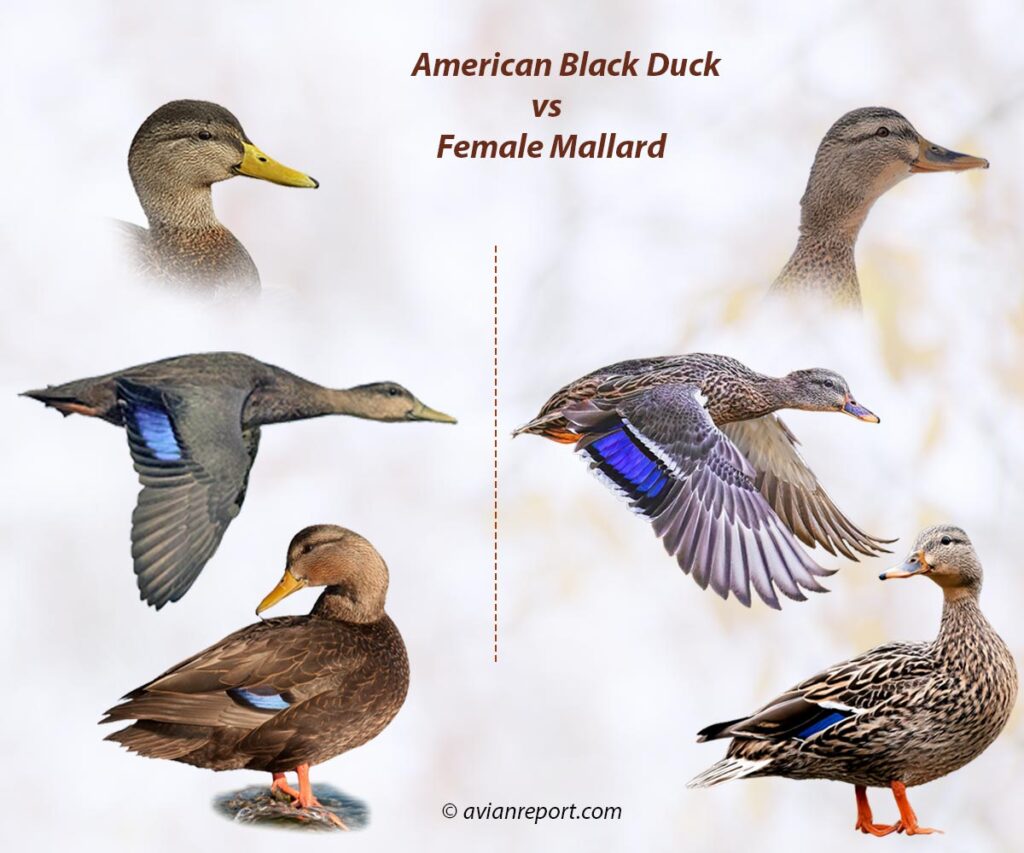
Distinguishing an American Black Duck (Anas rubripes) from a female Mallard (Anas platyrhynchos) is a challenges in North American bird identification. Although these two dabbling ducks are genetically very similar—and frequently hybridize—their evolutionary paths have produced consistent, observable field marks that allow reliable separation when approached systematically.
This guide focuses on the most dependable identification features, emphasizing body coloration, speculum borders, and flight marks, while also addressing hybridization, seasonal plumage changes, and behavioral cues.
- Taxonomic Background: Close Relatives, Different Niches
- Body Plumage: Dark Chocolate vs. Mottled Tan
- Size and Structure: Subtle but Real
- Rump and Tail: A High-Reliability Marker
- The Speculum: The Single Best Field Mark
- Head and Face: Cold vs. Warm Tones
- Bill Color and Sex Differences
- In Flight: The White Underwing Flash
- Hybridization: Expect the Unexpected
- Seasonal Confusion: Eclipse Plumage
- Behavior and Habitat Clues
- Identification Checklist (Field Workflow)
- Final Takeaway
Taxonomic Background: Close Relatives, Different Niches
The American Black Duck belongs to the “mallard complex,” alongside Mallards, Mottled Ducks, and Mexican Ducks. Long considered a Mallard subspecies, it was formally recognized as distinct in the early 20th century due to its larger average size, darker plumage, and bill and leg coloration.
Ecologically, the split is clear:
- American Black Duck: Forested wetlands, coastal marshes, shaded pools
- Mallard: Open wetlands, agricultural landscapes, urban ponds
Where their ranges overlap—especially in the Atlantic and Mississippi Flyways—careful field identification is essential.
Body Plumage: Dark Chocolate vs. Mottled Tan
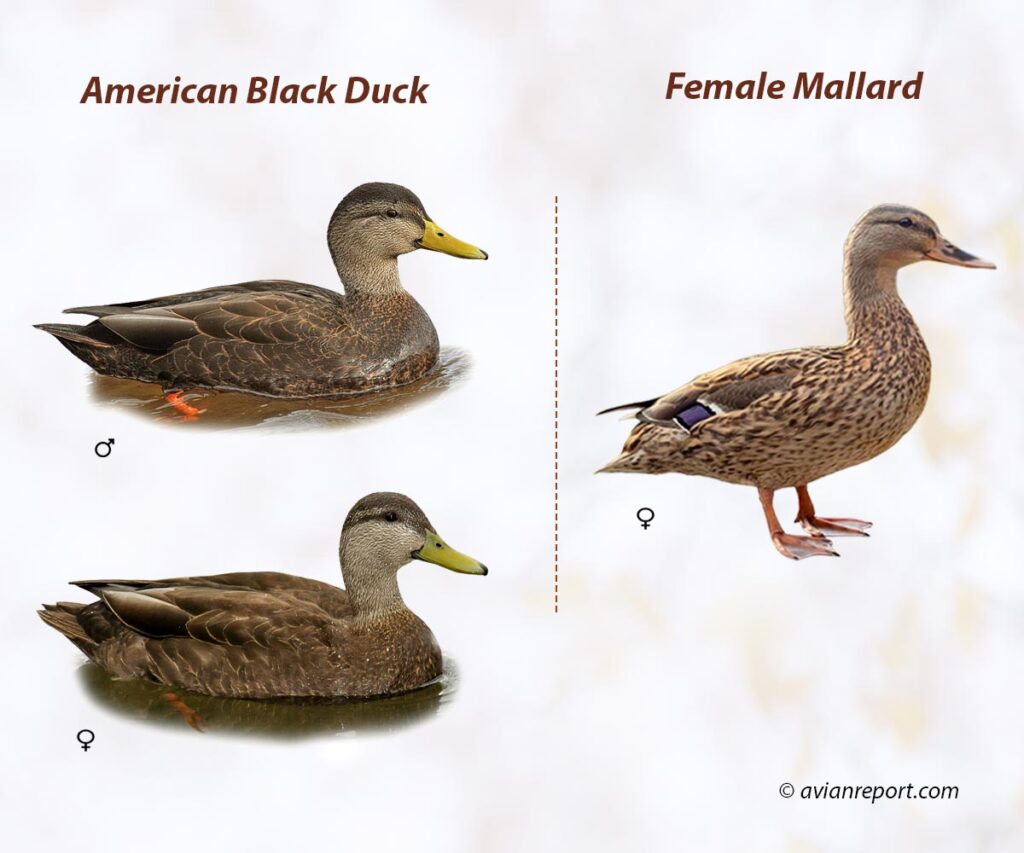
The most immediate differentiator for observers at a distance is the overall value and tone of the body plumage. The American Black Duck is characterized by deep blackish-brown or “dark chocolate” feathers, whereas the female Mallard appears significantly paler and warmer in tone.
Overall Color Value (Most Useful at Distance)
- American Black Duck: In the American Black Duck, the dark brown body feathers are edged with very narrow, pale buff margins. This “tight” patterning results in a uniform dark appearance from the neck to the tail. Upon close inspection, these feathers create a scalloped effect on the flanks, but the overall impression is one of high contrast and deep saturation.
- Female Mallard: The female Mallard’s plumage is characterized by a “coarser” mottling. Each individual feather shows a sharp contrast between a dark brown center and a wide, bright buff or orange-tan edge. This leads to an overall mottled tan or creamy-orange brown appearance that lacks the cold, dark intensity of the Black Duck.
This difference in “color value” is often the first clue when scanning distant birds.
Size and Structure: Subtle but Real
Structurally, the two species are very similar. However, the American Black Duck is, on average, heavier and bulkier, making it the largest species in the genus Anas.
| Measurement | American Black Duck | Mallard |
| Length | 54–59 cm | 50–65 cm |
| Weight | 720–1,640 g | 700–1,600 g |
| Wingspan | 88–95 cm | 81–98 cm |
Field tip: Size alone is unreliable in mixed flocks—plumage characters are far more diagnostic.
Rump and Tail: A High-Reliability Marker
The posterior region of the bird offers a high-reliability field mark. The female Mallard possesses a conspicuously whitish tail and pale undertail coverts, which are often visible even when the bird is at rest.
The American Black Duck lacks these white areas entirely; its tail and undertail coverts are as dark as the rest of the body, creating a seamless dark profile from the base of the neck to the tip of the tail.
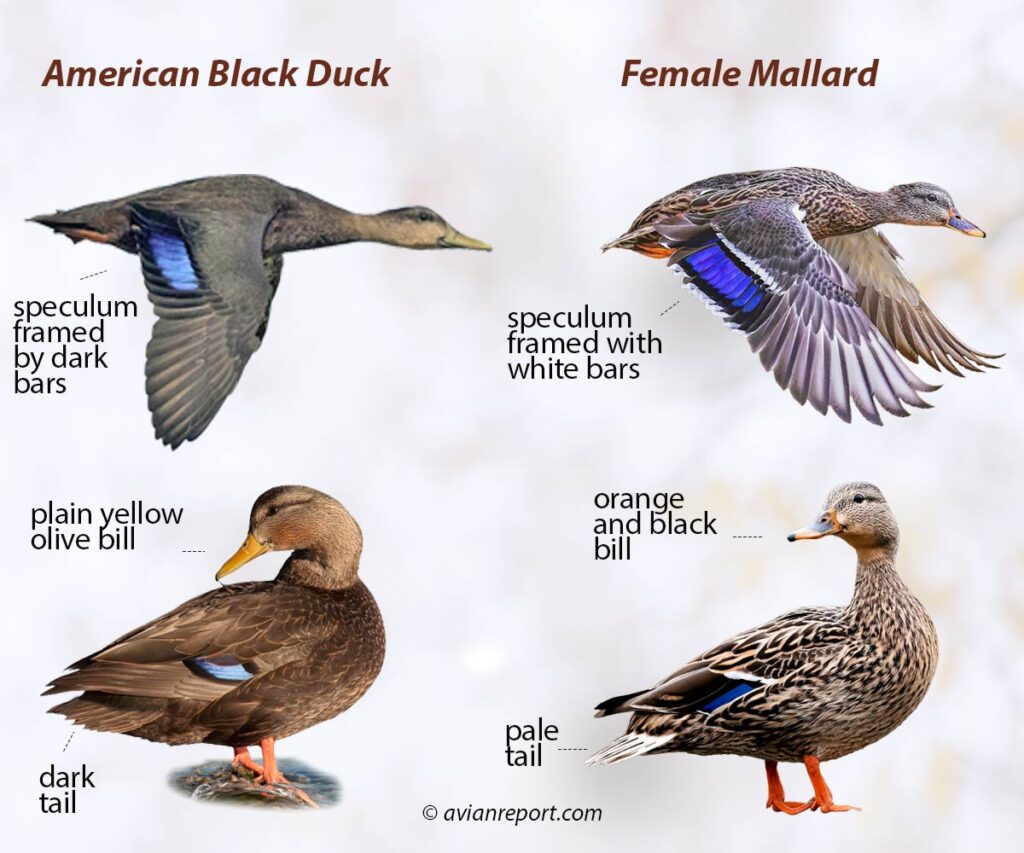
American Black Duck: Tail and undertail entirely dark. The speculum is deep violet to purplish-blue, black borders, not white. May show a very thin trailing pale edge—but never bold white bars.
The Speculum: The Single Best Field Mark
The speculum (wing patch) is the most definitive identification feature when visible.
The speculum, or iridescent wing patch on the secondary flight feathers, serves as the most definitive morphological separator between these two species, provided it can be clearly viewed. The conflict resides not just in the color of the patch, but in the presence and width of the bordering bars.
White Borders and Secondary Coverts
The Mallard (both male and female) displays an iridescent blue to purple speculum that is framed on both the top and bottom by prominent, thick white bars. These bars are formed by the white tips of the greater secondary coverts (anterior border) and the white tips of the secondaries themselves (posterior border).
The American Black Duck’s speculum ranges from deep iridescent purple to dark violet-blue. Crucially, it lacks the bold white borders of the Mallard. The speculum is instead bordered by black margins. While a very narrow, indistinct white trailing edge may occasionally be present on the posterior border, it is never the thick, bold white stripe seen on a Mallard.
| Feature | Black Duck | Female Mallard |
| White borders | Absent | Thick, obvious |
| Visual contrast | Low | High |
| Diagnostic value | Very high | Very high |
Rule of thumb: White-barred speculum = Mallard.
Dark-edged speculum = Black Duck.
Head and Face: Cold vs. Warm Tones
The head of both species is lighter than the body, but the degree of contrast and the specific patterning of the throat and eye-line vary significantly.
The Two-Toned Effect
The American Black Duck shows a clear contrast between the dark body and the pale head. The head and neck are a pale grayish-brown or silvery-gray, which creates a “two-toned” look against the chocolate-brown breast. The head is finely streaked with dark lines, particularly on the crown and behind the eye, but the base color remains cold and grayish.
The female Mallard’s head is a warmer buff or tan. While it is also lighter than the body, the transition is more gradual, and the face lacks the high-contrast “colder” tone of the Black Duck.
Throat and Bill-Base Markers
A subtle but important field mark is the throat. The female Mallard has a clean, unstreaked whitish or buff throat. The American Black Duck features a throat that is finely streaked with grayish-brown, continuing the pattern found on the cheeks. Additionally, the Mallard often displays a distinctive tan or buff cheek patch near base of the bill, whereas the Black Duck’s face is more uniformly streaked.
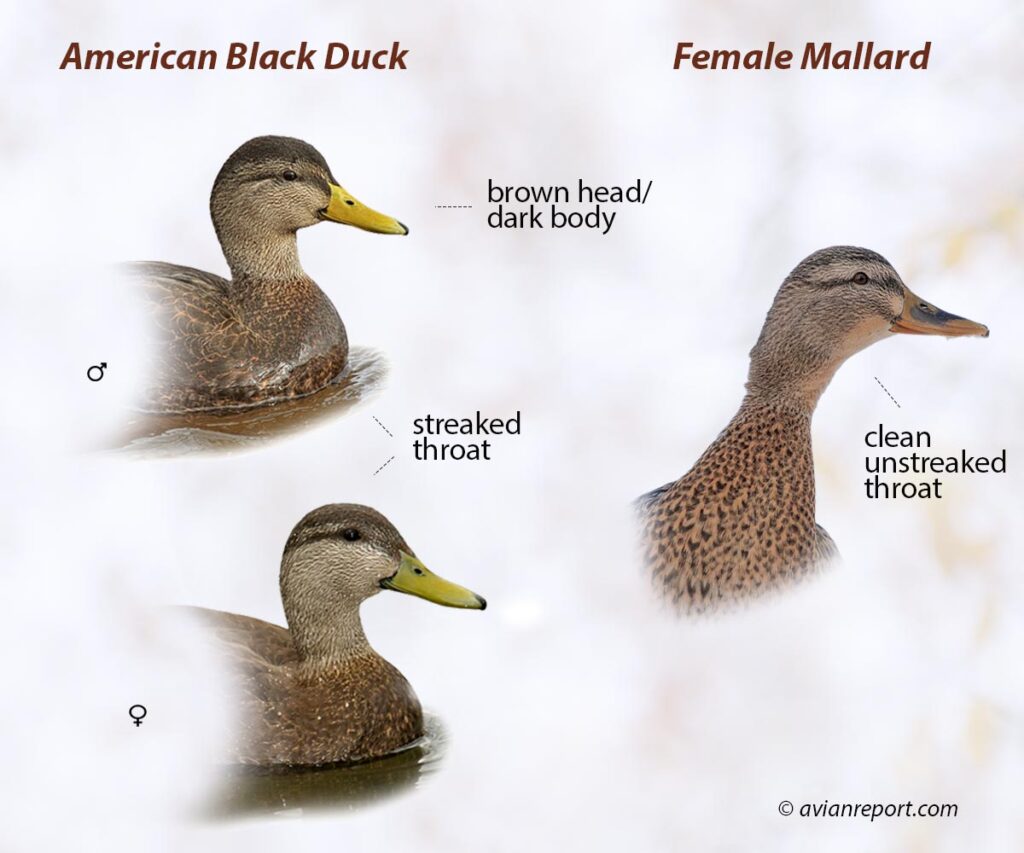
Female Mallard: Warmer buff head with gradual body transition. The throat is unstreaked buff or pale.
Bill Color and Sex Differences
Bill color helps both with species ID and sexing, especially outside breeding season.
| Species | Sex | Bill Color |
| Black Duck | Male | Clear yellow to olive-yellow |
| Black Duck | Female | Olive to greenish-gray |
| Mallard | Male | Bright yellow or orange-yellow |
| Mallard | Female | Orange with black mottling |
A “female-looking” duck with a solid yellow bill is usually a male Mallard in eclipse plumage.
In Flight: The White Underwing Flash
The underwings of the American Black Duck are a brilliant, clean white. Because the bird’s body and upperside are so dark, the contrast with the white underwing creates a “flash” effect similar to a strobe light.
Some hunters and observers describe this as a “silver coloration” on the underside, which distinguishes it from the whiter, but less contrasting, tone of the Mallard’s underwing.
The Mallard also has white underwings, but the contrast is significantly reduced because the female Mallard’s body is a lighter mottled tan, and the male Mallard (even in eclipse) has a lighter breast and belly.
The underwing flash of the Black Duck is consistently described as brighter and higher-contrast than that of any other dabbling duck in its range.
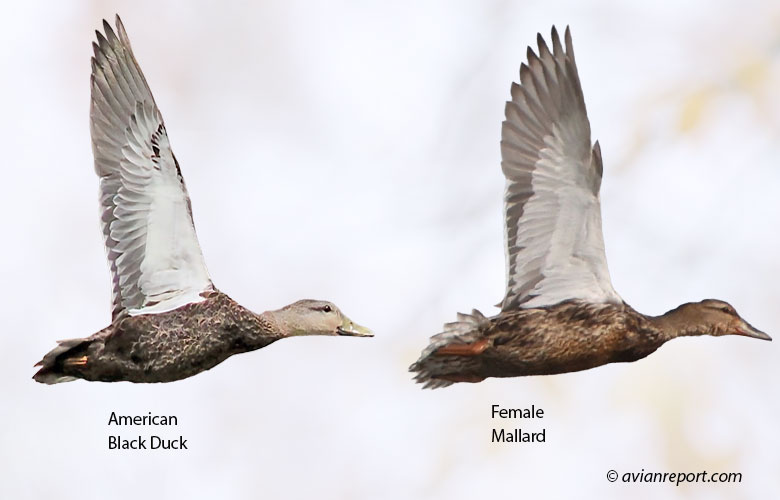
Mallard: White underwings, but with less contrast.
One of the most striking—and underused—field marks: This “flash” is visible at long distances and in low light, making it invaluable for fly-by identification.
Hybridization: Expect the Unexpected
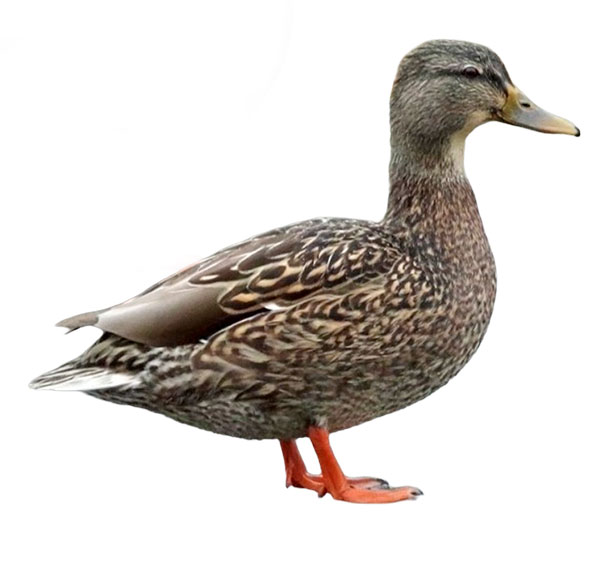
The American Black Duck and Mallard frequently hybridize, producing individuals that exhibit intermediate characters. Studies have indicated that hybridization is common enough that up to 13.2% of the Black Duck population may carry Mallard genes.
Identifying Intermediate Features
Hybrids often present as a bird with the dark body of a Black Duck but with subtle Mallard traits.
Common indicators of hybridization include:
• Greenish Sheen: A male hybrid may have the dark body of a Black Duck but show patches of iridescent green on the head, particularly on the crown or behind the eye.
• Atypical Speculum Borders: A bird that lacks the broad white bars of a Mallard but shows a thin or partial white line on either the top or bottom of the speculum is likely a hybrid.
• Tail Feathers and Curls: The presence of any white in the tail or the “drake’s curl” (the curled central tail feathers characteristic of Mallards) on a dark-bodied bird confirms Mallard ancestry.
• Underwing Lining: USGS research suggests that the presence of dark brown feathers on the underwing lining—where a pure Mallard should have gray or light feathers—is a key marker for Black Duck influence in birds that otherwise look like Mallards.
Seasonal Confusion: Eclipse Plumage
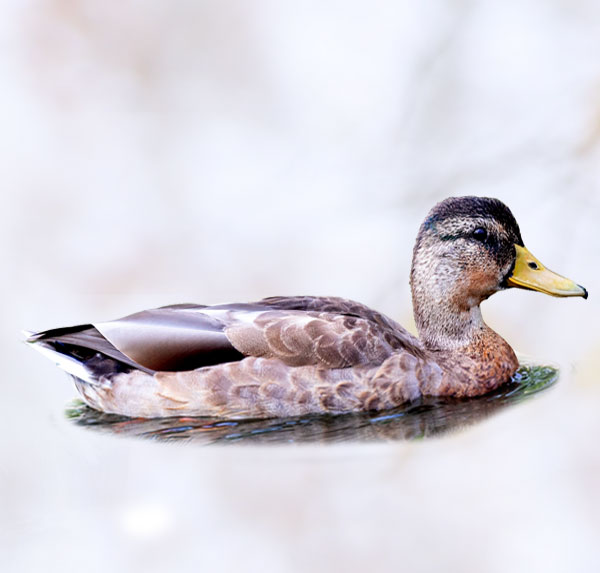
From midsummer through early fall, males of both species molt into dull “eclipse” plumage.
Eclipse Mallard males: Retain bright yellow bills
Eclipse Black Duck males: Similar to females but with cleaner yellow bills
This period produces many misidentifications—bill color is often the key.
Male Mallard in eclipse plumage (photo). Although the plumage may look dark, and there is head/body color contrast, the bill is yellow and the tail is white.
Behavior and Habitat Clues
- American Black Duck: Shy, wary, avoids heavy human presence
- Mallard: Highly adaptable, common in urban and suburban settings
In mixed flocks, Black Ducks are often the first to flush.
Identification Checklist (Field Workflow)
- Assess overall darkness
- Check rump and tail for white
- Confirm speculum borders
- Use underwing flash in flight
- Account for hybrids and eclipse plumage
Final Takeaway
Separating an American Black Duck from a female Mallard is not about one single mark—it’s about pattern recognition and hierarchy. Start with overall color value, verify with tail and speculum, and confirm with flight views when possible.
Mastering this comparison not only solves the classic “brown duck problem,” but also sharpens broader waterfowl identification skills—especially in regions where hybridization is common.
Photo Credits:
The photographic material used in this article comes from photos licensed under “Creative Commons” and mostly from birders and photographers. I am profoundly grateful for your generous support in making these images available; they have truly made this article possible. Many thanks to Andrew Morffew, Mark Mochell, Elizabeth Milson, Emily Chen, Dennis Church, Wendy Miller, Ken Slade, John Benson, Mick Thompson, Steve Guttman, Nicole Beaulac, Andy Reago, Chrissy McLaren, Garry C., Shawn Taylor, Steve Kersting, Gary Leaven, Vicky DeLoach, Don Hoechlin, Tom Murray, Kevin Krebs, Deborah Freeman, Kenneth Cole-Schneider, Doug Greenberg, Ian Preston, Brian Garrett, John Strung, Becky Matsubara, Judy Gallagher, Bob Jensen, Veit, Sand Diego Zoo, David Inman, Dan Mooney, Ian Preston, Lloyd Davis, Denis Fournier, Gregory Heaton, Greg Lavaty, Dona Hilkey, Alain Doyle, Aaron Maizlish, Ashley Tubs, Richard George, Ethan Gosnell, Nick, , Steve Valasek, Mitch Walters, , and Julio Mulero.
References:
allaboutbirds.org: Mallard-American Black Duck Identification – All About Birds, Cornell Lab of Ornithology
audubon.org: American Black Duck – Audubon Field Guide
ducks.org: American Black Duck – Ducks Unlimited
fieldguide.mt.gov: American Black Duck – Montana Field Guide
mdc.mo.gov: Waterfowl Bird Identification – Missouri Department of Conservation
northernwoodlands.org: Total Eclipse of the Duck – Northern Woodlands Magazine
nwtf.org: Waterfowl ID Tips: Know Your Ducks in Flight – National Wild Turkey Federation
pubs.usgs.gov: Description and Identification of American Black Duck and Mallard – U.S. Geological Survey
U.S. Fish and Wildlife Service: Ducks at a Distance Waterfowl ID Guide – U.S. Fish & Wildlife Service
Author:
