
Identifying white-plumaged geese can be challenging, especially within mixed flocks of Snow Goose (Anser caerulescens) and Ross’s Goose (Anser rossii). These closely related species share nearly identical white-and-black plumage and frequently occur together across North American flyways, making field identification difficult.
Despite their similar appearance, Snow and Ross’s Geese differ in consistent morphological, structural, and behavioral traits. This guide highlights the most reliable field marks for distinguishing the two species, providing practical identification criteria for both professional researchers and birders.
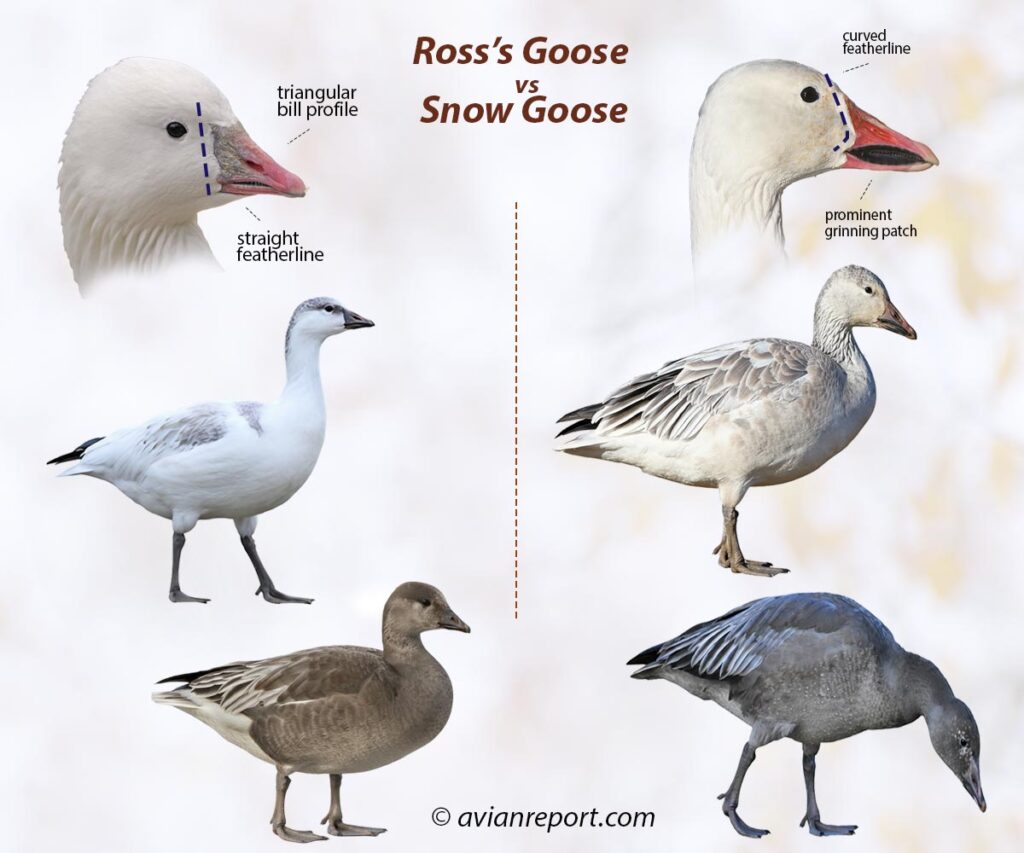
- Diagnostic Summary: The Essential Checklist
- Evolutionary Lineage and Taxonomic Differentiation
- Plumage Variations: The White and Blue Morphs
- Age-Class Diagnostics: Juvenile Identification
- Hybridization and the Spectrum of Intermediates
- Behavioral and Ecological Nuances
- Flight Identification: Silhouette and Wingbeats
- Field Identification Flowchart
Diagnostic Summary: The Essential Checklist
Effective field identification of the Snow Goose and Ross’s Goose needs an inverted pyramid approach, beginning with the most critical structural diagnostics before progressing into finer morphological nuances.
In large flocks, the primary challenge lies in isolating the smaller Ross’s Goose from the more ubiquitous Lesser Snow Goose. The following comparison table synthesizes the metrics and structural markers utilized by professional observers and researchers to ensure high-confidence identification.
| Feature | Snow Goose | Ross’s Goose |
| Primary Identification Profile | Lanky, aggressive, robust bill | Compact, “toy-like,” gentle expression |
| Total Body Length | 27.2–32.7 in | 22.6–25.2 in |
| Body Mass (Mean) | ≈1,966.2 g (1,404.5–2,801.5 g) | ≈1,330.9 g (848.5–1,612.5 g) |
| Wingspan | 54.3 in (138 cm) | 44.5–45.7 in (113–116 cm) |
| Bill Structure | Large, triangular, curved mandibles | Stubby, triangular, straight mandibles |
| Grinning Patch | Prominent black oval (tomial gap) | Absent or faint dark line |
| Bill Base Interface | Strongly curved feather line | Straight feather line |
| Basal Caruncles | Always absent | Grayish, warty bumps (adults) |
| Head Profile | Sloping forehead, oval/wedge shape | Steep forehead, high rounded crown |
| Neck Proportions | Long, slender, lanky | Short, thick, compact |
| Vocalization | Deep, nasal honking | High-pitched, squeaky cackling |
Evolutionary Lineage and Taxonomic Differentiation
The identification challenge between Ross’s Goose and Snow Goose stems from their evolutionary divergence. Genetic studies show that Ross’s Goose split from the Snow Goose lineage roughly two million years ago, likely during the Pleistocene, when glacial advances isolated populations into separate refugia. This long period of allopatric speciation produced Ross’s Goose as a smaller-bodied species—about two-thirds the size of a Snow Goose—adapted to specific Arctic niches.
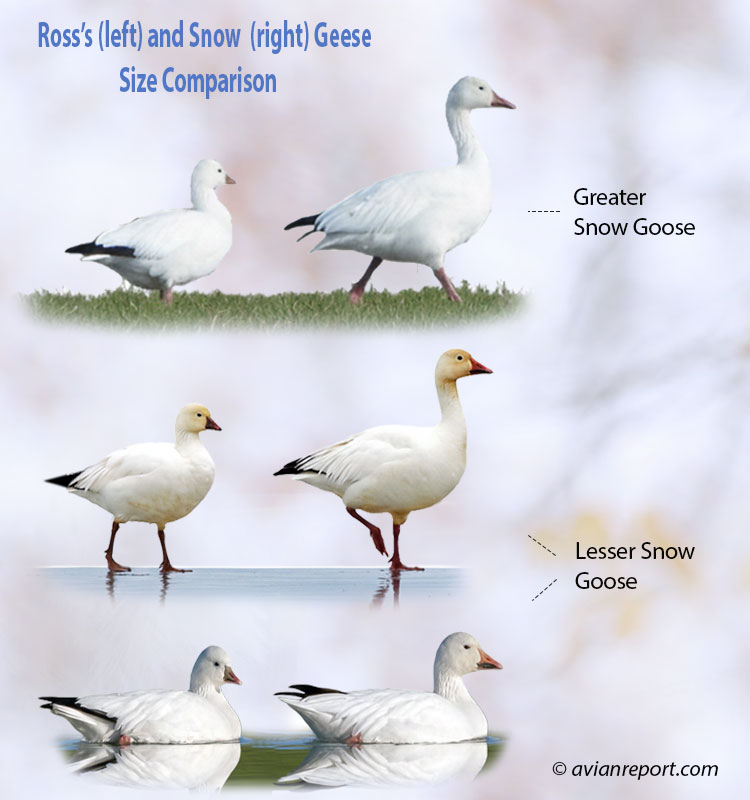
Snow Goose occurs as two subspecies: the Lesser Snow Goose and the larger Greater Snow Goose (A. c. atlantica). Ross’s Geese most often associate with Lesser Snow Geese in the Central and Pacific Flyways, where size differences are subtle and structural traits become critical for identification. In contrast, the Greater Snow Goose dominates the Atlantic Flyway and appears markedly larger, making Ross’s Goose look conspicuously small by comparison.
Structural Morphology: Bill Anatomy
The bill is the most reliable feature for separating Ross’s Goose from Snow Goose, even when size is distorted by distance or lighting.
Grinning Patch (Tomial Gap)
Snow Goose shows a prominent “grinning patch”: a black, oval tomial gap created by the strongly bowed lower mandible. This is a structural feature—not just coloration—and remains visible even when the bill is closed, reflecting the species’ specialized grubbing behavior.
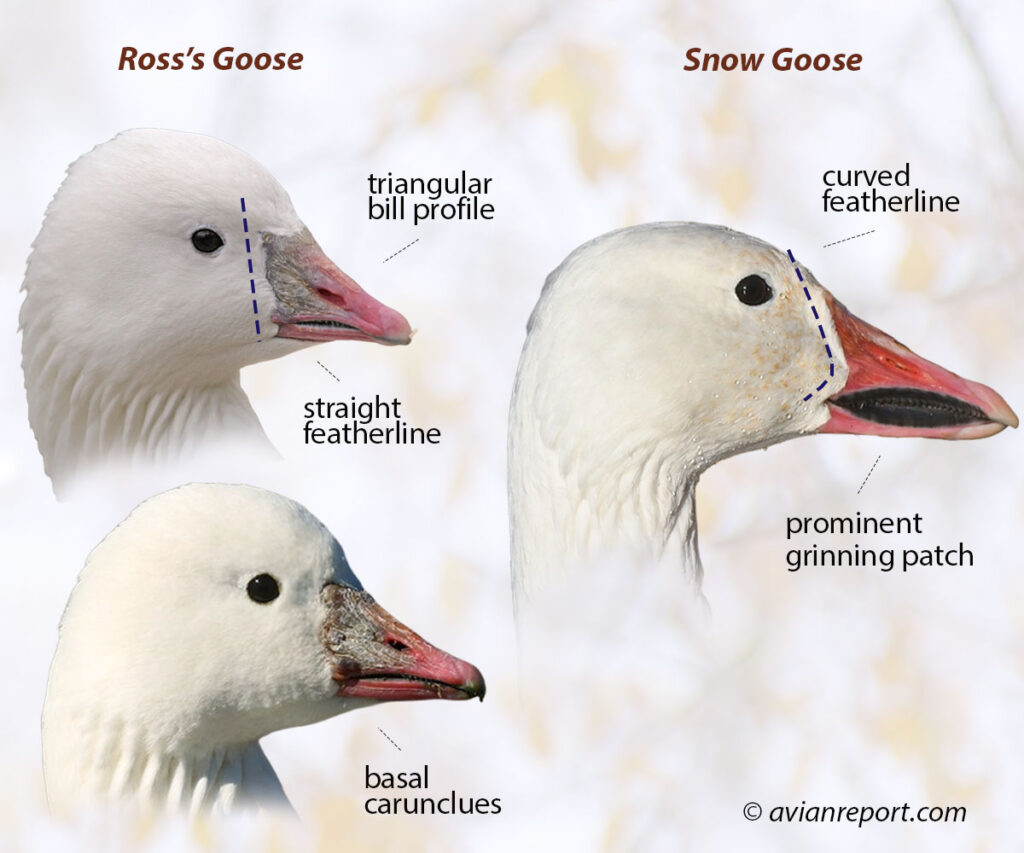
Ross’s Goose lacks a true grinning patch. Its mandibles meet in a nearly straight line, producing a clean, triangular bill profile. At most, a faint dark line may be visible, but it never forms the distinct black oval seen on Snow Goose. Any bird showing a clear black gap at the bill is a Snow Goose.
Basal Caruncles: Adult Ross’s Geese develop gray-brown “crusty” area at base of the upper mandible. With age birds develop basal caruncles—warty protuberances at the base of the bill—most pronounced in older males. Snow Goose bills are smooth and uniformly colored at the base and never develop caruncles at any age.
Malar Feather Line or Featherline: The feather-to-bill boundary is a nearly binary diagnostic. In Ross’s Goose, facial feathering meets the bill in a straight line, creating a compact, “punched-in” expression. In Snow Goose, the feather line curves forward into the bill, forming a convex interface. When other traits are ambiguous, this malar line remains a dependable indicator of species identity.
Proportional Metrics: Head and Neck Ratios
When scanning large flocks, overall shape and posture are often the fastest way to detect the smaller Ross’s Goose among Snow Geese.
Head Shape and Crown Profile
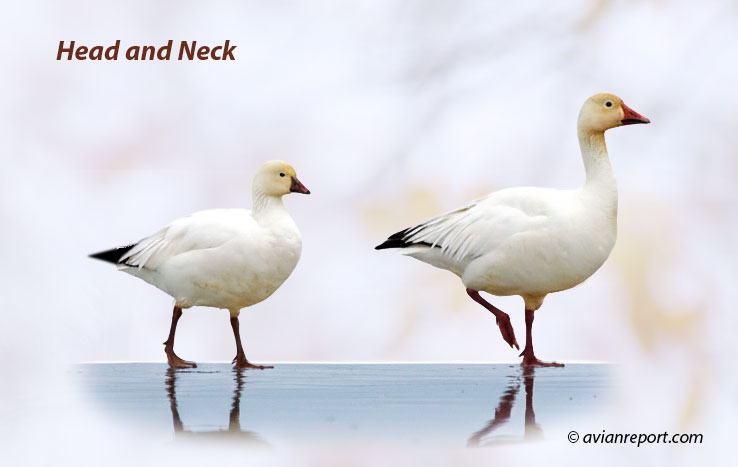
Ross’s Goose shows a high, rounded crown and steep forehead, producing a nearly circular, “apple-shaped” head with the eye centered in the face. Snow Goose has a flatter, elongated, wedge-shaped head with a gently sloping forehead, giving a longer and more angular profile.
Neck Length and Silhouette
Ross’s Goose has a proportionately shorter, thicker neck, creating a compact, “chubby” silhouette in flight; the head and neck project only slightly beyond the wings. Snow Goose has a long, slender neck that often extends prominently, producing a more elongated, streamlined outline. A useful ratio is that Ross’s Goose bill length is usually shorter than the thickness of the upper neck, whereas in Snow Goose the bill is longer than the neck’s thickness.
Morphometric Basis
These differences are supported by measurements: the culmen of Ross’s Goose averages about 45.1 mm in males, while Snow Goose bills are substantially larger, reflecting adaptation to more intensive tuber-digging foraging.
| Metric | Ross’s Goose (Male) | Lesser Snow Goose |
| Culmen Length | ≈45.1 mm | >50 mm |
| Tarsus Length | Delicate, shorter | Robust, longer |
Plumage Variations: The White and Blue Morphs
Both species are dimorphic, existing in a common “white morph” and a rarer “blue morph”. Identifying these morphs requires an understanding of their genetic underpinnings and the specific plumage patterns that separate the two species.
White Morph Identification
In the white morph, both species are essentially identical in plumage color: stark white bodies with black primary feathers and gray primary coverts. Identification of white morphs relies entirely on the structural morphology of the bill, head, and neck.
The Blue Morph: Snow Goose vs. Ross’s Goose
The “Blue Goose” was originally considered a separate species before being recognized as a color morph of the Snow Goose in 1973. The blue morph Snow Goose features a dark blue-gray body with a white head and, frequently, a white upper neck. The blue morph Ross’s Goose, however, is an extreme rarity, with some estimates suggesting it occurs in only 0.008% of the population.
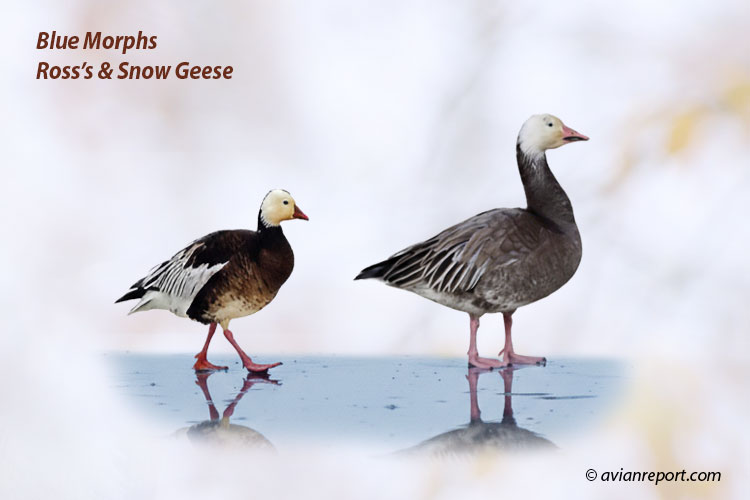
Diagnostic markers for a true blue morph Ross’s Goose include:
- Neck Transition: In blue morph Snow Geese, the white of the head usually extends halfway down the neck. In the blue morph Ross’s Goose, the dark body plumage extends much higher, often reaching the base of the throat and the rear part of the crown.
- Body Saturation: Blue Ross’s Geese are often described as having “blacker” or more intensely dark plumage on the back and neck compared to the gray-toned Snow Goose.
- Belly Color: While many blue Snow Geese have white bellies, almost all blue Ross’s Geese detected thus far have been white-bellied.
It is important to note that many suspected “blue Ross’s Geese” are actually hybrids. Any dark goose showing a Ross’s-like size but a curved bill base (featherline) or a hint of a grin patch should be scrutinized as a hybrid.
Age-Class Diagnostics: Juvenile Identification
Distinguishing juvenile (first-winter) birds is critical for accurate population counts and requires an understanding of the gradual transition from gray to white plumage.
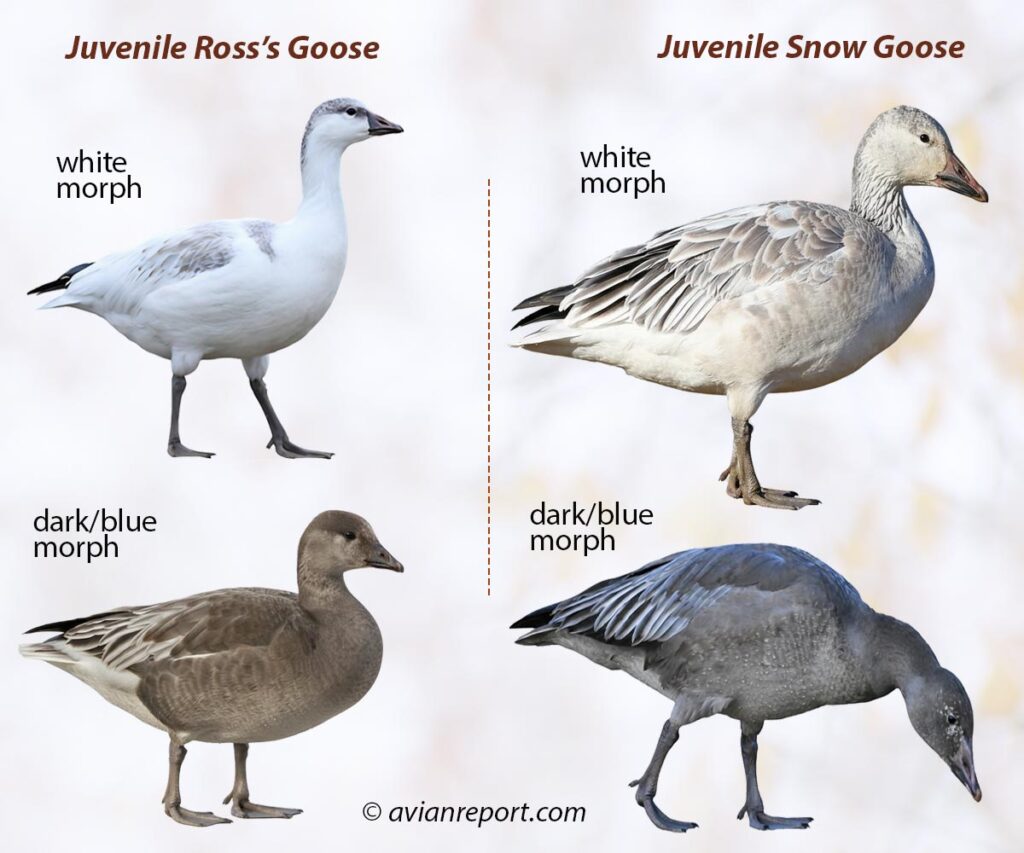
Juvenile White Morphs
Juvenile Snow Geese are heavily marked with dingy gray plumage early in the fall, particularly on their upperparts. Their legs and bills are initially blackish or dark dusky gray. Over the winter, they gradually molt into white feathers, and their bills typically begin to turn pink by November, though some may retain dark bills as late as December.
Juvenile Ross’s Geese are significantly whiter and “cleaner” in appearance than juvenile Snow Geese. They show only a very light, pale wash of gray on the head and back. Critically, the bills of juvenile Ross’s Geese transition to pink much earlier than those of Snow Geese, often showing pink as early as October.
Juvenile Blue Morphs
Juvenile blue morphs of both species appear as dark gray-brown birds with dark bills and legs. Ross’s Goose has white wing coverts, showing a white folded wing, but this is often concealed. In this stage, size and bill structure, are a reliable way to separate them.
| Age Characteristic | Snow Goose | Ross’s Goose |
| Initial Plumage | Heavily dingy gray | Pale, light gray wash |
| Bill Color Transition | Pink by Nov/Dec | Pink by Oct |
| Structural Growth | Bills grow throughout year 1 | Bills grow throughout year 1 |
| Juvenile Grin Patch | Large and prominent | Faint, becoming adult structure |
Hybridization and the Spectrum of Intermediates
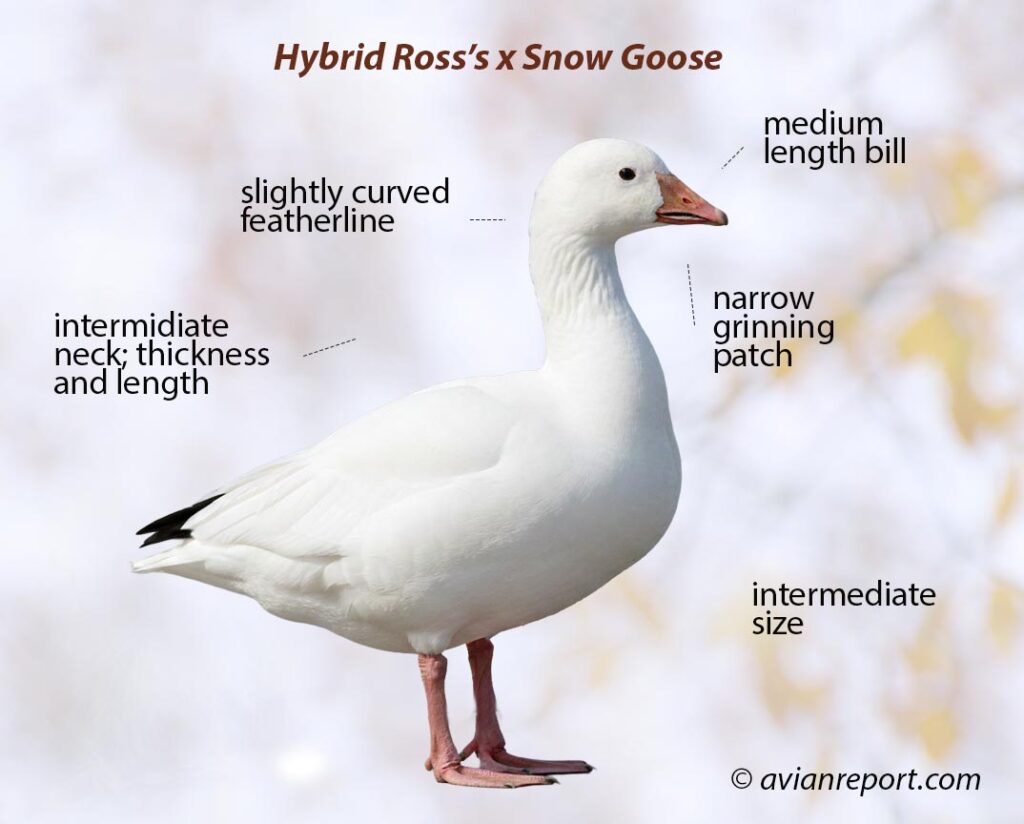
Hybridization between Snow and Ross’s Geese is a significant factor in field identification, as these birds are fertile and can produce a full range of intermediate phenotypes. Hybrids are estimated to make up between 0.2% and 4.8% of the population.
Identifying Hybrid Traits
Observers must be cautious of birds that do not fit neatly into either species category. Hybrids often exhibit:
- Intermediate Size: Too large for a Ross’s, too small for a typical Snow Goose.
- Mixed Bill Features: A bill length that is intermediate, or a malar feather line that is slightly curved rather than straight or sharply bowed.
- Diluted Grin Patch: A grinning patch that is present but less robust than that of a pure Snow Goose.
Because blue morph genes are likely introduced to the Ross’s population through Snow Goose ancestry, many experts argue that nearly all “blue Ross’s Geese” should be viewed as products of past hybridization.
Behavioral and Ecological Nuances
The physiological differences between these species reflect their divergent ecological roles and foraging niches.
Foraging Mechanics: Grubbing vs. Grazing
The Snow Goose’s heavy, serrated bill and curved mandibles are adaptations for “grubbing”—digging deep into muddy substrate to extract the roots and tubers of aquatic plants like sedges (Carex) and cotton grass (Eriophorum). This is a high-energy, aggressive foraging style.
The Ross’s Goose, with its smaller, straight-edged bill, is primarily a grazer. It clips short grasses and sedges close to the surface and rarely digs for tubers. In mixed flocks, Ross’s Geese are more frequently seen on the drier edges of wetlands or in agricultural fields grazing on waste grain, while Snow Geese may be found in wetter, muddier areas.
Flocking and Social Hierarchy
Snow Geese are generally more aggressive and social, forming massive flocks of several hundred thousand individuals. They often dominate the central feeding areas.
Ross’s Geese are usually found in much smaller numbers, often mixed into Snow Goose flocks rather than forming their own pure groups. They are less aggressive and tend to follow the leadership of the larger Snow Goose groups.
Vocalizations
The auditory experience of a goose flock can also provide diagnostic clues. The Snow Goose has a deep, nasal, one-syllable honk. The Ross’s Goose produces a much higher-pitched, squeaky, almost cackling sound. In a mixed flock, the Ross’s calls are often described as being “lost” within the deeper roar of the Snow Geese.
Flight Identification: Silhouette and Wingbeats
Identifying these species in the air requires a focus on structural proportions rather than plumage.
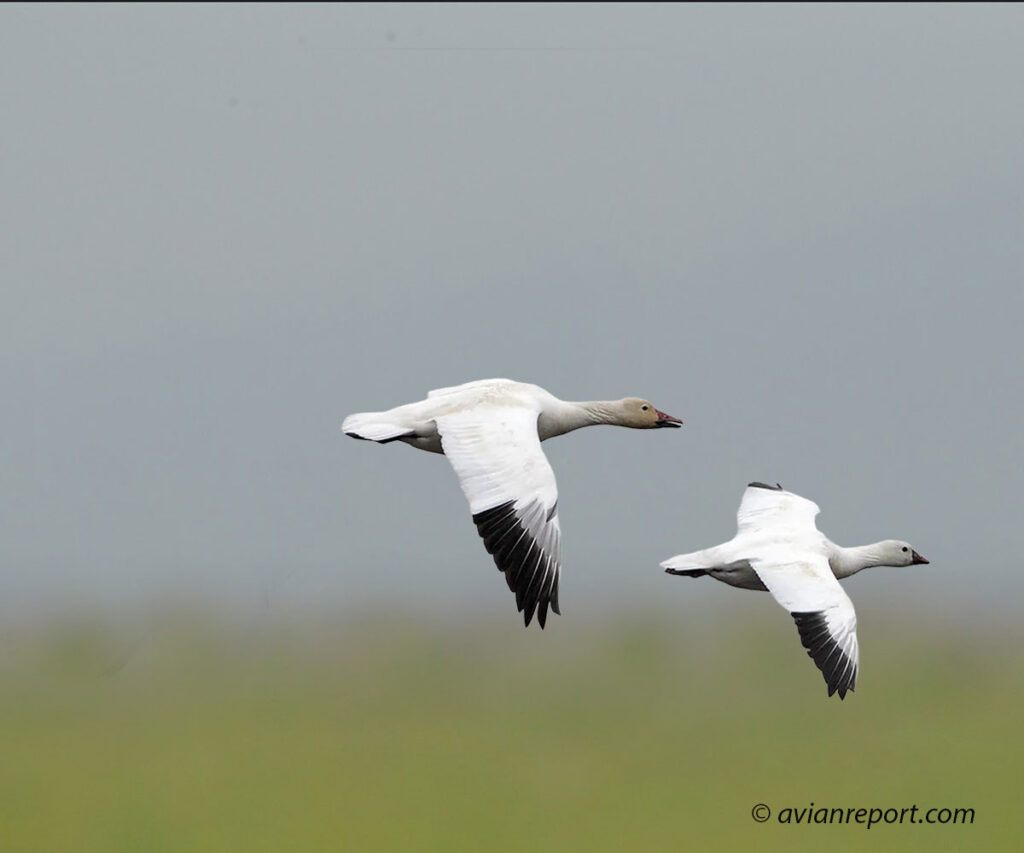
- Wingbeat Frequency: Ross’s Geese have a faster wingbeat than Snow Geese. Their smaller wings must move more rapidly to support their body mass.
- Silhouette: The “short-necked” look is exaggerated in flight. A Ross’s Goose looks “all body” with a small head stuck directly to the front.
- Proportional Position: Because they have shorter necks, the head of a Ross’s Goose does not extend as far forward from the leading edge of the wing as it does in a Snow Goose.
Population Trends and Regional Context
The likelihood of encountering Ross’s Goose varies widely by region and has shifted dramatically in recent decades.
Range Expansion
Once rare and largely confined to the Pacific Flyway, Ross’s Goose has undergone rapid population growth since the 1970s, increasing from fewer than 100,000 individuals to more than 1.7 million. Its breeding range has expanded east across the Arctic, and it now winters commonly in the Central and Mississippi Flyways, where it can comprise up to one-third of mixed “light goose” flocks.
Agricultural Subsidy
Both Ross’s and Lesser Snow Geese have benefited from industrial agriculture, feeding extensively on waste grain in corn and rice fields. This has removed traditional winter food limitations and driven population booms, leading to overabundance designations, extended hunting seasons, and growing concerns about Arctic habitat degradation.
Implications for Identification
As populations increase and ranges overlap, hybridization is expected to become more frequent, potentially blurring morphological boundaries between the species. For both field birders and researchers, accurate identification will continue to depend on careful attention to structural traits—particularly the malar line, grinning patch, and head shape—rather than plumage alone.
Field Identification Flowchart
To ensure maximum field utility, the following logic-based approach should be applied to every candidate bird:
- Size Scan: Is the bird noticeably smaller (2/3 size) than the majority?
- If Yes: Likely Ross’s Goose candidate.
- If No: Likely Snow Goose candidate.
- Neck Check: Does the neck appear short and thick, or long and lanky?
- Short/Thick: Ross’s.
- Long/Lanky: Snow.
- Head Shape: Is the crown high and rounded, or sloping and oval?
- Rounded: Ross’s.
- Oval/Sloping: Snow.
- The “Smoking Gun” (Bill Base): Is the feathering line straight and vertical?
- Straight: Ross’s.
- Curved: Snow (or Hybrid).
- The Grin Patch: Is there a visible black gap on the closed bill?
- Absent: Ross’s.
- Present: Snow (or Hybrid).
- Caruncles (Adults Only): Are there grayish bumps at the bill base?
- Present: Confirmed Ross’s.
- Absent: Likely Snow.
Following this protocol is likely to help observers achieve a high degree of taxonomic accuracy even within the chaotic environment of a hundred-thousand-bird flock. The distinction between Snow Goose (Anser caerulescens) and Ross’s Goose (Anser rossii) can be rewarding challenge.
Photo Credits:
The photographic material used in this article comes from photos licensed under “Creative Commons” and mostly from birders and photographers. I am profoundly grateful for your generous support in making these images available; they have truly made this article possible. Many thanks to Andrew Morffew, Mark Mochell, Elizabeth Milson, Emily Chen, Dennis Church, Wendy Miller, Ken Slade, John Benson, Mick Thompson, Steve Guttman, Nicole Beaulac, Andy Reago, Chrissy McLaren, Garry C., Shawn Taylor, Steve Kersting, Gary Leaven, Vicky DeLoach, Don Hoechlin, Tom Murray, Kevin Krebs, Deborah Freeman, Kenneth Cole-Schneider, Doug Greenberg, Ian Preston, Brian Garrett, John Strung, Becky Matsubara, Judy Gallagher, Bob Jensen, Veit, Sand Diego Zoo, David Inman, Dan Mooney, Ian Preston, Lloyd Davis, Denis Fournier, Gregory Heaton, Greg Lavaty, Dona Hilkey, Alain Doyle, Aaron Maizlish, Ashley Tubs, Richard George, Ethan Gosnell, Nick, , Steve Valasek, Mitch Walters, , and Julio Mulero.
References:
ace-eco.org: Dynamics of Pre-breeding Nutrient Reserves in Subarctic Staging Lesser Snow Geese and Ross’s Geese – Avian Conservation and Ecology.
allaboutbirds.org: Ross’s Goose and Snow Goos Identification – All About Birds, Cornell Lab of Ornithology. audubon.org: Ross’s Goose – Audubon Field Guide, National Audubon Society.
birdnote.org: Sister Species: Snow Goose and Ross’s Goose – BirdNote.
bryanpfeiffer.com: A Blue Ross’s Goose – Bryan Pfeiffer.
canuck.dnr.cornell.edu: Body Size and Age of Recruitment in Snow Geese – Cornell University. digitalcommons.unl.edu: What Are Blue Ross’s Geese? – DigitalCommons@University of Nebraska–Lincoln digitalcommons.usf.edu: Blue-phase Ross’ Geese: A Call for Photographs – Digital Commons joshvandermeulen.blogspot.com: Juvenile Ross’s × Snow Goose Hybrid – Explorations of an Ecologist
researchgate.net: Carcass Components of Lesser Snow and Ross’s Geese – ResearchGate.
researchgate.net: What Are Blue Ross’s Geese? – ResearchGate
sdakotabirds.com: Identification Keys and Tips: Snow Goose vs. Ross’s Goose – South Dakota Birds
sibleyguides.com: Identification of White Geese – Sibley Guides
Author:
