
Canada Goose (Branta canadensis) and Cackling Goose (Branta hutchinsii) were officially split into separate species in 2004, creating one of North America’s most challenging waterfowl identification puzzles. Though both share the classic white-cheeked look, they differ in structure, voice, behavior, and flight style. This field guide breaks down the most reliable identification markers—head and bill proportions, neck length, vocalizations, and wingbeat cadence—to help birders and researchers confidently separate these closely related geese in mixed flocks across the continent.
- The 2004 Split: Canada Goose and Cackling Goose
- Morphological Anchors
- The Identification Gap: Distinguishing parvipes from hutchinsii
- The Impact of Introgression and Nutrition
- Bioacoustic Markers: Frequency and Repetition
- Behavioral and Flight Kinematics
- Aerodynamics and Energy Efficiency: The Science of the "V"
- Comprehensive Subspecies Compendium
- Field Strategies and Citizen Science Protocols
- The Taxonomic Evolution: From One Species to Two
- Conclusions
The 2004 Split: Canada Goose and Cackling Goose
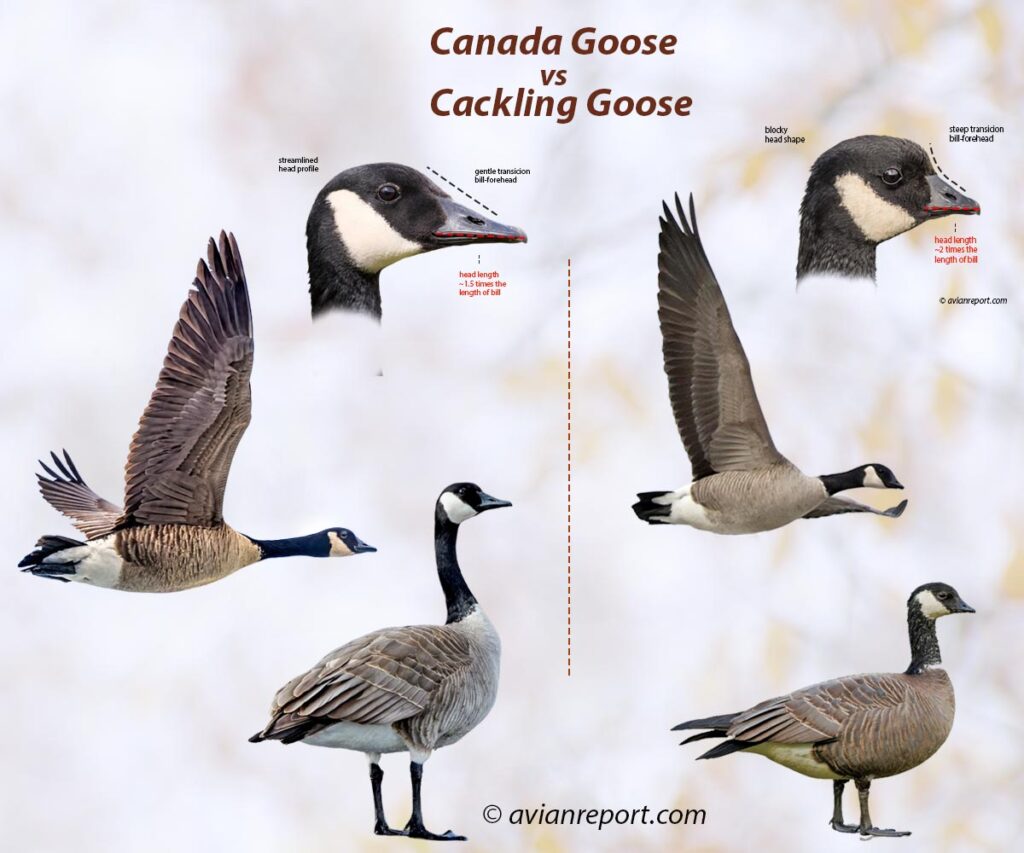
In July 2004, the American Ornithologists’ Union officially split the former Canada Goose into two species: the large Canada Goose and the smaller, tundra-breeding Cackling Goose. Although specialists had long recognized differences in size, voice, and breeding ecology, the change created new challenges for field identification. Distinguishing these similar “white-cheeked geese” now requires careful attention to proportions, subspecies variation, and vocalizations.
The taxonomic evolution: From One Species to Two (Read at the bottom)
Quick Reference: Comparative Identification Matrix
The following table provides a high-level comparison of prototypical features. It serves as an essential baseline for field identification, though it must be emphasized that direct side-by-side comparison in mixed flocks is the gold standard for accuracy.
| Field Mark | Canada Goose (B. canadensis) | Cackling Goose (B. hutchinsii) |
| Average Body Mass | 5.0 to 15.0+ lbs (2.2 to 6.8+ kg) | 3.0 to 7.0 lbs (1.4 to 3.2 kg) |
| Typical Height | 29 to 45 inches (74 to 114 cm) | 22 to 30 inches (56 to 76 cm) |
| Bill Morphology | Long, wedge-shaped, sloping profile | Short, stubby, triangular, abrupt transition |
| Skull Profile | Rounded to oval; streamlined | Squared or blocky; often “pin-headed” |
| Neck Length | Long, slender, reaching silhouette | Short, thick, “truncated” appearance |
| Primary Projection | Shorter; wings look broad in flight | Longer; wings appear narrow and pointed |
| Vocalization | Deep, resonant, musical “honks” | High-pitched “yips,” squeaks, or “cackles” |
| Wing Cadence | Slow, powerful, rhythmic (approx. 4 Hz) | Rapid, frantic, high-frequency |
Morphological Anchors
The Size of the Canada and Cackling Geese
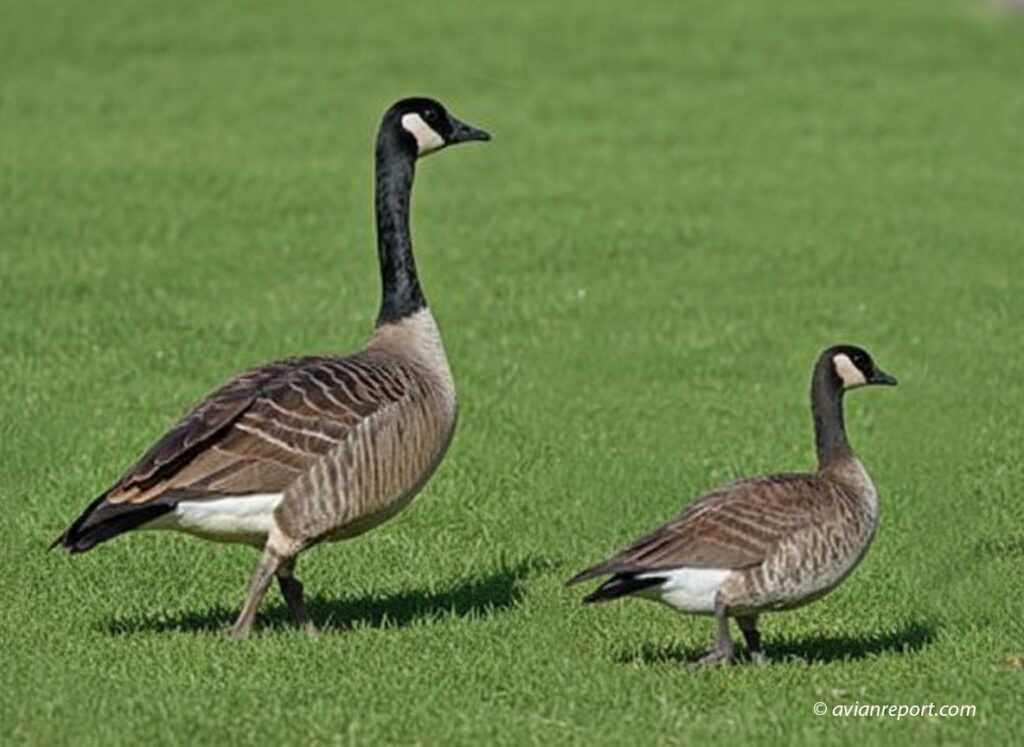
Size is a helpful initial indicator but not a fully reliable, standalone field mark for separating Canada and Cackling Geese due to significant size overlap between small Canada subspecies (like parvipes) and larger Cackling subspecies (Richardson’s). While Cackling Geese are generally smaller, more compact, and closer to the size of a Mallard, smaller female or immature Canada Geese can approach the size of a Cackling Goose.
The Bill-to-Head Length Ratio
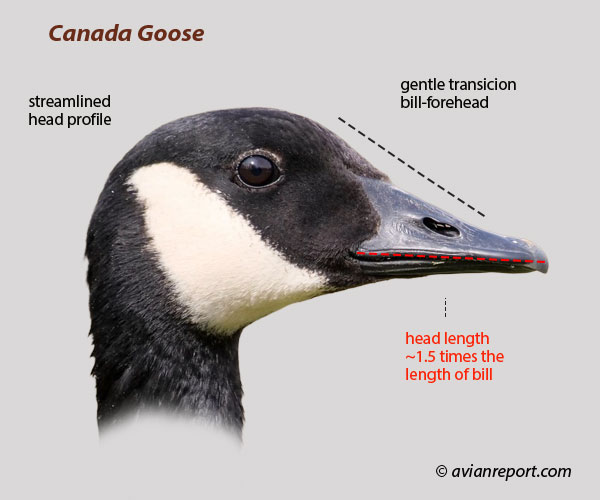
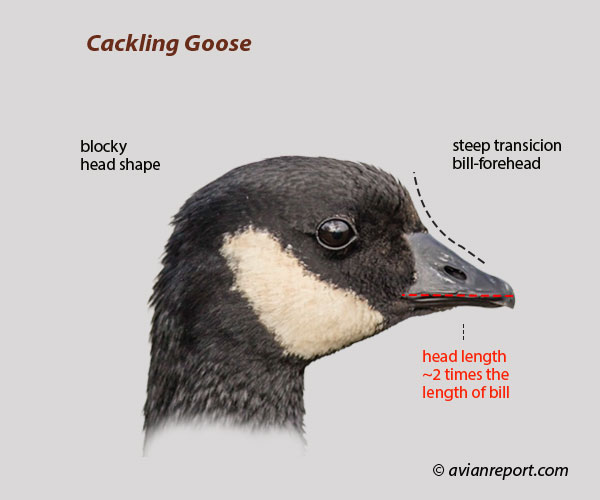
Experts rely on the skeletal structure of the head, which provides the most consistent anchors for species determination. The most diagnostic metric is the ratio of the bill length to the head length (measured from the base of the bill to the back of the crown).
- Canada Goose Proportions: The bill of a Canada Goose is relatively large. In prototypical specimens, the head length is approximately 1.5 times the length of the bill. This creates an elongated, streamlined head profile.
- Cackling Goose Proportions: The bill is significantly smaller in proportion to the head. The head length of a Cackler is typically 2.0 times (or more) the length of the bill. This results in a “tiny-billed” look that appears disproportionate to the bird’s body.
Forehead Steepness and Abrupt Transitions
The angle at which the bill meets the forehead is a crucial field mark.
- Canada Goose Profile: Characterized by a gently sloping forehead that often forms a continuous line with the culmen (top of the bill). This creates a “Canvasback-like” or wedge-shaped profile that emphasizes the bird’s streamlined nature.
- Cackling Goose Profile: Features an abrupt, steep transition from the bill to the forehead. The forehead rises almost vertically from the base of the bill, creating a “knobby” or “squared” appearance. This steepness contributes to the overall “blocky” head shape characteristic of the species.
The “Roman Nose” vs. Straight Culmen
Bill shape variation, while subtle, can offer further clues.
- Richardson’s Cackling Goose (hutchinsii): Often displays what is termed a “Roman Nose”—a pronounced droop or slight curve nearest the tip of the bill. This gives the bill a bluntly triangular, thick-set appearance despite its small absolute size.
- Canada Goose (canadensis): Typically shows a straighter or more gently tapered culmen. Even in smaller Canada subspecies like parvipes, the bill maintains a fine-tipped, elegant appearance rather than the stubby, “pinched-in” look of a Cackler.
Neck and Body Proportions
Proportional analysis beyond the head provides additional confirmation, particularly regarding the relationship between the neck and the torso.
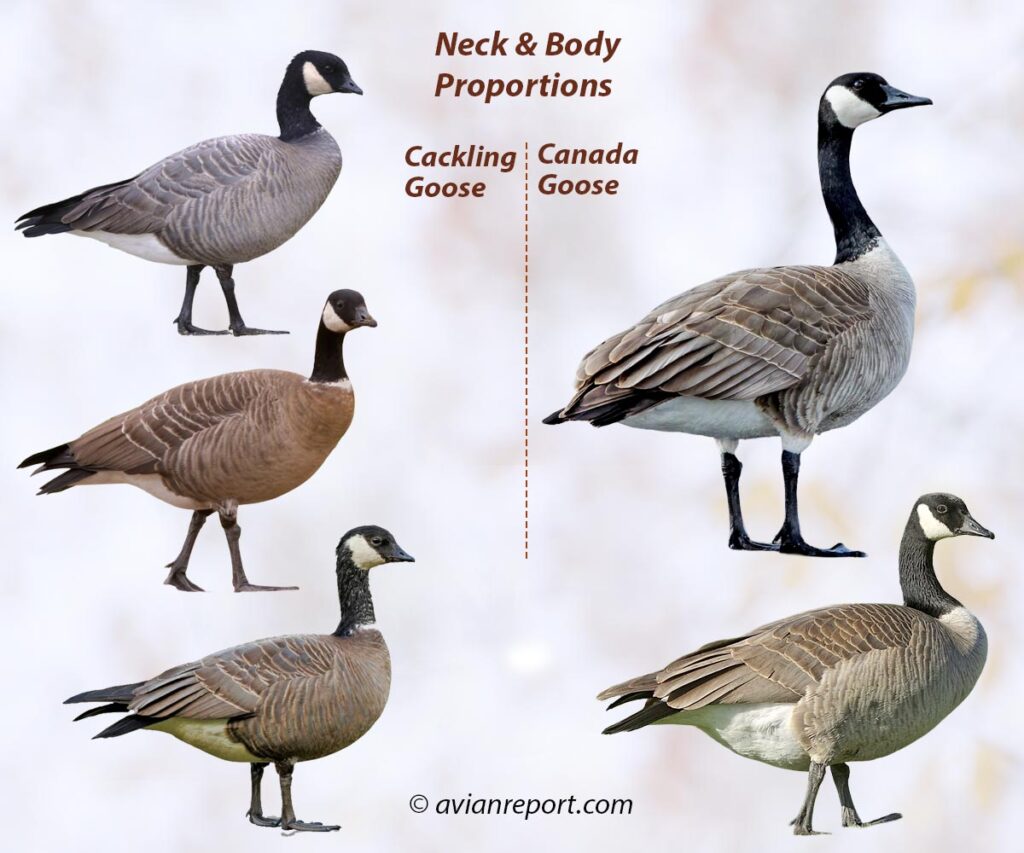
Neck Length and Girth
One of the defining features of a Canada Goose is its long, slender neck, which adds to its graceful silhouette. In contrast, the Cackling Goose possesses a shorter, thicker neck that is proportionally smaller relative to its body size.
- Field Indicator: In a relaxed posture, the neck of a Cackling Goose can appear almost as wide as it is tall. Even when alert and craning the neck, a Cackler will lack the elegant “S-curve” or long reach typical of a Canada Goose.
- Implication: This stocky neck contributes to a “Mini-Me” or “toy version” impression, where the bird looks robust and compact rather than elongated.
Body Structure and GISS
The “General Impression of Size and Shape” (GISS) is a summation of multiple markers.
- Cackling Goose GISS: A compact, high-waisted appearance with relatively short legs and long wings. From a distance, they can appear closer in scale to a Mallard or a Brant than to a Giant Canada Goose.
- Canada Goose GISS: A long-bodied, heavy-set, and imposing presence. They possess larger feet and longer legs, which are necessary to support their greater mass.
The Identification Gap: Distinguishing parvipes from hutchinsii
The primary challenge of modern goose identification centers on the intermediate-sized individuals: the smallest Canada Goose subspecies, the Lesser Canada (B. c. parvipes), and the largest Cackling Goose subspecies, the Richardson’s (B. h. hutchinsii).
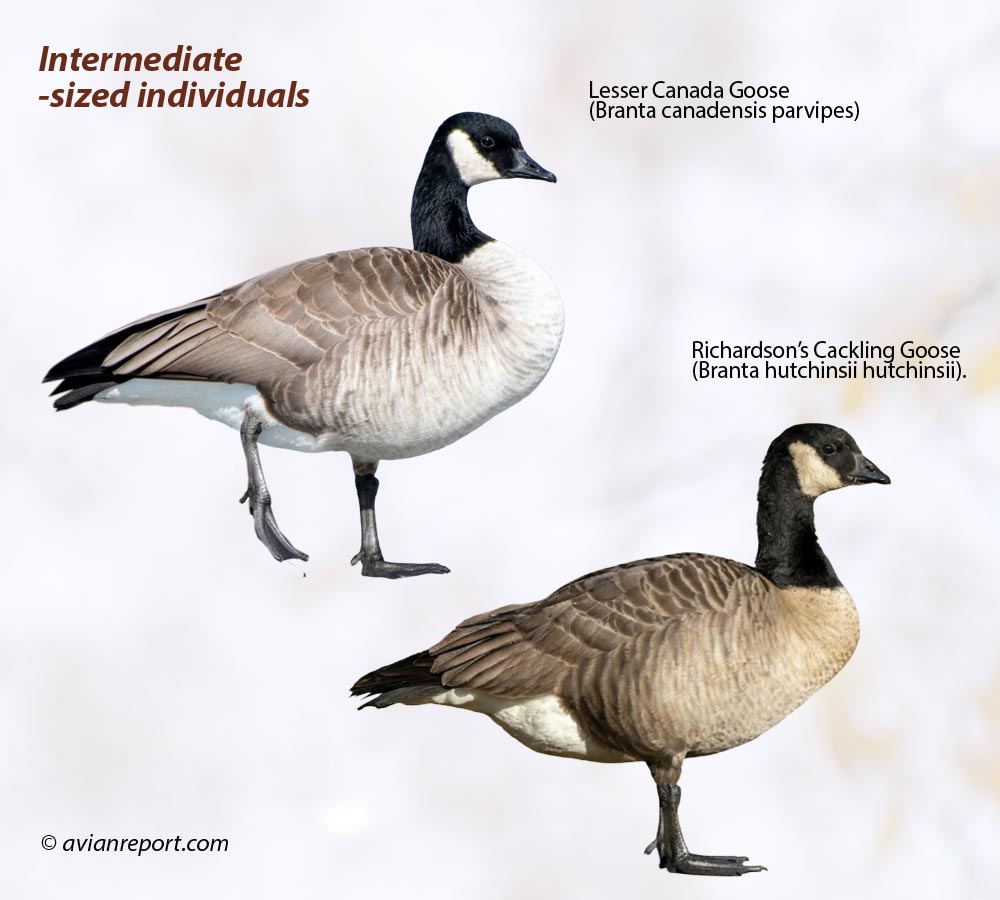
The Heart of the Conundrum
Because these two taxa represent the size interface where species meet, their morphological measurements frequently overlap.
- Culmen (Bill) Measurement: Richardson’s bills average 32mm to 40mm, while Lesser Canada bills average 40mm to 52mm. Birds at the 40mm mark are virtually identical in bill length.
- Body Mass Overlap: Large male Richardson’s from southern breeding cohorts overlap significantly with small female Lesser Canadas, especially those from northern boreal populations that are smaller than their southern counterparts.
Detailed Field Marks for Separation
To resolve this gap, observers must look for the “expression” of the head and specific plumage tones.
| Feature | Lesser Canada Goose (parvipes) | Richardson’s Cackling (hutchinsii) |
| Expression | Gentle, elegant, “Canada-like” | Blocky, stocky, “pin-headed” |
| Crown Shape | Typically rounded, dome-like, no rear peak | Typically flat crown with a peak at the rear |
| Forehead | Gently sloped; continuous with bill | Steep; abrupt angle with the bill |
| Plumage Tone | Typically brown, matching large Canadas | “Frosty” or grayer sheen on upperparts |
| Cheek Patch | Simple white patch; no indentation | Often shows a step-off indentation |
| White Collar | Rare; inconsistent | Frequent, though not obligatory |
The Impact of Introgression and Nutrition
The identification is further complicated by historical and current hybridization events. A narrow hybrid zone exists between 59°N and 60°N latitude, coinciding with the sub-Arctic and Arctic ecotone. In this region, mismatches between morphology and genetics are most common, suggesting significant introgression.
Additionally, research shows that Canada Goose size is highly plastic; individuals raised in overcrowded colonies with poor juvenile nutrition can become stunted, resulting in “runts” that mimic Cacklers in size but retain the skeletal proportions of Canada Geese.
Bioacoustic Markers: Frequency and Repetition
When visual cues are ambiguous, the distinct vocal repertoire of these geese often provides the definitive identification marker. These differences are deeply rooted in the anatomy of the syrinx, the avian vocal organ.
Canada Goose
The vocalizations of Branta canadensis are characterized by rich, musical, and deep honking.
Frequency Range: The primary vocal range typically lies between 500 Hz and 850 Hz.
Acoustic Structure: Spectral analysis reveals that a single honk consists of two distinct parts produced without interruption. The first part is a “rattle” based on a fundamental frequency of approximately 145 Hz, followed by a “scream” or more resonant section at approximately 740 Hz.
Call Rate: Mean repetition rate is relatively low, often recorded at one call every three seconds.
Cackling Goose
The Cackling Goose is aptly named for its high-pitched, yelping, and laughing vocalizations.
Subspecific Variation: In the smallest subspecies (minima and leucopareia), the call is a high-frequency yelp that is “utterly unlike” the honk of a Canada Goose. In the larger hutchinsii and taverneri, the call retains a “honking quality” but is consistently higher in pitch and faster in tempo than any Canada subspecies.
Vocal Frequency: While specific Hz data for hutchinsii honks is less comprehensive, the perceived pitch is often described as “double” that of a Canada Goose.
Aural Impression: A flock of Cackling Geese sounds more like a collection of Snow Geese or Greater White-fronted Geese than a typical Canada Goose flock.
Behavioral and Flight Kinematics
Observation of the geese in flight or during social interactions can reveal behavioral “fingerprints” that aid in identification.
Wingbeat Frequency and Cadence
The physics of avian flight dictates that smaller, lighter birds must flap their wings more rapidly to maintain lift, a phenomenon known as wing cadence.
- Canada Goose Flight: Displays a slow, powerful, and methodical wingbeat. Studies of formation flight have recorded an overall mean frequency of 4 beats per second (4 Hz).
- Cackling Goose Flight: Exhibits a much higher wingbeat frequency. This is often described as “frantic” or “rapid,” reminiscent of the wing cadence of a large duck or a Brant.
- Formation Dynamics: When small Cackling Geese are forced to fly in formation with larger Canada Geese, they must increase their wingbeat frequency—sometimes by as much as 18%—to maintain positional stability and visual maneuverability.
Neck Silhouette in Flight
In the air, the relative neck length becomes even more apparent.
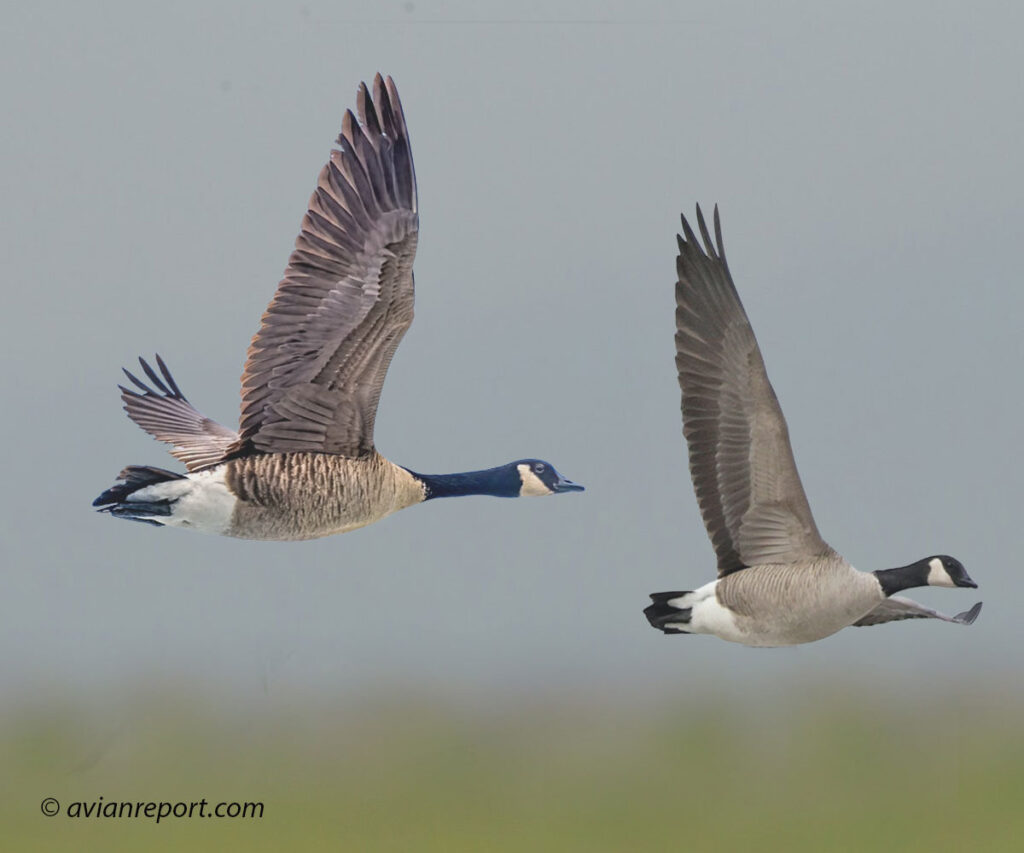
- Canada Goose: Shows a long, graceful extension that balances its heavy body, creating a classic, well-proportioned silhouette.
- Cackling Goose: The neck looks “truncated” or “way too small,” giving the bird a front-heavy or “awkward” appearance in flight. This “stubby” silhouette is often the first clue for observers scanning a high-flying flock.
Aerodynamics and Energy Efficiency: The Science of the “V”
The gregarious nature of both species is rooted in the aerodynamic advantages of group flight. Understanding these mechanics explains why the two species so frequently associate.
Wake Vortex Dynamics
Formation flight allows geese to exploit the “upwash” regions of vortices generated by leading birds.
- Efficiency Gains: Canada Geese positioning their wingtips within these regions can achieve a 32% improvement in aerodynamic efficiency.
- Metabolic Impact: Formation flight translates into an 11.4% to 14.5% decrease in heart rate and significant energy savings (1.7% to 3.4%) during long-distance migration.
- Implication for Identification: Because these efficiency gains are maximized by birds of similar size and cadence, Cackling Geese often form their own “sub-flocks” or tight clusters within a larger Canada Goose gaggle. Scanning for these “tighter” groups can lead to higher Cackling discovery rates.
Locomotor-Respiratory Coupling
The relationship between wingbeat frequency (fW) and respiratory frequency (fV) is essential for flight endurance.
- fW/fV Ratio: In free-flying Canada Geese, this ratio is consistently 3:1, meaning three wingbeats occur for every one breath.
- Respiratory Changes: During flight at 50 km/h, respiratory frequency (fV) increases from a resting rate of 14.8 breaths per minute to 78.4 breaths per minute.
Comprehensive Subspecies Compendium
Expert-level identification requires an awareness of all eleven subspecies and their typical ranges, as range is often the most important clue for subspecific determination.
The Canada Goose Lineup (B. canadensis)
| Subspecies | Common Name | Key Characteristics | Range |
| B. c. maxima | Giant | Largest; very pale; massive bill; white forehead common | Interior US/Canada; common in parks |
| B. c. interior | Hudson Bay | Medium-large; darker mantle; common migrant | Central/Eastern flyways |
| B. c. moffitti | Moffitt’s | Large; pale; often has dark throat stripe | Western/Intermountain regions |
| B. c. parvipes | Lesser | Smallest Canada; straight bill; rounded crown | Boreal forests; migrates to Great Plains |
| B. c. occidentalis | Dusky | Very dark; rich chocolate breast | SE Alaska; winters in Oregon/WA |
The Cackling Goose Lineup (B. hutchinsii)
| Subspecies | Common Name | Key Characteristics | Range |
| B. h. hutchinsii | Richardson’s | Small; very pale; blocky head; “Roman Nose” | Central Arctic; migrates to Great Plains |
| B. h. minima | Ridgway’s | Smallest; darkest; tiny bill; frantic beat | W Alaska; winters in Pacific NW |
| B. h. leucopareia | Aleutian | Thick white neck collar; squarer head | Aleutian Islands; winters in California |
| B. h. taverneri | Taverner’s | Largest Cackler; intermediate bill; darker than Richardson’s | NE Alaska/NW Canada; SW US winter |
Field Strategies and Citizen Science Protocols
The inherent difficulty of separating these species has led to refined protocols for reporting data to repositories like eBird.
The “Slash” Category: Cackling/Canada Goose
When a bird is observed at a distance, in poor lighting, or exhibits intermediate traits (such as a “runt” interior or a hybrid), the recommended professional standard is to record the sighting as a “slash” (Canada/Cackling Goose).
- Experience-Based Insight: If the observer is asking “Is that a Cackling or just a small Canada?”, it is statistically more likely to be a Canada Goose. Cackling Geese, when classic, are “cartoonishly” small and should be unmistakable once the search image is calibrated.
Establishing a Local Baseline
A critical step in expertise is becoming intimately familiar with the local “resident” Canada Geese (typically maxima or moffitti).
- Calibration: Knowing the size and vocalizations of local residents allows the observer to immediately recognize an anomaly—be it the high-pitched “yip” of a passing migrant or the “pin-headed” profile of an Arctic visitor.
Group Dynamics and Social Stickiness
The various subspecies often exhibit “social stickiness,” where individuals from the same breeding cohort stay together within a larger mixed flock.
- Search Strategy: Instead of scanning a flock of 1,000 birds as a whole, experts break the flock into sub-groups or family units. Finding one Cackling Goose often leads to the discovery of several more nearby, as they tend to feed in tight, body-contact groups.
The Taxonomic Evolution: From One Species to Two
The split of the “Canada Goose” complex was not merely an administrative change but a reflection of deep evolutionary history uncovered through mitochondrial DNA (mtDNA) analysis. Research indicates that the two species diverged approximately one million years ago, a timeline supported by a 2% difference in mtDNA sequences.
This genetic separation is reinforced by the fact that the Barnacle Goose (Branta leucopsis) is more closely related to the Cackling Goose lineage, whereas the Nene or Hawaiian Goose (Branta sandvicensis) is a derivative of the Canada Goose lineage.
Prior to this split, up to eleven subspecies were recognized under the broad umbrella of Branta canadensis. These are now allocated between the two species as follows:
Canada Goose (Branta canadensis) Subspecies
The Canada Goose currently comprises seven larger subspecies, typically characterized by larger body mass, longer necks, and interior or southern breeding grounds:
- B. c. canadensis (Atlantic Canada Goose)
- B. c. interior (Hudson Bay Canada Goose)
- B. c. maxima (Giant Canada Goose)
- B. c. moffitti (Moffitt’s or Great Basin Canada Goose)
- B. c. parvipes (Lesser Canada Goose)
- B. c. occidentalis (Dusky Canada Goose)
- B. c. fulva (Vancouver Canada Goose)
Cackling Goose (Branta hutchinsii) Subspecies
The Cackling Goose consists of four (formerly five) smaller subspecies that breed primarily in the Arctic tundra:
- B. h. hutchinsii (Richardson’s or Hutchins’s Cackling Goose)
- B. h. taverneri (Taverner’s Cackling Goose)
- B. h. minima (Cackling Cackling Goose – often referred to as Ridgway’s)
- B. h. leucopareia (Aleutian Cackling Goose)
- †B. h. asiatica (Bering Cackling Goose – considered extinct since 1929).
Conclusions
The distinction between Branta canadensis and Branta hutchinsii remains a rewarding and dynamic challenge in modern birding. Success in the field requires a departure from binary “large vs. small” thinking in favor of a holistic, multi-character assessment. Focusing on the structural anchors of the skull—the steep forehead and the 2.0x head-to-bill ratio—and confirming these findings through wing cadence and bioacoustic analysis, allows a observer to navigate the complexities of this one-million-year-old split with confidence.
Photo Credits:
The photographic material used in this article comes from photos licensed under “Creative Commons” and mostly from birders and photographers. I am profoundly grateful for your generous support in making these images available; they have truly made this article possible. Many thanks to Andrew Morffew, Mark Mochell, Elizabeth Milson, Emily Chen, Dennis Church, Wendy Miller, Ken Slade, John Benson, Mick Thompson, Steve Guttman, Nicole Beaulac, Andy Reago, Chrissy McLaren, Garry C., Shawn Taylor, Steve Kersting, Gary Leaven, Vicky DeLoach, Don Hoechlin, Tom Murray, Kevin Krebs, Deborah Freeman, Kenneth Cole-Schneider, Doug Greenberg, Ian Preston, Brian Garrett, John Strung, Becky Matsubara, Judy Gallagher, Bob Jensen, Veit, Sand Diego Zoo, David Inman, Dan Mooney, Ian Preston, Lloyd Davis, Denis Fournier, Gregory Heaton, Greg Lavaty, Dona Hilkey, Alain Doyle, Aaron Maizlish, Ashley Tubs, Richard George, Ethan Gosnell, Nick, , Steve Valasek, Mitch Walters, , and Julio Mulero.
Author:
