
Distinguishing Lesser Scaup (Aythya affinis) vs Greater Scaup (Aythya marila) is one of the most persistent identification challenges faced by North American birders and waterfowl enthusiasts. These nearly identical “bluebills” share similar plumage and habitats, yet subtle differences in head shape, wing pattern, bill structure, and behavior provide reliable clues in the field. This in-depth guide breaks down the most diagnostic field marks—supported by structural comparisons and practical observation tips—to help birders, photographers, and wildlife professionals confidently separate these two closely related diving ducks.
- Comparative Taxonomic and Biometric Metrics
- Structural Morphology: The Head Shape
- Technical Deep Dive: Bill Anatomy and Mandible Metrics
- Wing Patterns and Flight Identification
- Plumage and Iridescence: Deconstructing the "Color Trap"
- Age-Class Diagnostics: Juveniles and Intermediate Plumages
- Behavior and Ecological Niche Differentiation
- Similar Species: Avoiding Common Misidentifications
- Conclusion: The Ethics of Reporting
- Diagnostic Summary: The Triple-Threat Identification
Comparative Taxonomic and Biometric Metrics
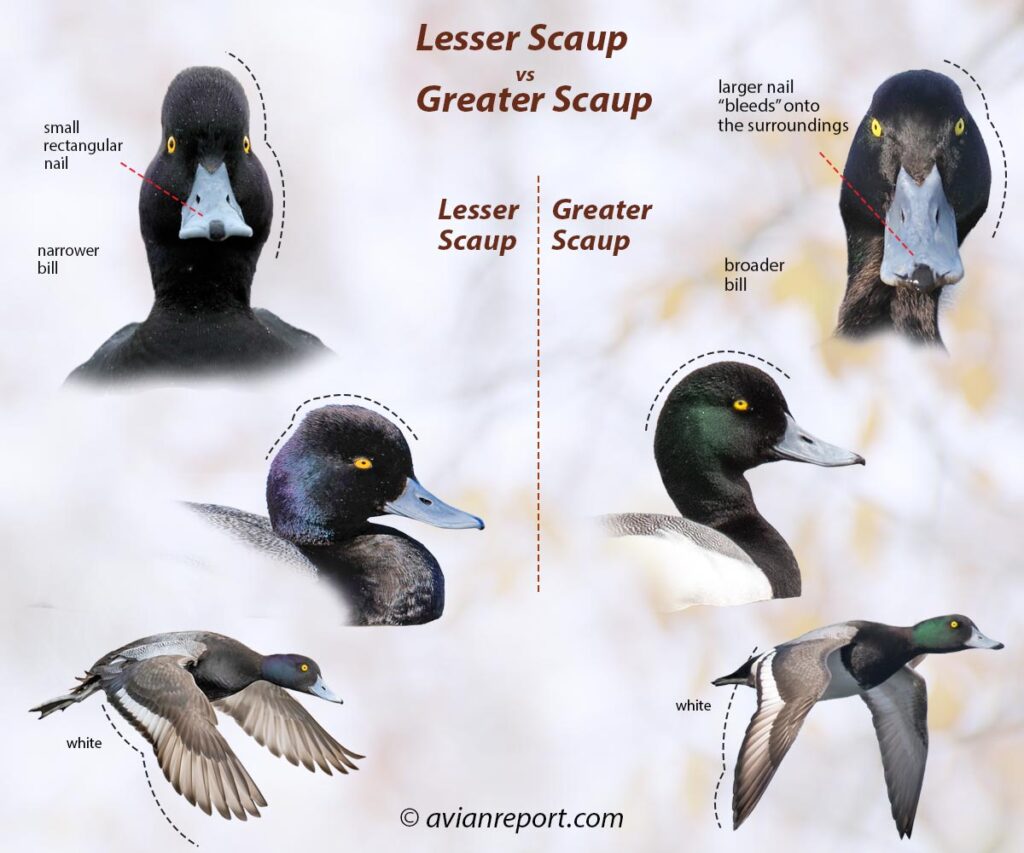
The structural differences between Aythya affinis and Aythya marila are rooted in their distinct evolutionary adaptations to varying environments. The Greater Scaup is a circumpolar species, breeding across the northern hemisphere’s tundra, while the Lesser Scaup is a strictly New World bird with a broader range that extends into temperate prairie wetlands. This difference in breeding geography is reflected in their physical size and mass, with the Greater Scaup being objectively larger and more robust.
Within the North American population, the Lesser Scaup is vastly more numerous, accounting for approximately 90% of the combined population, while the Greater Scaup represents a specialized 10%.
Quantitative Biometric Comparison
Reliable identification often begins with an assessment of the bird’s overall mass and proportions. While size is difficult to judge in a lone individual, it becomes a powerful tool when the two species are found in mixed rafts.
| Metric | Lesser Scaup | Greater Scaup |
| Average Length | 16.5–18.0 in (42–46 cm) | 18.0–22.1 in (46–56 cm) |
| Wingspan | 26.8–30.7 in (68–78 cm) | 28.4–31.1 in (72–79 cm) |
| Average Weight (Male) | 1.8 lbs (830 g) | 2.3 lbs (1,050 g) |
| Average Weight (Female) | 1.6 lbs (725 g) | 2.15 lbs (975 g) |
| Bill-to-Head Ratio | Bill ≈ 2/3 of head length | Bill ≈ 3/4 of head length |
These metrics suggest that the Greater Scaup is approximately 10% longer and up to 20% heavier than the Lesser Scaup. This increased mass is particularly evident in the “heavier-jawed” look of the Greater Scaup when viewed from the front, a result of a broader skull and wider bill base.
Structural Morphology: The Head Shape
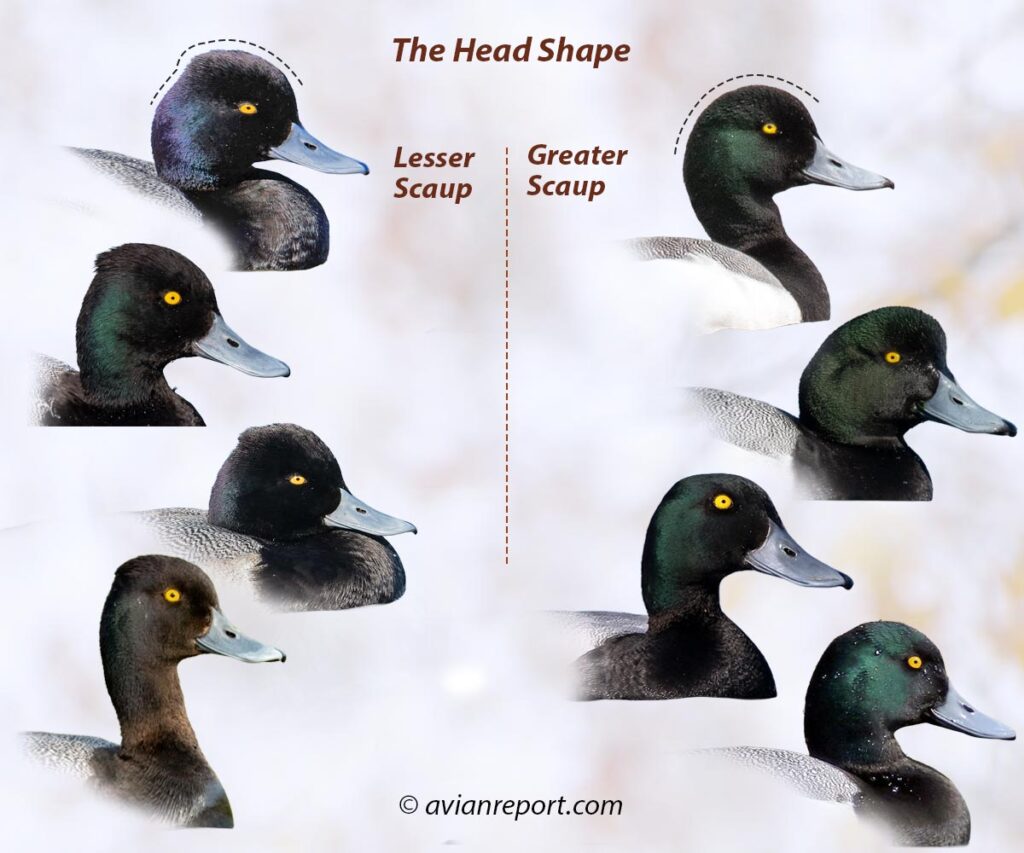
Ornithological experts, including David Sibley, emphasize that head shape is perhaps the most reliable visual clue for birds at rest. This distinction remains valid across sexes and age classes, making it a cornerstone of scaup identification.
The Peaked Crown of the Lesser Scaup
The crown of the Lesser Scaup is dominated by longer feathers located at the posterior of the head. This creates a vertical appearance where the head height often exceeds its horizontal length. When the bird is relaxed, the forehead rises steeply, rounding off to a high, short, peaked crown that descends into a flat nape. This specific arrangement often produces a “notch” or a “corner” at the very back of the head, giving the bird an almost “flat-headed” or “flat-necked” profile compared to its larger cousin.
The Rounded Fan-Shape of the Greater Scaup
In contrast, the Greater Scaup’s head is characterized by a horizontal orientation, where the length of the head appears greater than its height. The forehead slopes more gradually than that of the Lesser Scaup, rounding into a long, evenly curved crown. The highest point of this curve is consistently situated further forward, typically directly above or just in front of the eye. The rear of the head and the nape are smoothly rounded, lacking the angular “peaked” look of the Lesser.
Frontal and Proportional Nuances
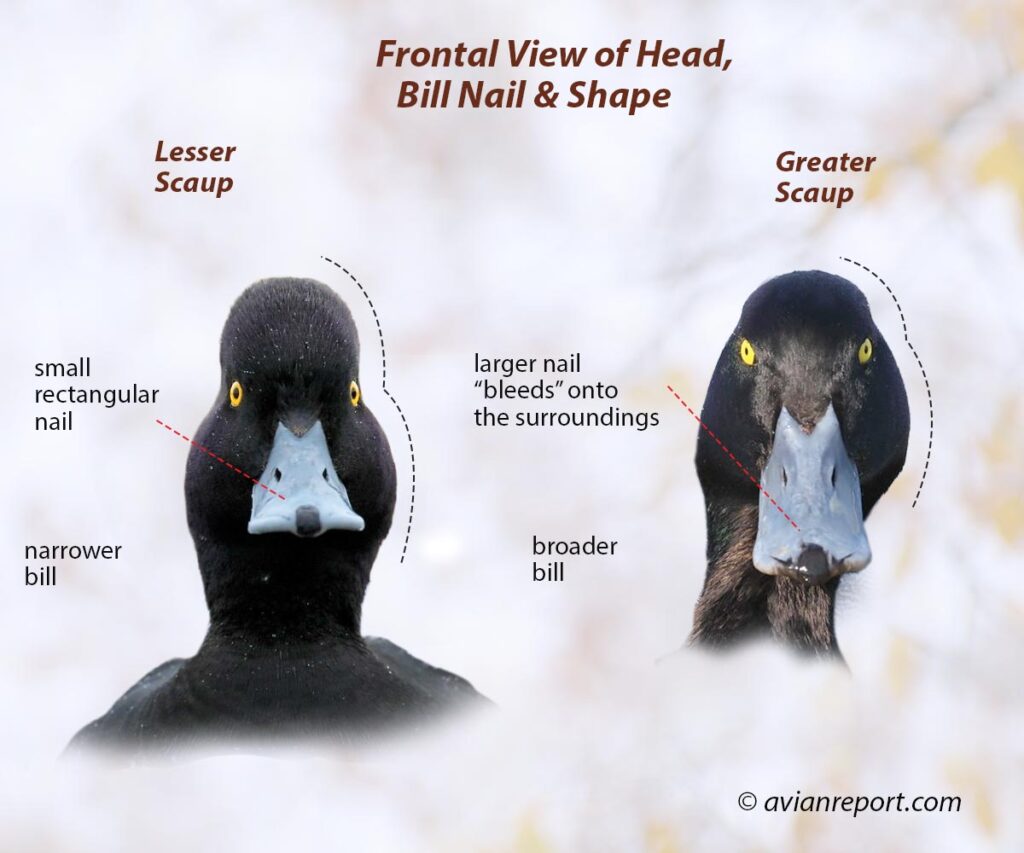
When observed from a frontal perspective, the Greater Scaup displays “chubby cheeks,” with the head width expanding significantly below the eye. This creates a broad, robust appearance that contrasts with the narrower, more vertically aligned face of the Lesser Scaup. Furthermore, the neck of the Lesser Scaup is proportionately thinner, while the Greater Scaup possesses a thicker, more powerful neck suited for its larger body mass.
Technical Deep Dive: Bill Anatomy and Mandible Metrics
For the advanced researcher, the bill provides a secondary suite of diagnostic markers that can confirm an identification even when head shape is ambiguous due to behavioral posturing.
The Bill Nail (Maxillary Unguis)
The nail at the tip of the bill serves as a critical morphological differentiator.
- Lesser Scaup: The nail is small and strictly rectangular in shape. It occupies a smaller percentage of the bill’s tip and is often difficult to see without a high-powered spotting scope or detailed photograph.
- Greater Scaup: The nail is broad, large, and frequently takes on a triangular or rounded-triangular appearance. In drakes, the black pigment of the nail often extends or “bleeds” onto the surrounding blue tissue of the bill, creating a larger dark mark than is ever seen on a Lesser Scaup.
Bill Shape and Concavity
The overall geometry of the bill also differs. The Lesser Scaup’s bill is narrower and possesses a more concave upper mandible (culmen) when viewed from the side. This gives the bill a “scooped” or slightly hooked look. The Greater Scaup has a broader, deeper-based bill that is more robust throughout its length and tends to widen or “flare” slightly toward the tip. This flare is the origin of the regional name “broadbill” used by hunters in the Northeast.
Wing Patterns and Flight Identification
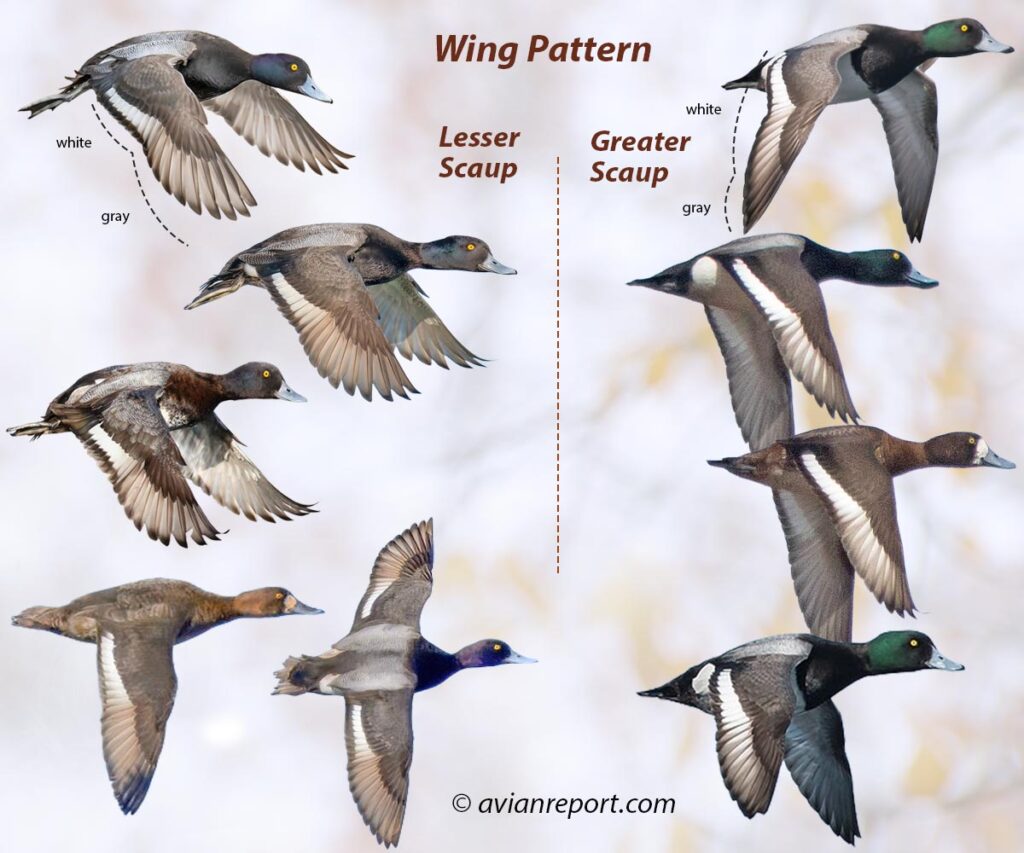
The “wing stripe” diagnostic is frequently cited as the “gold standard” for scaup identification, provided the bird is in flight or actively stretching. This mark is based on the pigmentation of the flight feathers and is remarkably consistent across both sexes.
The Secondary vs. Primary Extension
The white band on a scaup’s wing is formed by the secondaries and, in the case of the Greater Scaup, the inner primaries.
- Lesser Scaup: The white is almost exclusively restricted to the secondary feathers. As the white band reaches the “bend” of the wing (the junction between secondaries and primaries), it stops abruptly, transitioning into a uniform gray or brownish-gray on the primaries.
- Greater Scaup: The white band is more extensive, bleeding out from the secondaries and continuing through the inner and middle primary feathers. In many adult males, this white stripe reaches nearly to the wingtip, creating a bold, elongated flash that is visible at great distances.
Interpretation of the Gradient
Recent digital photography studies have noted that the transition on the Greater Scaup is often more of a gradient, where the white slowly pales as it moves toward the wingtip. In the Lesser Scaup, the color transition is described as “abrupt,” with no significant pale wash extending beyond the secondaries. Observers must be cautious of “blown-out” highlights in bright sunshine, which can make the gray primaries of a Lesser Scaup appear deceptively white.
Plumage and Iridescence: Deconstructing the “Color Trap”
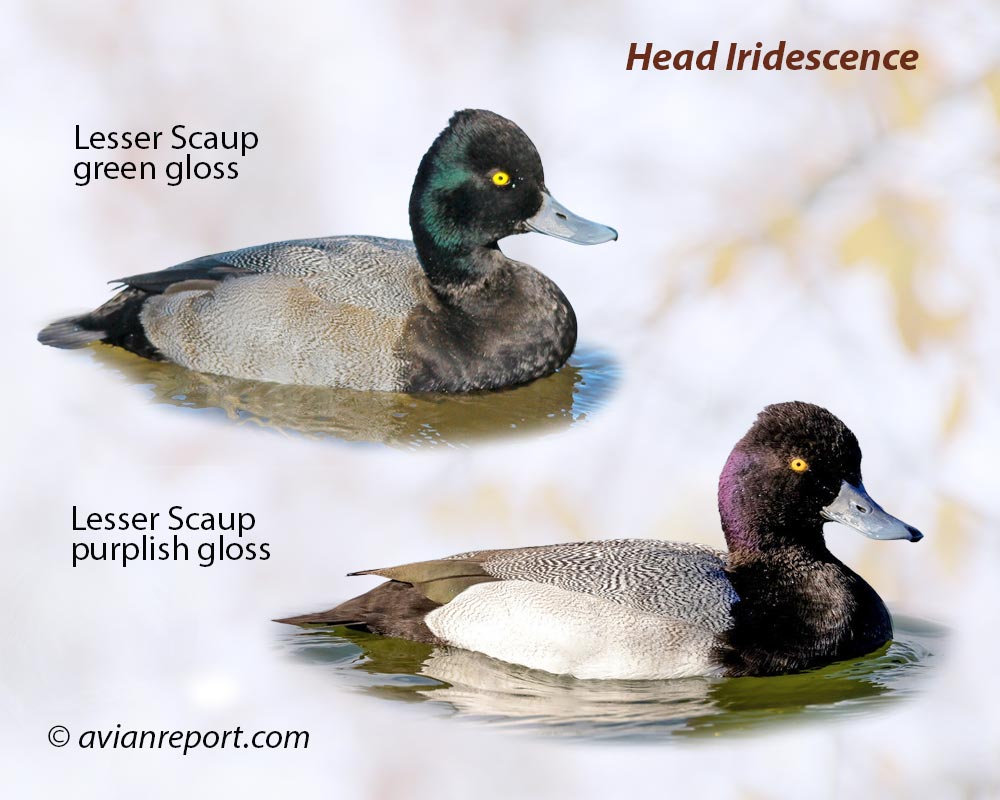
A common misconception in birding is that the head color—purple for Lesser and green for Greater—is a definitive field mark. In reality, head color is a structural iridescence that is highly dependent on light angle and should only be used as supporting evidence.
The Iridescence Paradox
Structural colors in feathers are produced by the microscopic arrangement of keratin and melanosomes, which refract light.
- Lesser Scaup: The head typically shows a purplish gloss, but it can appear distinctly green in many lighting conditions, especially when the bird turns its head toward the sun.
- Greater Scaup: The head almost always shows a green gloss and very rarely, if ever, displays purple. A purple sheen is a strong indicator of a Lesser Scaup, but a green sheen is entirely non-diagnostic.
Back and Flank Contrast
The density of vermiculation—the fine black-and-white barring on the mantle and scapulars—provides another subtle clue for drakes in breeding plumage.
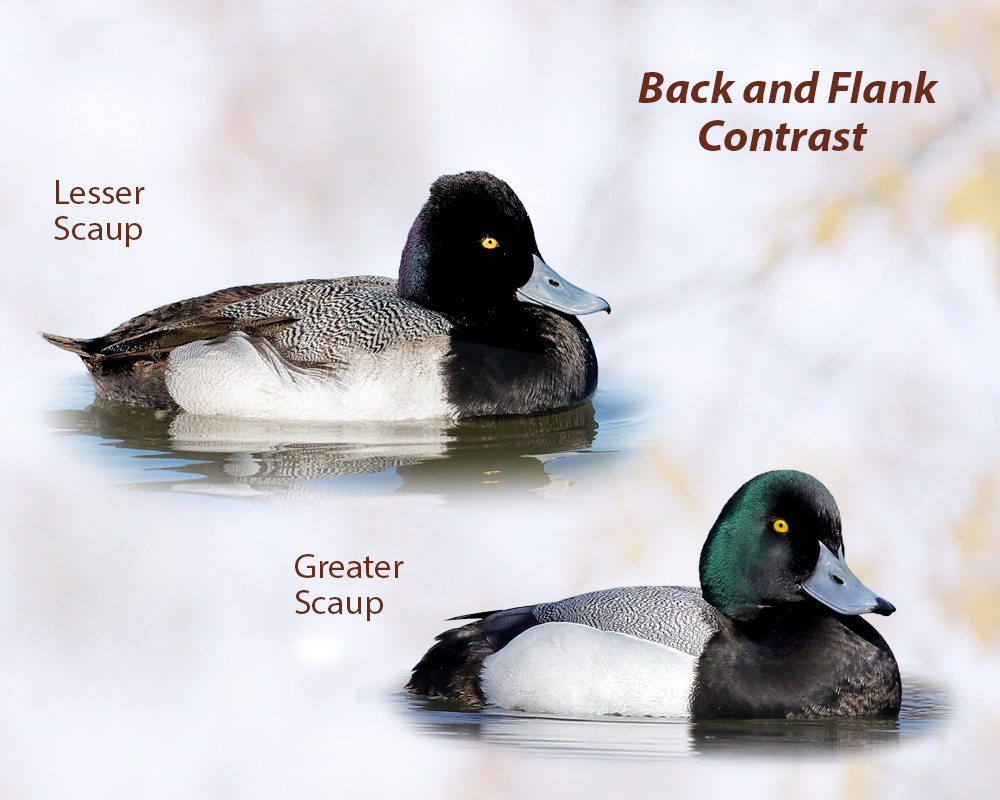
- Greater Scaup: The white bars are wider and the black bars thinner, resulting in a back that appears lighter gray or even white from a distance. The flanks are often stark, “bleached” white with very little visible stippling.
- Lesser Scaup: The black barring is denser and coarser, making the back appear darker gray. The flanks are frequently washed with a pale gray stippling, giving the bird a “dirtier” or more textured look compared to the “clean” Greater.
Age-Class Diagnostics: Juveniles and Intermediate Plumages
The identification challenge intensifies when dealing with females, juveniles, and males in eclipse or intermediate plumage. During these stages, observers must rely on a combination of structural marks and the progression of soft-part colors.
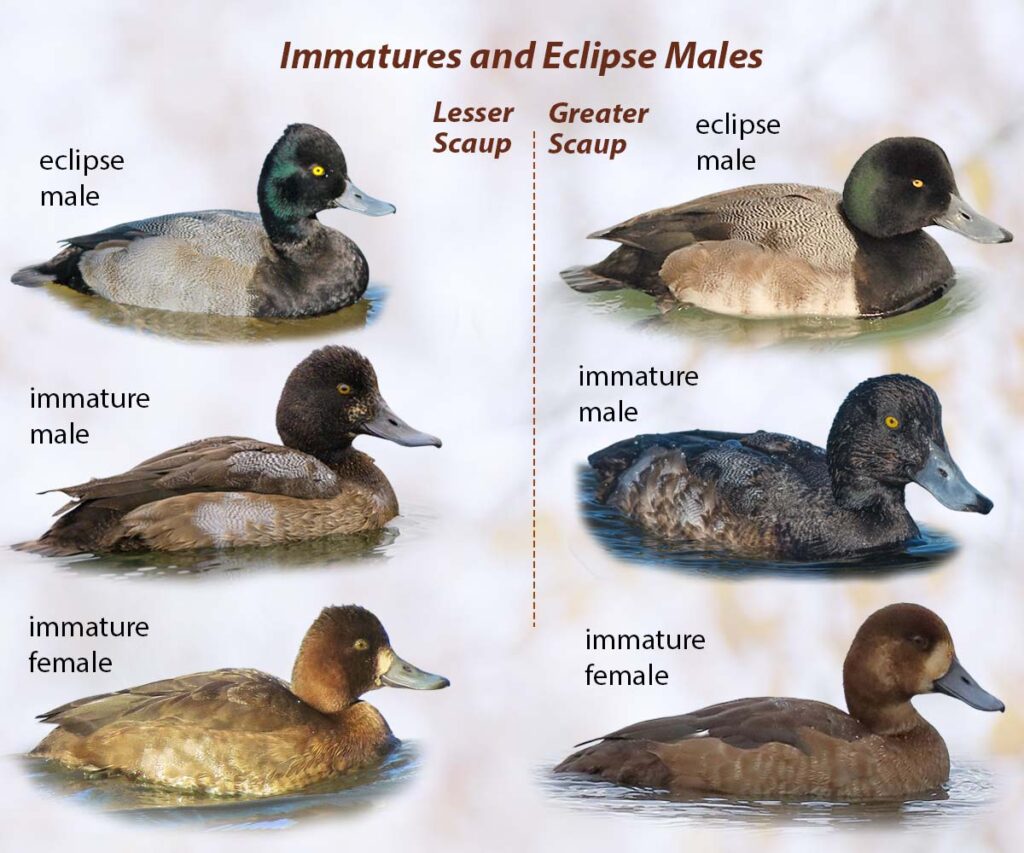
Immature and Eclipse Males
During the autumn and early winter, many scaups are in a state of partial molt. Immature males often appear as a “mottled” version of the adult, with a dark head and chest but brownish-gray flanks and a duller, gray-blue bill. In these cases, head shape and the wing stripe remain the only reliable diagnostics, as the body plumage is too inconsistent to trust.
The 3-Year Iris Progression in Females
One of the most fascinating aspects of scaup biology is the age-related change in iris color, particularly in females.
- Juveniles: Both sexes are born with dark brown or olive-colored irises.
- Lesser Scaup Females: Research conducted in the Northwest Territories indicates that the transition to the classic yellow eye is a multi-year process.
- First Year: Dark brown to brownish-olive.
- Second Year: Transitional olive-yellow or brownish-yellow.
- Third Year and Beyond: Bright lemon yellow. Because this transition is protracted, a female with a dark or “muddy” eye in winter is almost certainly a bird of the year (hatch-year) or a second-year individual.
Female Facial Patches and Caps
Females of both species are predominantly brown with a white patch at the base of the bill.
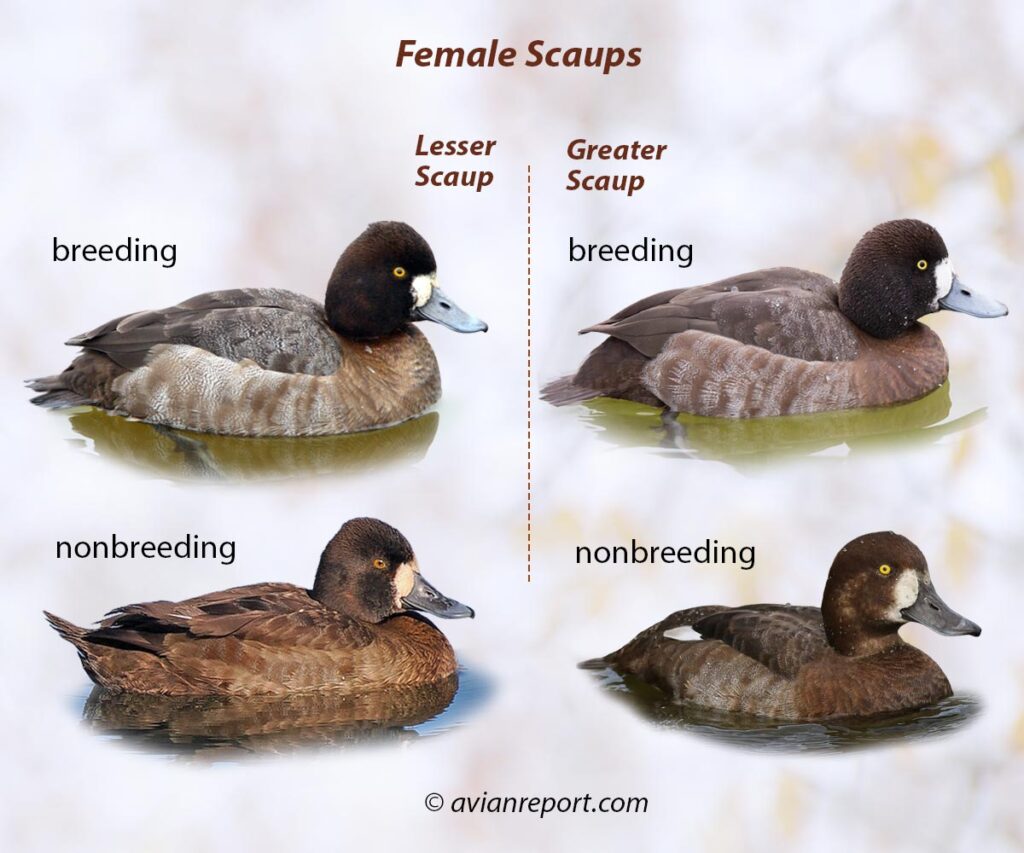
- Lesser Scaup Female: Generally shows a more pronounced dark “cap” on the head, which contrasts with the slightly paler cheeks, and the peak at the rear of the crown is usually visible.
- Greater Scaup Female: The head is more uniform in its warm chocolate-brown tone, and the rounded profile is typically maintained. Occasionally, older females may develop a pale “ear patch” behind the eye in summer or even show subtle male-like vermiculation on the back.
Behavior and Ecological Niche Differentiation
While morphological overlap is high, the two species have evolved to fill slightly different ecological niches, which can provide valuable context for identification.
Habitat and Salinity Preferences
A general rule of thumb used by many birders is the “Salt vs. Fresh” divide.
- Greater Scaup: Strongly prefers large, open-water environments. In winter, they are most common on saltwater bays, coastal estuaries, and the Great Lakes. They are rare on small, sheltered inland lakes.
- Lesser Scaup: A generalist that is equally at home on coastal bays and small, inland freshwater ponds, reservoirs, and marshes. If you see a lone scaup on a small neighborhood pond in the interior of the country, the statistical probability favors Lesser Scaup by a wide margin.
Foraging and Posture
Head shape can change significantly depending on the bird’s activity.
- Loafing/Sleeping: This is the optimal time to judge head shape, as the feathers are relaxed.
- Diving: Before submerging, scaups engage in “feather-flattening” to reduce buoyancy. This “hair-slicking” behavior compresses the crown feathers, making even a Lesser Scaup look round-headed and making identification nearly impossible during active foraging.
- Rafting Dynamics: Both species form large, dense flocks known as “rafts”. Interestingly, while they may share the same body of water, they rarely intermingle freely, instead forming tight, species-specific clusters within the larger group.
Reproduction and Brood Size
On the breeding grounds, a subtle behavioral clue can be found in the size of the broods.
- Lesser Scaup: Typically has larger broods, ranging from 8 to 14 ducklings.
- Greater Scaup: Typically has smaller broods, ranging from 5 to 11 ducklings.
Similar Species: Avoiding Common Misidentifications
The scaup identification challenge is often complicated by the presence of other “Oreo ducks” that share similar habitats and plumage patterns.
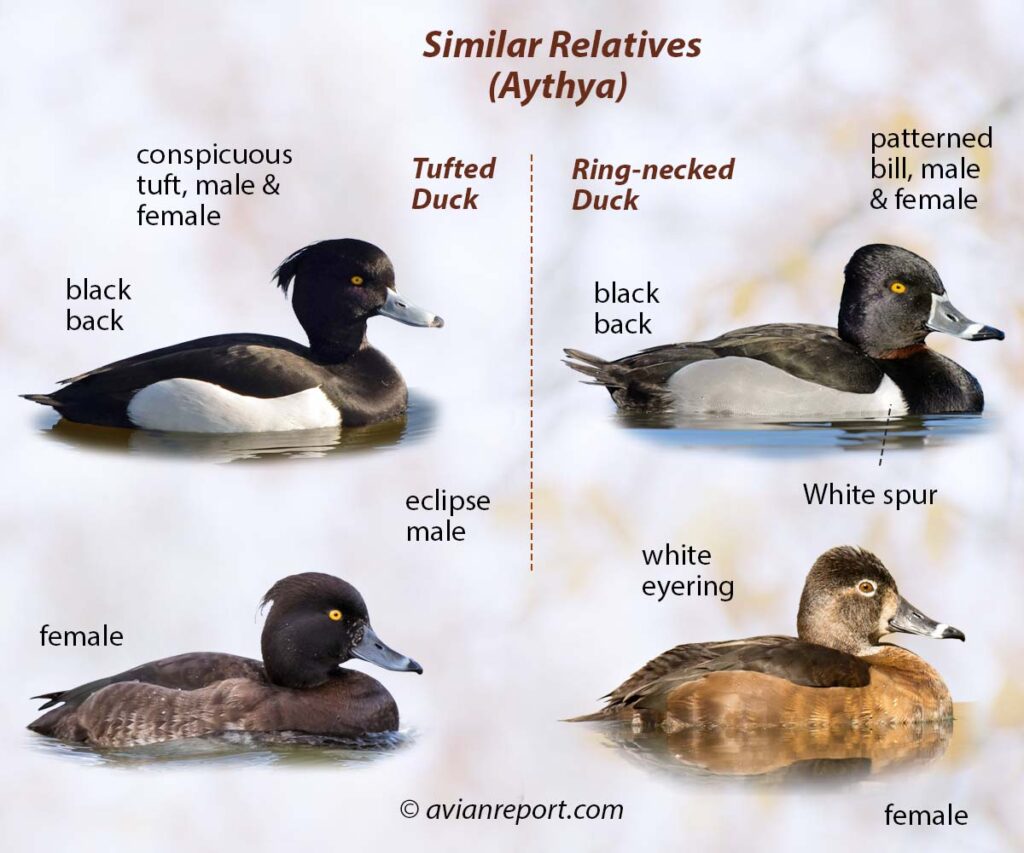
Ring-necked Duck (Aythya collaris)
The most common source of confusion is the Ring-necked Duck.
- Bill: Ring-necked Ducks have a distinctive white ring near the tip of the bill and a white base, which both scaup species lack.
- Back: The male Ring-necked Duck has a solid black back, whereas both scaups have gray, vermiculated backs.
- Flanks: Ring-necked Ducks show a prominent white “spur” or vertical bar at the front of the gray flanks, a mark absent in scaups.
Tufted Duck (Aythya fuligula)
A rare vagrant from Eurasia, the Tufted Duck is occasionally found in scaup rafts.
- Crest: The male Tufted Duck has a long, drooping crest of feathers at the back of the head.
- Back: The Tufted Duck has a solid black back, making it more similar to the Ring-necked Duck than the scaups.
Conclusion: The Ethics of Reporting
The identification of Lesser and Greater Scaup is a skill that develops over years of field observation. Even the most experienced ornithologists occasionally encounter birds that defy certain categorization due to individual variation, poor lighting, or extreme distance. In such instances, the most scientifically rigorous action is to report the bird as “Greater/Lesser Scaup” or “Scaup sp.”. This humility in reporting ensures that population data remains accurate and that the integrity of regional records is maintained. By focusing on the structural “Triple-Threat” of head shape, wing stripe, and bill nail, birders can approach every “bluebill” sighting with the confidence of a senior researcher and the precision of a master field observer.
Diagnostic Summary: The Triple-Threat Identification
For those seeking an immediate determination in the field, identification should focus on the “Triple-Threat” of diagnostic marks. These features offer the highest statistical probability of a correct identification when viewed in combination under adequate light.
- Head Profile and Peak Position: The Lesser Scaup typically presents a taller, narrower head with a distinct peak or “notch” located toward the rear of the crown, behind the eye. The Greater Scaup features a broader, more smoothly rounded head, often described as fan-shaped, with the highest point of the curve positioned further forward, typically above or slightly in front of the eye.
- Wing Stripe Extension: In flight or when the bird flaps its wings while on the water, the white wing stripe of the Lesser Scaup is largely restricted to the secondary feathers, terminating abruptly at the “bend” of the wing. In the Greater Scaup, this white stripe extends significantly into the inner primary feathers, creating a longer, more continuous band that reaches toward the wingtip.
Bill Nail Morphology: The small black tip of the bill, known as the nail, is narrow and rectangular in the Lesser Scaup. In the Greater Scaup, the nail is broader and often triangular, frequently featuring a dark pigment that “bleeds” into the surrounding blue of the bill tip.
Photo Credits:
The photographic material used in this article comes from photos licensed under “Creative Commons” and mostly from birders and photographers. I am profoundly grateful for your generous support in making these images available; they have truly made this article possible. Many thanks to Andrew Morffew, Mark Mochell, Elizabeth Milson, Emily Chen, Dennis Church, Wendy Miller, Ken Slade, John Benson, Mick Thompson, Steve Guttman, Nicole Beaulac, Andy Reago, Chrissy McLaren, Garry C., Shawn Taylor, Steve Kersting, Gary Leaven, Vicky DeLoach, Don Hoechlin, Tom Murray, Kevin Krebs, Deborah Freeman, Kenneth Cole-Schneider, Doug Greenberg, Ian Preston, Brian Garrett, John Strung, Becky Matsubara, Judy Gallagher, Bob Jensen, Veit, Sand Diego Zoo, David Inman, Dan Mooney, Ian Preston, Lloyd Davis, Denis Fournier, Gregory Heaton, Greg Lavaty, Dona Hilkey, Alain Doyle, Aaron Maizlish, Ashley Tubs, Richard George, Ethan Gosnell, Nick, , Steve Valasek, Mitch Walters, , and Julio Mulero.
References:
allaboutbirds.org: Greater Scaup/Lesser Scaup Identification – All About Birds, Cornell Lab of Ornithology.
arizonabirds.org: Identification Challenge: Lesser vs. Greater Scaup – Arizona Birds.
audubon.org: Greater or Lesser Scaup? Here Are the Biggest Differences – National Audubon Society.
digitalcommons.usf.edu: Eye Color of Female Lesser Scaup in Relation to Age – Digital Commons @ USF, University of South Florida.
digitalcommons.usf.edu: Identification Challenge: Lesser vs. Greater Scaup – Digital Commons @ USF, University of South Florida.
drundel.com: Separation of Greater and Lesser Scaups – Duck Identification Using Wing Plumage.
ducks.org: Greater Scaup – Ducks Unlimited.
ducks.org: Lesser Scaup: Key Identification, Habitat & Migration Information – Ducks Unlimited.
featheredphotography.com: Greater Scaup – Using Knowledge of Behaviors to Get the Shot You’re After – Feathered Photography.
fieldandstream.com: The Bluebill Duck: How to Identify, Hunt and Cook Scaup – Field & Stream.
mbr-pwrc.usgs.gov: Greater Scaup Identification Tips – USGS Patuxent Wildlife Research Center.
myodfw.com: Scaup – Oregon Department of Fish & Wildlife.
newconaturalist.wordpress.com: ID Challenge: Greater and Lesser Scaup – New Colorado Naturalist.
rwdigital.ca: 6 Must-Know SEO Tips for 2026 – RW Digital.
stateofthebirds.nhaudubon.org: Greater Scaup – NH Audubon.
stokesbirdingblog.blogspot.com: Lesser Scaup Identification – Stokes Birding Blog.
toddhensonphotography.com: Lesser Scaup – Todd Henson Photography.
utahbirds.org: Comparison of Greater and Lesser Scaups – Utah Birds.
wildlifetrusts.org: How to Identify Diving Ducks – The Wildlife Trusts.
Author:
