
Identifying female Blue-winged Teal (Spatula discors) vs. female Cinnamon Teal (Spatula cyanoptera) can be a challenge. While breeding drakes are unmistakable, females, Blue-winged Teal juveniles vs. Cinnamon Teal, and Blue-winged eclipse males vs. Cinnamon Teal all share confusingly similar “brown duck” plumage. To master female teal identification, you need to look beyond the blue wing patches they both share. This guide breaks down the essential structural nuances, bill shapes, and facial contrasts you need to confidently identify these ducks in the field.
- The "ID Myth" vs. Reality
- 1. Head Pattern and Facial Contrast
- 2. Bill Structure
- 3. Overall Color Tone
- 4. Eye Color (Adult Females Only)
- Quick Diagnostic Comparison Table
- Range and Habitat Considerations
- 1. The "Ghost" Facial Pattern
- 2. Eye Color
- 3. Wing Coverts and Scapulars
- Comparison at a Glance: Eclipse Drakes
- Pro-Tip: The "Transition" Window
- Juvenile Birds
- Conclusions
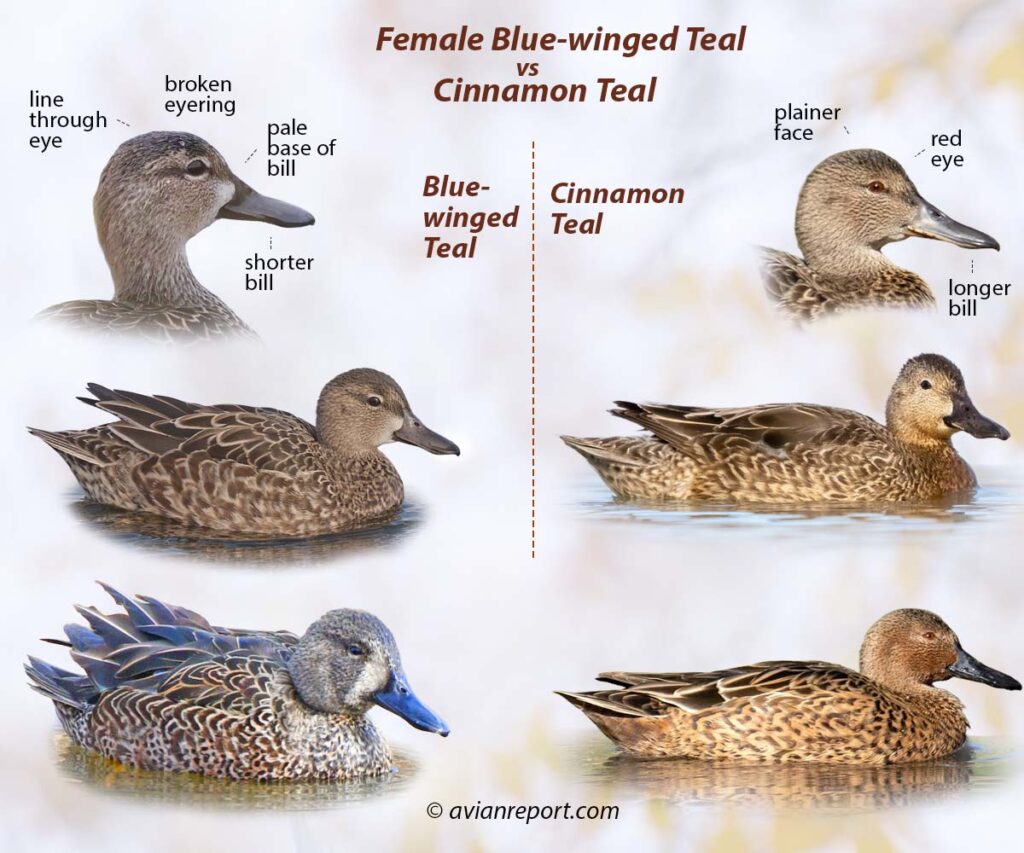
The “ID Myth” vs. Reality
Many birders rely on the blue wing patch (the “upperwing coverts”) to separate these species. Do not fall into this trap. Both species possess nearly identical sky-blue wing patches. Unless the bird is in flight or stretching, this feature won’t help you differentiate the two.
Instead, use the following “Four Pillars of Identification”:
1. Head Pattern and Facial Contrast
This is your most reliable field mark for stationary birds.
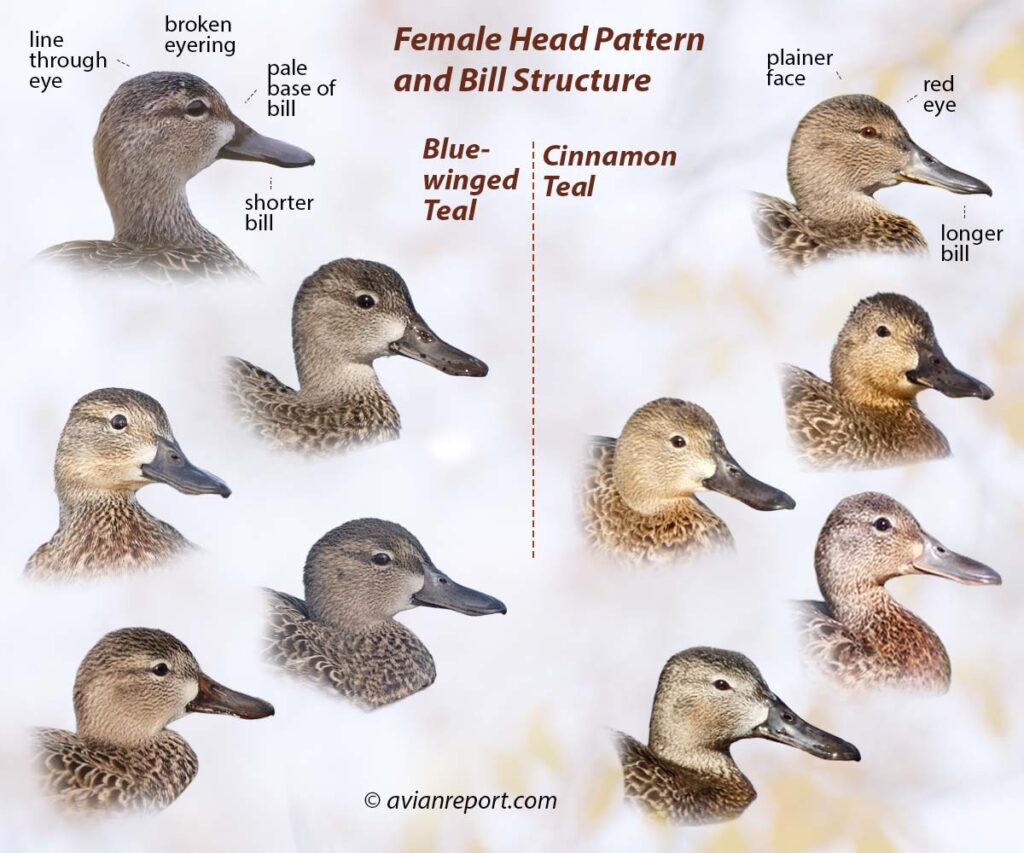
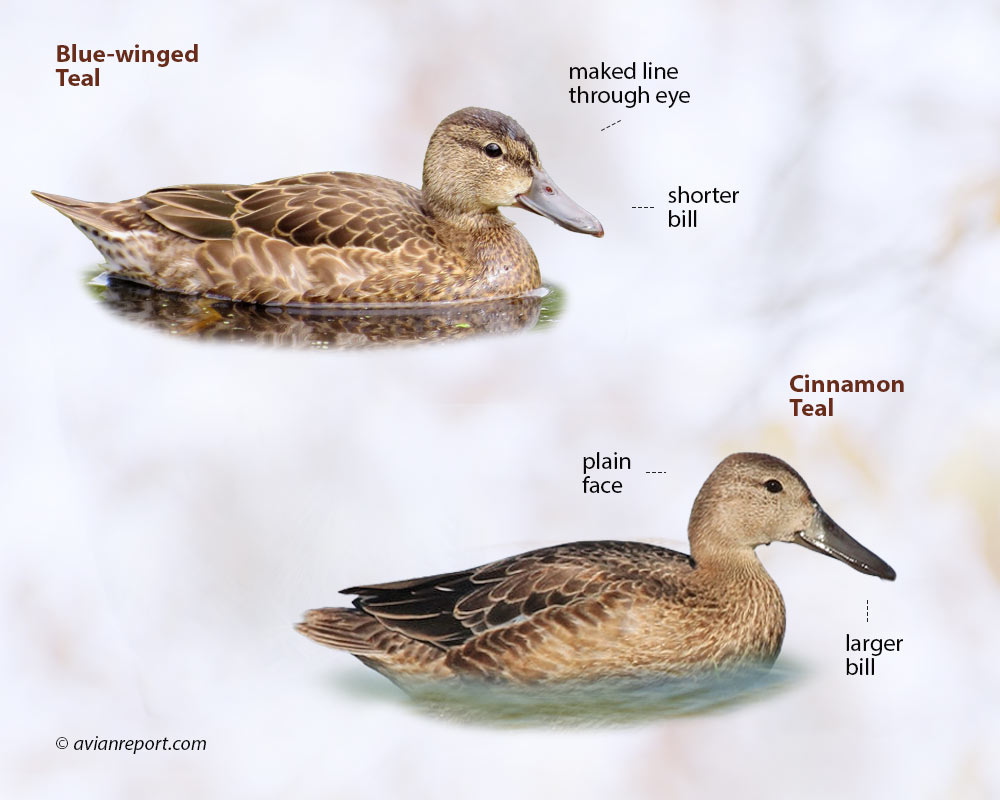
- Blue-winged Teal: Generally shows a high-contrast face. Look for a distinct dark line through the eye, a dark crown, and a notable pale spot at the base of the bill. There is usually a broken white eye-ring that appears more prominent against the darker face.
- Cinnamon Teal: Features a low-contrast, “plainer” face. The eye line is smudged or absent, and the overall head color is a warmer, more uniform buffy-brown. They lack the distinct pale loral spot (the area between the eye and bill) seen in Blue-wings.
2. Bill Structure
If the light is flat and plumage is worn, look at the “tool” on the bird’s face.
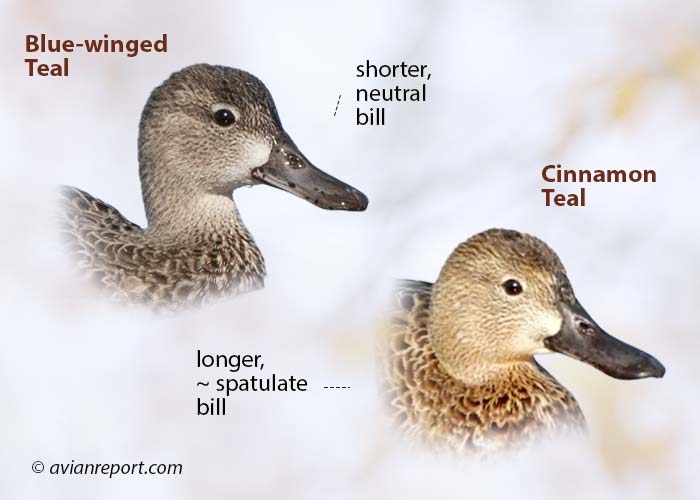
| Feature | Blue-winged Teal | Cinnamon Teal |
| Length | Relatively shorter. | Noticeably longer and “heavier.” |
| Shape | Straight, fairly neutral. | Slightly “spatulate” (expanded toward the tip). |
| Profile | Proportional to the head. | Often looks “front-heavy” or shoveler-like. |
3. Overall Color Tone
While lighting can be deceptive, the “wash” of the bird is a strong secondary clue.
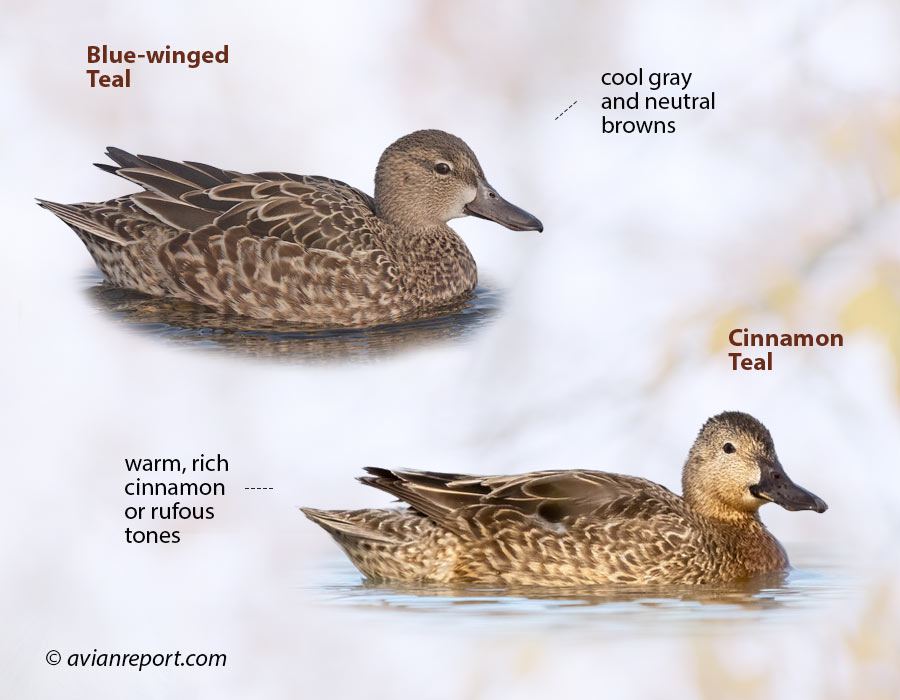
- Blue-winged Teal: Tends toward cool grays and neutral browns. The spotting on the flanks is often crisp and dark.
- Cinnamon Teal: Tends toward warm, rich cinnamon or rufous tones, even in females. The breast and flanks often look “muddier” or more saturated.
4. Eye Color (Adult Females Only)
- Blue-winged Teal: Always a dark brown iris.
- Cinnamon Teal: Occasionally shows a pale or dull orange iris, though this is variable and requires an excellent light and spotting scope view.
Expert Tip: The “Eye-Ring” Check
If you see a bold, clean white eye-ring on a plain-faced bird, look closer at the bill. If the bill is very large, you might actually be looking at a female Northern Shoveler. Teal eye-rings are typically thinner and more “broken.”
Quick Diagnostic Comparison Table
| Feature | Blue-winged Teal (Female) | Cinnamon Teal (Female) |
| Loral Spot | Distinct, bright pale spot at bill base. | Indistinct or absent; face looks uniform. |
| Eye Line | Dark, well-defined through the eye. | Faint, blurry, or non-existent. |
| Overall Impression | “Clean” face, “cold” body tones. | “Plain” face, “warm” body tones. |
| Bill Shape | Standard teal bill. | Longer, slightly expanded at the tip. |
Range and Habitat Considerations
Geography is your friend, but it is not a guarantee.
DISTRIBUTION MAPS
- Blue-winged Teal are widespread across North America but are the dominant “blue-winged” teal in the East and Midwest.
- Cinnamon Teal are primarily birds of the West.
Caution: In the Great Basin and Central Valley, both species frequently hybridize. If a bird shows intermediate characteristics—such as a faint loral spot but a very long, spatulate bill—it may be a hybrid.
The “Eclipse” Enigma: Distinguishing Molting Males
In late summer and early autumn, male teals undergo a prebasic molt, losing their bright breeding colors for a cryptic “eclipse” plumage that resembles females. This is often the most frustrating window for identification, as the birds are flightless and drab.
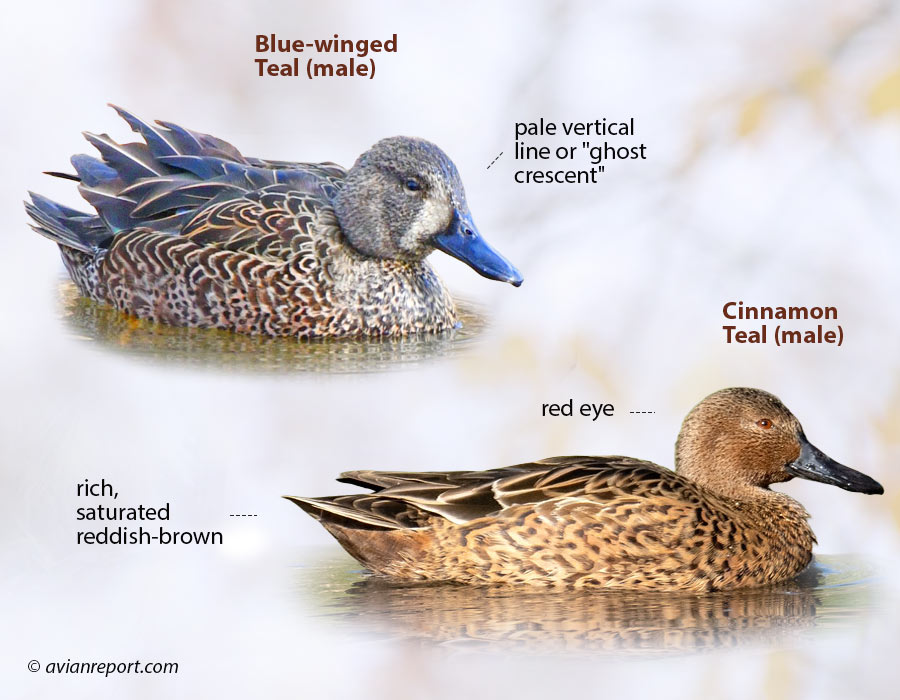
However, “Eclipse” males (and transitioning drakes) offer slightly different clues than females. Here is how to separate them:
1. The “Ghost” Facial Pattern
Even in full eclipse, many males retain a faint “shadow” of their breeding finery.
- Blue-winged Teal: Look for a faint, pale vertical line or “ghost crescent” between the eye and the bill. Even if the white is gone, the feathering in that area often remains paler than the rest of the face.
- Cinnamon Teal: The face remains stubbornly uniform. You won’t see a ghost crescent, but you may see a richer, more saturated reddish-brown wash on the cheeks compared to a true female.
2. Eye Color
This is often the “smoking gun” for eclipse drakes.
- Blue-winged Teal: Drakes typically maintain a dark brown or blackish iris, making it very difficult to distinguish from a female based on the eye alone.
- Cinnamon Teal: Adult males almost always retain their striking red or vivid orange iris throughout the eclipse phase. if you see a “female-type” teal with a piercing red eye, it is a Cinnamon Teal drake.
3. Wing Coverts and Scapulars
While the blue wing patches are similar, the long feathers over the back (scapulars) can differ:
- Blue-winged Teal: Scapulars are usually more patterned with buffy internal markings or “V” shapes.
- Cinnamon Teal: Scapulars in molting males often appear more solid and darker, sometimes retaining a few unpatterned, rusty-edged feathers from the previous season.
Comparison at a Glance: Eclipse Drakes
| Feature | Blue-winged Teal (Eclipse Male) | Cinnamon Teal (Eclipse Male) |
| Iris Color | Dark Brown | Vivid Red or Bright Orange |
| Facial Markings | Faint “ghost” of a white crescent. | Plain, uniform, warm brown. |
| Overall Tone | Cool, grayish-brown. | Warm, rufous-tinted brown. |
| Bill | All black, moderate length. | All black, long and shovel-like. |
Pro-Tip: The “Transition” Window
By late September and October, many drakes begin their pre-alternate molt back into breeding plumage.
- Look for “Pin-feathers”: A Blue-winged Teal male might start showing a few white feathers in the crescent area.
- Look for “Rust”: A Cinnamon Teal male will start showing patches of solid, deep cinnamon feathers appearing on the breast or flanks.
Juvenile Birds
Bill Structure and Facial Tone
Even in mottled juvenile plumage, subtle structural and facial clues help separate these two similar teals.
• Cinnamon Teal: Shows a noticeably longer, broader, more spatulate (“shoveler-like”) bill, paired with a warmer, plainer rusty-brown face and only a faint or absent line through the eye. White loral spots are typically absent or very subtle. Overall tone tends toward richer reddish-brown.
• Blue-winged Teal: Exhibits a thinner, more delicate bill and a cooler gray-brown face with clearer patterning. A more distinct darker line through the eye, variable white eye-ring or loral spot, and a generally grayer overall tone are common.
Additional Seasonal Clues
Some late-season individuals provide extra hints beyond structure and tone.
• Cinnamon Teal (juvenile males in late summer/autumn): May begin showing reddish eye color as they molt toward adult plumage.
• Blue-winged Teal (juvenile males): Typically retain dark eyes.
Field Impression
When views are brief, focus on the combination of bill size and facial warmth.
• Cinnamon Teal: Large, broad bill plus plain, warm-toned face.
• Blue-winged Teal: Smaller bill with a cooler, more intricately patterned face.
Conclusions
- Structure Over Color: When identifying female-type teals, always prioritize bill shape and facial contrast over plumage “warmth,” which can be distorted by lighting.
- The Loral Spot is Key: For stationary birds, the presence of a crisp, pale spot at the base of the bill is the most reliable indicator of a Blue-winged Teal.
- Check the Eyes: In late summer, always carry a spotting scope. A red or orange eye on a drab, brown duck is the “smoking gun” that identifies an eclipse male Cinnamon Teal.
- Respect the “Teal sp.”: If the bird is distant, the light is flat, or the individual shows intermediate traits in the West, it is scientifically responsible to record it as a “Blue-winged/Cinnamon Teal” hybrid or species pair.
- Practice Makes Perfect: Late summer and early autumn provide the best opportunity to study these birds side-by-side during their most challenging plumage phases.
Photo Credits:
The photographic material used in this article comes from photos licensed under “Creative Commons” and mostly from birders and photographers. I am profoundly grateful for your generous support in making these images available; they have truly made this article possible. Many thanks to Andrew Morffew, Mark Mochell, Elizabeth Milson, Emily Chen, Dennis Church, Wendy Miller, Ken Slade, John Benson, Mick Thompson, Steve Guttman, Nicole Beaulac, Andy Reago, Chrissy McLaren, Garry C., Shawn Taylor, Steve Kersting, Gary Leaven, Vicky DeLoach, Don Hoechlin, Tom Murray, Kevin Krebs, Deborah Freeman, Kenneth Cole-Schneider, Doug Greenberg, Ian Preston, Brian Garrett, John Strung, Becky Matsubara, Judy Gallagher, Bob Jensen, Veit, Sand Diego Zoo, David Inman, Dan Mooney, Ian Preston, Lloyd Davis, Denis Fournier, Gregory Heaton, Greg Lavaty, Dona Hilkey, Alain Doyle, Aaron Maizlish, Ashley Tubs, Richard George, Ethan Gosnell, Nick, , Steve Valasek, Mitch Walters, , and Julio Mulero.
Author:

Amazingly useful for identifying a blue-winged teal in a photo I got. The face colorings gave it away.
Hello Rowan, glad to hear that the the note on Females Blue-winged and Cinnamon Teals was helpful!
Al.