
Distinguishing between female Common and Red-breasted Mergansers is a classic birding challenge, often requiring careful observation of subtle field marks. This guide breaks down the key diagnostic differences, focusing on the “crisp vs. blurry” neck line, bill structure, and crest shape to help birders identify these look-alike diving ducks.
The Neck Transition: “Crisp vs. Blurry”
This is the single most reliable field mark for a bird at rest.
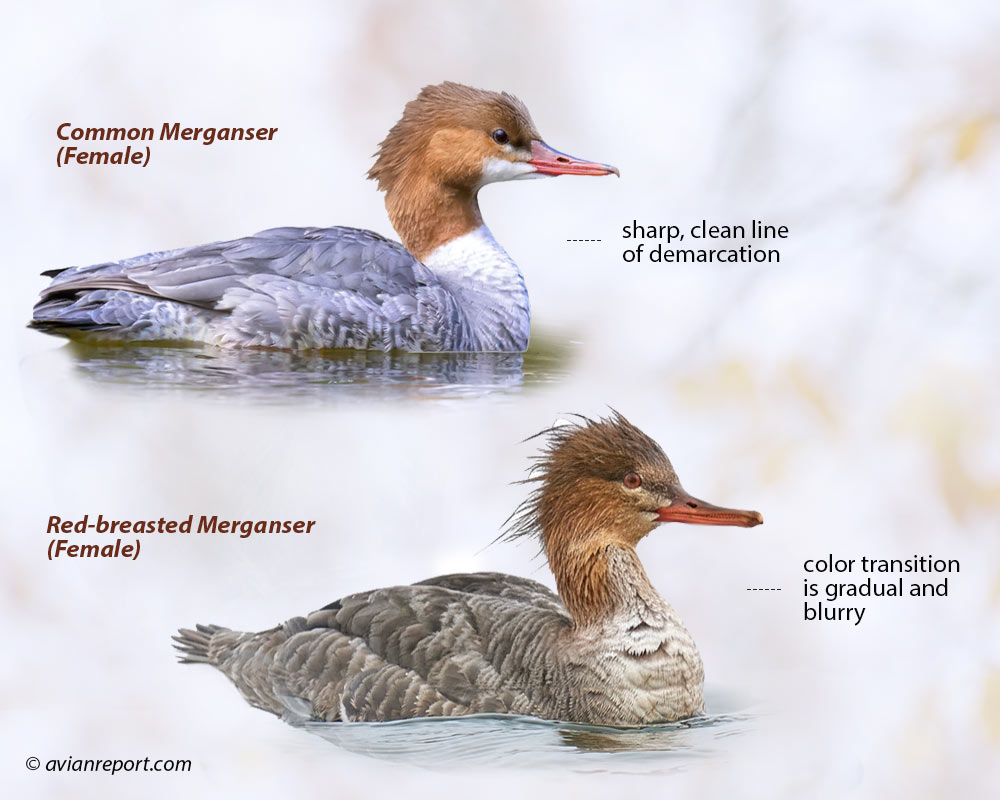
- Common Merganser: Features a sharp, clean line of demarcation where the rusty-cinnamon head meets the white/pale gray neck. It looks like the bird is wearing a crisp, high-collared sweater. There is often a distinct white chin patch that pops against the red.
- Red-breasted Merganser: The color transition is gradual and blurry. The brown of the head fades slowly into the gray of the neck with no clear “border.” Think of it as a “gradient” effect rather than a clean cut.
Bill Structure and Nostril Placement
When the light is flat and colors are hard to see, silhouette and bill structure become your primary tools.
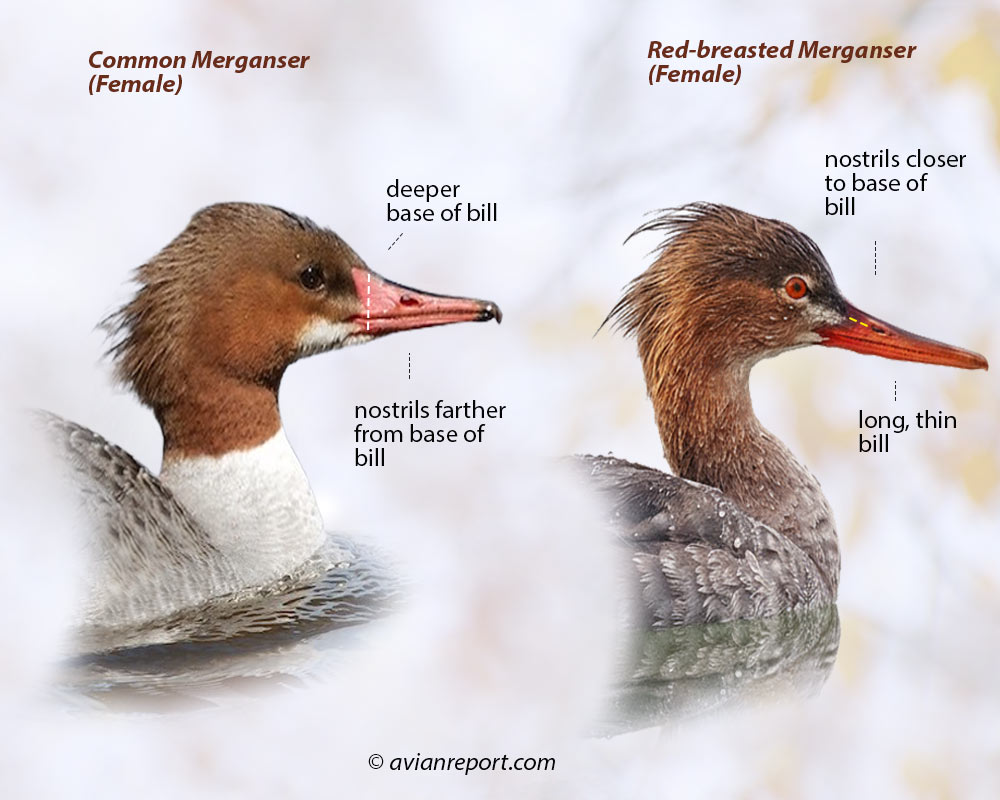
- The Bill Shape: The Common Merganser has a thicker, heavier bill that is deep at the base. The Red-breasted Merganser has a noticeably thinner, more delicate bill that often appears slightly “upturned”.
- The Nostril: If you have a high-quality scope view, look at the nostril placement.
- In the Common Merganser, the nostril is located near the middle of the bill.
- In the Red-breasted Merganser, the nostril is located near the base (closer to the feathers).
The Lores and Facial Pattern
The “lores” (the space between the eye and the bill) provide subtle but definitive clues.
- Red-breasted Merganser: The lores are generally pale, making the eye stand out.
- Common Merganser: The lores are usually the same color as the rest of the head or a dark smudge extending from the eye to the bill.
The “Bad Hair Day” Factor (Crest Shape)
While both species possess crests, the “vibe” of the plumage differs:
- Common: Has a thicker, more rounded, and uniform crest that drapes down the back of the head.
- Red-breasted: Features a “punk rock” look—the crest is often wispy, thin, and double-pointed, looking more like a messy tuft of hair than a smooth mane.
Comparison Cheat Sheet
| Feature | Female Common Merganser | Female Red-breasted Merganser |
| Neck Border | Sharp, crisp transition | Gradual, blurry fade |
| Bill Shape | Heavy, deep at base | Thin, delicate, slightly upturned |
| Nostril | Near the center of the bill | Near the base of the bill |
| Lores | Pale/Clean | Darker smudge/line |
| Chin Patch | Distinct white patch | Indistinct or absent |
| Typical Habitat | Freshwater (Lakes/Rivers) | Saltwater/Brackish (Coasts/Estuaries) |
Nonbreeding males and Juveniles
During the late summer and autumn, your “female” merganser might actually be a juvenile or a male in nonbreeding plumage. However, the color transition between the head and neck, the bill shape, size, and nostril placement remains consistent.
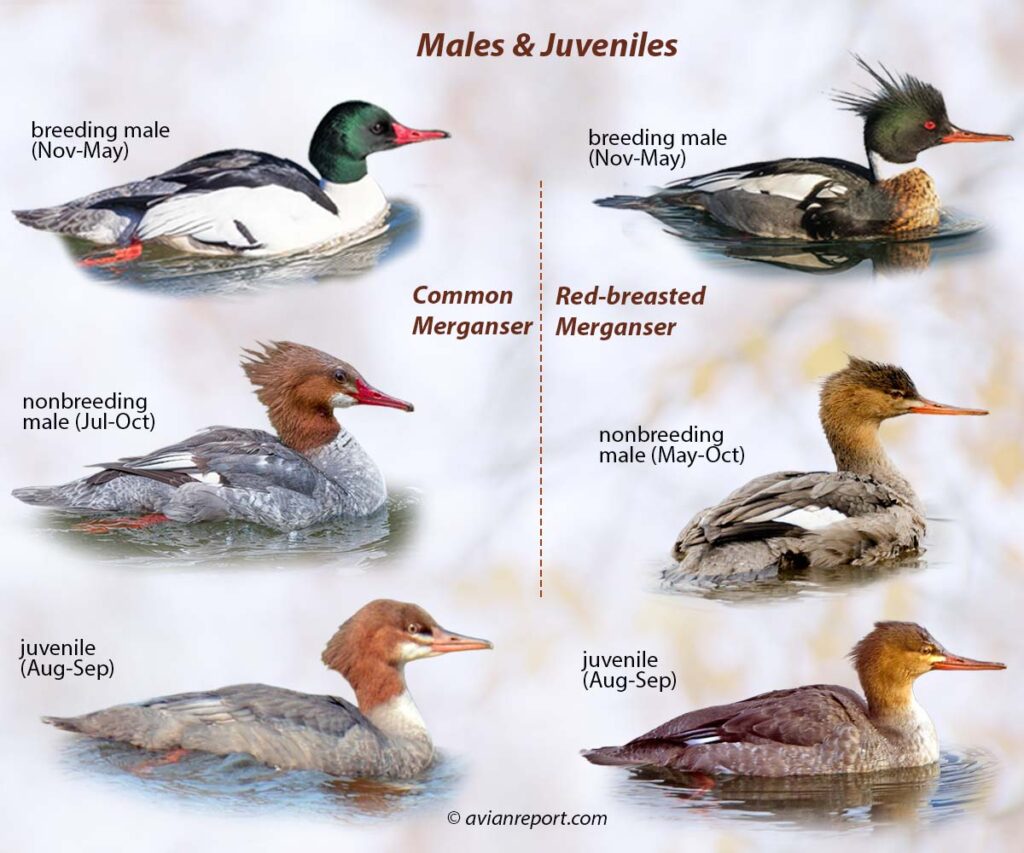
Males in nonbreeding plumage
In late summer, adult males undergo a “basic” or eclipse molt. They lose their iridescent green heads and bold white bodies to become more camouflaged.
- Common Merganser: A male in nonbreeding plumage looks remarkably like a female, but his crest is usually shorter, and if you catch him stretching his wings, you’ll see a much larger white wing patch than a typical female. The red bill is usually brighter than that of a female.
- Red-breasted Merganser: The Common Merganser in nonbreeding plumage trades his punk-rock crest for a shorter and wispy version and adopts a brownish head. Look for the single black bar across the white wing patch (visible in flight or when preening). Some nonbreeding Red-breasted Merganser tend to keep a blurry reddish breast and other smudged colors of the breeding plumage.
The Juveniles
Juvenile birds are essentially “muted” versions of the females. They lack the saturated rusty-brown head colors and have shorter, less-developed crests.
- Common Merganser: Juveniles are paler-headed than adult females and their patterns are less distinct. The facial pattern created by the white chin patch and white loral streak is characteristic. Juvenile birds show the neat line separating the color of the head from the gray of the breast.
- Red-breasted Merganser: These birds often show a whitish line in the lores, sometimes mixed with black. Like in adult females, the color of the head blends with the color of the breast.
Habitat (The “General” Rule)
Habitat is a strong indicator. If you are on an inland, freshwater river in winter, it is statistically more likely to be a Common Merganser. If you are birding a coastal bay or the open ocean, the Red-breasted Merganser is the expected species.
Tip: During migration, these habitats overlap. Never ID based on habitat alone; always look for that “crisp vs. blurry” neck line!
Conclusion
Distinguishing a Female Common Merganser from a Female Red-breasted Merganser ultimately comes down to structure and contrast. The crisp versus blurry neck transition remains the single most dependable field mark, supported by bill thickness, nostril placement, facial pattern, and crest shape. Even when observing juveniles or males in nonbreeding plumage, these structural cues remain consistent.
Photo Credits:
The photographic material used in this article comes from photos licensed under “Creative Commons” and mostly from birders and photographers. I am profoundly grateful for your generous support in making these images available; they have truly made this article possible. Many thanks to Andrew Morffew, Mark Mochell, Elizabeth Milson, Emily Chen, Dennis Church, Wendy Miller, Ken Slade, John Benson, Mick Thompson, Steve Guttman, Nicole Beaulac, Andy Reago, Chrissy McLaren, Garry C., Shawn Taylor, Steve Kersting, Gary Leaven, Vicky DeLoach, Don Hoechlin, Tom Murray, Kevin Krebs, Deborah Freeman, Kenneth Cole-Schneider, Doug Greenberg, Ian Preston, Brian Garrett, John Strung, Becky Matsubara, Judy Gallagher, Bob Jensen, Veit, Sand Diego Zoo, David Inman, Dan Mooney, Ian Preston, Lloyd Davis, Denis Fournier, Gregory Heaton, Greg Lavaty, Dona Hilkey, Alain Doyle, Aaron Maizlish, Ashley Tubs, Richard George, Ethan Gosnell, Nick, , Steve Valasek, Mitch Walters, , and Julio Mulero.
Author:
